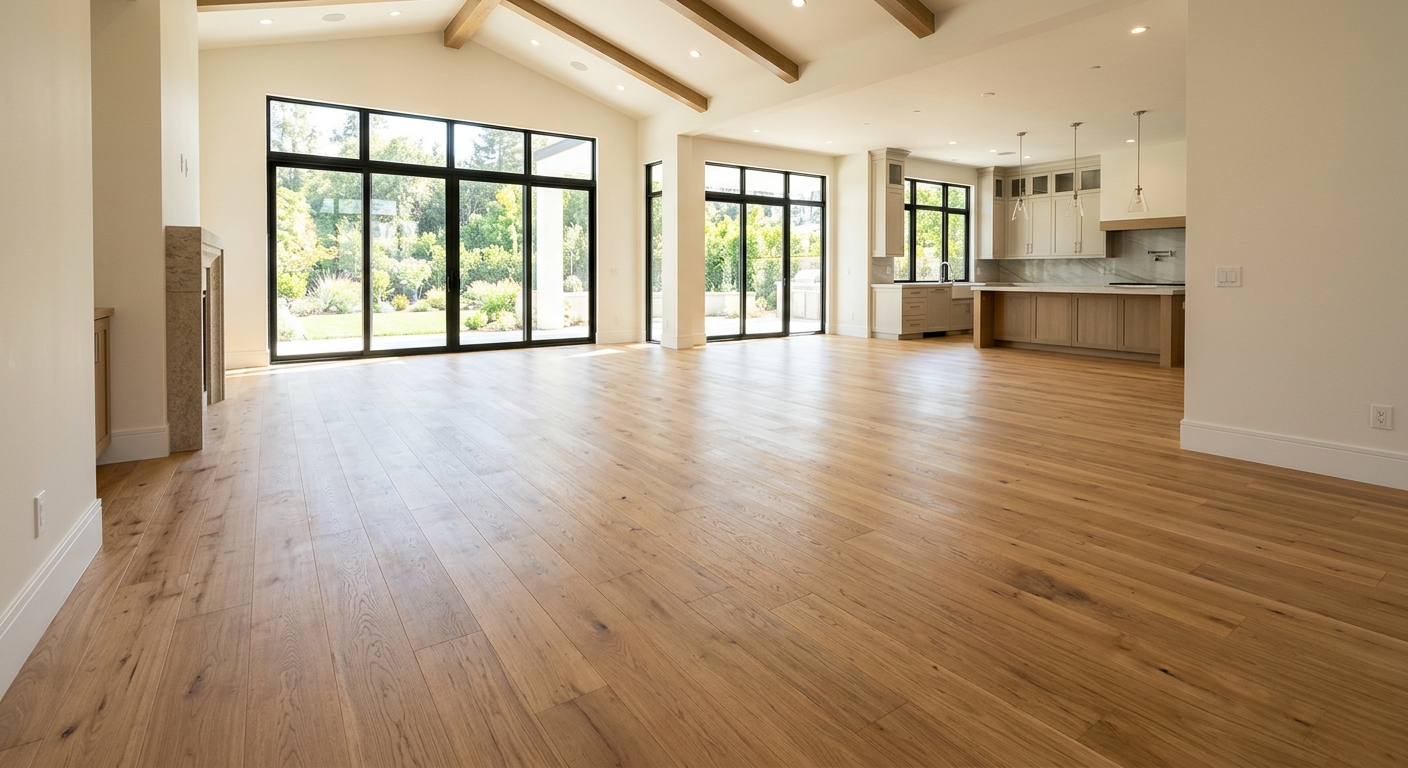
Flooring options and costs in Athabasca
Athabasca homeowners usually start flooring shopping with one big question: what will the job really cost here? With a population of 2,759 (Statistics Canada, 2021 Census), Athabasca has a smaller local trades base than Edmonton, so contractors often bundle travel and scheduling into their pricing—especially for long stretches of inventory or when crews are booked in nearby communities. Costs also reflect that many homes are older: 39.4% of dwellings were built before 1981 (Statistics Canada, 2021 Census), and that age shows up in typical prep work like subfloor levelling, OSB patching, or adding new underlayment before a new surface can be installed. Those prep steps commonly add about $1.50–$4.00 per sq ft in the Edmonton region, and Athabasca is no exception.
Edmonton-area winters also shape flooring choices and budgets. Indoor humidity swings and basement moisture are frequent issues, and below-grade spaces rarely behave like “ideal dry rooms.” That’s why solid hardwood pricing can look attractive on paper, but it’s often limited to above-grade installs in Athabasca. Engineered hardwood and luxury vinyl plank (LVP) typically handle seasonal movement and minor slab moisture better. If you’re considering radiant heat compatibility (common in Alberta new builds and renovations), LVP and most tile systems are straightforward choices, while many solid hardwood and some laminate options may not meet manufacturer requirements.
In Athabasca, flooring installs tend to be especially in demand around established residential pockets such as the downtown and riverside neighbourhoods, where homeowners often renovate main-floor living spaces during slower winter months. Use the table below to compare realistic options and typical per-square-foot pricing for the Athabasca job you’re planning.
| Type |
Best Room |
Moisture Resistance |
Lifespan |
Price per sq ft |
| Solid hardwood (nail-down, above grade only) |
Living / dining (dry, above grade) |
Low to moderate (needs stable indoor humidity) |
25–60 years |
$10 – $25 |
| Engineered hardwood (float or glue, above + on-grade) |
Main floor, hallways |
Moderate (better for seasonal movement) |
20–35 years |
$10 – $22 |
| Laminate (click-lock, above-grade) |
Bedrooms, living rooms |
Low to moderate (protect from spills) |
10–25 years |
$4 – $8 |
| Luxury vinyl plank / LVP (waterproof, any level) |
Kitchen, main floor, basements |
High (waterproof core) |
15–25 years |
$5 – $10 |
| Porcelain / ceramic tile |
Kitchen, bathrooms, entries |
Very high (with proper underlayment) |
25–50 years |
$5 – $15 |
| Carpet (broadloom or modular tile) |
Bedrooms, stairs |
Low (needs dry subfloor) |
8–15 years |
$4 – $8 |
Prices are estimates only and vary by project scope, site access and material selection.
What affects the price of flooring in Athabasca
In Athabasca and the broader Edmonton economic region, the same “flooring type” can come in 30–50% apart from one quote to the next. The biggest reasons aren’t just brand differences—they’re the amount of site prep, the complexity of layout and transitions, and whether the installer has to manage moisture or an uneven subfloor. Even when two homeowners choose similar finishes, one home may need significant levelling (or underlay replacement), while the other is ready for install—so labour and materials change immediately.
Technically, indoor humidity swings and below-grade moisture drive these differences. Solid hardwood expands and contracts with humidity; it’s also not a good fit for basements and typically shouldn’t be glued or floated over concrete. In practice, that means Athabasca basements often steer budgets toward engineered wood or LVP. LVP is commonly waterproof and tolerates minor slab moisture better, which reduces the risk of gapping or cupping and can lower remediation costs later. Colder regions like Athabasca also make radiant-heat-compatible systems more common, and that usually favours LVP and most tile systems.
Cost can move either direction with local conditions. For example: if your home built before 1981 (39.4% of dwellings) has dips or damaged subflooring, levelling/patching can add roughly $1–$4 per sq ft before flooring ever goes down. If you’re doing a small bathroom remodel, the tile price band ($5–$15 per sq ft) may look higher, but fewer material failures and long-term durability can justify it. If you’re covering a large basement footprint, LVP priced in the $5–$10 per sq ft range can be more economical than engineered hardwood once prep and moisture control are included.
| Price Factor |
Why It Matters |
Cost Impact |
| Room area in sq ft |
Directly drives material quantity, labour hours and waste factor |
Small rooms can be disproportionately expensive; larger jobs spread overhead |
| Subfloor condition — levelling or repair needed before install |
Old homes often require patching, OSB overlay, or smoothing compound |
Typical prep can add about $1.50–$4.00 per sq ft regionally |
| Moisture / below-grade install — rules out solid hardwood |
Humidity swings and basement moisture affect dimensional stability |
May increase cost if you switch from solid hardwood to engineered/LVP or add moisture controls |
| Material choice — solid vs. engineered vs. LVP vs. tile |
Different products carry different per-sq-ft and installation requirements |
Solid hardwood typically runs $10–$25 per sq ft; LVP $5–$10; tile $5–$15; laminate/vinyl $4–$8 |
| Removal and disposal of existing flooring |
Demolition time and disposal fees vary by material and thickness |
Can materially change labour totals, especially with glued-down flooring and underlayment |
| Stair nosing / transitions — charged per step or per linear foot |
Edges and doorways add labour beyond “flat area” installation |
Frequently adds several hundred dollars on multi-level homes |
| Radiant heat compatibility — limits material options |
Not every product tolerates heat cycling over hydronic/electric systems |
May push you toward LVP or engineered/tile systems; reduces failed-install risk |
| Installation method — float vs. glue-down vs. nail-down |
Method determines prep, fastening, acclimation and labour intensity |
Glue-down and tile work are generally more labour-intensive than click-lock floating |
Permits & regulations in Alberta
In Alberta, flooring installation itself typically does not require a building permit. Most homeowners can proceed with surface flooring replacements—like engineered hardwood, LVP, laminate, carpet, or tile—without pulling a permit, as long as you’re not altering structural elements. However, “associated work” can trigger permits, and that’s where Athabasca projects sometimes get delayed if homeowners skip the upfront planning.
Work that commonly DOES require a permit: electrical permits for modifications to in-floor heating circuits (new wiring, thermostat changes, or rewiring), and permits if you’re making structural changes such as joist repairs beyond straightforward subfloor patching. Work that typically does NOT require a permit: removing and installing new flooring over an existing subfloor, levelling with non-structural patch/compound, replacing underlayment, installing moisture barrier where allowed by the system, and setting standard tile/stone over an appropriate substrate system.
Step-by-step, Athabasca homeowners can verify a contractor’s credentials before work starts:
- Ask for their Alberta business licence/registration details (and confirm they’re permitted to perform the trade work they’re selling).
- Request a Certificate of Insurance showing general liability and adequate coverage for your project.
- Ask whether they have WSIB/WCB coverage if applicable, then verify they can provide documentation upon request.
- For condo/apartment work: request board approval in writing and confirm any required underlay/sound control specs before you purchase materials.
- Get a written scope that states whether disposal, patching, and any required electrical coordination are included.
Best flooring for each room in your Athabasca home
Choosing the right flooring in Athabasca comes down to matching the product to moisture exposure, daily traffic and comfort needs—while respecting Edmonton-region indoor humidity swings and basement moisture behaviour. In living and dining areas, many homeowners do well with engineered hardwood or high-quality laminate because they provide a warm finish without the same humidity sensitivity you get with solid hardwood. For bedrooms, carpet is still a strong pick: it adds softness underfoot and sound absorption, which is helpful in busy households and for stair-adjacent noise control.
In kitchens, the winning combination is usually luxury vinyl plank (LVP) for waterproof practicality, or large-format porcelain tile when you want the easiest long-term cleanability and the most water-resilient finish. Basements are where Athabasca homes most often benefit from LVP: it’s waterproof, handles vapour and minor slab moisture better, and reduces the chance of gapping or cupping that can happen with solid wood. For bathrooms, porcelain or ceramic tile is the standard choice because it tolerates wet conditions when installed over an appropriate waterproofing system.
Radiant heat compatibility is increasingly common in Alberta renovations. If you’re installing over hydronic or electric in-floor heat, LVP and most tile systems generally work well when installed to manufacturer temperature/installation specs, while many solid hardwood installations are restricted or not recommended.
As a simple pricing reality check: for a typical main-floor refresh, moving from laminate in the $4–$8 per sq ft band to engineered wood can be justified because engineered hardwood typically lasts longer and stands up better to seasonal movement—especially in older Athabasca housing stock where subfloors can be slightly uneven. For basements, LVP often protects your budget because waterproof performance can prevent expensive failure and rework.
| Room |
Best Material |
Why |
Moisture Risk |
Price Band per sq ft |
| Living / dining room |
Engineered hardwood |
Warm feel with improved stability through seasonal humidity swings |
Low to moderate (above-grade controlled spaces) |
$10 – $22 |
| Master bedroom |
Carpet or engineered hardwood |
Comfort and sound absorption (carpet) or durability with easier maintenance (engineered) |
Low (avoid spills and keep humidity reasonable) |
$4 – $8 |
| Secondary bedrooms |
Laminate (high-quality) or carpet |
Budget-friendly durability for daily wear in multiple bedrooms |
Low |
$4 – $8 |
| Kitchen |
Luxury vinyl plank (LVP) or porcelain tile |
Handles spills, easy cleaning, and frequent chair/foot traffic |
Moderate to high (wet spots, tracked-in water) |
$5 – $10 |
| Basement (finished) |
LVP (waterproof core) |
Waterproof performance and better tolerance for vapour and minor slab moisture |
High (below-grade moisture variability) |
$5 – $10 |
| Bathroom |
Porcelain / ceramic tile |
Best wet-room performance when installed with proper substrate and sealing |
Very high |
$5 – $15 |
How to choose a flooring contractor in Athabasca
Choosing a contractor in Athabasca is about more than the lowest per-square-foot number. Start by verifying Alberta compliance and capacity: ask for proof of general liability insurance (so you’re not left holding the cost for accidents or property damage), and confirm WSIB/WCB coverage if the business provides documentation and coverage is applicable to your project. Get confirmation of their registration/business details and request a copy of the certificate before the work begins. If they can’t provide paperwork promptly, treat it as a warning sign—especially on older homes where subfloor repair work often becomes necessary.
Next, get 2–3 itemised written quotes that break labour and materials down separately, instead of one lump sum. Make sure the scope includes what people often forget: product acclimation, subfloor inspection, levelling/patching allowances, underlayment choices, moisture barrier (when required), and disposal/removal of your existing flooring. Ask if a permit is required for any electrical-related radiant heating modifications and whether they coordinate that work or if you must arrange it.
Warranty terms matter too. Request the workmanship warranty length (and what qualifies as a defect), plus the product/manufacturer warranty details, including whether it’s transferable if you sell your home. Payment schedule should be conservative: never pay more than 10–15% upfront; hold back payment until the job is complete and you’ve confirmed transitions, trim, and clean-up. Also demand a start date and completion estimate in writing so you can plan around weather and material lead times.
- Confirm they have a valid business registration and are insured for flooring installation work.
- Request a Certificate of Insurance and verify the coverage limits.
- Ask for WSIB/WCB clearance documentation where applicable.
- Get itemised labour vs. materials quotes (no “all-in” only pricing).
- Ensure subfloor prep is inspected and included in writing (levelling/patching allowance).
- Clarify moisture-related steps: underlayment/moisture barrier and ventilation requirements.
- Confirm the installation method (float, glue-down, nail-down) matches your flooring warranty.
- Check what’s included in stair work, thresholds and transitions (per step/linear foot).
- Verify demolition/removal and disposal are included or priced separately.
- Ask about acclimation time for hard surface flooring before installation.
- Review warranty length and whether it’s transferable at sale.
- Require a written start date, projected completion date and schedule terms.
Red flags in Athabasca: vague scopes (“we’ll handle it”), no proof of insurance/coverage, refusing to itemise labour and materials, starting without checking subfloor condition and moisture risk, and demanding large upfront payments (more than 10–15%).
Frequently asked questions — flooring in Athabasca
Can I install flooring over existing tile in Athabasca?
Often yes, but it depends on the tile surface condition and what product you’re installing. In Athabasca, the two common concerns are uneven tile (movement at grout lines) and the added height that can affect transitions and door clearances. For LVP, many installers can float over properly bonded tile if the surface is level and clean, but they’ll usually check for loose tiles and lippage first. For laminate, many manufacturers require a very flat substrate. For tile-to-tile upgrades, contractors may still prefer to remove damaged areas or do a proper underlayment system so you don’t lock in failures.
From a budget standpoint, removal is one of the variable drivers—so your quote can move by hundreds of dollars. If your tile is intact and level, you may stay closer to the $5–$10 per sq ft LVP range. If the tile is cracked or uneven, plan for levelling/patching, and the project may drift upward.
What is the best flooring for a high-traffic area in Athabasca?
For high-traffic zones in Athabasca—entries, hallways, and the main route between kitchen and living areas—LVP and engineered hardwood are usually the most practical. LVP’s waterproof core helps with everyday spills and tracked-in meltwater, which matters during cold snaps and wet shoulder seasons common in the Edmonton region. Engineered hardwood also performs well when the home maintains reasonable indoor humidity, but it’s still better suited to above-grade traffic areas rather than damp basements.
If you’re choosing between bands, LVP commonly lands around the $5–$10 per sq ft range, while engineered hardwood is often higher (commonly $10–$22 per sq ft depending on wear layer and brand). The extra cost is most justified when you want a wood-look finish that lasts longer without the “click” seams showing wear.
How do I prepare my subfloor before new flooring?
Preparation is where Athabasca projects succeed or fail, especially in homes built before 1981, since older subfloors can be uneven or patchy. The contractor should start with a subfloor inspection: check for softness, squeaks, moisture risk, and flatness. Then they’ll typically level high and low spots using approved patch/levelling compound or add an overlay (like properly fastened OSB) where needed. For moisture-prone areas, underlayment and vapour management become part of the system—particularly for below-grade installs.
You can expect levelling/repair add-ons in the Edmonton region around $1.50–$4.00 per sq ft when smoothing and patching are required. For basement work, preparation may also include confirming the slab condition and choosing a waterproof system like LVP instead of solid hardwood, which is sensitive to humidity swings.
Is cork or bamboo flooring a good choice in Athabasca?
Cork and bamboo can look great, but in Athabasca you have to treat them as “conditional” choices. The key issue is moisture and humidity stability. Cork is naturally resilient, but it can be affected by moisture if the installation and underlayment aren’t system-matched; it generally isn’t my first pick for basements or areas with below-grade vapour exposure. Bamboo is a hardwood product; depending on whether it’s solid or engineered, it may have similar humidity sensitivity concerns to other wood products.
In most Athabasca homes, cork or bamboo works best on above-grade levels where indoor humidity is stable and spill risk is controlled—like living rooms and bedrooms. If you need waterproof performance for kitchens or basements, LVP (often $5–$10 per sq ft) is usually the safer bet. For budget planning, if you’re comparing options, the cost premium for cork/bamboo only makes sense when you’re also confident about subfloor flatness and dryness.
What is the difference between floating and glued-down flooring?
Floating flooring is installed as a “board system” that doesn’t attach directly to the subfloor. Most click-lock laminate and many LVP products float over an underlayment layer; they expand and contract across their surface while remaining mechanically locked together. Glued-down flooring is attached directly to the subfloor with adhesive, which can help reduce movement but requires very strict subfloor flatness and correct moisture conditions to keep the bond from failing. In Athabasca, that distinction matters because uneven or moisture-prone bases can create problems over time.
For basement areas or rooms with known moisture risk, floating waterproof products (like LVP) are often easier to manage, while glue-down wood options may be more sensitive to slab moisture and require strict system-approved prep. If your contractor proposes glue-down over a questionable substrate, ask what moisture checks they perform and which manufacturer instructions they follow.
What flooring holds up best to pets in a Athabasca home?
For pets, the best-performing choices in Athabasca are typically waterproof LVP and porcelain tile—because they handle accidents and are easier to clean without absorbing moisture. LVP also tends to resist everyday scuffs better than many softer floors, and it’s comfortable enough for regular household use when installed over the right underlayment. If you have long-haired shedding, carpet can be comfortable, but it generally has a higher replacement risk if moisture or urine accidents occur in a basement or on a subfloor that isn’t perfectly dry.
In pricing terms, LVP often falls in the $5–$10 per sq ft band, while tile commonly sits in the $5–$15 per sq ft range depending on grade and layout complexity. For high-pet areas like hallways and kitchens, I usually steer homeowners toward LVP; for bathrooms, tile is the most reliable. If you want an engineered wood look, pick engineered—not solid—and confirm the manufacturer supports your humidity conditions.