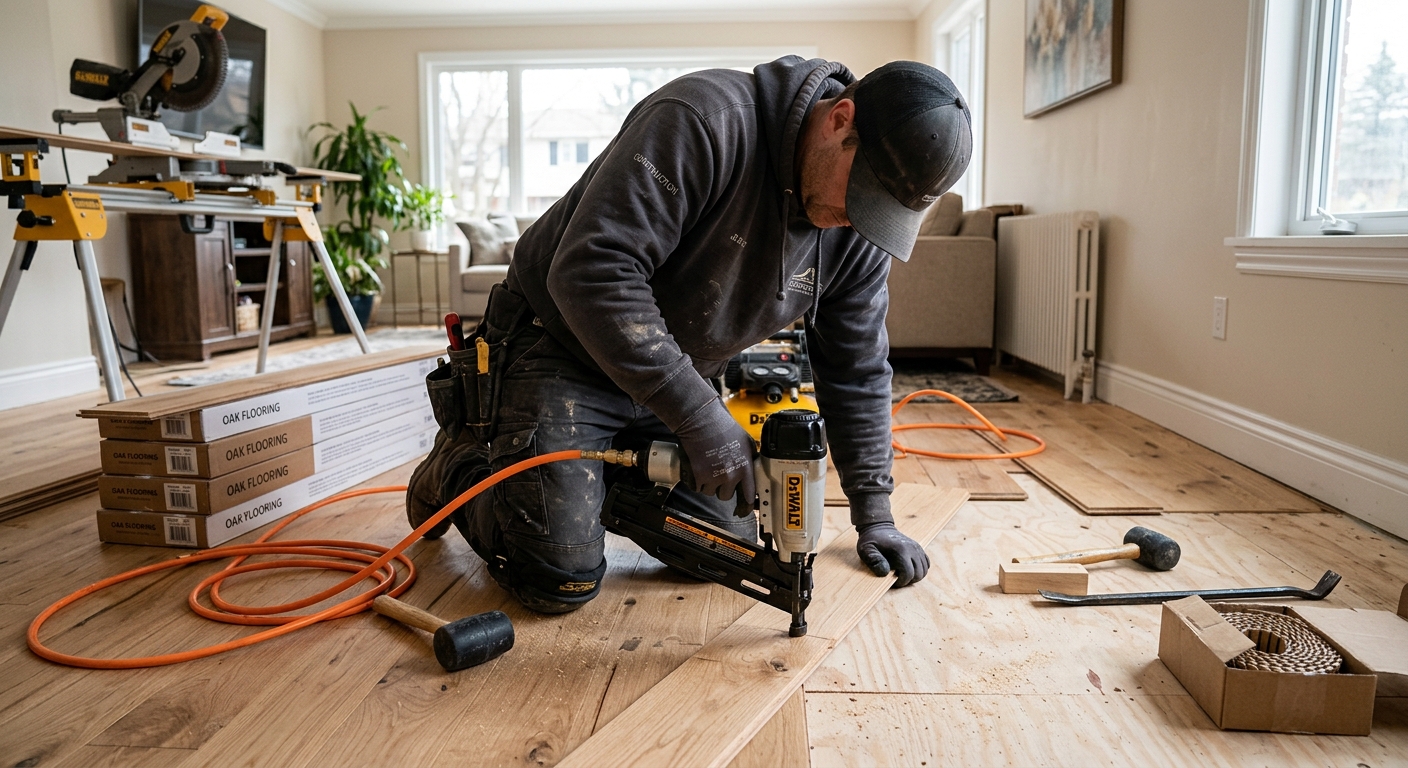
Flooring options and costs in Cochrane
Cochrane homeowners usually start comparing flooring by looking at price per square foot, but the real cost picture depends on how your home behaves in winter and shoulder seasons. With Cochrane at about 32,199 people (Statistics Canada, 2021 Census), you’ll also find a steady mix of older and newer builds—however, only 9.9% of homes were built before 1981, and that matters because older foundations and subfloors often need levelling, patching, or repair before a new floor can sit flat. In Calgary’s dry, cold prairie climate, humidity swings are a major cost driver: materials expand and contract, and basements can see moisture migration through concrete. That’s why below-grade installs typically favour engineered wood, luxury vinyl plank (LVP) or SPC, rather than traditional ¾-inch solid hardwood.
Contractors around Cochrane—especially near the downtown corridor and along key routes connecting to Calgary—stay busy because many buyers renovate to improve resale before winter. If you’re doing a whole main floor plus stairs, labour can be higher due to transitions, stair nosing, and trim reinstallation. Ceramic and porcelain tile is also sensitive to flatness, so crack isolation membranes and levelling are common scope items.
Below is a practical snapshot of typical installed price ranges for common flooring types in Cochrane, before you compare your room-by-room plan and subfloor prep needs.
| Type |
Best Room |
Moisture Resistance |
Lifespan |
Price per sq ft |
| Solid hardwood (nail-down, above grade only) |
Living / dining (dry, above-grade) |
Low to moderate (humidity-sensitive) |
20–60 years (proper maintenance) |
$8,00 – $15,00 |
| Engineered hardwood (float or glue, above + on-grade) |
Main floor / hallways |
Moderate to high (more dimensionally stable) |
15–30 years |
$8,00 – $14,00 |
| Laminate (click-lock, above-grade) |
Bedrooms / living spaces (dry) |
Moderate (core can swell if water sits) |
10–25 years |
$3,50 – $7,00 |
| Luxury vinyl plank / LVP (waterproof, any level) |
Basements and main floors |
High to very high (waterproof cores) |
15–25 years |
$4,50 – $9,50 |
| Porcelain / ceramic tile |
Kitchen, bathrooms (wet areas) |
Very high (with proper grout/sealing plan) |
25–50+ years |
$6,00 – $12,00 |
| Carpet (broadloom or modular tile) |
Bedrooms |
Low (stains with spills) |
7–15 years |
$3,50 – $6,50 |
Prices are estimates only and vary by project scope, site access and material selection.
What affects the price of flooring in Cochrane
In Cochrane and the wider Calgary area, two homeowners can receive quotes for the “same” floor that differ by 30–50% once you account for prep, moisture risk and labour realities. Calgary’s dry, cold prairie climate creates large indoor humidity swings, and below-grade conditions can add moisture migration through concrete. That’s a technical driver: solid hardwood expands and contracts with humidity, and it can’t be glued or floated over concrete; it also performs poorly in basements where vapour and relative humidity are harder to control. Engineered hardwood and LVP/SPC handle humidity changes and below-grade installs far better, which directly changes what products your installer recommends.
Radiant heat also plays a role. Colder regions and some newer builds rely on in-floor hydronic systems, which rules out most solid hardwood and some laminate setups. Older housing stock in the region frequently needs subfloor levelling or repair—especially where aged plywood is uneven or transitions between rooms create dips. Depending on how out-of-flat your surface is, levelling can add roughly $1–$4 per square foot.
Concrete examples from typical Cochrane projects: (1) a basement conversion often requires a vapour-management approach and a fully waterproof LVP layer—material selection may cost a bit more, but it avoids expensive hardwood callbacks; (2) tile in a main-floor foyer usually triggers levelling and sometimes a crack isolation membrane, because tile installations are unforgiving to unevenness; (3) upgrading from laminate at the low end of the market (around $3–$7/sq ft) to LVP at $4.50–$9.50/sq ft can be justified if you want waterproof performance and fewer moisture-related failures.
| Price Factor |
Why It Matters |
Cost Impact |
| Room area in sq ft |
Materials and install labour scale with total surface area. |
Higher square footage usually improves unit pricing; small jobs cost more per sq ft. |
| Subfloor condition |
Levelling, patching and repair are often required for a flat, sound base. |
Commonly adds $1–$4 per sq ft depending on how uneven the surface is. |
| Moisture / below-grade install |
Solid hardwood is humidity-sensitive and not ideal over concrete or basements. |
May shift you to engineered hardwood or LVP/SPC; adds vapour/mitigation items. |
| Material choice |
Solid, engineered, LVP, and tile have different price points and installation requirements. |
Can change your budget by several dollars per sq ft (e.g., LVP vs. laminate). |
| Removal and disposal of existing flooring |
Demo time, disposal fees and waste handling increase labour and overhead. |
Often a noticeable line item, especially with carpet tack strips or tile removal. |
| Stair nosing / transitions |
Stairs and transitions require extra labour, mouldings and precise finishing. |
Charged per step or linear foot; can add meaningfully to total cost. |
| Radiant heat compatibility |
Temperature cycles affect expansion; not all products tolerate radiant heat. |
May increase cost by limiting choices to specific engineered/LVP systems. |
| Installation method |
Float vs. glue-down vs. nail-down changes labour time and prep needs. |
Glue-down and tile typically cost more due to adhesives, membranes and careful setting. |
Permits & regulations in Alberta
In Alberta, a typical flooring installation does not require a building permit. Installing flooring over an existing, non-structural surface—such as floating engineered hardwood, click-lock laminate, LVP/SPC, or carpet—usually falls under standard trade work. However, associated work can trigger permits. For example, structural subfloor repair (if it involves load-bearing changes), moisture remediation that alters construction, and any in-floor heating circuit work that touches electrical components may require electrical permitting, inspections or approvals through the appropriate channels.
In condominiums, permitting isn’t usually the main issue—sound control is. Corporation rules often restrict or require specific underlay to meet sound transmission expectations (commonly discussed as STC/IIC targets). If you’re installing hardwood or tile in a multi-unit building in Cochrane, confirm the condo declaration requirements and request board approval in writing before the job starts.
To verify a contractor in Cochrane step-by-step, ask for and check: (1) their Alberta licence number (and business name) from the relevant online registry; (2) a current certificate of insurance—confirm liability coverage limits and effective dates; (3) WSIB/WCB coverage documentation for workers on site; (4) a written scope that shows whether permits (if any) are included. A reputable installer will provide proof up front and won’t pressure you to start without documentation.
Best flooring for each room in your Cochrane home
Choosing the right flooring room-by-room is the fastest way to avoid costly issues in Cochrane’s climate—cold winters, dry indoor air, and occasional humidity spikes. For living and dining areas, engineered hardwood or high-quality laminate provides warmth and durability without the same humidity sensitivity as solid wood. In the master bedroom, carpet is often the comfort winner for softness and sound absorption, while engineered hardwood is a strong alternative if allergies or pets are a concern.
Kitchens take the hardest daily abuse, so LVP (waterproof) or large-format porcelain tile are the practical picks. Basements are where the Calgary region’s moisture realities show most: LVP is typically the clear winner because it’s waterproof, tolerates vapour better than solid wood, and handles below-grade installs more safely. Bathrooms should be porcelain or ceramic tile only, because splash and spills are inevitable. If you’re planning renovations in rooms over in-floor heating, radiant heat compatibility matters—solid hardwood is often limited, while engineered hardwood designed for radiant systems and many LVP products are typically more reliable with temperature cycling.
Dollar-wise, upgrading from laminate (often around $3–$7/sq ft) to LVP (often $4.50–$9.50/sq ft) may not make sense for a dry above-grade living room, but it can be justified for a basement where moisture would otherwise shorten the life of less-stable materials.
| Room |
Best Material |
Why |
Moisture Risk |
Price Band per sq ft |
| Living / dining room |
Engineered hardwood |
Looks like wood with better humidity tolerance for seasonal swings. |
Low (above-grade, dry controlled air) |
$8,00 – $14,00 |
| Master bedroom |
Carpet or engineered hardwood |
Carpet adds comfort and quieter footsteps; engineered keeps a cleaner, warmer look. |
Low |
$3,50 – $14,00 |
| Secondary bedrooms |
Laminate |
Good value, easy maintenance, and family-friendly durability when kept dry. |
Low to moderate (spills need quick cleanup) |
$3,50 – $7,00 |
| Kitchen |
Luxury vinyl plank (LVP) or porcelain tile |
Waterproof/cleanable surfaces for everyday spills and heavy traffic. |
Moderate to high |
$4,50 – $12,00 |
| Basement (finished) |
LVP (waterproof) |
Best chance to stay stable over vapour and seasonal shifts below grade. |
High (vapour migration through concrete possible) |
$4,50 – $9,50 |
| Bathroom |
Porcelain / ceramic tile |
Handles splashes and wet use; long service life with proper installation. |
High |
$6,00 – $12,00 |
How to choose a flooring contractor in Cochrane
When you’re picking a contractor in Cochrane, don’t rely on word-of-mouth alone—verify coverage and scope. Start with Alberta licence details (business name and licence number) and request a current certificate of liability insurance. Next, confirm workers are covered under WSIB/WCB; ask for clearance documentation or proof of coverage for the period the work will be done. If they can’t show these items promptly, that’s a major warning sign.
Then get 2–3 itemised written quotes. You want a breakdown that separates materials (product cost, underlay, membranes, adhesives, trim) and labour (prep/levelling, installation method, stair work, transitions). Avoid a “lump sum” quote that doesn’t say whether removal and disposal are included or whether levelling is included up to a defined standard.
Warranty matters too. Ask how long the workmanship warranty is and what it covers if you see gaps, lifting, or edge failures. Confirm the product manufacturer warranty details, and whether it’s transferable to you as the homeowner. For payment, never pay more than about 10–15% upfront; hold back a portion until the job is complete and you’ve received as-builts or final closeout documents. Finally, get the start date and completion estimate in writing so weather delays or material backorders don’t turn into endless timelines.
- Confirm Alberta licence/business name matches the quote and invoice.
- Request liability insurance certificate with effective dates.
- Verify WSIB/WCB coverage and ask for clearance documentation.
- Use itemised quotes: materials vs labour vs prep.
- Check whether subfloor levelling is included and to what flatness standard.
- Confirm underlay/membrane type for your subfloor and humidity conditions.
- Ask if removal and disposal of old flooring is included.
- Clarify stair work, nosing, and moulding/transitions pricing.
- Get a written warranty: workmanship length and limitations.
- Ask who handles damage to baseboards/trim and how reinstallation is priced.
- Review the payment schedule—10–15% max upfront; holdback at completion.
- Ensure the project timeline and site protection plan are in the contract.
In Cochrane, I’d treat these as red flags: (1) they won’t show insurance and WSIB/WCB proof; (2) they won’t provide an itemised scope for levelling, underlay, and moisture protection; (3) they promise solid hardwood in a basement without a moisture plan; (4) they start work before you confirm product acclimation and subfloor readiness; (5) their quote includes no mention of stairs/transitions or disposal, then adds costs after demo.
Frequently asked questions — flooring in Cochrane
Hardwood vs laminate vs vinyl plank — which is best?
In Cochrane and across Alberta’s dry-cold prairie climate, “best” depends on moisture exposure and where you’re installing. Solid hardwood is beautiful, but it’s typically best for above-grade rooms only because humidity swings can cause movement, and it’s not designed for direct basement concrete applications. Laminate is usually the budget-friendly option (often around $3–$7/sq ft), but if water sits on it, edges and the core can swell. Luxury vinyl plank (LVP) is often the most forgiving choice: it’s waterproof and more stable for basements and kitchens, which is why it commonly lands around $4.50–$9.50/sq ft installed. For many families, engineered hardwood gives a middle-ground look and performance.
What flooring is best for a Cochrane basement?
For Cochrane basements, LVP (or SPC where specified) is usually the safest bet because it’s waterproof and better suited to vapour and moisture migration through concrete. Calgary-area basements often deal with seasonal humidity changes, and that’s where solid hardwood tends to struggle—movement, separation, and edge failure can show up over time. Engineered hardwood can be workable on properly prepped and controlled on-grade surfaces, but it’s still riskier than waterproof products in a typical below-grade renovation. Expect a quote to include moisture-aware prep, and sometimes additional underlayment or vapour solutions. If your contractor is recommending tile or carpet downstairs, ask how they’ll manage vapour and subfloor flatness.
Can I install hardwood over concrete?
Generally, solid hardwood is not recommended over concrete. In Alberta, especially in basements, the issue isn’t just “can it be installed,” but whether the product can handle humidity/vapour and temperature cycling. Solid nail-down hardwood is intended for above-grade wood subfloors. If you’re set on a hardwood look over concrete, engineered hardwood is the more common approach, typically installed in a way your installer specifies for that subfloor and moisture conditions (often glue-down or a controlled floating system). If radiant heat is present, that further affects product selection. Ask your installer what their moisture testing and prep steps are before any flooring goes down.
How long does flooring installation take?
Timelines in Cochrane depend mainly on square footage, subfloor condition, and how much prep and transition work is required. A straightforward above-grade install can move quickly—often within a few days for a typical single-floor footprint—while jobs with subfloor levelling, removal/disposal, or many stair transitions stretch the schedule. Tile can also add time because it requires careful setting and sometimes extra membrane work, plus curing considerations. Weather can affect scheduling when access is limited or if materials need acclimation. The best way to avoid surprises is to request a written schedule: start date, daily work hours, expected completion date, and what triggers change orders.
What flooring works with radiant heat?
Radiant heat compatibility is important in Alberta because warm cycles can impact expansion and contraction. Many contractors steer homeowners toward engineered hardwood systems specifically rated for radiant heat, or to LVP designed for in-floor heating. Most solid hardwood options are limited on radiant systems due to movement risk, and some laminate products are also restricted depending on the product build and underlay requirements. The safest route is to ask your contractor which exact product lines are approved for radiant heat and what installation method is required (including underlayment type and acclimation). If your quote doesn’t mention radiant heat compatibility, you should treat it as incomplete.
Engineered vs solid hardwood — what's the difference?
Solid hardwood is one continuous piece of wood (commonly ¾-inch thick), and it’s usually installed nail-down over a suitable above-grade wood subfloor. Engineered hardwood is a layered product—typically a real wood top veneer bonded to plywood or similar stable layers—making it more dimensionally stable during Alberta’s humidity swings. That stability is why engineered wood is often a better choice for on-grade installs and sometimes basements when the substrate conditions are right. Cost can overlap: engineered may run similarly to hardwood bands (around $8–$14/sq ft), while solid is often higher (commonly $8–$15/sq ft) once you factor in the right subfloor setup. The “best” choice is usually dictated by your location in the home and your moisture conditions.