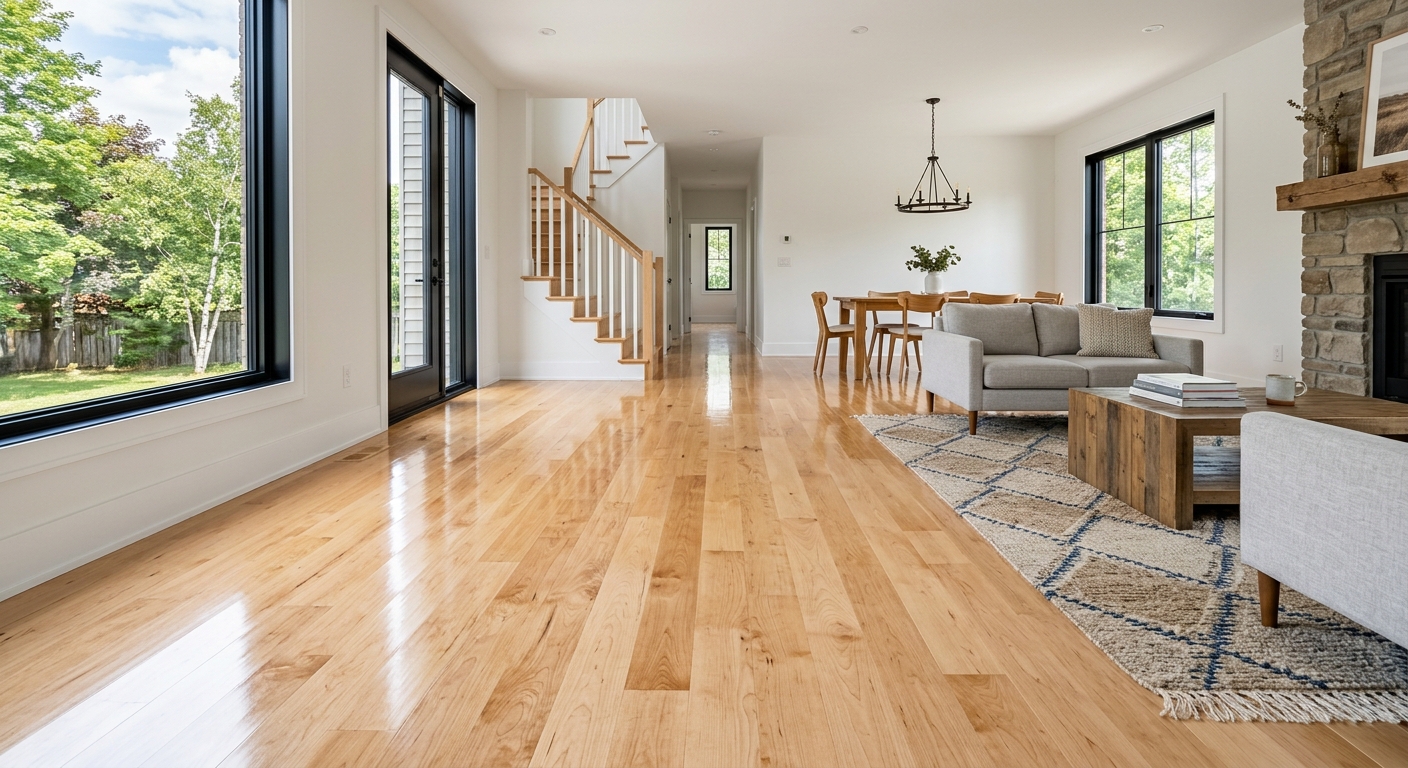
Flooring options and costs in Cougar Ridge
Flooring in Cougar Ridge typically comes down to how your home is built, how moisture behaves through the seasons, and what’s underneath your current surface. With a population of 7,150 in Cougar Ridge (Statistics Canada, 2021 Census), the market is busy enough that most trades can line up installers quickly—but pricing still varies because Calgary-area basements and older main-floor framing often need extra prep. In this region, indoor humidity can swing dramatically, and older housing stock frequently shows up with out-of-level concrete or worn plywood that requires levelling before you can lay a finish product. That prep step alone can add roughly $1–$3 per sq ft, and in more uneven areas the total can climb further depending on how much repair or patching is required.
Calgary and surrounding communities sit in a dry, cold prairie climate with large seasonal humidity swings, which affects expansion/contraction for some materials. That’s why below-grade installs in basements often steer homeowners toward engineered wood, luxury vinyl plank (LVP) or SPC, while traditional ¾-inch solid hardwood is usually limited to above-grade work. If your project is near high-demand pockets like the newer residential pockets off 5 Avenue and surrounding service areas, you’ll often see the same pattern: homeowners choose stable products for speed, durability, and fewer callbacks. Use the ranges below as a starting point, then we’ll break down the real cost drivers that move a quote up or down.
| Type |
Best Room |
Moisture Resistance |
Lifespan |
Price per sq ft |
| Solid hardwood (nail-down, above grade only) |
Living / dining |
Low to moderate (humidity sensitive) |
25–60 years |
$8–$15 |
| Engineered hardwood (float or glue, above + on-grade) |
Main floor bedrooms / hallways |
Moderate to high (more dimensionally stable) |
20–40 years |
$9–$14 |
| Laminate (click-lock, above-grade) |
Living areas with pets/kids |
Low to moderate (water-limiting depends on core) |
10–25 years |
$3–$7 |
| Luxury vinyl plank / LVP (waterproof, any level) |
Kitchen / finished basement |
High (waterproof when installed correctly) |
15–30 years |
$4–$9 |
| Porcelain / ceramic tile |
Bathroom / entry / laundry |
Very high (but grout and setting matter) |
25–50 years |
$6–$12 |
| Carpet (broadloom or modular tile) |
Bedrooms |
Low (needs dry conditions) |
8–20 years |
$5–$10 |
Prices are estimates only and vary by project scope, site access and material selection.
What affects the price of flooring in Cougar Ridge
Two homeowners in Calgary-area communities can receive quotes that differ by 30–50% for the “same” flooring because the scope is rarely identical. The biggest swing comes from technical prep (especially flatness and moisture control), the material you select, and how complex your layout is—transitions, stair work, and removal/disposal all add up quickly. In Cougar Ridge and the wider Calgary region, indoor humidity swings drive solid hardwood expansion and contraction, and that’s why below-grade work typically favours engineered wood or waterproof LVP/SPC. Cold-season conditions also affect radiant-heat compatibility: many homeowners with in-floor systems end up choosing materials that tolerate temperature cycling better, which can rule out most solid hardwood and some laminate builds.
Older regional housing stock frequently needs subfloor levelling or repair, particularly on main-floor plywood or in basements with uneven concrete. It’s not unusual to see levelling budget items run from about $1 to $4 per sq ft depending on how out-of-level the surfaces are. For example, if you’re converting a basement from carpet to LVP, you may pay less for prep than you would for a tile job where flatness requirements are stricter and crack isolation membranes are sometimes budgeted. In contrast, a bathroom renovation with tile may start with a material band similar to $6–$12 per sq ft, but the total often rises when floor flattening, membranes, and careful setting are included.
Concrete examples you’ll notice in Cougar Ridge: (1) Main-floor dips and hump areas over older subflooring can force extra labour for self-levelling or patch systems. (2) If moisture migration through slab is suspected, the contractor may recommend engineered hardwood or LVP instead of solid wood, protecting your investment. (3) Complex layouts with multiple doorways and transitions can make “cheap per sq ft” products more expensive in the final tally once labour is counted.
| Price Factor |
Why It Matters |
Cost Impact |
| Room area in sq ft |
More floor area increases materials, underlay/adhesives, and labour time. |
Direct proportional cost increase (often the largest single line item). |
| Subfloor condition |
Levelling, patching, or replacing failing boards affects install speed and success. |
Often adds about $1–$4 per sq ft; can be higher in severely uneven areas. |
| Moisture / below-grade install |
Basements and on-slab areas limit solid hardwood and many laminate cores. |
Switching to engineered/LVP can raise material cost but reduces risk and rework. |
| Material choice |
Solid, engineered, LVP/SPC, and tile have different installation complexity. |
Solid hardwood commonly sits higher (e.g., $8–$15 band) than LVP (e.g., $4–$9). |
| Removal and disposal of existing flooring |
Old flooring, tack strips, underlay, and disposal fees add labour and time. |
Can noticeably increase total; often priced per sq ft or as a fixed haul-away fee. |
| Stair nosing / transitions |
Stairs require extra pieces, cutting, and precise finishing. |
Typically charged per step and/or linear foot for transitions; adds cost quickly. |
| Radiant heat compatibility |
Temperature cycling limits material options and affects underlayment choices. |
May require specific engineered products or approved underlays; can change labour plan. |
| Installation method |
Float vs. glue-down vs. nail-down changes labour and system requirements. |
Glue-down and tile setting usually cost more in labour than straightforward floating. |
Permits & regulations in Alberta
In Alberta, the flooring installation itself typically does not require a building permit. What can trigger permitting depends on what’s being altered alongside the floor. For example, if your project includes structural subfloor repair that changes load-bearing elements, moisture remediation measures that involve specialized system work, or any work tied into in-floor heating circuits, that associated work may require electrical permits. Similarly, if you’re modifying electrical components connected to radiant heat (thermostats, wiring, breakers), the permit requirements can apply even when the “flooring” part is straightforward.
In condominiums, the bigger restriction is usually not a permit—it’s the corporation’s rules. Sound transmission requirements (commonly discussed as STC/IIC targets) often restrict which underlay you can use on upper-floor hard flooring, and boards frequently require approved materials and installation methods. Always check the condo declaration and request written board approval before installing hardwood or tile on above-grade floors in a multi-unit building, since a wrong underlay can lead to disputes or required removal.
To verify a contractor in Cougar Ridge, check three things in order: (1) their Alberta licence/registration status through the appropriate provincial online registry for their trade; (2) their liability insurance certificate—confirm it’s current and matches your job address; and (3) WSIB/WCB coverage—ask for a clearance letter or proof of coverage and verify the period. A legitimate contractor should provide these quickly before you sign a contract or pay any deposit.
Best flooring for each room in your Cougar Ridge home
Choosing flooring room-by-room matters in Cougar Ridge because moisture and comfort needs differ across a typical Calgary-area bungalow and basement layout. Living and dining areas usually benefit from engineered hardwood or a high-quality laminate: both keep a warm feel underfoot and handle day-to-day humidity swings better than solid wood. For master bedrooms, carpet is still a strong comfort choice—quiet underfoot and more forgiving—while engineered hardwood is a good option if you have allergies or want easy cleaning.
In kitchens, the practical answer is luxury vinyl plank (LVP) or large-format porcelain tile. LVP is waterproof and forgiving for spills, and tile is ideal when you want the longest service life and the easiest wet-area maintenance. For bathrooms, stick to porcelain or ceramic tile only, with proper waterproofing at wet-wall transitions. Basements (finished) are where local climate realities show up: LVP is the clear winner in most cases because it’s waterproof and designed to handle below-grade conditions far better than solid hardwood, which is humidity sensitive and generally limited to above grade. If your home has radiant heat, favour products that are explicitly rated for in-floor heating—this is increasingly common in Alberta new builds and renovations, and it can narrow your options.
Here’s where the cost difference can be justified. If you’re comparing LVP at about $4–$9 per sq ft versus engineered hardwood around $9–$14 per sq ft, spending more on engineered can make sense for main-floor aesthetics and feel. But in a basement, the “cheaper” choice often becomes LVP because it reduces risk of dimensional issues and moisture-related callbacks. Over time, that stability usually beats paying twice.
| Room |
Best Material |
Why |
Moisture Risk |
Price Band per sq ft |
| Living / dining room |
Engineered hardwood |
Warm look with improved stability for prairie humidity swings. |
Low to moderate (manage indoor humidity) |
$9–$14 |
| Master bedroom |
Carpet or engineered hardwood |
Carpet adds comfort and sound absorption; engineered suits cleanability. |
Low |
$5–$10 |
| Secondary bedrooms |
Carpet |
Budget-friendly comfort that hides minor subfloor imperfections. |
Low |
$5–$9 |
| Kitchen |
Luxury vinyl plank (LVP) |
Waterproof performance for spills and easy daily cleaning. |
Moderate (wet messes happen) |
$4–$9 |
| Basement (finished) |
LVP (waterproof) |
Handles below-grade conditions better than solid hardwood or most laminate. |
Moderate to high |
$4–$9 |
| Bathroom |
Porcelain / ceramic tile |
Built for wet conditions when installed with correct setting and waterproofing. |
High |
$6–$12 |
How to choose a flooring contractor in Cougar Ridge
Picking the right flooring contractor in Cougar Ridge starts with verification, then moves to documentation and clarity. In Alberta, you want a contractor who can show current liability insurance and WSIB/WCB coverage. To check: ask for their certificate of insurance (confirm dates and that your project address is covered by the policy) and request proof of WSIB/WCB coverage, typically a clearance letter or direct confirmation. You should also verify that their trade registration/licence status is active via the relevant Alberta online registry for the work they’re performing. If they can’t provide documentation early, it’s a strong sign to keep looking.
Next, get 2–3 itemised written quotes. The quote should separate labour and materials (including underlay, adhesives, crack isolation membranes if needed, and any levelling/patch systems). Avoid “all-in” numbers unless the scope is fully listed. Carefully review what’s excluded: subfloor flattening, disposal/haul-away, moving furniture, stair installation, transitions, undercutting door jambs, and whether any permits are handled if radiant heat wiring is involved. Warranty details matter too: confirm workmanship warranty length, product/manufacturer warranty terms, and whether warranties are transferable to new owners.
For payment schedule, never pay more than 10–15% upfront. Hold back a portion until the job is complete and verified. Also ask for a start date and completion estimate in writing—especially important in Calgary-area schedules where crew availability can change week to week.
- Ask for licence/registration proof and confirm it’s active.
- Request a liability insurance certificate and verify coverage dates.
- Get WSIB/WCB proof (clearance letter or confirmation) before work begins.
- Require an itemised quote: labour, materials, underlay, adhesives, and prep items.
- Confirm whether removal and disposal are included (haul-away fees vary).
- Ensure stairs and transitions are priced clearly (per step / per linear foot).
- Ask how they address subfloor flatness (and what measurements they’ll take).
- For basements, ask directly what moisture plan they use.
- Confirm radiant heat compatibility (approved products and underlays).
- Verify warranty coverage: workmanship, product, and any exclusions for moisture.
- Use a payment schedule with a holdback until completion and cleanup.
- Get the timeline in writing, including access/setup requirements.
Red flags to watch for in Cougar Ridge: contractors who won’t provide insurance/coverage documentation; quotes that omit subfloor levelling or moisture-related prep while assuming “perfect floors”; pressure to pay the majority upfront; vague scopes with no disposal/stair/transition line items; and no written workmanship warranty terms or start/finish dates.
Frequently asked questions — flooring in Cougar Ridge
How do I compare flooring quotes?
To compare flooring quotes in Cougar Ridge fairly, insist on itemised breakdowns rather than lump sums. You want the same scope across quotes: exact flooring type and grade, underlay/adhesives (or tile membranes), levelling materials, and labour rate assumptions. Ask whether removal and disposal are included, and how stairs and transitions are priced (per step or per linear foot). For below-grade jobs, confirm the moisture plan—especially if the contractor is offering solid hardwood; in Calgary’s cold, dry prairie climate with humidity swings, solid wood is usually limited to above grade. As a reality check, a move from laminate around $3–$7 per sq ft to LVP around $4–$9 per sq ft can be a smart upgrade when moisture risk is present, but only if the prep scope is comparable.
Can I install flooring over existing tile in Cougar Ridge?
Sometimes you can, but it depends on the tile condition and the flooring type. Tile is dimensionally stable, but the surface height and flatness matter. For floating products like click-lock laminate, you typically need a smooth, level substrate and may still require a suitable underlayment system approved for that surface. For LVP or engineered hardwood, many contractors will assess grout ridges and bond/leveling requirements; if the existing tile is cracked or uneven, levelling becomes necessary. Tile-over-tile also increases floor build-up, which can affect door clearances and transitions. In Cougar Ridge, since basements and main floors often involve uneven surfaces, don’t assume “yes” automatically—ask the contractor to measure flatness and describe the exact prep method. This is one reason two quotes can vary by 30–50% even when the final flooring looks similar.
What is the best flooring for a high-traffic area in Cougar Ridge?
For high-traffic areas in Cougar Ridge—entries, hallways, and busy living spaces—the best balance is usually engineered hardwood on the main level or LVP/SPC where moisture exposure is possible. Engineered hardwood handles humidity swings better than solid wood, while still giving a premium look; it’s commonly priced in the $9–$14 per sq ft band. If the area is near an exterior door, gets winter salt tracking, or is connected to a basement stair run, waterproof LVP (often $4–$9 per sq ft) is a practical choice because it’s forgiving with spills and easier to maintain. Carpet can work in bedrooms, but for consistent wear in hallways it tends to show flattening and can trap dirt, requiring more frequent maintenance. Whatever you choose, ask about scratch resistance, wear layer thickness (for LVP/engineered), and the underlay compatibility for your subfloor.
How do I prepare my subfloor before new flooring?
Subfloor prep is where good flooring installs are won or lost in Alberta. The contractor should start by checking flatness and stability—especially over older plywood or any concrete that isn’t perfectly level. Depending on the flooring, prep can include removing damaged materials, repairing loose boards, and using patch/levelling compounds to bring the floor into spec for that product. For bathrooms and wet zones, it’s also about ensuring the correct waterproofing system is used under tile. For basements, preparation is often moisture-focused: that’s why many projects favour engineered wood or waterproof LVP instead of solid hardwood that can be humidity sensitive. You’ll usually see prep add about $1–$4 per sq ft when levelling/repair is needed, and the range can be higher if the surfaces are significantly out of level or if transitions require additional framing work.
Is cork or bamboo flooring a good choice in Cougar Ridge?
Cork and bamboo can be good materials, but they’re not automatically the best choice for every Cougar Ridge room. Cork is naturally resilient and comfortable, but it can still be sensitive to moisture if seams aren’t sealed well or if it’s installed incorrectly. Bamboo can be stable, yet it’s still a wood-based product that can react to Alberta’s humidity swings—more so if your installation is over concrete without an appropriate moisture plan. For basements, LVP/SPC is usually the safer route because it’s waterproof and dimensionally stable for below-grade conditions. If you really want cork or bamboo, discuss room-by-room placement: consider above-grade areas only (living areas, bedrooms) and confirm the manufacturer’s instructions for humidity and subfloor moisture. As a budget comparison, moving from laminate $3–$7 per sq ft or LVP $4–$9 per sq ft to premium natural materials can cost more, so confirm durability expectations and warranty terms before committing.
What is the difference between floating and glued-down flooring?
Floating flooring is installed without being permanently bonded to the subfloor. Most click-lock laminate and many LVP products “float” over an underlayment, which helps manage minor imperfections and provides a bit of sound control. Because they don’t rely on glue to hold them to the slab, floating floors can be easier and faster to install, but they require the right underlay and a properly prepared, stable base. Glued-down flooring uses adhesive to bond the planks or panels directly to the subfloor. This can improve stability and reduce movement, which matters for certain engineered hardwood and some premium systems—especially when you have to limit movement for a tight, consistent finish. In Cougar Ridge’s climate with seasonal humidity swings, the correct method and product rating are crucial; solid hardwood generally isn’t the same “below-grade friendly” story as engineered or waterproof LVP, and your contractor should specify the approved installation system for your home.