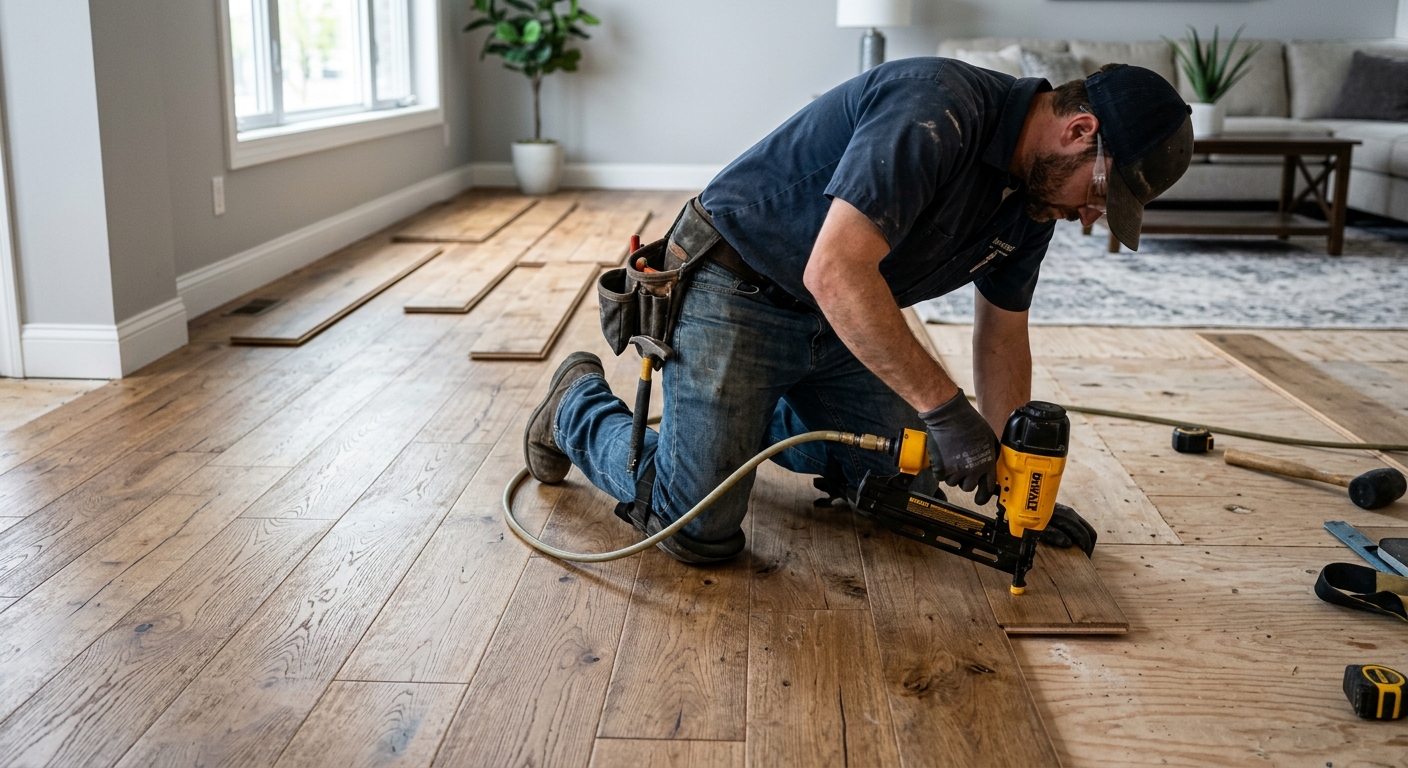
Flooring options and costs in Fairview
Fairview homeowners usually start with “what will look good,” then quickly land on “what will hold up.” With a population of 2,817 and roughly 74.6% of households owning their homes (Statistics Canada, 2021 Census), many projects are upgrades meant to last through long Alberta seasons. One big cost driver is that 58.3% of homes were built before 1981 (Statistics Canada, 2021 Census). Older subfloors in Fairview often need levelling or repair—before you ever see a new plank—so installed pricing can move even when room size stays the same.
In the Athabasca–Grande Prairie–Peace River region, seasonal humidity swings and occasional basement moisture are common realities. That climate pattern influences both material behaviour and labour scheduling. Solid hardwood is sensitive to moisture and can’t be installed over concrete; contractors also tend to steer basement and other below-grade spaces toward engineered wood or luxury vinyl plank (LVP) because those systems tolerate expansion and minor moisture exposure better. Cold-weather comfort matters too—radiant heat is increasingly planned in Alberta homes, and that can affect which products are compatible. Because older housing stock is prevalent, hidden prep work (uneven floors, squeaks, patched OSB/plywood, or thin subfloor layers) is also more frequently part of the budget.
In Fairview, trades tend to be busiest around the core residential areas where main-floor renovations are common, and the same prep issues show up repeatedly. Next, compare typical flooring types and realistic per-square-foot pricing in the table below.
| Type |
Best Room |
Moisture Resistance |
Lifespan |
Price per sq ft |
| Solid hardwood (nail-down, above grade only) |
Living / dining, bedrooms |
Low to moderate (humidity sensitive) |
30+ years with proper conditions |
$6–$12 |
| Engineered hardwood (float or glue, above + on-grade) |
Main floor, hallways, on-grade levels |
Moderate (handles humidity better) |
20–30 years |
$8–$16 |
| Laminate (click-lock, above-grade) |
Living areas, bedrooms (not wet areas) |
Low to moderate (edges can swell) |
10–20 years |
$3–$9 |
| Luxury vinyl plank / LVP (waterproof, any level) |
Kitchen, basement, rec rooms |
High (waterproof core) |
15–25 years |
$4–$12 |
| Porcelain / ceramic tile |
Kitchen, bathrooms, entries |
High (porous grout needs maintenance) |
25+ years |
$9–$18 |
| Carpet (broadloom or modular tile) |
Bedrooms, stairs where comfort matters |
Low (needs dryness) |
8–15 years |
$2–$6 |
Prices are estimates only and vary by project scope, site access and material selection.
What affects the price of flooring in Fairview
In Fairview and across the Athabasca–Grande Prairie–Peace River region, two quotes for the “same” flooring can still differ by 30–50%. The usual reason isn’t the product—it’s the prep, moisture work, and the complexity of the install. Humidity swings and basement moisture affect expansion gaps, acclimation time, underlay choice, and whether additional moisture mitigation is required. Solid hardwood expands and contracts with indoor humidity and cannot be installed over concrete; that limitation alone often pushes costs up when a home has a slab or a below-grade area that needs flooring.
Colder-weather comfort also plays into cost. In Alberta homes where radiant heat is installed (or planned), most contractors will restrict choices to products rated for radiant systems. That can remove some solid hardwood and some laminate options, or require specific underlay. Meanwhile, older regional housing stock—consistent with Fairview’s share of pre-1981 homes—frequently comes with uneven or weakened subfloors. Even a “simple” levelling pass or patching can add $1–$4 per sq ft to the installed total, depending on how much correction is needed.
Here are a few concrete Fairview examples that change pricing: (1) A 1,000 sq ft main floor with engineered hardwood may land in the mid range of the “$8–$16” band if the subfloor is flat, but can climb if levelling is required; (2) A basement finish with waterproof LVP might stay closer to the “$4–$12” band because it tolerates moisture vapour better, even when minor subfloor imperfections exist; (3) A bathroom tiled install can jump within the $12–$25 tile per-square-foot reality when the subfloor needs waterproofing prep and layout complexity increases.
| Price Factor |
Why It Matters |
Cost Impact |
| Room area in sq ft |
Materials and labour scale directly with surface area and waste factor. |
Typically the largest variable on the quote. |
| Subfloor condition |
Levelling or repair is required before many systems perform properly. |
Often adds $1–$4 per sq ft for prep. |
| Moisture / below-grade install |
Moisture limits product types (solid hardwood is usually a poor match). |
May require moisture mitigation and changes to materials. |
| Material choice |
Solid vs. engineered vs. LVP vs. tile have different tolerances and build-up. |
Shifts the quote by product band differences. |
| Removal and disposal of existing flooring |
Old flooring removal, underlay stripping, and disposal take time and may add debris handling. |
Can add several hundred to over $1,500 depending on extent. |
| Stair nosing / transitions |
Transitions and stair work are labour-intensive and priced per step or per linear foot. |
Often increases total cost significantly on stairs. |
| Radiant heat compatibility |
Only certain products/underlays are approved to perform without damage. |
May add cost if a compatible higher-tier product is needed. |
| Installation method |
Float vs. glue-down vs. nail-down changes subfloor tolerances and labour time. |
Can move labour totals by hundreds on typical projects. |
Permits & regulations in Alberta
In Alberta, flooring installation itself typically does not require a building permit. That said, associated work can trigger permitting—especially when you’re dealing with electrical systems, structural changes, or in-floor heating components. For example, if your project includes repairs that affect a structural subfloor system, any moisture remediation steps that involve major substrate changes, or work that touches existing in-floor heating wiring/circuits, electrical permits may be required and inspections can be triggered.
In condominiums, the rules are often about noise and impact performance. Even when a permit isn’t required, the condo corporation’s requirements related to sound transmission (often referencing STC/IIC expectations) can restrict or require specific underlay under hard flooring on upper floors. Always review the condo declaration and request board approval in writing—especially if you’re installing hardwood or tile over areas where sound impact is a concern.
To verify contractor qualifications in Fairview, follow three steps. First, ask for their Alberta licence/registration information (and confirm it through the appropriate online registry for their trade). Second, request a certificate of liability insurance with the coverage amount and confirm it’s current for the project dates. Third, confirm WSIB/WCB coverage (clearance letter or proof of account status). A reputable contractor will provide these documents promptly before work starts, and they should match the scope being quoted.
Best flooring for each room in your Fairview home
Choosing the best flooring in Fairview means matching the material to moisture exposure, day-to-day traffic, and winter comfort. In living and dining rooms, engineered hardwood or a high-quality laminate often provides a warm feel and good durability while better tolerating Alberta’s indoor humidity swings than solid wood. For most master bedrooms, carpet remains a strong comfort and sound option—especially in homes where noise control matters—while engineered hardwood is a practical upgrade if you prefer a hard surface.
Kitchens and entry areas take the most abuse from wet boots and occasional spills, so luxury vinyl plank (LVP) is usually the safer “set it and forget it” choice. If you want the crisp finish of tile, large-format porcelain tile is excellent because it handles water and cleaning well. For basements, LVP is the clear winner in the Athabasca–Grande Prairie–Peace River region: it’s waterproof, handles typical below-grade moisture vapour better, and avoids many of the risks that come with solid wood and most laminate systems. Bathrooms should be porcelain or ceramic tile—this is where tile’s water resistance and long-term maintenance fit best.
Radiant heat compatibility is increasingly relevant in Alberta. If you’re installing (or already have) in-floor heating, ask the contractor to confirm the product’s radiant rating and required underlay. One dollar example: if engineered hardwood lands closer to the $8–$16 per sq ft band but your basement has fluctuating moisture, LVP at the $4–$12 per sq ft band can cost less overall and reduce the risk of edge swelling or cupping that would otherwise force an expensive redo.
| Room |
Best Material |
Why |
Moisture Risk |
Price Band per sq ft |
| Living / dining room |
Engineered hardwood |
Warm look, stable performance through humidity swings. |
Low to moderate |
$8–$16 |
| Master bedroom |
Carpet or engineered hardwood |
Carpet boosts comfort; engineered provides a harder-wearing upgrade. |
Low |
$2–$14 |
| Secondary bedrooms |
Carpet |
Budget-friendly comfort and sound dampening for family traffic. |
Low |
$2–$8 |
| Kitchen |
Luxury vinyl plank (LVP) or porcelain tile |
LVP handles everyday moisture; porcelain is ideal for frequent wet cleanup. |
Moderate to high |
$4–$18 |
| Basement (finished) |
Luxury vinyl plank (waterproof) |
Best tolerance for below-grade moisture and vapour conditions. |
High |
$4–$12 |
| Bathroom |
Porcelain / ceramic tile |
Long service life in wet zones when installed with correct systems. |
High |
$12–$25 |
How to choose a flooring contractor in Fairview
Start with proof. In Alberta, confirm the contractor’s licence/registration for their trade category, ask for current liability insurance, and verify WSIB/WCB coverage. The practical way to check is to request: (1) a clearance letter or proof of WSIB/WCB status; (2) a certificate of insurance showing coverage in the correct name and project period; and (3) their licence/registration details, then verify the information using the relevant online registry. If they can’t provide these documents (or they hesitate), treat that as a warning sign.
Next, get 2–3 itemised quotes. You want a breakdown that separates labour from materials (underlay, leveling compound, trims, transitions, stair work, removal/disposal). A lump sum quote often hides costs that appear later during prep—particularly in older Fairview homes where levelling or subfloor repair is common. Read the scope line-by-line for inclusions and exclusions: permit pull included or not (if any electrical/radiant work is involved), disposal included, and whether patching/levelling is based on a flat-fee allowance or actual quantities.
Warranty matters too: confirm the workmanship warranty length, product/manufacturer warranty terms, and whether it’s transferable if you sell the home. For payment scheduling, never allow more than 10–15% upfront; request a holdback until the job is complete and reviewed. Finally, ask for a written start date and a completion estimate—flooring timelines in Alberta can shift when subfloor prep or acclimation is needed.
- Ask for licence/registration details and verify via the Alberta online registry.
- Confirm liability insurance is current and specific to the contractor’s legal entity.
- Request WSIB/WCB clearance/proof before any work begins.
- Require itemised labour and material pricing (not just “installed price”).
- Make sure removal/disposal is stated clearly in the scope.
- Confirm levelling/repair allowance and what happens if more prep is needed.
- Get written details on transitions, stair nosing, and trim installation.
- Ask how acclimation will be handled for hardwood/engineered products.
- Check that moisture mitigation steps (where needed) are included in writing.
- Confirm radiant heat compatibility for any hard-surface product.
- Verify workmanship warranty length and claim process before signing.
- Use a staged payment schedule with a holdback until completion.
In Fairview, four common red flags are: quoting without checking subfloor flatness and moisture conditions, refusing to provide insurance and WSIB/WCB proof, giving only a “lump sum” with no line-item labour/material scope, and promising solid hardwood in basements without a plan for moisture control and appropriate installation method.
Frequently asked questions — flooring in Fairview
Hardwood vs laminate vs vinyl plank — which is best?
In Fairview, “best” depends mainly on moisture and where the floor will be installed. Solid hardwood looks great above grade, but it’s humidity sensitive and not suited to below-grade spaces. Laminate can be a good budget option for living areas, but its edges can swell if moisture gets underneath, especially during basement humidity swings. Luxury vinyl plank (LVP) is usually the safest all-rounder because it’s waterproof and tolerates moisture vapour better—so it’s a frequent pick for basements. If you want a clear cost anchor, many homeowners compare bands like LVP at roughly $4–$12 per sq ft versus engineered or hardwood ranges that often land higher depending on product tier and prep needs. For a concrete decision, tell your contractor where the install is (main floor vs basement) and whether radiant heat is present.
What flooring is best for a Fairview basement?
For most Fairview basements, waterproof LVP is the practical first choice. The Athabasca–Grande Prairie–Peace River region often sees seasonal humidity swings and basement moisture realities that solid hardwood and many laminate products aren’t built to handle long-term. LVP performs well because it can tolerate moisture exposure and doesn’t rely on the same moisture stability as wood-based products. Another factor is older housing stock: with a high share of pre-1981 homes (Statistics Canada, 2021 Census), it’s common to find uneven or patched subfloors that need levelling—LVP is generally more forgiving of minor irregularities once properly prepped. If you’re budgeting, LVP is often found in the $4–$12 per sq ft band, while tile or hardwood in a basement typically costs more and carries additional moisture-install risks.
Can I install hardwood over concrete?
Usually, no for solid hardwood. Solid hardwood is generally nail-down and intended for above-grade applications where indoor humidity can be controlled; it can’t be installed over concrete slab as a standard practice because moisture can migrate through concrete and wood will react by expanding and contracting. Engineered hardwood is the product most homeowners consider for concrete: it can be installed using approved methods (often floating or glue-down depending on the manufacturer system and slab moisture conditions). In Alberta—including Fairview—contractors also pay attention to radiant heat compatibility and moisture mitigation, especially in older homes where slab moisture and subfloor condition may not be uniform. If you’re considering hardwood over concrete, ask for a moisture assessment and confirm the installation method matches the product warranty.
How long does flooring installation take?
Typical timelines depend on room size, product type, and how much prep is needed. A straightforward main-floor install can move quickly once materials are on-site, but in Fairview older homes often add time for subfloor levelling/repair before any plank or tile goes down. For example, engineered hardwood and LVP can proceed faster than tile because tile needs careful layout, mortar work, and curing time. Carpet generally installs quickly with fewer precision steps. Allow extra time for acclimation when using hardwood or engineered products and for moisture mitigation if a below-grade area is involved. In practice, a multi-day schedule is common for a full main floor, and basement projects can run longer if there’s significant prep. Your contractor should provide a written start date and completion estimate, updated after they’ve inspected the subfloor.
What flooring works with radiant heat?
With radiant heat in Alberta, compatibility depends on the product’s radiant rating and the correct underlay or installation system. Many homeowners do best with options specifically approved for in-floor heating—often certain engineered hardwood systems and some laminate/luxury vinyl products with documented radiant compatibility. Most solid hardwood choices are more restricted due to sensitivity to temperature and moisture, and they must be installed following strict manufacturer instructions. If you’re upgrading a home with radiant heat in Fairview, confirm the manufacturer’s requirements in writing before purchasing. Also ask your installer to verify underlay type (if any), floor build-up height, and acclimation process. When quotes are being compared, the cost difference is often justified by using the correct compatible product and underlayment—especially when a “regular” product would be more likely to void warranty.
Engineered vs solid hardwood — what's the difference?
Solid hardwood is one consistent wood piece and is typically installed nail-down over appropriate above-grade substrates. It’s more sensitive to indoor humidity swings and generally isn’t recommended for below-grade spaces or over concrete slabs. Engineered hardwood is made with a top veneer of real wood over a layered core. That layered construction makes it more dimensionally stable through changes in humidity, which is why it’s commonly used on main floors that experience Alberta winter/summer variation—and it’s often the option considered when concrete is involved (when installed with an approved method and after moisture conditions are checked). Pricing varies by product tier; for example, hardwood-related installs can be higher than LVP, while LVP often sits around $4–$12 per sq ft. If your home is older (many Fairview homes were built before 1981), engineered hardwood can also reduce the risk from minor subfloor issues because it’s better suited to the realities of older builds.