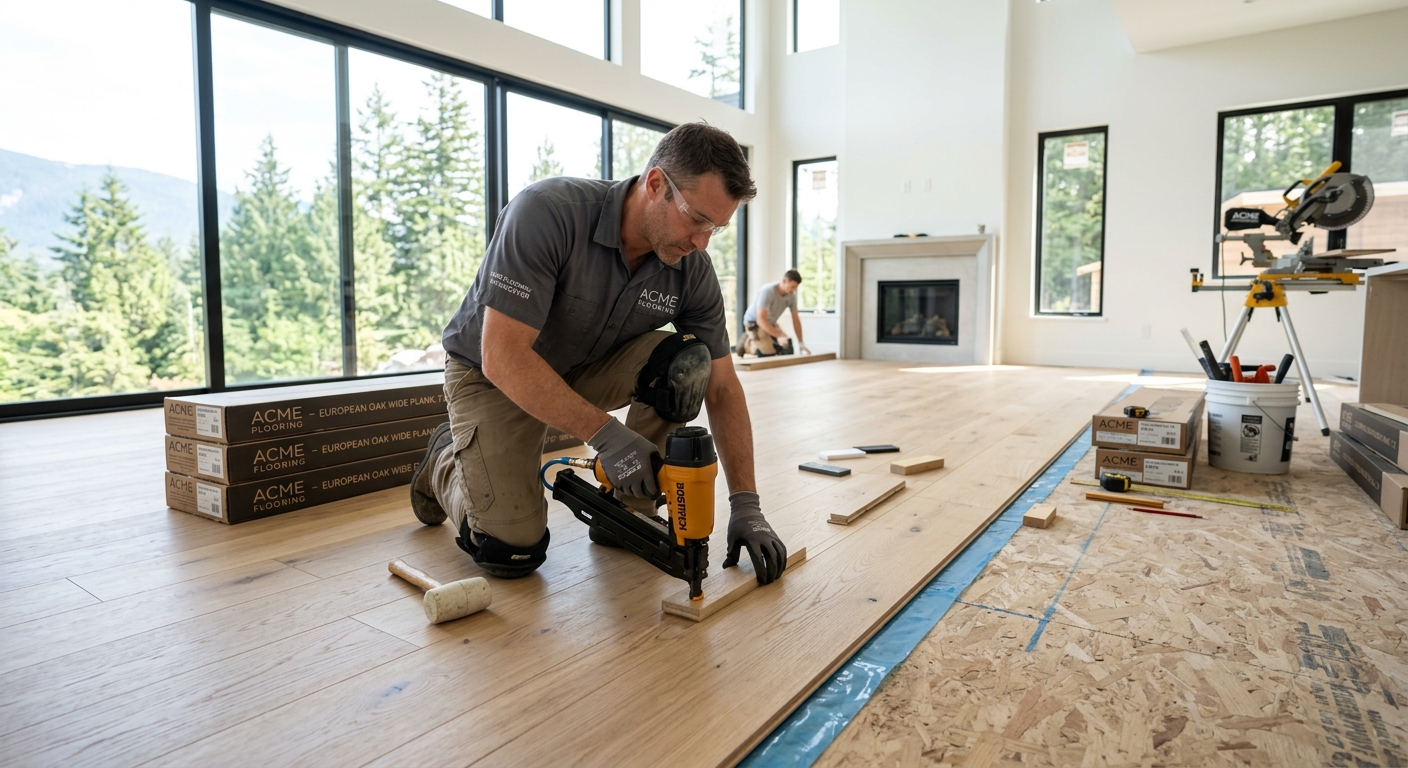
Flooring options and costs in Sunalta
Sunalta, Alberta is known for character homes and infill living where upgrades are common—and flooring is usually the first “big ticket” renovation. With a population of 1,910 people in the area (Statistics Canada, 2021 Census), demand stays steady for trusted installers, especially around the inner-city pockets where older renovations are the norm. In Calgary’s dry, cold prairie climate, indoor humidity swings can be harsh on materials, and that’s one reason costs can climb when prep is needed. Older regional housing stock often has out-of-flat subfloors (aged plywood, transitions between rooms, and patchy concrete), and that levelling/repair work can add roughly $1–$4 per sq ft depending on what’s discovered during removal. In practice, even if your finish choice fits the budget (say, LVP or laminate), the scope of subfloor work can be what pushes a quote up or down.
Basements across Calgary—including many homes closer to the Mission area end of Sunalta—often face moisture migration through concrete. Because of that, above/below-grade planning matters: solid hardwood is typically limited to above grade, while engineered hardwood and waterproof LVP/SPC are far more forgiving. Tile pricing can also look straightforward until flatness is checked; porcelain/ceramic is sensitive to lippage and bond issues, so crack isolation and levelling are frequently budgeted. With that in mind, the table below breaks down typical options, where they perform best in Sunalta homes, and the realistic per-square-foot pricing you should expect.
| Type |
Best Room |
Moisture Resistance |
Lifespan |
Price per sq ft |
| Solid hardwood (nail-down, above grade only) |
Living / dining, bedrooms (not basements) |
Low to moderate (needs stable indoor humidity) |
25–60 years |
$8,–$15 |
| Engineered hardwood (float or glue, above + on-grade) |
Main floor living areas, hallways |
Moderate to good (handles swings better) |
20–40 years |
$8,–$14 |
| Laminate (click-lock, above-grade) |
Bedrooms, closets (dry zones) |
Low to moderate (seams can be vulnerable) |
10–25 years |
$3,–$7 |
| Luxury vinyl plank / LVP (waterproof, any level) |
Kitchen, main floor, finished basements |
High (waterproof cores; vapour-tolerant) |
15–25 years |
$4,–$10 |
| Porcelain / ceramic tile |
Kitchen, bathrooms, wet zones |
Very high (cementitious underlay/setting matters) |
25–50 years |
$6,–$12 |
| Carpet (broadloom or modular tile) |
Bedrooms, stairs (comfort-focused areas) |
Low (needs dry subfloor; moisture-sensitive) |
8–15 years |
$3,–$5 |
Prices are estimates only and vary by project scope, site access and material selection.
What affects the price of flooring in Sunalta
In Sunalta and across the Calgary area, you can see the same basic flooring idea priced 30–50% apart—mainly because the “hidden scope” differs. One quote might include full removal, detailed subfloor levelling, and transition/stair work; another might use a cheaper underlay, skip levelling, or assume your slab/panel floors are flatter than they are. The technical reality is that Calgary’s dry, cold prairie conditions create bigger humidity swings than many homeowners expect, and that affects material movement and install tolerances. Basements are also a cost driver: moisture migration through concrete can rule out solid hardwood and many laminate installs, pushing budgets toward engineered hardwood or waterproof LVP/SPC.
Solid hardwood expands and contracts with indoor humidity, and it can’t be glued or floated on concrete in most residential scenarios. That means in Edmonton-level dryness isn’t the issue—you’ll still pay for stability strategies here in Alberta. Radiant heat compatibility also matters: colder-season homes with in-floor heat (popular in newer builds and some renovations) typically reduce your solid hardwood and some laminate options, so installers price around products rated for heat exposure.
Older homes in the region often need levelling or repair before flooring goes down. In Sunalta-style renovations, that can add $1–$4 per sq ft—enough to shift your total from “laminate friendly” to “engineered hardwood territory” quickly. For example, if you’re comparing laminate (commonly around $3–$7 per sq ft) to engineered hardwood (about $8–$14 per sq ft), the price gap may be worth it once levelling, transitions, and a humidity-friendly system are accounted for. Similarly, if tile is in your plan (often $6–$12 per sq ft), remember flatness and crack isolation can add labour on top of the base material cost.
| Price Factor |
Why It Matters |
Cost Impact |
| Room area in sq ft |
Directly drives material quantity and labour hours |
Higher areas reduce per-sq-ft waste; small rooms often cost relatively more |
| Subfloor condition |
Levelling or repair may be mandatory for a flat, squeak-free install |
Typically adds $1–$4 per sq ft where aged plywood or uneven concrete is found |
| Moisture / below-grade install |
Determines allowable materials and underlayment/vapour strategies |
Can add prep steps and push you from solid hardwood to LVP/SPC or engineered |
| Material choice |
Solid vs engineered vs LVP vs tile have different installation requirements |
Solid hardwood and tile usually land at the higher end of typical Alberta bands |
| Removal and disposal of existing flooring |
Time, hauling, and disposal fees vary by existing material type |
Often a major line item in older Sunalta homes |
| Stair nosing / transitions |
Stairs are labour-intensive and usually priced per step or per linear foot |
Can materially increase total even if floor area stays the same |
| Radiant heat compatibility |
Some products are not rated for heat cycling or surface temperature |
May require different product selection and thicker/better-rated underlay systems |
| Installation method |
Float vs glue-down vs nail-down changes prep, labour, and timing |
Glue-down and tile setting can increase labour; nail-down depends on subfloor type |
Permits & regulations in Alberta
In Alberta, installing flooring as a standalone finish typically does not require a building permit. That said, associated work can trigger permits—especially where building systems are touched. For your Sunalta renovation, think of permits in two categories: what is usually “no permit,” and what is “permit likely or required.”
Typically does NOT require a permit: removing and installing new floor covering (LVP, laminate, engineered or solid hardwood), routine subfloor surface prep that doesn’t change structure (like grinding high spots, minor patching, or underlayment replacement), and trim/baseboard reinstallation. Most standard stair work for nosing/finish also falls under normal renovation scope.
May require a permit: structural subfloor repair (framing modifications), moisture remediation that involves engineering-level changes or major surface mitigation, and any work that intersects with electrical systems—such as adjusting or modifying in-floor heating controls/circuits, or adding new heated zones. In condominiums, the unit is often governed by the corporation’s noise and sound-transmission rules, including required underlay systems for hard-surface flooring on upper floors (STC/IIC expectations are commonly specified). Always review your condo declaration and request board approval in writing before installing hardwood or tile on an above-grade condo unit.
To verify your contractor in Sunalta: confirm their Alberta licence (if applicable to their trade scope), ask for liability insurance with a current certificate, and ensure they have WSIB/WCB coverage (or the applicable provincial coverage status). You can typically start by checking the contractor’s standing through public directories online, then request a certificate of insurance and clearance letter directly from them. A reputable installer should provide these quickly, in writing, before work starts.
Best flooring for each room in your Sunalta home
Choosing the right flooring for Sunalta means matching material performance to how each space behaves in Calgary’s dry, cold prairie climate. Living and dining areas usually benefit from warmth underfoot and stable appearance through seasonal humidity swings. For these zones, engineered hardwood is often the best balance: it looks like wood, yet it’s more forgiving than solid hardwood when indoor conditions drift. If you want a lower-cost alternative, a high-quality laminate can work well in dry rooms, but it’s still more seam-sensitive than waterproof products.
In a master bedroom, comfort and sound matter. Carpet (broadloom or quality modular tile) helps with acoustics and softness on cold mornings, while engineered hardwood remains a strong option if you prefer a harder surface. Kitchens and entries see spills and wet-mopping frequency—here, LVP (waterproof) or large-format porcelain tile are dependable choices. Basements are the clearest call: waterproof LVP is the winner for finished spaces because it’s designed to handle moisture vapour concerns and below-grade conditions that can cause trouble for solid wood.
Bathrooms should be porcelain or ceramic tile only. Also, if your home uses radiant heat (common in Alberta new builds and some renos), confirm the flooring is rated for heat cycling—this can limit certain solid hardwood and some laminate systems. If you’re deciding between options, a practical example is choosing LVP around $4–$10 per sq ft in a basement instead of solid hardwood that’s often limited to above grade; the upfront delta can be justified because you avoid the higher risk and prep costs tied to moisture.
| Room |
Best Material |
Why |
Moisture Risk |
Price Band per sq ft |
| Living / dining room |
Engineered hardwood |
Wood look with better humidity tolerance for Alberta swings |
Low to moderate (above grade) |
$8,–$14 |
| Master bedroom |
Carpet or engineered hardwood |
Comfort and quieter steps; easy to keep dry and stable |
Low (if vents/humidity are maintained) |
$3,–$7 |
| Secondary bedrooms |
Laminate or carpet |
Cost-effective durability in daily use |
Low |
$3,–$7 |
| Kitchen |
Luxury vinyl plank (LVP) |
Waterproof core for spills and frequent cleaning |
Moderate (routine wetting) |
$4,–$10 |
| Basement (finished) |
Luxury vinyl plank (LVP) / SPC |
Best stability over concrete and safer with vapour concerns |
High (below grade moisture migration) |
$4,–$10 |
| Bathroom |
Porcelain / ceramic tile |
Impervious surface and long-life finish when installed flat |
High (direct water exposure) |
$6,–$12 |
How to choose a flooring contractor in Sunalta
Start by verifying your contractor is set up for Alberta work—then insist on itemised quotes. Ask for their Alberta licence status (based on the type of work they’re performing), liability insurance, and WSIB/WCB coverage. To check each: (1) request their certificate of insurance and confirm it matches your contractor’s legal name and is current, (2) ask for a clearance letter or proof of coverage for employees, and (3) confirm their business details through public online directories where available. If they hesitate or provide photos that don’t match the legal name, take that seriously.
Next, get 2–3 written, itemised quotes—labour and materials broken down, not a single lump-sum number. The scope needs to be explicit: is disposal included? Is furniture moving included? What’s the plan for transitions between rooms and around doorways? If levelling is needed, is the cost included as a line item, and what levelness standard are they meeting? Permit pulls should be specified when relevant, particularly if any electrical work touches radiant systems.
Review warranty terms carefully. You want a written workmanship warranty (often best when it’s clear about coverage and duration), plus the manufacturer warranty for the flooring product—and confirm whether it’s transferable if you sell your home. For payment, never pay more than 10–15% upfront. Use a holdback until the job is complete and cleaned up, and get a start date plus a completion estimate in writing.
- Ask for insurance and WSIB/WCB proof before signing anything.
- Request their written scope: subfloor prep, underlay/vapour barrier type, and levelling plan.
- Confirm whether existing flooring removal and disposal are included.
- Get transition and stair nosing pricing stated per step or per linear foot.
- Require an itemised materials list (underlay, adhesive, membranes, grout/thinset if tile).
- Ask who supplies and installs reducers, T-mouldings, and caulking/expansion gaps.
- Clarify what’s excluded: floor leveling depth limits, rotten wood repair, cracked concrete repairs.
- Verify product suitability for your climate and space (basement moisture, radiant heat rating).
- Confirm they’ll follow manufacturer acclimation instructions (critical in Alberta).
- Get the workmanship warranty in writing, with start date and coverage wording.
- Use a payment schedule with a holdback until final walk-through is complete.
- Require a job schedule estimate and who is responsible for site protection and clean-up.
In Sunalta, red flags include: refusing to provide insurance/coverage documentation, giving only a lump-sum quote with no prep or transition details, not discussing basement moisture limitations (e.g., pushing solid hardwood over concrete), promising radiant heat compatibility without product ratings, and asking for large upfront deposits (beyond 10–15%).
Frequently asked questions — flooring in Sunalta
How long does flooring installation take?
In Sunalta, timelines depend less on the finish and more on prep. For many typical main-floor installs, you’re often looking at a few days to remove existing flooring, prep and level where needed, then install and trim. If levelling is required due to aged plywood or uneven transitions, the schedule can stretch because flooring installers often need additional drying/curing time for patches and smoothing compounds. Tile takes longer than LVP or laminate because of setting, grout curing, and careful layout for flatness. Basements can add time if moisture mitigation steps are required or if the concrete needs additional surface prep for adhesion. As a rough planning point, keep your expectations flexible if you discover out-of-level areas during demo—this is common in older Calgary housing stock.
What flooring works with radiant heat?
For radiant heat in Alberta, the key is product compatibility and installation method. Solid hardwood is often limited by temperature tolerances and movement risk with heat cycling, so many contractors steer homeowners to engineered hardwood or manufacturer-approved products rated for radiant applications. Many laminates are also restricted unless specifically rated—heat can affect locking mechanisms and cause premature wear if the temperature profile isn’t supported. Waterproof LVP/SPC can be a good option when it’s rated for radiant use and installed with the correct underlay or vapour barrier system (if required by the manufacturer). Always ask for the product’s written radiant heat rating and follow acclimation instructions. A good contractor will also explain the heating “startup” procedure after install, because that impacts warranty validity.
Engineered vs solid hardwood — what's the difference?
Solid hardwood is typically a single piece of wood installed nail-down and, in most cases, kept to above-grade applications in Calgary/Alberta because seasonal humidity swings can cause expansion and shrinkage. It’s also not the go-to choice over concrete slabs. Engineered hardwood uses a layered construction (a stable core with a wood wear layer), which helps it tolerate relative humidity changes better. That’s why engineered hardwood is often used on main floors and on-grade areas in Sunalta renovations. Pricing usually reflects that difference: you may see solid hardwood commonly in the $8–$15 per sq ft band, while engineered often lands around $8–$14 per sq ft depending on thickness and finish. If your project includes a basement or any moisture-vapour concern, engineered is usually preferred over solid—though LVP/SPC may still be safer for below-grade wet risk.
Do I need to level my subfloor first?
Often, yes—especially in Sunalta where older homes frequently have uneven plywood or inconsistent concrete surfaces. Flooring can hide small imperfections, but many products demand specific flatness requirements to prevent squeaks, gaps, or early wear. Tile is the most sensitive: uneven subfloors can cause lippage, poor adhesion, and grout line failure, so levelling and sometimes crack isolation membranes are commonly budgeted. For LVP/SPC and laminate, small irregularities may be manageable, but severe dips or ridges can lead to clicking/locking stress and edge separation. Levelling scope is typically where quotes diverge: one installer might include $1–$4 per sq ft for prep when they discover low/high spots, while another may only cover “minor patching.” The right approach is to measure flatness before you lock in the material, then price levelling based on actual conditions, not assumptions.
What's the most durable flooring for pets and kids?
For pets and kids in Alberta, durability means more than scratch resistance—it’s also how the floor handles moisture, impacts, and frequent cleaning. Waterproof LVP/SPC is often the practical winner in homes with active families because it tolerates spills and easy mopping better than laminate and doesn’t have the seam vulnerability that can show up over time. In terms of price, LVP/SPC commonly sits around $4–$10 per sq ft depending on thickness and brand—often a better value than tile if you want comfort underfoot. Carpet can be durable with the right fibre and quality pad, but it’s less forgiving of repeated wet accidents; you’ll want good stain protection and fast dry-out. Hardwood can be durable, but you still need humidity stability and protective maintenance, particularly in Calgary’s dry/cold seasons. A contractor can also help you choose wear layers and thickness for engineered hardwood if you prefer the wood look.
How do I choose flooring for humidity in Sunalta?
Humidity is a big deal in Sunalta and throughout Calgary because indoor relative humidity swings across seasons can stress wood materials. Solid hardwood expands and contracts with humidity changes, so it’s typically limited to above-grade installs and requires stable indoor conditions. Engineered hardwood handles humidity swings better and is often a safer wood-look option on main floors. For bathrooms, kitchens, and especially finished basements, humidity risk changes the material decision: basements can see moisture vapour migration through concrete, and that typically rules out solid hardwood and many laminate installs. In those areas, waterproof LVP/SPC is designed to handle higher moisture risk more reliably. If you’re comparing budgets, remember that basement-safe choices often reduce risk-adjusted costs—even if laminate seems cheaper at $3–$7 per sq ft—because you avoid costly callbacks tied to cupping, gapping, or bond issues.