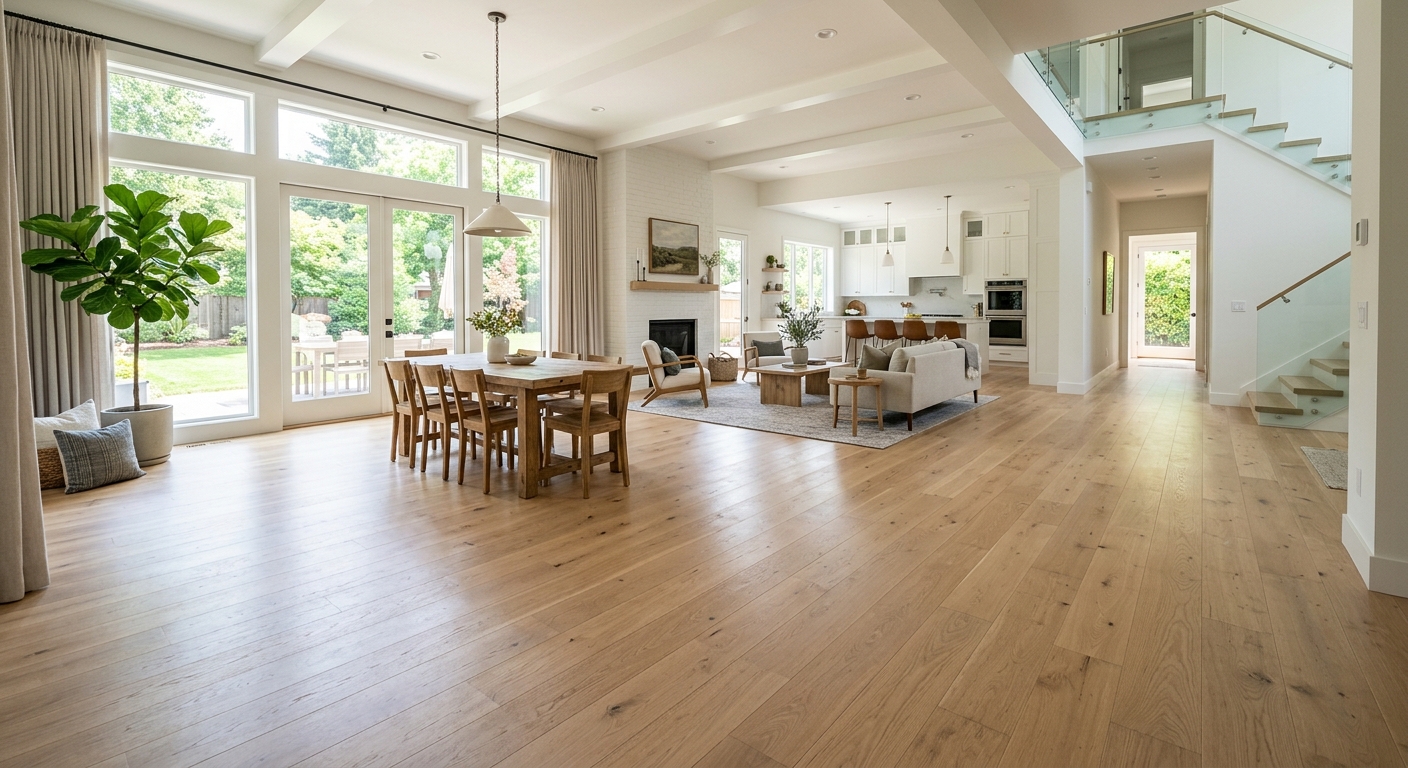
Flooring options and costs in Wainwright
Wainwright homeowners have a lot of choices, but costs and performance come down to Alberta’s seasonal swings. With a population of 6,606 (Statistics Canada, 2021 Census) and about 70.2% of households owning their homes (Statistics Canada, 2021 Census), most projects are renovation-based rather than new builds—and that matters for prep. In homes built before 1981 (47.3% of dwellings in the area, Statistics Canada, 2021 Census), the most common “hidden” line item is often subfloor levelling and repair. That prep work can add roughly $1–$4 per sq ft depending on whether we’re just smoothing low spots or rebuilding damaged OSB/plywood sections before any new flooring goes down.
In the Camrose–Drumheller region, cold winters and moisture exposure (especially in lower levels) push buyers toward engineered wood and luxury vinyl plank (LVP). These products handle dimensional change and below-grade conditions more reliably than solid hardwood, which is sensitive to humidity. Radiant heat compatibility is another local driver—colder Alberta homes increasingly favour flooring assemblies that can safely sit over in-floor heat. Labour availability can also affect price, particularly in peak seasons when installers are booked around the same school-year window and spring re-opening of basements.
Demand is especially strong around the north end residential blocks and the older core where many properties are post-1970s construction and renovations run back-to-back. The result: quotes vary widely, so it’s smart to compare apples-to-apples before you decide. Use the table below as a practical baseline, then we’ll break down the real cost drivers in the next section.
| Type |
Best Room |
Moisture Resistance |
Lifespan |
Price per sq ft |
| Solid hardwood (nail-down, above grade only) |
Living/dining (no in-floor heat) |
Low (avoid basements; sensitive to humidity) |
25–50 years |
$10 – $18 |
| Engineered hardwood (float or glue, above + on-grade) |
Living/dining, bedrooms |
Medium–High (better tolerance for Alberta swings) |
20–35 years |
$11 – $17 |
| Laminate (click-lock, above-grade) |
Bedrooms, hallways, living areas |
Medium (fine with prompt clean-up; not for flooding) |
10–25 years |
$4 – $10 |
| Luxury vinyl plank / LVP (waterproof, any level) |
Kitchen, basement (finished) |
High (waterproof core; handles below-grade installs) |
15–25 years |
$6 – $12 |
| Porcelain / ceramic tile |
Kitchen, bathrooms |
Very high (water-safe with proper grout/seal approach) |
30–50 years |
$12 – $28 |
| Carpet (broadloom or modular tile) |
Bedrooms, stairs (comfort) |
Low–Medium (needs good underlay; sensitive to moisture) |
8–15 years |
$4 – $8 |
Prices are estimates only and vary by project scope, site access and material selection.
What affects the price of flooring in Wainwright
If you get two quotes for the same room size in Wainwright, a 30–50% difference isn’t unusual in the Camrose–Drumheller region. The reason is usually not the “flooring” itself—it’s what happens before and after the new surface goes down. Indoor humidity swings in Alberta expand and contract wood products, and below-grade moisture risk can force different underlayments, vapour barriers, and subfloor preparation. In older housing stock (47.3% of dwellings built before 1981, Statistics Canada, 2021 Census), uneven boards and patchy subfloors also drive cost up quickly.
Technically, solid hardwood is the most sensitive. It cannot be glued or floated over concrete the way engineered wood can, and it performs poorly in basements where moisture vapour is harder to control. That’s why, in this region’s colder conditions, homeowners often pivot to engineered hardwood or waterproof LVP. Radiant heat compatibility also limits choices: many solid hardwood installs aren’t recommended over in-floor heating, while engineered wood and certain LVP assemblies are designed to tolerate heat cycling.
In practice, here are common Wainwright scenarios that move pricing: a 300 sq ft living space with minor dips might come in near the laminate band of about $4–$10 per sq ft, but if we uncover cupping under old underlay, levelling materials and labour can push the job closer to the $10–$18 range. Meanwhile, a finished basement that needs a proper vapour barrier and flooring transition detailing may favour LVP (often $6–$12 per sq ft), but tile (typically $12–$28 per sq ft) can become cost-effective only when you need a harder surface and are budgeting for heavier underlayment and prep. The takeaway: subfloor and moisture conditions often determine whether you’re paying the low end of a band or the high end.
| Price Factor |
Why It Matters |
Cost Impact |
| Room area in sq ft |
Drives material quantity, underlay, and labour time |
+$100 to +$2,000 depending on size and waste |
| Subfloor condition |
Levelling/repair is often required to prevent movement and squeaks |
Typically +$1 to +$4 per sq ft |
| Moisture / below-grade install |
Rules out solid hardwood and affects underlay/vapour barrier choices |
Often +$0.50 to +$3 per sq ft |
| Material choice |
Solid vs. engineered vs. LVP vs. tile have different hardware and prep needs |
Can shift total by 20%+ on the same room |
| Removal and disposal of existing flooring |
Tear-out and hauling add labour; adhesives can be messy on concrete |
Usually +$300 to +$1,500 total |
| Stair nosing / transitions |
Transitions and stair components are priced per step or per linear foot |
Commonly +$200 to +$900 |
| Radiant heat compatibility |
Limits which products can be installed safely over in-floor heat |
Can add +$1 to +$5 per sq ft for the right system |
| Installation method |
Float vs. glue-down vs. nail-down changes prep and labour |
May change labour by 10% to 25% |
Permits & regulations in Alberta
In Alberta, installing flooring itself typically does not require a building permit. However, the “associated work” around flooring can trigger permitting—especially when you’re changing structure, moisture control systems, or electrical components tied to heating. If your project involves structural subfloor repair (for example, significant joist repairs or reframing), moisture remediation measures (like correcting chronic water ingress), or alterations to in-floor heating circuits, you may need electrical-related approvals depending on what’s being modified. If you’re planning any work that touches wiring, thermostats, or electrical service components, confirm requirements with your contractor before work begins.
For homeowners in Wainwright living in a condominium or multi-unit building, the bigger “rule” isn’t usually a permit—it’s the building’s noise and impact requirements. Many corporations require specific underlay for hard-surface floors to meet sound transmission targets (commonly referenced as STC/IIC performance). Always review the condominium declaration and ask for board approval in writing before installing hardwood or tile on upper floors. If you’re unsure, request the corporation’s underlay specifications so the installer can propose a compliant assembly from day one.
To verify your contractor in Alberta, follow a simple step-by-step: (1) check licensing status through provincial online resources for the appropriate trade/registration where applicable; (2) request a certificate of insurance and confirm liability coverage limits; (3) ask for WSIB/WCB clearance or proof of coverage; and (4) keep copies of both insurance certificates and the clearance letter in your project file. For in-floor heat or electrical-adjacent scopes, insist the contractor coordinates permits/approvals before any wiring work starts.
Best flooring for each room in your Wainwright home
Choosing the right flooring by room is the fastest way to protect your budget in Wainwright. With Alberta temperature swings and the moisture risk you often see in basements and lower-level spaces, the “best” option isn’t the prettiest one—it’s the one that tolerates the conditions without cupping, gapping, or unexpected callbacks. For living and dining rooms, engineered hardwood or high-quality laminate usually hits the sweet spot of warmth, durability, and easier seasonal tolerance than solid hardwood. In bedrooms, homeowners often prefer carpet for comfort and sound absorption—especially in a town where many homes share common walls or have finished lower levels that need quieter flooring.
For kitchens, go with luxury vinyl plank (LVP) or large-format porcelain tile. LVP is waterproof and handles splashes and quick cleanups, while porcelain offers a tougher surface for heavier foot traffic. Basements are where the decision becomes decisive: fully waterproof LVP is the clear winner for finished basements because it can handle below-grade moisture and vapour concerns far better than solid wood and most laminate. Bathrooms should be porcelain or ceramic tile for water safety.
Radiant heat compatibility is increasingly relevant in newer Alberta builds and renovations. If you’re installing or upgrading in-floor heat, confirm the flooring assembly is rated for it before you buy—solid hardwood options are often limited, while engineered wood and certain LVP systems are typically more forgiving. For cost justification: if your living area is 400 sq ft, moving from a laminate band of about $4–$10 per sq ft to engineered wood nearer $11–$17 per sq ft can be worth it when you want fewer issues with seasonal movement and a higher-end look that’s easier to live with in Wainwright’s climate.
| Room |
Best Material |
Why |
Moisture Risk |
Price Band per sq ft |
| Living / dining room |
Engineered hardwood |
Warm feel, better dimensional stability than solid |
Low (typical main floor use) |
$11 – $17 |
| Master bedroom |
Carpet or engineered hardwood |
Carpet adds comfort; engineered keeps a clean, modern look |
Low (monitor humidity for long-term comfort) |
$4 – $17 |
| Secondary bedrooms |
Laminate |
Good durability for families with easier replacement of sections |
Low (above-grade, if well ventilated) |
$4 – $10 |
| Kitchen |
Luxury vinyl plank (LVP) or porcelain tile |
Water resistance and easy cleaning |
Medium (spills and daily wet work) |
$6 – $28 |
| Basement (finished) |
Luxury vinyl plank (waterproof) |
Best tolerance for below-grade moisture and vapour |
High (use proper underlayment and sealing) |
$6 – $12 |
| Bathroom |
Porcelain / ceramic tile |
Water-safe surface when installed with correct detailing |
Very high (wet areas) |
$12 – $28 |
How to choose a flooring contractor in Wainwright
In Wainwright and across Alberta, the right flooring contractor is the one who can prove they’re insured, covered, and accountable—not just the one with the lowest number. Start with Alberta verification: request the contractor’s liability insurance certificate (and confirm it’s current), then ask for WSIB/WCB clearance or proof of coverage for their workers. If they can’t provide documents immediately, that’s a strong warning sign. Next, ask how they handle responsibility for subfloor prep and moisture issues—because in older Wainwright homes, prep is where projects succeed or fail.
Get 2–3 itemised written quotes. You want a breakdown that separates labour, materials, underlay/vapour barrier, removal and disposal, and any levelling/patch work. Avoid “lump sum” quotes that don’t explain what’s included, especially for stairs, transitions, and bathrooms where tile labour and layout complexity change costs quickly. Read the scope carefully: is permit pulling included if required for associated electrical/in-floor heating work? Is disposal included for old flooring and underlay? Are transitions included where flooring meets tile, carpet, or existing thresholds?
Warranty matters for both workmanship and product. Confirm the labour warranty length and what it covers (for example, separation, gapping, or lifting). Ask whether the product warranty is transferable if you sell the home. Payment schedule should be conservative: never pay more than 10–15% upfront; hold back a portion until the job is complete and you’ve reviewed the final installation. Finally, require a start date and a completion estimate in writing so you can plan around Alberta winter realities.
- Ask for certificate of insurance and WSIB/WCB clearance before signing.
- Get 2–3 itemised quotes with labour/material/underlayment separated.
- Confirm who does subfloor levelling and how high spots/low spots are addressed.
- Require written scope for removal and disposal (including adhesive limits).
- Confirm underlay/vapour barrier type for your specific product and basement risk.
- Ask about stair labour, stair nosing, and transition edging pricing per step/linear foot.
- Ensure the quote states the acclimation process for colder Alberta storage conditions.
- Confirm radiant heat compatibility in writing if you have (or plan) in-floor heat.
- Review warranty terms: workmanship length, exclusions, and product coverage.
- Set a payment schedule with no more than 10–15% upfront and a holdback at completion.
- Require a start/completion timeline and a contact for day-of coordination.
- Ask for references from recent Wainwright or Camrose–Drumheller installations.
Red flags to watch in Wainwright: they won’t provide insurance/WSIB/WCB proof on request; they won’t discuss subfloor moisture or levelling despite older housing; they quote without detailing underlay/vapour barrier and transitions; they pressure you for a large upfront payment; or they promise radiant heat installs with products that aren’t specifically rated for it.
Frequently asked questions — flooring in Wainwright
How much does flooring cost in Wainwright?
In Wainwright, your total price depends mostly on prep (subfloor levelling/repair), removal, and the specific material you choose. As a baseline, laminate or vinyl plank projects commonly land in the $4–$10 per sq ft and $6–$12 per sq ft ranges respectively, while tile and higher-end options are usually higher—tile often runs about $12–$28 per sq ft. Carpet installation typically fits the $4–$8 per sq ft band when labour and basic materials are included. In older homes (Statistics Canada, 2021 Census shows 47.3% built before 1981 in the local profile), expect that levelling and patch work can materially change the final number. If you’re comparing quotes, make sure one includes vapour barrier/underlay and levelling provisions; that’s where the biggest differences occur, not just in the surface material.
Hardwood vs laminate vs vinyl plank — which is best?
“Best” depends on room and moisture risk. Hardwood (especially solid) is a great look, but in Alberta’s humidity swings it’s more sensitive—solid hardwood is typically limited to above-grade installations only. Engineered hardwood is often the safer hardwood choice because it tolerates seasonal movement better and can be installed with more flexible systems. Laminate is usually budget-friendly (commonly $4–$10 per sq ft), but it’s not waterproof; it struggles if water sits at seams. Luxury vinyl plank (LVP) is the practical winner for basements and spill-prone areas because many products are waterproof and handle below-grade conditions far more reliably, often in the $6–$12 per sq ft range. For a Wainwright home, I generally recommend engineered for main floors and LVP for basements unless you’ve confirmed a very dry subfloor and vapour control.
What flooring is best for a Wainwright basement?
For Wainwright basements, waterproof LVP is usually the best fit. Camrose–Drumheller conditions bring cold winters and moisture risk, and below-grade spaces can have higher vapour levels even when walls look dry. Waterproof LVP is designed to handle that better than solid hardwood and most laminate—both can react badly to moisture and dimensional movement over time. Carpet can be comfortable, but it’s rarely ideal for basements because any hidden moisture can lead to odours or premature wear. A key detail is not just the product: correct vapour barrier/underlayment, sealed perimeter details, and any needed subfloor levelling are what prevent problems from coming back. If you’re budgeting, don’t skip prep—older housing stock (47.3% built before 1981 in the local profile, Statistics Canada, 2021 Census) is where levelling and repair can change your final cost.
Can I install hardwood over concrete?
Often, yes—but it depends on the hardwood type and the concrete condition. Solid hardwood usually has strict limitations because it’s sensitive to moisture and dimensional change; it’s typically installed nail-down on approved above-grade wood subfloors only. For concrete slabs, engineered hardwood is generally the more appropriate choice, because it’s commonly installed with a glue-down or engineered-specific system over properly prepared concrete. The concrete must be flat and properly treated for moisture (including testing when needed). In Wainwright, concrete moisture and winter-summer humidity cycling are real factors—so a good contractor will assess the slab, address high spots, and confirm the required moisture mitigation steps before installation. If you’re considering radiant heat, confirm the engineered product and underlayment assembly are rated for it in writing.
How long does flooring installation take?
Typical timelines depend on room size, subfloor condition, and whether you’re removing existing flooring. For many Wainwright single-floor projects, installation itself might be a day or two, but prep often sets the schedule. Subfloor levelling and repairs can add 1–3 days, especially in older homes where patching and smoothing are required before any click-lock or floating system can be laid. Tile usually takes longer due to layout and curing times, and stairs/transitions can add additional labour time. Also remember material acclimation: in Alberta winter conditions, products should be conditioned to indoor temperature before install. When you request quotes, ask for a written start date and completion estimate that includes removal, underlay/vapour barrier setup, levelling, and cleanup.
What flooring works with radiant heat?
Radiant heat changes the “safe product list.” In Alberta, radiant heat compatibility is important because heat cycling can stress materials if they aren’t rated for it. In general, engineered hardwood is often a better match than solid hardwood over radiant systems, and many LVP manufacturers also provide radiant-heat-approved guidelines for specific products and installation methods. Laminate can work if the product is explicitly rated for radiant heat, but not all are suitable—especially if the underlay system isn’t compatible. Tile is commonly compatible with radiant heat as well, but it has its own requirements for thinset, subfloor flatness, and detailing. The safest approach in Wainwright is to ask your installer to confirm compatibility in writing for the exact product model they propose, and to confirm the installation method and underlayment/vapour barrier meet the radiant heat requirements.