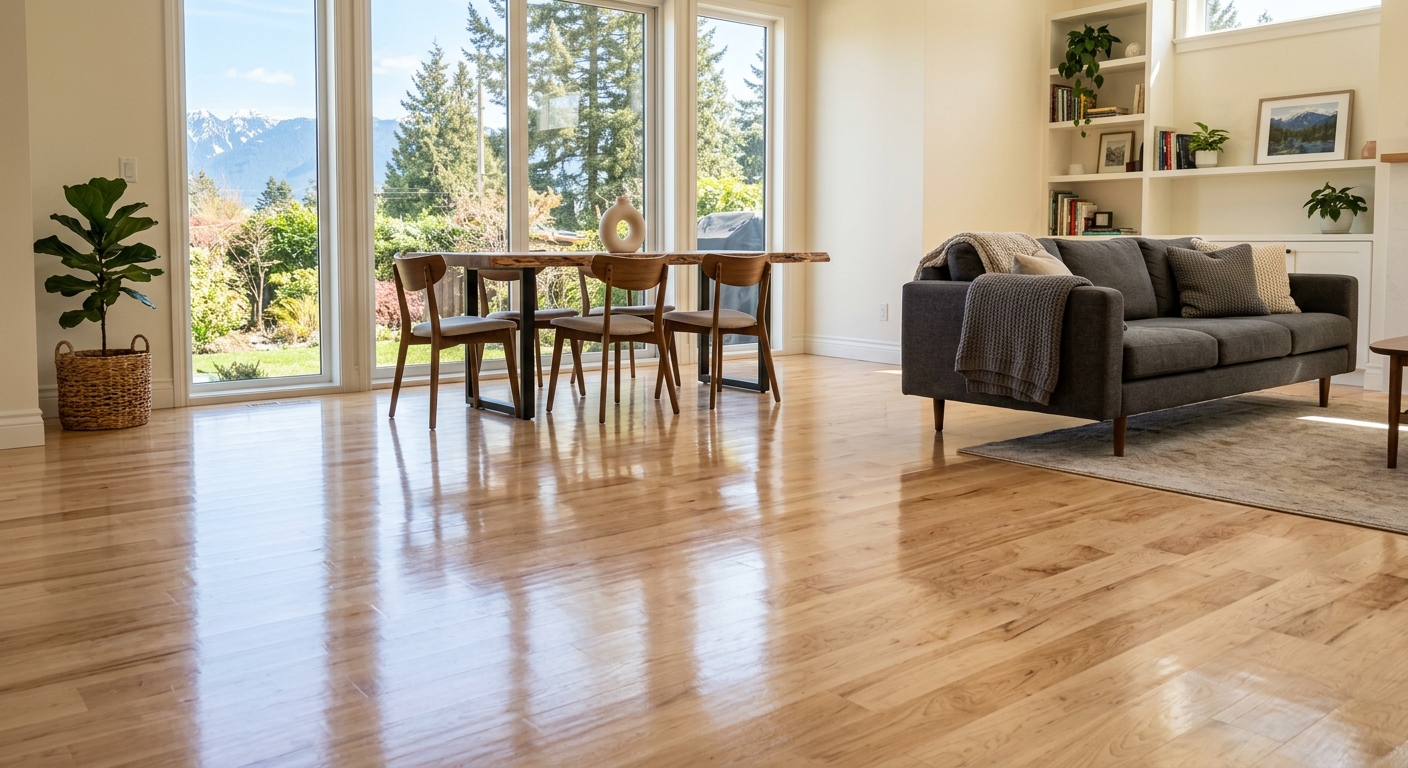
Flooring options and costs in Castlegar
Castlegar homeowners usually want flooring that looks great, but also holds up to the Kootenays’ day-to-day reality: seasonal humidity swings, frequent below-grade moisture movement, and older housing where the subfloor often isn’t perfectly flat. With 76.1% of households in the city owning their homes and 64.5% of local dwellings built before 1981 (Statistics Canada, 2021 Census), it’s common to see patching over old finishes, uneven boards, and moisture concerns around basements and slab-on-grade areas—before you even start choosing a surface.
In the Kootenay market, pricing is also influenced by contractor availability and project sequencing. For example, levelling and repairs can take time (and added labour) because many crews need to correct dips, high spots, or failing underlay before installation. That’s why engineered hardwood and luxury vinyl plank (LVP) are often the safest “middle ground” in homes that can’t promise consistently stable indoor humidity. Solid hardwood can be beautiful, but it behaves differently with moisture and temperature swings, so it’s typically limited to above-grade rooms with good humidity control.
If you’re in an area with heavier traffic like the West Kootenay region near downtown Castlegar and along main residential corridors, flooring replacements are especially in demand—schools, offices, and busy households keep scheduling tight, and contractors prioritize projects that don’t require rework. From there, the table below gives a practical cost comparison to help you read quotes line-by-line.
| Type |
Best Room |
Moisture Resistance |
Lifespan |
Price per sq ft |
| Solid hardwood (nail-down, above grade only) |
Living rooms, dining rooms (above grade) |
Low to moderate (not for basements) |
25–40 years (with stable indoor humidity) |
$12 – $20 |
| Engineered hardwood (float or glue, above + on-grade) |
Main floors and hallways (above + on-grade) |
Moderate to good (better tolerance) |
20–35 years |
$12 – $20 |
| Laminate (click-lock, above-grade) |
Bedrooms and hallways (above grade) |
Moderate (not ideal for wet zones) |
10–25 years (depends on wear layer) |
$5 – $10 |
| Luxury vinyl plank / LVP (waterproof, any level) |
Kitchen, entries, bathrooms, finished basements |
High (waterproof surface) |
15–25 years |
$5 – $10 |
| Porcelain / ceramic tile |
Bathrooms, kitchens, entries |
Very high (tile tolerates moisture) |
25–50 years |
$12 – $25 |
| Carpet (broadloom or modular tile) |
Bedrooms, stairs (comfort-focused) |
Low to moderate (avoid high-moisture basements) |
8–15 years |
$4 – $9 |
Prices are estimates only and vary by project scope, site access and material selection.
What affects the price of flooring in Castlegar
It’s normal to see quotes for the same overall “square footage plus new floors” range jump by about 30–50% across the Kootenays and wider British Columbia. The biggest reason isn’t just the flooring—it’s what the contractor discovers after moving furniture and opening up the edges. In Castlegar, indoor humidity swings and below-grade moisture are the key technical drivers. Solid hardwood expands and contracts with humidity; that movement can lead to gapping, peaking, or de-bonding problems if the basement/ground level isn’t controlled. Engineered hardwood and luxury vinyl plank are built with better dimensional stability, so they handle the Kootenay conditions far better for on-grade and lower-level areas.
Temperature matters too. In colder parts of the region, homeowners more often add or retrofit radiant-heat compatibility, which rules out most solid hardwood and some laminate products. Older housing stock also affects cost: when homes are built before 1981, you commonly need subfloor levelling or repair before installation—often adding $1–$4 per sq ft depending on whether it’s patching, replacing weak sections, or adding a new underlayment plan.
Here are a few real examples I see in Castlegar: (1) a slight “wavy” subfloor across 400 sq ft can add days of labour before installing hardwood or tile, (2) slab or below-grade moisture can steer you from solid hardwood to engineered wood or LVP (so material costs may rise, but call-backs drop), and (3) if stair transitions and door jamb trims are included, the job can swing upward—especially when you’re mixing materials like LVP in the basement and hardwood on the main floor. Those choices link directly to the price bands: hardwood typically sits around $12 – $20 per sq ft, while LVP/laminate projects often start closer to $5 – $10 per sq ft, but the “extras” can narrow or widen the difference fast.
| Price Factor |
Why It Matters |
Cost Impact |
| Room area in sq ft |
Materials scale directly; labour efficiency changes with room size and layout |
Smaller rooms often cost more per sq ft due to waste and transitions |
| Subfloor condition |
Levelling, patching, replacing damaged underlay, and preparing for glue/float |
Commonly adds $1–$4 per sq ft in older Castlegar homes |
| Moisture / below-grade install |
Basements and slab-on-grade areas restrict solid hardwood and some laminates |
Shifts you to engineered hardwood or waterproof LVP; can change the material line item |
| Material choice |
Solid vs. engineered vs. LVP vs. tile varies in price, installation method, and labour intensity |
Hardwood is typically higher per sq ft than LVP/laminate; tile often sits at the top end |
| Removal and disposal of existing flooring |
Taking up old flooring, underlay, staples/glue, and disposing legally |
Can add a noticeable labour charge, especially with multiple layers |
| Stair nosing / transitions |
Transitions are where most “hidden” cost lives—per step or per linear foot |
Often increases cost even when the main area is straightforward |
| Radiant heat compatibility |
Some products warp or de-bond under higher heat cycles |
May require higher-end engineered/approved vinyl or tile rated for in-floor heat |
| Installation method |
Float vs. glue-down vs. nail-down changes prep, tools, and cure/wait times |
Glue-down and tile typically cost more in labour and schedule management |
Permits & regulations in British Columbia
In British Columbia, installing new flooring by itself generally does not require a building permit. That means standard work like removing existing carpet, floating engineered hardwood, installing LVP, or tiling a bathroom floor typically proceeds without permits. Where it can change is when the flooring project expands into regulated trade work. For example, electrical permits may be required if your scope includes in-floor heating wiring or upgrades to an existing electrical circuit to support the system.
In multi-unit housing (condominiums), the rules are usually about sound and building standards rather than “flooring permits.” Hard flooring can require specific underlay or approvals to meet sound transmission expectations (often referenced with STC/IIC). Always review your condo declaration and request written board approval before installing hardwood or tile on upper floors, and confirm the underlay/thickness plan matches what’s allowed.
For Castlegar homeowners, verifying a contractor is practical and worth doing step-by-step:
- Check their British Columbia business details and licence/registration (as applicable) using the appropriate online registry tools.
- Request a current certificate of insurance showing liability coverage.
- Confirm WSIB/WCB coverage (or equivalent provincial coverage documentation) for their workers—ask for a clearance letter or current coverage proof.
- Get it all before work starts, and ensure the quote includes the scope that matches what you approved.
Best flooring for each room in your Castlegar home
Choosing the right flooring in Castlegar is mainly about matching each room’s moisture exposure, daily traffic, and comfort needs to a material that tolerates the Kootenays’ humidity swings. In living and dining areas, engineered hardwood or high-quality laminate is a strong balance: you get a warmer look than tile, and engineered construction typically handles seasonal movement better than solid wood. For the master bedroom, carpet remains a comfort winner—especially if you want sound absorption and underfoot warmth during cool mornings. In the kitchen, I usually recommend luxury vinyl plank (LVP) or large-format porcelain tile because spills are common and cleanup is straightforward. Both options resist moisture better than many “above-grade only” products.
Basements are the deciding zone in Castlegar. With below-grade space and moisture vapour movement, LVP is the clear winner: it’s waterproof at the surface and more forgiving if humidity fluctuates. Solid hardwood and most laminate generally don’t perform well in basements without very stable conditions. Bathrooms should be porcelain or ceramic tile only—water resistance is the priority, and proper waterproofing and grout workmanship matter as much as the tile itself.
If you have (or plan) radiant heat, ask for flooring rated as compatible with in-floor heating. This is increasingly popular in British Columbia, and it affects product selection—solid hardwood is often limited, while certain engineered wood, LVP, and tile are commonly approved.
Price-wise, don’t assume “cheaper is worse.” For example, a basement switch from carpet to waterproof LVP often costs more in material line items than a basic laminate approach, but it can prevent moisture-related replacements—protecting your total cost over time. Typically, you’ll see LVP around $5 – $10 per sq ft, while porcelain tile commonly lands in the $12 – $25 per sq ft band once installation is included.
| Room |
Best Material |
Why |
Moisture Risk |
Price Band per sq ft |
| Living / dining room |
Engineered hardwood |
Warm look, more stable than solid through seasonal swings |
Low (if above grade) |
$12 – $20 |
| Master bedroom |
Carpet or engineered hardwood |
Comfort and sound control with carpet; stability with engineered wood |
Low to moderate (depends on basement access/door drafts) |
$4 – $20 |
| Secondary bedrooms |
Laminate (high-quality) or engineered hardwood |
Durable for daily use; easier maintenance than carpet |
Low (above grade) |
$5 – $20 |
| Kitchen |
Luxury vinyl plank or porcelain tile |
Easy cleanup; strong spill resistance |
Moderate (spills are frequent) |
$5 – $25 |
| Basement (finished) |
Luxury vinyl plank |
Waterproof surface and better tolerance to below-grade conditions |
High (vapour movement and occasional humidity spikes) |
$5 – $10 |
| Bathroom |
Porcelain / ceramic tile |
Moisture-friendly surface; long service life |
Very high |
$12 – $25 |
How to choose a flooring contractor in Castlegar
When you’re hiring a flooring contractor in Castlegar, focus on proof and process—not just the price. First, verify British Columbia coverage and compliance: ask for a current certificate of liability insurance and confirm workers’ coverage documentation (WSIB/WCB equivalent clearance or proof). Contractors should also be able to show their standing and provide documentation before you sign anything. If a quote can’t back up insurance coverage, treat it as a risk.
Second, get 2–3 itemised written quotes (not lump sums). You want a breakdown showing labour, subfloor prep/levelling, underlay or moisture membrane materials, stair and transition work, and removal/disposal. Ask whether permits are included (if any electrical work is part of radiant heating), and what exactly is excluded—things like furniture moving, hauling, subfloor replacement, or matching existing flooring for transitions. Older homes in the Kootenays often need prep; if levelling is missing from the quote, the final cost can climb.
Third, read the warranty details. A workmanship warranty should state length and what’s covered. Then check the manufacturer’s product warranty (and whether it’s transferable to a new owner). Finally, be smart about payment. Never pay more than 10–15% upfront; hold back a portion until the job is complete and you’ve confirmed transitions, stair edges, and clean-up are finished.
Timeline matters in the Kootenays—weather and shop lead times can affect ordering. Get the start date and completion estimate in writing.
- Request a certificate of liability insurance and confirm the policy is current.
- Ask for workers’ compensation coverage proof/clearance and verify it matches the company name on the quote.
- Confirm whether they do subfloor levelling/repair in-house or through subcontractors.
- Get itemised labour and material quantities (sq ft, linear feet for transitions, number of stair treads/nosing pieces).
- Ensure removal and disposal of existing flooring is included (and how many layers).
- Ask what they do about high/low spots and how flatness will be measured.
- Confirm underlay/moisture barrier recommendations are based on your floor type and basement/on-grade conditions.
- Verify stair work and transitions pricing is listed (per step or per linear foot).
- Ask about acclimation: how long materials are stored on-site before install.
- Check warranty terms in writing: workmanship coverage and manufacturer warranty conditions.
- Agree on a payment schedule with a holdback until punch list items are done.
- Require a written schedule with start date and completion estimate.
Common red flags I see in the Castlegar area: a “one price fits all” estimate with no allowance for subfloor levelling; refusing to provide insurance or coverage documentation; missing scope items like disposal, stair transitions, or moisture prep; vague warranties (no written workmanship term); and requiring large upfront payments beyond 10–15% without milestones or a holdback.
Frequently asked questions — flooring in Castlegar
Engineered vs solid hardwood — what’s the difference?
Solid hardwood is one piece of wood throughout the plank and it’s most sensitive to humidity movement. In British Columbia—especially in homes with older basements or on-grade areas—humidity swings can cause gapping or cupping if conditions aren’t stable. Engineered hardwood is built with a real wood top layer over layered cross-grain construction, which improves dimensional stability. In practice around Castlegar, engineered hardwood is usually the better choice when you want the look of hardwood but may have less consistent indoor humidity. If your contractor also includes proper subfloor prep and acclimation, engineered tends to hold up longer. Cost-wise, you’ll commonly see hardwood projects land around $12 – $20 per sq ft installed, but the “right” option depends on where it’s going—above grade only for solid, broader use for engineered.
Do I need to level my subfloor first?
Often, yes—especially in older Castlegar homes built before 1981 (Statistics Canada, 2021 Census). When subfloors aren’t flat, you can get bounce, squeaks, poor locking on click-lock laminate, and visible lippage or cracked grout lines with tile. For hardwood and LVP, unevenness can also stress joints and increase the chance of gaps. Many contractors will check flatness with a straightedge and may recommend levelling compound, shimming, or localized repair depending on what they find. Subfloor levelling/repair is frequently priced as a separate line item, and in the Kootenays it can add roughly $1–$4 per sq ft depending on how extensive the repair is. If a quote doesn’t mention subfloor prep at all, ask directly—missing this step is a major reason for quote differences across British Columbia.
What's the most durable flooring for pets and kids?
For pets and kids in Castlegar, the most durable “day-to-day” option is often luxury vinyl plank (LVP) with a good wear layer. It’s waterproof at the surface, handles spills quickly, and is easier on everyday accidents than many wood options. Carpet can be comfortable, but it typically needs faster cleanup and good moisture control to avoid odours or staining, which can be harder in below-grade spaces. For homes where you want a hard surface but still prefer warmth underfoot, high-quality laminate can work in above-grade rooms. In basements, I generally steer people toward LVP rather than laminate or solid hardwood. Pricing commonly starts around $5 – $10 per sq ft for LVP and laminate bands, while hardwood and tile usually run higher. The most important durability factor isn’t just the material—it’s correct prep and installation so joints perform as intended.
How do I choose flooring for humidity in Castlegar?
In Castlegar and the Kootenays, humidity swings and below-grade moisture movement mean you should select products based on where the flooring will sit. Solid hardwood is typically limited to above-grade areas where you can maintain stable indoor humidity. Engineered hardwood and luxury vinyl plank are more forgiving because they tolerate movement better and are safer choices for on-grade and finished basement installs (assuming the subfloor is properly prepped and dry). Tile is also very moisture tolerant because it isn’t affected by humidity the way wood is, though grout and waterproofing workmanship matter. A practical approach is to tell your contractor whether you’re installing in a basement, near exterior walls, or over a slab-on-grade section. If you’re considering radiant heat, confirm product compatibility too—heat cycles can affect adhesives and some floor types. In the Kootenay pricing reality, engineered hardwood and LVP often compete in the $12 – $20 versus $5 – $10 bands respectively, so your “humidity-safe” choice should drive the decision.
Do condos restrict hard flooring?
Often, yes—at least in terms of sound control rather than a permit issue. For condos in British Columbia, the building corporation’s rules commonly require approved underlay and, in some cases, specific floor coverings to meet sound transmission expectations (often discussed in STC/IIC terms). Because requirements vary by building, you should review your condo declaration and request written approval before installing hardwood or tile on upper floors. Your contractor should be able to recommend an underlay system that matches your chosen material and your building’s requirements. Even if the flooring itself doesn’t require a permit, installing without approval can lead to disputes and the cost of rework. If you’re planning a hardwood look, engineered hardwood may be approved more readily than some rigid systems, but it still depends on underlay thickness and the building’s policies. For pricing context, condo projects often land in the hardwood band around $12 – $20 per sq ft, but the underlay and labour details can change the final quote.
How do I compare flooring quotes?
Start by comparing like-for-like scopes. In Castlegar, quote differences are frequently caused by what’s included: subfloor levelling, moisture barriers, underlay type, removal and disposal of old flooring, stair nosing/transitions, and whether transitions are counted per step or per linear foot. Request itemised quotes showing labour and materials separately instead of a single lump sum, and confirm the unit of measurement (sq ft vs. linear feet). Ask whether the contractor will acclimate materials on-site and what they will do for high/low subfloor spots. Check warranties: workmanship length and manufacturer warranty conditions (and whether warranties are transferable). Verify insurance and coverage proof before signing. Finally, look at payment terms—avoid paying more than 10–15% upfront and plan a holdback until completion and punch-list items are finished. Use the regional price bands as a sanity check: carpet often sits around $4 – $9, and tile commonly runs $12 – $25, but only your detailed scope should confirm which quote is truly best.