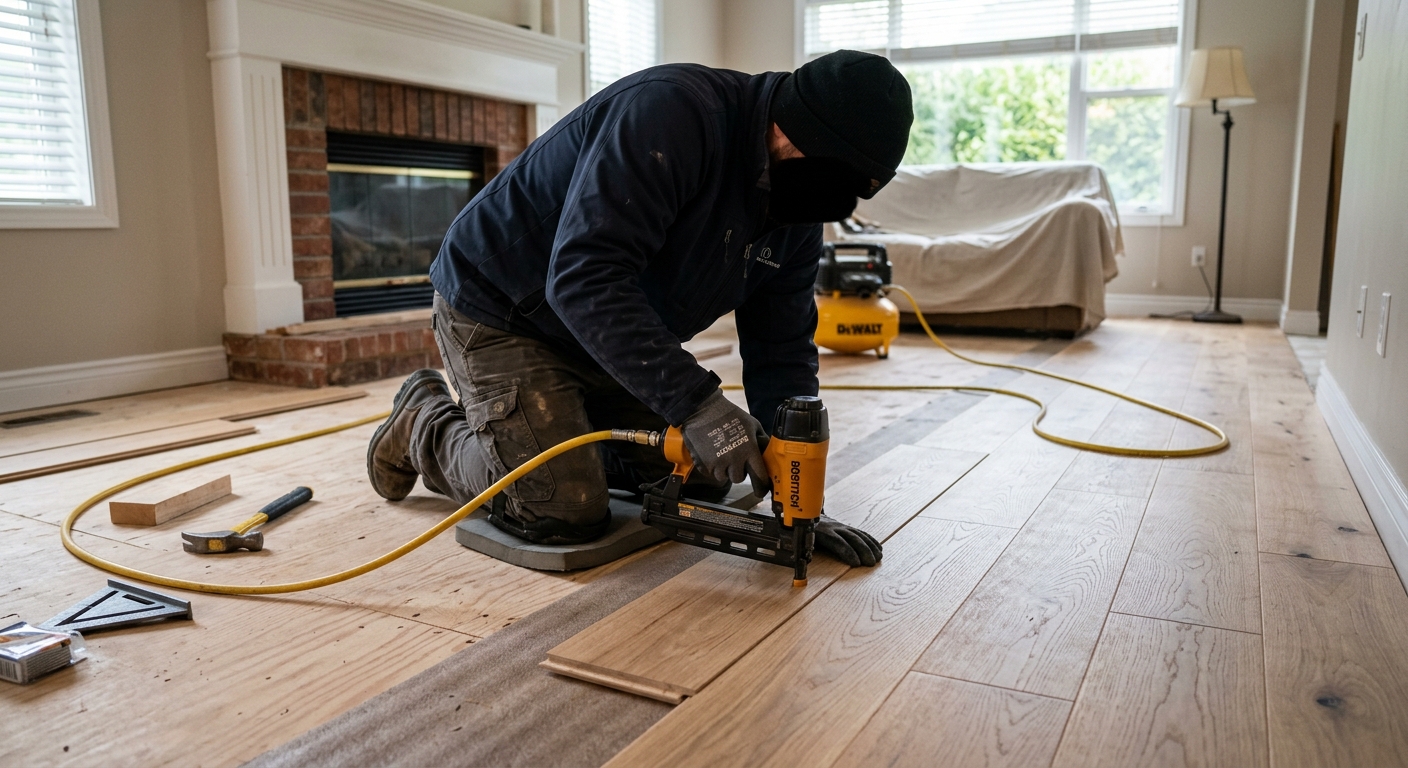
Flooring options and costs in Hope
Hope is a small, fast-changing community in the Lower Mainland–Southwest where flooring choices are shaped as much by moisture as by style. With 6,686 residents in the 2021 Census and about 48.0% of homes built before 1981, many properties in town have older subfloor layers that may need levelling, patching, or even resurfacing before you can install new flooring. That prep work is a common reason your quote can change after the contractor assesses the plywood or concrete condition.
In the Hope area, the wet, marine climate means indoor humidity swings in winter and shoulder seasons. Concrete slabs and below-grade areas can also show moisture wicking, even when the slab looks “dry.” For that reason, solid hardwood is usually best kept to above-grade rooms with careful humidity control and proper expansion gaps. Engineered hardwood and luxury vinyl plank (LVP) are typically better performers where you might see minor temperature swings or occasional humidity variation. Labour availability in the Lower Mainland–Southwest can also tighten up around peak seasons, which keeps installation pricing fairly firm.
In town, trades often see steady demand around the Fraser Valley corridor and the older residential pockets near downtown Hope, where homeowners are updating aging main-floor assemblies and finishing basements. Next, use the table to compare realistic material cost bands so you can ask for apples-to-apples quotes.
| Type |
Best Room |
Moisture Resistance |
Lifespan |
Price per sq ft |
| Solid hardwood (nail-down, above grade only) |
Main living areas (above grade) |
Low to moderate (sensitive to humidity) |
25–60 years |
$9 – $18 |
| Engineered hardwood (float or glue, above + on-grade) |
Main floor and bedrooms |
Moderate to good (layered construction) |
15–30 years |
$9 – $17 |
| Laminate (click-lock, above-grade) |
Bedrooms, living rooms (above grade) |
Low to moderate (not ideal for wet areas) |
10–20 years |
$4 – $10 |
| Luxury vinyl plank / LVP (waterproof, any level) |
Kitchen, bathrooms (with correct details), finished basements |
High (waterproof with correct installation) |
15–25 years |
$5 – $12 |
| Porcelain / ceramic tile |
Kitchen, bathroom, entries |
Very high (with proper grout and membrane) |
30–50+ years |
$10 – $20 |
| Carpet (broadloom or modular tile) |
Bedrooms and stairs |
Low (susceptible to moisture and spills) |
8–15 years |
$4 – $8 |
Prices are estimates only and vary by project scope, site access and material selection.
What affects the price of flooring in Hope
In Hope and across the Lower Mainland–Southwest, two quotes for the same room size can differ by roughly 30–50% when you look beyond the “flooring price” and into prep, moisture control, and labour. The biggest drivers are indoor humidity swings in a marine climate, the condition of older subfloors, and the fact that Greater Vancouver area labour is among the highest in Canada. When contractors measure unevenness or discover damaged plywood, the job becomes more about prep and patching than laying product.
Technically, solid hardwood expands and contracts with humidity, and it also isn’t the right choice for most basements or slab-on-grade areas where moisture wicking can occur. That’s why we typically recommend engineered hardwood or LVP in the areas most likely to see below-grade humidity. If you’re comparing bands, moving from laminate or LVP at $4 – $10 into tile at $10 – $20 can be justified when the room needs high water resistance or long-term durability.
Concrete examples I see in Hope: (1) A 600 sq ft main-floor update where the subfloor is crowned or has dips may require levelling compounds and additional fasteners, adding about $1–$3 per sq ft in practice. (2) A finished basement where the slab shows dampness often needs a proper moisture barrier system and sometimes floor-surface prep, pushing you toward waterproof LVP rather than solid wood. With nearly half the local housing stock built before 1981, these “hidden” subfloor realities are common enough to factor into your budget from day one.
| Price Factor |
Why It Matters |
Cost Impact |
| Room area in sq ft |
Material quantities and labour time scale with square footage |
Low room sizes often cost proportionally more due to setup and minimum charges |
| Subfloor condition — levelling or repair needed |
Older plywood and underlayment layers can be uneven or deteriorated |
Commonly adds about $1–$4/sq ft depending on repairs and levelling thickness |
| Moisture / below-grade install — rules out solid hardwood |
Humidity swings and moisture vapour affect material stability |
Engineered/LVP may cost more than laminate but reduces costly failures |
| Material choice — solid vs. engineered vs. LVP vs. tile |
Different layers and performance targets change both product and underlayment needs |
Solid hardwood often runs highest; tile and LVP land mid-to-high depending on grade |
| Removal and disposal of existing flooring |
Time, labour, and disposal fees vary by material and subfloor attachment |
Can add a meaningful flat fee plus hauling costs |
| Stair nosing / transitions |
Transitions are labour-intensive and require matching trim and profiles |
Often charged per step or per linear foot; increases total project cost |
| Radiant heat compatibility — limits material options |
Heat cycling can stress wrong product types |
May increase cost if you switch to approved engineered, LVP, tile or specific underlay |
| Installation method — float vs. glue-down vs. nail-down |
Different methods require different subfloor prep and labour time |
Glue-down usually requires tighter prep; nail-down needs stable above-grade conditions |
Permits & regulations in British Columbia
In British Columbia, the flooring installation itself usually does not require a building permit. You typically do not need a permit just to install flooring like hardwood, engineered wood, LVP, laminate, or tile when you’re working over existing, non-structural surfaces. However, permitting can come into play when the work touches electrical or structural systems.
Work that may require permits in BC: electrical permits for in-floor heating circuits (changing wiring, adding thermostats, or modifying electrical pathways), and any scope that involves substantial structural change—like significant subfloor reconstruction tied to load paths. If you’re doing moisture remediation that includes drilling, major membrane systems, or changes to plumbing/wet-area assemblies, ask your contractor to confirm whether any related trade permits apply.
Step-by-step: how a Hope homeowner should verify a contractor:
- Confirm their BC licence status (where applicable) by searching online for the contractor/business registration and licence details.
- Request a certificate of insurance (COI) showing general liability coverage and the correct business name.
- Ask for WSBC coverage documentation (clear proof they’re set up for workplace coverage where required).
- For condominiums: review the building rules on sound transmission (STC/IIC) and request written approval before installing hard flooring with any required underlay.
- Get the COI and coverage documents dated and ensure they’re valid for your project start date.
Best flooring for each room in your Hope home
Choosing the right flooring for Hope comes down to three real-life factors: moisture exposure, foot traffic, and how comfortable the room should feel in a wet marine climate. In living and dining areas, engineered hardwood is often the sweet spot—warm underfoot but more tolerant of humidity swings than solid wood. For bedrooms, you can go cozy with carpet for sound absorption and comfort, or choose engineered hardwood if allergies or maintenance are priorities.
In the kitchen, LVP or large-format porcelain tile usually wins. LVP’s waterproof surface handles spills and quick wipe-downs, which matters because Hope homes see winter tracking and frequent wet-foot traffic. In finished basements, LVP is the clear winner: it’s waterproof and can handle below-grade installs where moisture vapour issues rule out most solid hardwood and many laminate products. For bathrooms, porcelain or ceramic tile is the correct choice because it tolerates repeated wetting when paired with proper underlayment and grout/membrane details.
If your home uses radiant heating (increasing in new construction and some remodels), confirm compatibility before choosing materials. Most solid hardwood needs very specific specs over radiant, while tile, LVP and properly rated engineered products tend to be more straightforward. As a cost example: if you compare LVP around $5 – $12 versus tile at $10 – $20, tile can be worth the premium in bathrooms and entryways for longevity and water performance—while LVP is often the smarter value in basements where moisture vapour is the main concern.
| Room |
Best Material |
Why |
Moisture Risk |
Price Band per sq ft |
| Living / dining room |
Engineered hardwood |
Warm look and feel with better humidity tolerance than solid |
Low to moderate (depends on indoor humidity control) |
$9 – $17 |
| Master bedroom |
Carpet or engineered hardwood |
Carpet adds comfort and sound; engineered maintains warmth with easier cleanup than carpet |
Low |
$4 – $17 |
| Secondary bedrooms |
Laminate or engineered hardwood |
Laminate is budget-friendly; engineered offers a more resilient long-term finish |
Low |
$4 – $17 |
| Kitchen |
Luxury vinyl plank (LVP) or porcelain tile |
Waterproof surfaces handle spills and frequent cleaning |
Moderate (spills and wet tracking) |
$5 – $20 |
| Basement (finished) |
Luxury vinyl plank (LVP) |
Best performance on slab-on-grade and around humidity/vapour concerns |
High (below-grade moisture potential) |
$5 – $12 |
| Bathroom |
Porcelain / ceramic tile |
Durable, water-tolerant finish with proper membrane/grout details |
Very high |
$10 – $20 |
How to choose a flooring contractor in Hope
When you hire a flooring contractor in Hope, start with proof of who you’re actually dealing with and what protections are in place. In British Columbia, flooring installation itself often doesn’t trigger permits, but a professional contractor should still carry the right coverage. Ask for their liability insurance certificate (confirming the business name and dates), and request WSBC (workplace) coverage documentation where required. For licence verification, check the contractor’s business details and licence status through BC’s online resources, then compare it to what’s on their invoice and insurance paperwork.
Next, get 2–3 itemised written quotes so you can compare fairly. A proper quote breaks out labour, underlayment (if applicable), transitions/stair work, subfloor levelling/repair, moisture barrier/membrane if needed, and removal/disposal of existing flooring. Avoid lump-sum quotes that don’t explain what’s included. Read the scope for exclusions like moving furniture, reinstalling baseboards, door undercuts, or whether the contractor includes disposal and any waste haul-away fees.
Review warranty details too: workmanship warranty length and what it covers, plus the product manufacturer warranty (and whether it’s transferable if you sell). Payment matters: never pay more than about 10–15% upfront; hold back the remainder until the job is complete and the final cleanup is done. Finally, get a start date and completion estimate in writing.
- Confirm insurance COI matches the exact legal name on the contract.
- Request WSBC/coverage proof before work begins.
- Verify any applicable BC licence/registration using online checks.
- Get itemised labour + materials (no vague allowances).
- Ensure subfloor levelling/repair is included or clearly excluded.
- Confirm moisture barrier/membrane plan for basements/slab installs.
- Ask whether underlay is included and what R-value/spec it is.
- Confirm transition pieces and stair nosing are priced per step or per linear foot.
- Check if removal and disposal are included, including hauling.
- Confirm door trim/baseboard adjustments and undercutting are included.
- Review warranty terms in writing (workmanship + manufacturer).
- Use a payment schedule with a small upfront deposit and a final holdback.
Concrete red flags I see in the Hope market: contractors who won’t provide a dated COI; quotes that omit underlayment, levelling, or transitions while assuming “standard subfloors”; refusal to put start/completion dates in writing; vague “no responsibility for gaps/cupping” language when installing solid hardwood; and pressure to take large deposits up front without a signed scope.
Frequently asked questions — flooring in Hope
How do I compare flooring quotes?
In Hope and across the Lower Mainland–Southwest, the easiest way to compare is to line up the scope, not just the floor type. Ask every contractor to break out labour, material grade, underlayment, transitions (including stair nosing), and whether they include subfloor levelling/repair. Because many homes are older (48.0% built before 1981, Statistics Canada, 2021 Census), you should specifically request details on how they’ll address uneven plywood or any patches. For moisture-prone areas, require a written plan—especially for basements and slab-on-grade installs where solid hardwood is typically not recommended. If one quote lands in the laminate/vinyl range (for example, $4 – $10) and another is higher, verify what’s included: removals, levelling compounds, and moisture barriers can swing the real total.
Can I install flooring over existing tile in Hope?
Often you can, but it depends on how well the tile is bonded, how level it is, and what product you’re installing. Over ceramic/porcelain, click-lock laminate may work only if the tile surface is very flat and you use the right underlayment (some underlays are not suitable on hard, slick surfaces). For LVP, it can be successful when tile is stable and properly prepped, but you may need patching compounds to flatten grout lines to the manufacturer’s tolerances. For tile-to-tile updates, you’ll want to check for cracked or loose tiles first, then confirm if a membrane system is required. In Hope’s wet marine climate, the bigger risk is moisture trapped under assemblies; a good contractor will discuss moisture/vapour conditions before you cover anything permanently. A site visit is the only reliable way to confirm.
What is the best flooring for a high-traffic area in Hope?
For high-traffic areas in Hope—like main hallways, entries, and open living zones—look for durability and stability first. Engineered hardwood is a strong option in above-grade spaces because it handles normal humidity better than solid hardwood while still giving you the hardwood look. If you need waterproof performance or you expect frequent wet tracking, LVP is usually the most practical choice because it’s waterproof and easier to maintain. Carpet can work in bedrooms or lower-traffic zones, but it’s less forgiving for mud and wet shoes. Cost-wise, don’t compare only the “per sq ft” number: transitions, stair work, and subfloor prep often decide the final total. In many Hope projects, spending toward LVP (commonly in the $5 – $12 band) can be more cost-effective than tile in areas where you want warmth and quicker day-to-day cleanup.
How do I prepare my subfloor before new flooring?
Preparation starts with assessment: the contractor should check flatness, soundness, and any signs of moisture. For older Hope homes (48.0% built before 1981, Statistics Canada, 2021 Census), that often means identifying soft or uneven plywood, dealing with seams, and correcting dips with proper levelling compounds or patching systems. If the area is on-grade or below-grade, you’ll need a moisture plan; in those situations, solid hardwood is typically avoided because it doesn’t perform well with humidity and can’t be glued or floated over concrete the way layered products can. For click-lock laminate and LVP, subfloor flatness is critical to prevent joint separation or movement. Ask your contractor to describe what they’ll do—sanding vs. patching, whether they’ll install a moisture barrier, and what the tolerances are—before any product is delivered.
Is cork or bamboo flooring a good choice in Hope?
Cork and bamboo can be appealing for comfort and looks, but in Hope’s marine climate the key is performance under indoor humidity swings. Cork is generally dimensionally stable compared with some natural materials, and it provides softness underfoot; however, it’s not always as moisture-tolerant as LVP, especially over below-grade or slab-on-grade areas where vapour can rise. Bamboo can be stable when it’s engineered, but pure bamboo “solid” products still behave like other solid natural woods—so they’re sensitive to humidity and should usually be limited to above-grade applications with careful indoor conditions. If you’re set on these materials, ask for explicit installation guidance: whether it’s engineered, the underlayment requirements, acclimation steps, and whether the contractor tests moisture or recommends a vapour barrier. Practically, many Hope homeowners choose LVP (often $5 – $12) for basements because it’s waterproof and reduces the risk of expansion-related failures.
What is the difference between floating and glued-down flooring?
Floating flooring (common with click-lock laminate and some engineered systems) is installed without rigidly bonding the planks to the subfloor. Instead, it “floats” over an underlayment, relying on the locking joints and the underlay’s support. Glued-down flooring bonds the product to the subfloor using an adhesive, which can improve stability on some surfaces but requires the correct moisture conditions, surface prep, and an adhesive compatible with your specific product. In Hope, moisture and flatness matter: below-grade and slab-on-grade areas often push homeowners toward waterproof LVP that can tolerate vapour better, or toward engineered systems installed with the right method and moisture controls. For solid hardwood, nail-down is typical above grade, while glue-down solid hardwood approaches are often not recommended in conditions where humidity swings are significant. Always match the installation method to the manufacturer’s spec and your home’s moisture reality.