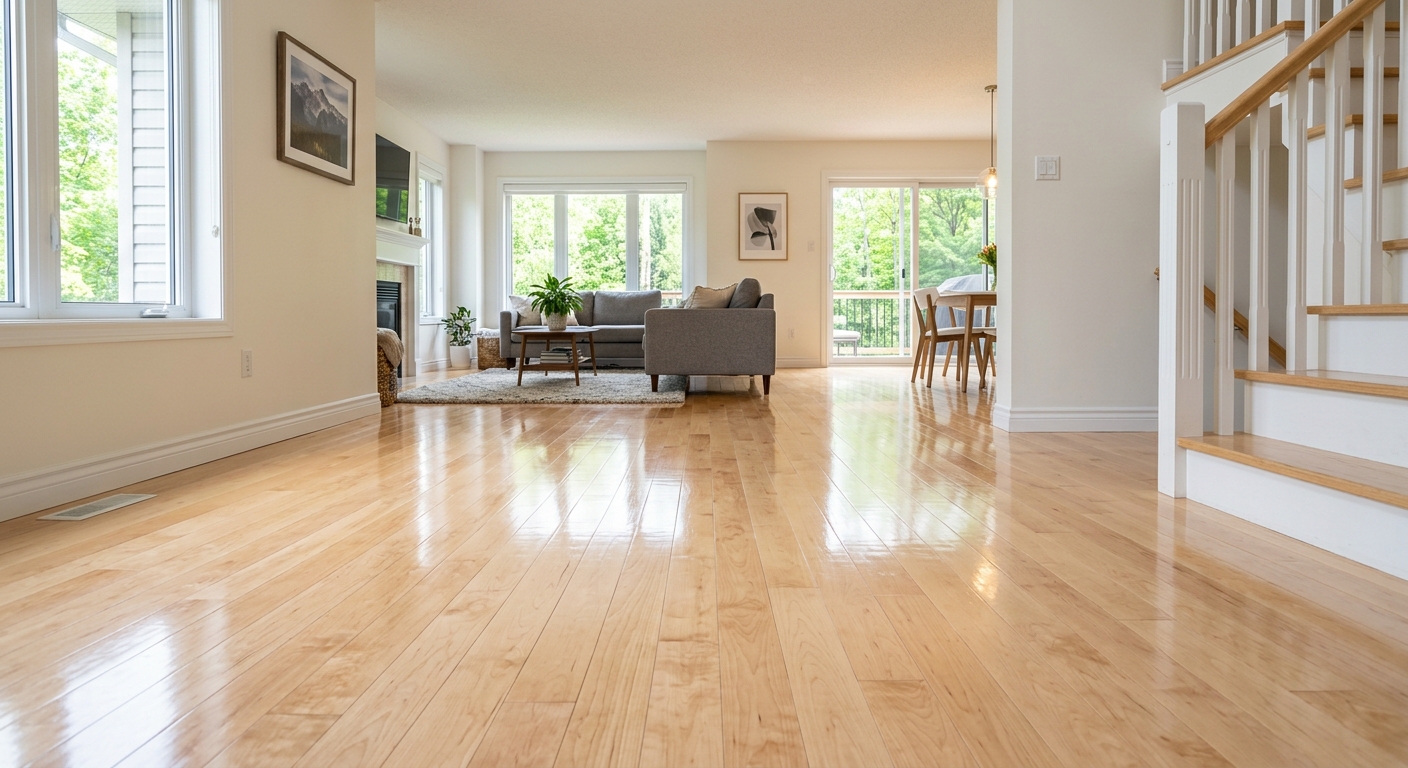
Flooring options and costs in Kamloops
Flooring costs in Kamloops depend heavily on what you install, where you install it (above grade vs. basement), and how much prep your subfloor needs. With 50.8% of Kamloops homes built before 1981 (Statistics Canada, 2021 Census), it’s common to find older crawlspaces and basements with uneven surfaces, older plywood, or previous patchwork that can’t be skipped. In many of these homes, levelling, grinding, or an OSB/underlayment upgrade is required before new flooring goes in—often adding roughly $2 to $4 per sq ft depending on flatness targets and whether repairs are required, not just skim levelling. Labour availability also varies by season; during the busier spring and early-summer stretches, trades tighten up and scheduling can influence the total price.
Kamloops sits in the Thompson–Okanagan, where dry winters and hot, sometimes smoky summers create noticeable indoor humidity swings. That matters because wood and laminate react to seasonal expansion, and basements can trap moisture even when the house feels “dry.” For below-grade spaces, engineered hardwood or luxury vinyl plank (LVP) is usually the practical choice, while solid hardwood is generally limited to above-grade installations. In neighbourhoods like Sahali and Westmount, we see strong demand for durable hard-surface flooring—partly because many homes have frequent family traffic and partly because moisture management becomes a predictable line item once you open up the subfloor.
Here are realistic installed cost ranges for common flooring choices in Kamloops, so you can compare quotes before you book site measurements.
| Type |
Best Room |
Moisture Resistance |
Lifespan |
Price per sq ft |
| Solid hardwood (nail-down, above grade only) |
Living / dining (above grade) |
Low to moderate (humidity swings) |
25–60 years |
$12 – $25 |
| Engineered hardwood (float or glue, above + on-grade) |
Living / hallways / bedrooms |
Moderate (handles seasonal movement better) |
20–40 years |
$14 – $28 |
| Laminate (click-lock, above-grade) |
Bedrooms / living (avoid below-grade) |
Low to moderate (surface water resistance varies) |
10–25 years |
$4 – $10 |
| Luxury vinyl plank / LVP (waterproof, any level) |
Kitchen / living / finished basement |
High (waterproof core + vinyl construction) |
15–30 years |
$6 – $14 |
| Porcelain / ceramic tile |
Kitchen / bathrooms |
High (with proper underlayment and grout) |
30+ years |
$15 – $30 |
| Carpet (broadloom or modular tile) |
Bedrooms / stairs |
Low (needs clean-up after spills) |
7–15 years |
$5 – $12 |
Prices are estimates only and vary by project scope, site access and material selection.
What affects the price of flooring in Kamloops
Even for “the same” flooring, quotes can differ by 30–50% across the Thompson–Okanagan and British Columbia because the work isn’t just laying material—it’s subfloor evaluation, moisture handling, levelling, and finishing details. In Kamloops, many homes are older (and half-built before 1981 in the wider local profile), so contractors often factor in repairs before anything else goes down. Add in Thompson–Okanagan’s dry winters, hot summers, and occasional smoky spells, and you get humidity swings that can expose weak subfloors or inadequate underlay systems.
The biggest technical driver is moisture and temperature movement. Solid hardwood expands and contracts with indoor humidity and can’t be safely installed over concrete or used in basements where moisture vapour is more likely. That’s why engineered hardwood and luxury vinyl plank (LVP) are often priced higher than laminate but can end up cheaper than callbacks and failure repairs. Colder pockets and radiant heating trends also influence scope: radiant heating is increasingly common in new builds, and it typically pairs better with engineered wood, tile, and quality LVP—while many solid hardwood products (and some laminate) are limited by manufacturer installation requirements.
Concrete examples from local jobs: first, if your living-room subfloor needs levelling, it may add about $1 to $4 per sq ft, depending on how far out it is and whether grinding/patching is feasible. Second, below-grade areas often require an appropriate system (vapour control primer/membrane where specified), which raises material and labour costs compared with above-grade installs that don’t need moisture mitigation. The result: a basement LVP can compete well against solid hardwood that’s “restricted,” while tile can cost more upfront (often aligned with the $15 to $30 per sq ft band) but may eliminate future replacement if moisture conditions are addressed correctly.
| Price Factor |
Why It Matters |
Cost Impact |
| Room area in sq ft |
More floor means more product, underlay, and labour time. |
Direct driver (often 40–70% of the total) |
| Subfloor condition |
Uneven surfaces require levelling/repair to meet installation flatness. |
Typically +$1 to $4 per sq ft when corrections are needed |
| Moisture / below-grade install |
Moisture vapour can break down materials and adhesives. |
Often +materials like primers/membranes; solid hardwood usually ruled out |
| Material choice |
Solid vs. engineered vs. LVP vs. tile affects both stability and complexity. |
Switching materials can shift project totals by thousands |
| Removal and disposal of existing flooring |
Demo time, hauling, and sometimes asbestos-risk procedures can apply. |
Can add several hundred to over a thousand depending on scope |
| Stair nosing / transitions |
Edges, nosings, and mouldings are labour-intensive and used per step/linear foot. |
Frequently charged separately (per step/linear foot) |
| Radiant heat compatibility |
Not every flooring product can tolerate radiant cycling. |
May add cost if you must choose engineered wood/LVP/tile rated for radiant |
| Installation method |
Float, glue-down, and nail-down require different prep and handling. |
Glue-down and nail-down often increase labour and adhesive-related materials |
Permits & regulations in British Columbia
In British Columbia, installing flooring itself typically does not require a building permit. However, associated work can trigger permit or code requirements depending on what’s being altered. For example, if the project involves electrical work—such as installing or modifying in-floor heating circuits, updating wiring, or adding new circuits—that work may require an electrical permit. If you have structural subfloor repair (especially where joists or load-bearing elements are altered), you may need approvals and inspections through the proper channels.
For condos, the rules are often more about the building’s internal requirements than government permits. Many corporations restrict hard flooring in suites due to sound transmission. That usually means you’ll need to follow the declaration and board-approved specs, including approved underlay systems and sometimes minimum STC/IIC performance targets for hard-surface floors.
Step-by-step for Kamloops homeowners: (1) Ask for the contractor’s BC licence number and verify it through the applicable online contractor registry for their trade category (if they’re registered for their scope). (2) Request a certificate of liability insurance and confirm the coverage amounts match the job size. (3) Ask for proof of WSIB/WCB coverage and a clearance letter where required, then confirm it’s current. (4) Make sure the quote clearly states what’s included (demo, levelling, vapour control where needed, and transitions) so there are no surprises during scheduling.
Best flooring for each room in your Kamloops home
Choosing the right floor for Kamloops is about matching the material to moisture exposure, traffic, and comfort—especially with Thompson–Okanagan humidity swings and the reality of older housing stock. For living and dining areas, engineered hardwood or a high-quality laminate can deliver warmth and a finished look without the same humidity sensitivity as solid wood. In a master bedroom, you can go either way: carpet for softer comfort and sound absorption, or engineered hardwood for an easier-clean, allergy-friendly surface.
In kitchens, waterproof luxury vinyl plank (LVP) is a top choice because spills and splashes are common and cleanup is straightforward. If you prefer a premium, long-lasting finish, porcelain/ceramic tile is excellent too, though it’s more labour-intensive to install and can raise the total cost into the tile band. In finished basements, LVP is usually the clear winner because it tolerates below-grade conditions and moisture vapour better than most laminate and solid hardwood. Bathrooms should be porcelain or ceramic tile only, since they’re designed for repeated wetting and drying when installed with the correct underlayment and grout system.
Radiant heat is increasingly popular in British Columbia new construction, and it typically works best with products rated for radiant systems—often engineered wood, tile, and certain LVP lines. Here’s a practical example: if solid hardwood is quoted at the upper end of the hardwood band (for example, $12 to $25 per sq ft), but your basement is included, that option may be rejected or require extra moisture mitigation. Switching to LVP can keep your budget closer to the $6 to $14 per sq ft range while avoiding costly callbacks.
| Room |
Best Material |
Why |
Moisture Risk |
Price Band per sq ft |
| Living / dining room |
Engineered hardwood |
Warm feel with better dimensional stability than solid wood. |
Low to moderate (humidity swings affect movement, not standing water) |
$14 – $28 |
| Master bedroom |
Carpet or engineered hardwood |
Carpet adds comfort and sound reduction; engineered hardwood is easy to maintain. |
Low |
$5 – $14 |
| Secondary bedrooms |
High-quality laminate or LVP (if there are spill concerns) |
Durable, family-friendly options with good value. |
Low to moderate |
$4 – $14 |
| Kitchen |
Luxury vinyl plank (LVP) or porcelain tile |
Water resistance and easier cleanup for daily spills. |
Moderate to high (wet mess risk) |
$6 – $30 |
| Basement (finished) |
LVP (waterproof) |
Handles below-grade moisture better and reduces failure risk vs solid. |
High (vapour and occasional leaks) |
$6 – $14 |
| Bathroom |
Porcelain / ceramic tile |
Built for wet areas with long-term performance. |
High |
$15 – $30 |
How to choose a flooring contractor in Kamloops
Start with licensing and coverage, then move to process and paperwork. In British Columbia, ask for the contractor’s trade licensing info for their scope, and request a current certificate of liability insurance showing they can cover site damage. Next, verify WSIB/WCB coverage: ask for proof and a clearance letter where applicable for the workers on your job. If a contractor won’t provide documents or tries to “explain it away,” that’s usually a sign you’ll pay later through delays, extra charges, or workmanship disputes.
Get 2–3 itemised written quotes, not lump sums. You want a breakdown that separates: labour, materials, underlay/primers/membranes, levelling compounds (if needed), stairs/transitions, and removal/disposal. Carefully check what’s excluded (for example, moving appliances, subfloor repairs beyond patching, or haul-away of heavy debris). Also confirm whether permits (when required for related electrical or in-floor heating) and inspections are included or excluded.
Warranty matters twice: the workmanship warranty (how long they stand behind installation) and the manufacturer warranty (how long the product lasts and what conditions must be met). Ensure the warranty process is clear and confirm whether it’s transferable if you sell the home.
For payment schedule, never pay more than 10–15% upfront. Hold back a portion until the job is complete and you’ve done a final walk-through for transitions, spacing, and finish quality. Timeline is also critical in Kamloops—ask for a start date and completion estimate in writing so you’re not stuck waiting on materials or subfloor prep.
- Ask for their BC licence/registration details for the work they’re quoting.
- Request certificate of liability insurance and confirm coverage is active.
- Verify WSIB/WCB coverage with proof and clearance where applicable.
- Get quotes with labour and materials itemised separately.
- Confirm subfloor levelling level targets and whether repairs are included.
- Ask how they manage moisture (primers/vapour control/membranes) for basements.
- Ensure disposal/hauling is stated (tonnage limits and fees vary).
- Check stair nosings and transitions are priced per step or linear foot.
- Ask who moves heavy furniture/appliances and whether it’s included.
- Review warranty terms for both workmanship and product; confirm transferability.
- Confirm payment schedule (keep 85–90% until substantial completion).
- Get start date and completion date in writing with a realistic material lead time.
Red flags I see with flooring contractors in Kamloops: they won’t show proof of insurance/coverage; they provide only a lump-sum number without specifying levelling or moisture prep; they dismiss basement moisture concerns for solid hardwood or laminate; they avoid answering product warranty questions; and they ask for large upfront payments (well beyond 10–15%) before any measurable prep starts.
Frequently asked questions — flooring in Kamloops
Do I need to level my subfloor first?
Often, yes—especially in Kamloops homes built before 1981, where older plywood, past patching, or uneven joists are common (Statistics Canada, 2021 Census). If the floor isn’t flat enough, you can get gaps in click-lock laminate, hollow spots under LVP, and squeaks that show up fast after installation. For tile, the tolerance is even tighter, and unevenness can lead to cracked grout or lippage. A contractor should measure flatness before quoting changes; if levelling is required, that usually adds about $1 to $4 per sq ft depending on whether it’s grinding, patch repair, or self-levelling compounds. That prep step is one reason two quotes for the “same” floor can differ significantly.
What's the most durable flooring for pets and kids?
For most families in Kamloops, waterproof LVP is the safest “durable and forgiving” choice because it handles spills and everyday impact without the humidity sensitivity of solid wood. It also cleans up quickly, which matters during mud-season tracking and summer smoke-related dust. If you’re more budget-focused, laminate can work above grade, but I usually recommend LVP when you have frequent accidents or you’re considering a basement install. Carpet is comfortable and hides wear, but it stains more easily and needs faster cleanup to avoid odours. Pricing-wise, LVP commonly lands in the $6 to $14 per sq ft range, while durable tile can be higher (often $15 to $30 per sq ft) but is extremely resilient when installed correctly.
How do I choose flooring for humidity in Kamloops?
Kamloops humidity swings—dry winters and hot, sometimes smoky summers—mean wood movement is real, even when a home “feels comfortable.” That’s why solid hardwood is typically restricted to above-grade installations and why it’s not recommended for basements or on concrete where moisture vapour may be present. Engineered hardwood and quality LVP tolerate seasonal movement far better, and LVP is also waterproof for minor spills. If you have an older home with a basement, ask the contractor how they’ll manage below-grade moisture (primer/membrane where needed) before choosing materials. In radiant heating homes common in British Columbia new construction, verify the product is radiant-compatible as part of the humidity and temperature-cycle plan.
Do condos restrict hard flooring?
Yes, often. In British Columbia condominiums, restrictions are frequently set by the building’s declaration and board rules, not by a blanket provincial rule. Hard flooring can be restricted or required to meet specific sound transmission performance (STC/IIC), and the corporation may require an approved underlay system. That’s why you should check your condo’s documents and request board approval in writing before installing hardwood or tile on upper floors. Practically, this also affects your quote: the underlay cost and install method may change, and some “basic” products that are fine for a single-detached home may not comply. If your quote doesn’t mention sound underlay or approval steps, ask before you sign.
How do I compare flooring quotes?
Compare quotes like an installer would: itemised scope first, then unit pricing. Make sure labour and materials are separated, and that the quote includes everything that impacts finish quality—subfloor prep/levelling, underlay or membranes, moisture mitigation, stair nosing, transitions, and removal/disposal. Two quotes that both list “engineered hardwood” can still differ because one may include levelling compounds or vapour control while the other assumes your subfloor is already flat and dry. Also compare warranty terms: workmanship coverage length and whether the manufacturer warranty depends on installation method. Finally, confirm payment schedule and timeline. If one quote asks for more than 10–15% upfront or won’t clarify inclusions, it’s a warning sign. Use local price bands as a sanity check (for example, tile often sits around $15 to $30 per sq ft; LVP commonly $6 to $14).
Can I install flooring over existing tile in Kamloops?
Sometimes, but it depends on tile condition and the flooring you’re installing. In Kamloops, existing tile can be a stable base, but you must address height transitions, grout lines, and any loose or cracked tiles. For LVP and laminate, the subfloor must be flat—if the tile has high ridges or movement, you may still need grinding or a flat overlay. For tile-to-tile, it may be possible in select scenarios, but proper thinset and surface prep become critical, and many contractors prefer not to stack tile without a clear system. Moisture is also part of the decision: if you suspect below-grade vapour issues, stacking layers can trap problems. The contractor should do a site assessment and explain the prep steps, not just say “yes” or “no.”