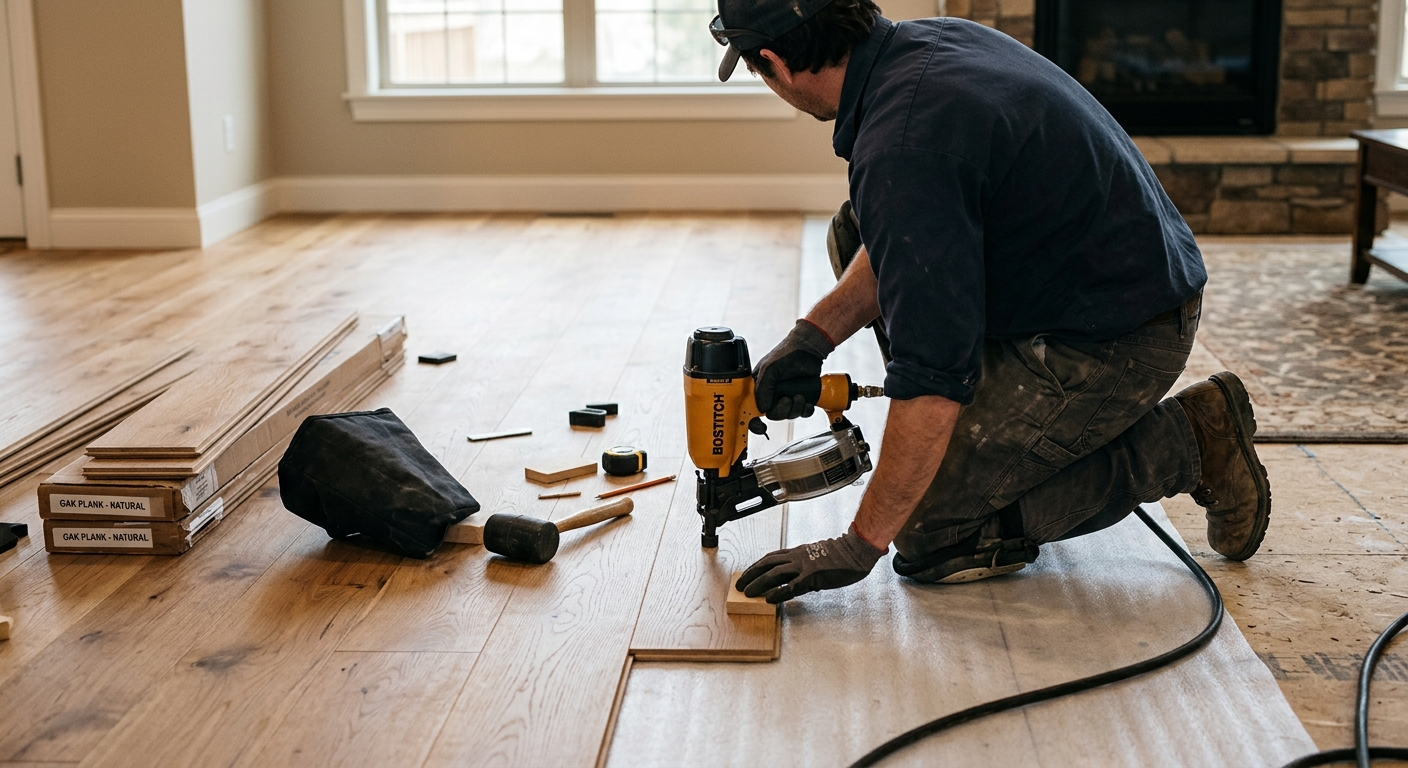
Flooring options and costs in Lake Country
Flooring in Lake Country is a little different than what you may see in the Lower Mainland or on the coast. With 28.3% of homes built before 1981, many properties arrive with older subfloors, uneven sections, and past renovations that need levelling or repair before any new finish goes down. At the same time, Lake Country owners are typically balancing comfort and value in a market where 78.5% of households own their homes (Statistics Canada, 2021 Census), so most projects are planned to last.
In the Thompson–Okanagan, dry winters and hot, sometimes smoky summers create noticeable indoor humidity swings. Those seasonal changes can move solid wood, especially above a crawlspace or in rooms that experience wide temperature cycling. The cost picture is also shaped by the region’s frequent below-grade areas and crawlspaces: moisture management is a major cost driver. That’s why, for basements and any on-grade spots that face moisture risk, contractors commonly recommend engineered hardwood or luxury vinyl plank (LVP) rather than solid hardwood. For new builds and remodels where radiant heat is used, engineered wood, tile, and quality LVP are often the best practical choices because they’re more dimensionally stable under temperature cycling.
In Lake Country, trade demand is especially steady around the Parkway / Creekside area and the newer lake-adjacent developments, where remodels and new builds often run together and the schedule can influence labour availability. Use the table below to compare typical installed ranges for the materials most homeowners ask for in Lake Country, BC.
| Type |
Best Room |
Moisture Resistance |
Lifespan |
Price per sq ft |
| Solid hardwood (nail-down, above grade only) |
Living / dining (stable indoor climate) |
Low to moderate (not for basements or concrete) |
25–60 years |
$12–$25 |
| Engineered hardwood (float or glue, above + on-grade) |
Living areas, hallways, bedrooms |
Moderate to high (tolerates humidity swings better) |
20–40 years |
$12–$25 |
| Laminate (click-lock, above-grade) |
Bedrooms, living areas (dry rooms) |
Low to moderate (seams can be vulnerable) |
10–25 years |
$4–$10 |
| Luxury vinyl plank / LVP (waterproof, any level) |
Kitchen, finished basement, main floor with risk |
High (waterproof core; handles spills well) |
15–30 years |
$6–$14 |
| Porcelain / ceramic tile |
Kitchen, bathroom, entries |
High (water-ready surfaces) |
25–50 years |
$15–$30 |
| Carpet (broadloom or modular tile) |
Bedrooms, stairs (comfort) |
Low to moderate (not for wet zones) |
8–15 years |
$4–$12 |
Prices are estimates only and vary by project scope, site access and material selection.
What affects the price of flooring in Lake Country
Even when you’re comparing the same room size and similar product grades, quotes for flooring in the Thompson–Okanagan can vary by 30–50% across British Columbia. The biggest reasons are usually technical: how much moisture management and subfloor prep is needed, how flat the existing surface is, and how much labour time the install actually takes with Lake Country’s mix of older homes and below-grade spaces. Disposal and hauling also add up locally, especially when crews must remove glued-down flooring layers or damaged subfloors.
Technically, indoor humidity swings in Lake Country (dry winters, hot summers, and occasional smoke impacts) create expansion and contraction pressure on materials. Solid hardwood expands and contracts with humidity, and it can’t be glued or floated over concrete and performs poorly in basements. Engineered hardwood and luxury vinyl plank (LVP) tolerate humidity swings and common minor slab moisture far better. In many colder pockets of BC where radiant heating is present, solid hardwood is often limited or ruled out by product warranties, which nudges choices toward engineered wood, tile, or LVP that are rated for radiant systems.
Older housing stock is another cost driver. With 28.3% of homes built before 1981 (Statistics Canada, 2021 Census), homeowners often run into subfloor levelling, patching, or replacing worn underlay layers. In practical terms, subfloor repair and levelling commonly add about $1–$4 per square foot before any finish material. For example, if your total budget is anchored to laminate at roughly $4–$10 per square foot, but the subfloor needs grinding and self-levelling, the final installed cost can drift toward the higher end of that range. Similarly, choosing LVP at a typical $6–$14 per square foot can be more economical than tile in a basement if the install avoids extensive membrane prep or if the surface flatness is borderline.
| Price Factor |
Why It Matters |
Cost Impact |
| Room area in sq ft |
Directly drives materials, labour time, and minimum job charges |
Usually scales linearly; small jobs can cost more per sq ft |
| Subfloor condition |
Levelling/repair is required for smooth installs and warranty compliance |
Often adds about $1–$4 per sq ft in older homes |
| Moisture / below-grade install |
Determines whether solid wood can be used and what membranes/primers are needed |
Can shift you from solid hardwood to engineered or LVP |
| Material choice |
Solid vs engineered vs LVP vs tile differ in underlayment and prep demands |
Moves installed pricing into different bands |
| Removal and disposal of existing flooring |
Extra labour for tear-out, grinding, and hauling fees |
Often a noticeable add-on, especially with glued-down layers |
| Stair nosing / transitions |
Transitions and staircase detailing are labour-intensive and priced per step/linear foot |
Commonly increases cost more than homeowners expect |
| Radiant heat compatibility |
Limits what products can be installed and affects underlayment selection |
May raise material costs and reduce “cheap” options |
| Installation method |
Float vs glue-down vs nail-down changes subfloor requirements and labour time |
Can add days of work on larger prep-heavy projects |
Permits & regulations in British Columbia
In British Columbia, installing flooring by itself typically does not require a building permit. Replacing flooring surface materials (hardwood, engineered wood, LVP, laminate, carpet, or tile) is generally considered non-structural finish work and is handled as part of normal contractor scope.
However, associated work may trigger permits. If the project involves electrical or in-floor heating modifications—such as installing or altering in-floor heating circuits—that can require electrical permitting. Similarly, structural subfloor repair, major reconstruction, or any work that affects structural components may require the appropriate permit pathway depending on scope.
For condominiums and multi-unit buildings, permits aren’t always the issue—building rules often are. Many condo corporations restrict or require specific underlays on upper floors to meet sound transmission expectations (commonly managed through STC/IIC considerations). Always review the condo declaration and request approval in writing before installing hard flooring (hardwood or tile) on upper-level units, and use the underlay specified or approved by the corporation.
To verify a contractor in Lake Country, start by confirming their business registration and licensing status where applicable, then ask for a current certificate of liability insurance. Next, request proof of WCB/WSIB coverage (workers’ compensation coverage for employees) so you’re not left responsible for workplace claims. When available, ask the contractor to provide a clearance letter or documentation acceptable to you and the building manager. Keep copies of everything in your project file.
Best flooring for each room in your Lake Country home
Choosing the right flooring by room matters in Lake Country because you’re dealing with both traffic and moisture differences across your home. In living and dining areas, engineered hardwood or a high-quality laminate is a strong balance of warmth and day-to-day durability. The Thompson–Okanagan climate’s humidity swings mean engineered wood typically performs better than solid hardwood in homes where humidity isn’t perfectly controlled, especially near exterior doors or over crawlspaces.
For bedrooms, carpet is often the best comfort and sound solution, particularly if you want softer feel and better acoustics. If you prefer a hard surface, engineered hardwood is still a reliable option. In kitchens, the moisture and spill reality of daily life usually points to luxury vinyl plank (LVP) or large-format porcelain tile. For finished basements, LVP is usually the clear winner: its waterproof construction tolerates seasonal humidity, minor vapour concerns, and occasional spills far better than solid wood and most laminates. Bathrooms should be porcelain or ceramic tile only because of water exposure at sinks, showers, and bath fixtures.
Radiant heat compatibility is increasingly common in British Columbia renovations and new construction. Tile and many rated engineered wood and quality LVP products are typically compatible when installed with the right underlay and follow product instructions. A key example: if tile is at $15–$30 per square foot, but you choose LVP around $6–$14 per square foot for a basement rec room, the price difference can be justified when it reduces moisture-risk prep and avoids the harsher maintenance of grout-heavy surfaces.
| Room |
Best Material |
Why |
Moisture Risk |
Price Band per sq ft |
| Living / dining room |
Engineered hardwood |
Warm look with better tolerance for humidity swings than solid wood |
Low to moderate (depends on proximity to exterior doors/crawlspaces) |
$12–$25 |
| Master bedroom |
Carpet or engineered hardwood |
Comfort and sound control (carpet) or easy maintenance (engineered) |
Low |
$4–$25 |
| Secondary bedrooms |
Laminate or carpet |
Laminate offers durability; carpet adds comfort for daily use |
Low |
$4–$12 |
| Kitchen |
Luxury vinyl plank (LVP) or porcelain tile |
Easy cleaning and strong spill resistance for everyday life |
Moderate to high (spills and frequent wet wipe-downs) |
$6–$30 |
| Basement (finished) |
Luxury vinyl plank (LVP) |
Waterproof performance and tolerance for below-grade conditions |
High (vapour and occasional water events are possible) |
$6–$14 |
| Bathroom |
Porcelain / ceramic tile |
Designed for water exposure with a long service life |
Very high |
$15–$30 |
How to choose a contractor in Lake Country
When you hire a flooring contractor in Lake Country, British Columbia, start with proof—not promises. Ask for their current business credentials (as applicable), a certificate of liability insurance, and workers’ compensation coverage for their employees (WCB/WSIB coverage). You can request the documents directly before signing anything. If a contractor can’t produce insurance and coverage certificates, treat that as a major warning sign. Also ask whether they can provide a clearance letter or documentation acceptable to your building manager or strata.
Get 2–3 itemised written quotes instead of one lump-sum number. The best quotes break labour and materials apart (including underlay, membranes, levelling compounds, fasteners, stair nosing, and transitions). Read the scope carefully: confirm what’s included for subfloor prep, how existing flooring removal is handled, whether disposal fees are included, and whether any permit-related steps (like electrical coordination for heated floors) fall under their responsibility.
Warranty matters too. Ask for the workmanship warranty length, who provides it, and whether it’s transferable to new homeowners. Confirm the product manufacturer warranty requirements—some warranties require specific moisture testing, proper underlay, or approved installation methods. For payment, never pay more than 10–15% upfront; use a holdback until the job is complete and you’ve confirmed clean edges, proper transitions, and full area coverage. Finally, request the start date and completion estimate in writing so you can plan around Lake Country weather and material lead times.
- Provide insurance and WCB/WSIB documentation before you book materials.
- Offer an itemised quote with labour and materials line items.
- Confirm what level of subfloor flatness they measure and how they correct deficiencies.
- State whether moisture testing and primers/membranes are included when needed.
- List disposal fees and confirm what must be removed by you vs them.
- Include stair nosing and transition pricing separately (per step or per linear foot).
- Specify underlay/membrane products by name and thickness.
- Confirm the installation method (float vs glue-down vs nail-down) matches the product.
- Detail floor expansion gap plan near doorways and fixed cabinets.
- Provide a written workmanship warranty and what it covers.
- Agree on a payment schedule with a holdback until completion.
- Schedule a site visit for measurements and before-start confirmation.
Concrete red flags I’ve seen in Lake Country: (1) a contractor who won’t provide insurance/WCB proof, (2) quotes that omit disposal or stair/transition costs, (3) “we’ll just level it later” without listing materials or costs, (4) pushing solid hardwood for basements despite moisture risk, and (5) no written warranty terms or unclear payment expectations.
Frequently asked questions — flooring in Lake Country
Hardwood vs laminate vs vinyl plank — which is best?
In Lake Country and across the Thompson–Okanagan, the “best” choice depends on moisture exposure and how much humidity swings your home experiences. Solid hardwood looks excellent, but it’s mainly an above-grade option; it can move with seasonal humidity and it generally isn’t the right call for basements. Laminate is budget-friendly (often around $4–$10 per square foot), but seams can be vulnerable if spills or damp conditions occur. Luxury vinyl plank (LVP) is usually the most forgiving: it’s waterproof and handles hot/smoky summers and winter dryness better in real-life households, especially in kitchens and finished basements. If you want the warm “wood” look with better stability, engineered hardwood is also a strong middle ground for living areas.
What flooring is best for a Lake Country basement?
For a basement in Lake Country, LVP is often the practical winner. The region’s moisture management is a major cost driver because below-grade spaces can have vapour movement and occasional damp conditions, and many older homes have crawlspaces or basements with uneven surfaces. LVP’s waterproof core helps it handle spills and minor moisture events far better than solid hardwood and most laminate. It also tends to be more forgiving when the subfloor isn’t perfectly flat, though proper prep still matters for an appearance-quality install. If your basement has radiant heat or you’re planning renovations, many quality LVP products are designed to be compatible when installed with the manufacturer’s requirements.
Can I install hardwood over concrete?
Often, you should not install solid hardwood directly over concrete. Solid nail-down hardwood is typically intended for above-grade subfloors with appropriate moisture and humidity conditions, and it isn’t meant for concrete slabs. Over concrete, engineered hardwood is commonly the more suitable option because the construction is more dimensionally stable, and installers can follow approved moisture-mitigation steps (like primers or membranes) when needed. If you’re considering tile or LVP for the area, those are naturally more forgiving with slab conditions. For any wood-on-concrete situation in British Columbia, the contractor should evaluate moisture risk and follow the flooring manufacturer’s installation instructions, especially in older lake-area houses where slab cracks or past repairs are more common.
How long does flooring installation take?
Timeline depends on room size, product type, and prep. In Lake Country, a straightforward above-grade click-lock laminate or LVP install in one average room can often be finished in roughly 1–2 days, assuming the subfloor is already flat and dry. Anything that requires grinding, levelling compound, or moisture mitigation can add time. Stair work, transitions, and undercutting door jambs typically add another half-day to a full day depending on complexity. Tile and projects with lots of removal/disposal usually take longer, commonly several days beyond the surface install because of layout and curing times for adhesives/levelers. The best approach is to request a written schedule that includes prep, install, and finish/clean-up dates.
What flooring works with radiant heat?
Radiant heat compatibility is important in British Columbia, and the Thompson–Okanagan’s colder months make in-floor heat a common comfort upgrade. In general, tile is very compatible because it conducts heat well, and many quality LVP and engineered wood products are also rated for radiant systems when installed with the correct underlay and adhesive methods. Solid hardwood is more often restricted because the heat and seasonal temperature cycling can drive excessive movement, and many solid products aren’t covered for radiant installation. If you’re installing over radiant, always follow the product’s radiant-specific instructions and verify the system is operating within the manufacturer’s recommended temperature range.
Engineered vs solid hardwood — what's the difference?
Solid hardwood is one piece of real wood throughout, and it tends to respond more noticeably to humidity changes. Engineered hardwood is built in layers (a stable core with a real wood veneer on top). In Lake Country’s climate—dry winters, hot summers, and indoor humidity swings—engineered hardwood typically performs better because it’s more dimensionally stable. Solid hardwood is usually best for above-grade areas with consistent indoor conditions, while engineered hardwood can often be used above-grade and on-grade applications (and sometimes over certain subfloors) when installed correctly. Pricing overlaps in local ranges; you might see engineered hardwood in the $12–$25 band similar to solid, but the difference is often in which spaces you can safely use it and how much moisture-prep risk you reduce.