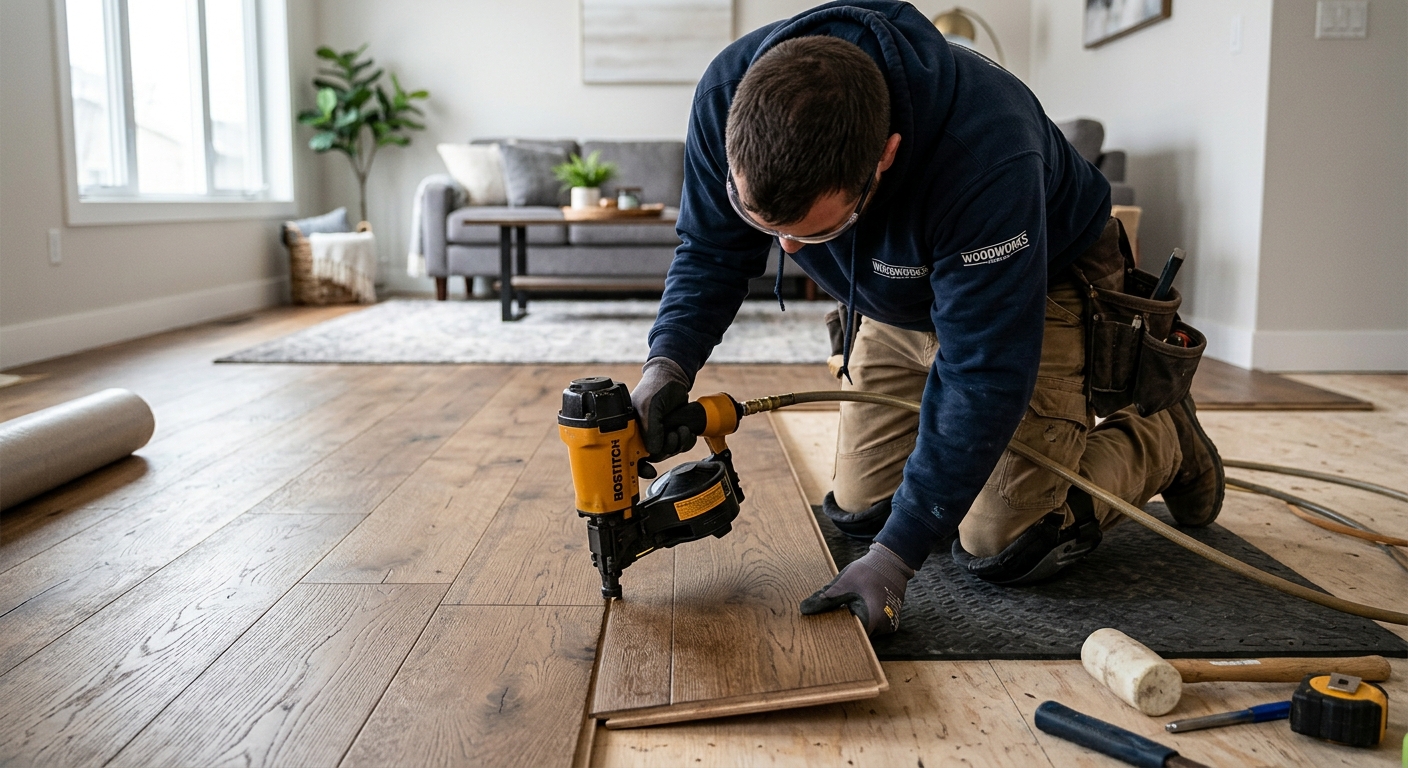
Flooring options and costs in North Kamloops
Flooring costs in North Kamloops tend to feel higher than in larger cities, mostly because many homes here are older and require more prep work before anything new can go down. With a population of 10,995 (Statistics Canada, 2021 Census), local contractors are busy and scheduling can affect the “installed” side of pricing. In Thompson–Okanagan, homes built decades ago frequently have uneven subfloors and past renovation patches, which often means levelling, grinding, or an OSB underlay step before you can install new hardwood or tile. That kind of prep can add roughly $1–$4 per square foot, depending on how far out of flat the surface is.
North Kamloops also sees dry winters and hot, sometimes smoky summers, which creates indoor humidity swings. In crawlspaces and basements (common in the area), that humidity change is a big reason moisture management becomes a cost driver. Solid hardwood can expand and contract with humidity and is a poor fit for basements or any below-grade concrete. For those areas, engineered hardwood and luxury vinyl plank (LVP) usually cost more upfront than laminate, but they tolerate seasonal movement and minor moisture far better. Many homeowners in North Kamloops—especially around Juniper Ridge and the older housing pockets near the downtown area—notice that the “same room size” quote can change by thousands once moisture testing, levelling, and disposal are included.
Use the table below to sanity-check the price bands for the most common flooring types before you compare written proposals.
| Type |
Best Room |
Moisture Resistance |
Lifespan |
Price per sq ft |
Price Range |
| Solid hardwood (nail-down, above grade only) |
Living / dining main floors |
Low (humidity sensitive) |
25–50 years |
$12–$25 |
$12,000–$25,000 |
| Engineered hardwood (float or glue, above + on-grade) |
Main floor bedrooms & living spaces |
Medium–high (core stability) |
20–35 years |
$12–$22 |
$12,000–$22,000 |
| Laminate (click-lock, above-grade) |
Bedrooms, hallways (no standing water) |
Low–medium (edges can swell) |
10–25 years |
$4–$10 |
$4,000–$10,000 |
| Luxury vinyl plank / LVP (waterproof, any level) |
Kitchen, entry, basement (finished) |
High (waterproof construction) |
15–25 years |
$6–$12 |
$6,000–$12,000 |
| Porcelain / ceramic tile |
Bathrooms & kitchens |
Very high (tile tolerates moisture) |
25–50 years |
$15–$30 |
$15,000–$30,000 |
| Carpet (broadloom or modular tile) |
Bedrooms for comfort |
Medium (needs dry subfloor) |
8–15 years |
$5–$12 |
$5,000–$12,000 |
Prices are estimates only and vary by project scope, site access and material selection.
What affects the price of flooring in North Kamloops
For the same room, quotes in Thompson–Okanagan and across British Columbia can differ by about 30–50% because the “installed” price isn’t just flooring material—it’s prep, moisture control, labour complexity, and removal/disposal. In North Kamloops, dry winters followed by hot, sometimes smoky summers create indoor humidity swings. That matters because solid hardwood expands and contracts; it also cannot be glued or floated over typical concrete/basements the way engineered systems can. The colder months and the region’s common radiant heating installs also narrow what products can be used, pushing homeowners toward engineered hardwood, quality LVP, and tile over many solid hardwood options. For older housing stock, levelling and repair often show up in every realistic budget—frequently adding $1–$4 per square foot before the first plank or tile is even installed.
Two practical examples you’ll see in North Kamloops: (1) If a contractor finds the subfloor isn’t flat enough for tile, they may need grinding or self-levelling underlayment, which raises labour and material costs—often steering budgets toward LVP as a “lower hassle” option in basements. (2) If you’re choosing between engineered hardwood and LVP for a main floor that has large temperature swings, engineered might run you in the $12–$22 per square foot band, while LVP commonly lands closer to $6–$12 per square foot; the difference is often justified when you factor in stability needs, longer expected lifespan, and fewer callbacks for edge swelling.
| Price Factor |
Why It Matters |
Cost Impact |
| Room area in sq ft |
Materials and labour scale directly with coverage, waste factor and subfloor prep |
Low to high (often the biggest driver) |
| Subfloor condition |
Levelling, patching, or repairing prevents clicking joints from failing and tile from cracking |
Often +$1 to $4 per sq ft |
| Moisture / below-grade install |
Basements and crawlspaces require moisture mitigation; rules out most solid hardwood |
Can add +$2 to $6 per sq ft |
| Material choice |
Solid vs. engineered vs. LVP vs. tile changes both product cost and installation method |
Wide swing; e.g., $4–$10 vs. $15–$30 bands |
| Removal and disposal of existing flooring |
Underlayment, old glue, and hauling fees vary with how many layers are present |
Commonly +$1 to $3 per sq ft |
| Stair nosing / transitions |
Stairs and custom transitions consume labour and trim materials |
Charged per step or linear foot |
| Radiant heat compatibility |
Some materials aren’t rated for in-floor systems or require specific underlay/thinset |
May increase labour and material to compliant options |
| Installation method |
Float, glue-down, nail-down, or thinset changes prep requirements and labour intensity |
Can shift total cost by 10–25% for the same room |
Permits & regulations in British Columbia
In British Columbia, installing flooring by itself typically does not require a building permit—most homeowners can proceed with an installation as long as the work stays within normal trade practices. However, associated work can trigger permitting. Examples of work that may require permits include electrical changes for in-floor heating circuits, and any substantial structural subfloor repairs that alter framing or create a change beyond cosmetic replacement. If moisture remediation involves engineered products and the contractor needs to address drainage or major below-grade conditions, ask upfront whether anything will require additional approvals.
In condos and multi-unit buildings, the bigger “rule” often isn’t a permit—it’s the building’s governing documents. Many corporations restrict hard flooring on upper floors due to sound transmission requirements (commonly referenced through STC/IIC expectations). That can mean you’ll need specific underlay, thicker assemblies, or a board approval process before installing hardwood or tile. Always review the condo declaration and request board approval in writing before work starts.
To verify a British Columbia contractor in North Kamloops, do these steps before signing: (1) confirm their licensing/registration status via the relevant online registry for their trade, (2) request a certificate of liability insurance naming you as applicable (or confirm they carry current coverage), and (3) ask for proof of WSBC/WCB coverage (clearance letter or current account status). A reputable contractor will provide all three documents promptly and match them to the proposal’s scope.
Best flooring for each room in your North Kamloops home
Choosing flooring in North Kamloops is mostly about matching performance to moisture and traffic, then balancing comfort with what the Thompson–Okanagan climate does to indoor conditions. In living and dining areas, homeowners usually want warmth underfoot plus durability through dry winter air and smoky-summer indoor swings—engineered hardwood is a strong choice, or high-quality laminate where budget matters. For master bedrooms, carpet remains popular because it reduces sound and feels comfortable at waking temperatures. That said, many people now pair engineered hardwood with a good underlay where noise isn’t as critical.
In kitchens, the daily reality is spills, tracked moisture, and frequent cleaning. Luxury vinyl plank (LVP) is often the best fit because it’s waterproof and tolerates minor water events that would damage laminate seams or solid wood. For bathrooms, porcelain or ceramic tile is the standard: tile handles moisture reliably, and it’s well suited to wet environments when installed with proper underlayment and grout work.
Basements (especially in older homes with crawlspaces and below-grade slabs) should be treated cautiously. LVP is typically the clear winner because it’s waterproof and dimensionally stable when vapour conditions change. Solid hardwood and most laminate aren’t designed for these conditions, and even engineered hardwood can be sensitive if moisture mitigation isn’t done correctly.
If you have (or are planning) radiant heat—common in newer British Columbia builds—verify that your product is rated for radiant compatibility. A common “value” decision is upgrading from laminate ($4–$10 per sq ft band) to engineered hardwood ($12–$22 band) only in areas that truly benefit from increased stiffness and longer wear, while using LVP in basements to avoid moisture-driven failures.
| Room |
Best Material |
Why |
Moisture Risk |
Price Band per sq ft |
| Living / dining room |
Engineered hardwood |
Comfortable warmth with better dimensional stability than solid wood |
Low (typical above-grade) |
$12–$22 |
| Master bedroom |
Carpet or engineered hardwood |
Carpet adds comfort and sound control; engineered adds easier maintenance |
Low |
$5–$12 (carpet) or $12–$22 (engineered) |
| Secondary bedrooms |
Laminate (quality click-lock) or carpet |
Laminate is cost-effective for dry spaces; carpet reduces noise for kids/guests |
Low |
$4–$10 (laminate) or $5–$12 (carpet) |
| Kitchen |
Luxury vinyl plank (LVP) or large-format porcelain tile |
LVP is quick to clean and waterproof; tile handles splashes and deep cleaning |
Medium (spills and regular wet mopping) |
$6–$12 (LVP) or $15–$30 (tile) |
| Basement (finished) |
Luxury vinyl plank (LVP) |
Waterproof and more tolerant of vapour/minor moisture than wood floors |
High (vapour and below-grade conditions) |
$6–$12 |
| Bathroom |
Porcelain / ceramic tile |
Best moisture tolerance when installed over proper prep and underlayment |
Very high |
$15–$30 |
How to choose a flooring contractor in North Kamloops
Start by verifying British Columbia coverage and credibility. Ask the contractor for: (1) proof of the correct licensing/registration for their trade (check the official online registry), (2) a certificate of liability insurance showing current coverage, and (3) evidence of WSBC/WCB coverage (typically a clearance letter or account status). If they can’t provide documents, it’s a risk—especially on jobs involving moisture remediation, stair modifications, or extended labour for older homes with uneven subfloors.
Next, get 2–3 itemised written quotes. You want a breakdown that separates labour, subfloor prep (levelling/grinding/self-levelling, primers/membranes if needed), underlayment, trim/transitions, removal/disposal, and stairs. Compare like-for-like—if one quote includes moisture testing and levelling and another doesn’t, the lower number will usually “catch up” later. Also confirm what’s excluded: matching baseboards, demolition layers, subfloor repair beyond a set amount, and whether permits (for any in-floor heating electrical work) are included or handled by an electrician.
Warranties matter in BC’s climate. Look for a workmanship warranty length, the product/manufacturer warranty terms (including exclusions), and whether the warranty transfers to a new owner. Payment should be staged; never pay more than 10–15% upfront. Hold back payment until the job is complete and the final walkthrough is done. Get a start date and completion estimate in writing so you can plan around North Kamloops weather and contractor scheduling.
- Confirm they provide licensing/registration details that match the scope (wood, tile, LVP, or all trades involved).
- Request certificate of liability insurance and check it’s current before work begins.
- Ask for WSBC/WCB clearance or equivalent proof of coverage.
- Use itemised quotes (labour, materials, subfloor prep, underlayment, transitions, disposal).
- Verify flatness expectations for tile/engineered flooring and what method they’ll use to achieve it.
- Ask how they handle moisture: vapour barrier/membrane, primers, and any below-grade precautions.
- Confirm radiant heat compatibility for any installed floors over in-floor heating.
- Check what’s included for stairs, stair nosing, and transitions (often priced per step or linear foot).
- Ensure disposal/hauling fees are explicitly included or clearly itemised.
- Read the scope for exclusions: subfloor damage repairs, rotten OSB, mould remediation, or extra levelling.
- Confirm workmanship warranty duration and whether you must register product for coverage.
- Lock payment schedule in writing; keep a holdback until completion and snagging is finished.
Red flags to watch for in North Kamloops: (1) a contractor who won’t provide insurance/WSBC/WCB documentation, (2) quotes that are “lump sum” with no line items for levelling, underlay, or disposal, (3) promises to install solid hardwood over concrete/basements without a moisture plan, (4) unclear warranty terms or refusal to put start/completion dates in writing, and (5) no discussion of how they’ll manage humidity swings (especially for engineered vs. laminate vs. LVP choices).
Frequently asked questions — flooring in North Kamloops
How do I choose flooring for humidity in North Kamloops?
In North Kamloops and across the Thompson–Okanagan, humidity swings happen because winters are dry and summers can be hot (and sometimes smoky), which changes how homes “hold” moisture. If you’re staying above grade, engineered hardwood and quality laminate can work well when the subfloor is dry and reasonably flat. For basements or any below-grade areas, treat moisture as a primary design constraint: LVP is usually the safest choice because it’s waterproof and tolerant of vapour conditions. Solid hardwood is humidity sensitive and generally isn’t recommended below grade. If you’re comparing budgets, remember the material bands: laminate installs often land around $4–$10 per sq ft, while LVP commonly runs $6–$12 per sq ft, and that extra cost is often cheaper than moisture-related failures later.
Do condos restrict hard flooring?
Often, yes. In British Columbia, condominiums typically manage hard flooring through the corporation’s rules on sound transmission. Even when flooring installation itself doesn’t require a building permit, hard-surface installs on upper floors can be restricted or require specific underlay thickness/assembly details to meet STC/IIC expectations. Before you buy materials, review the condo declaration and ask for board approval in writing—especially if you’re planning engineered hardwood, tile, or anything that could transmit impact noise. For North Kamloops homeowners, this is particularly important because many older buildings have established sound policies. Your contractor should be able to recommend an underlay system that matches the condo requirements and document what assembly is being installed.
How do I compare flooring quotes?
Compare quotes like-for-like. Ask each contractor to provide an itemised breakdown: labour, material, underlayment/membranes, subfloor prep (levelling/grinding or self-levelling), removal and disposal, and transitions/stair nosing. If one quote includes moisture mitigation and flatness work and another doesn’t, the lower number is misleading. In North Kamloops, older homes commonly need extra prep, which can add roughly $1–$4 per sq ft depending on how out-of-flat or damaged the substrate is. Also compare installation method: nail-down solid hardwood usually stays above grade; engineered can be installed above and on-grade; LVP is designed to handle moisture better. If you see big gaps—for example LVP at about $6–$12 per sq ft versus tile at $15–$30 per sq ft—make sure you’re not comparing different room sizes or different scope (like stairs and transitions).
Can I install flooring over existing tile in North Kamloops?
Sometimes, but it depends on tile condition and height transitions. If the existing tile is solidly bonded (not loose or rocking), properly level, and the floor height can accommodate the new flooring thickness plus underlayment, some installations may go over it. For LVP, a common approach is assessing flatness and using the correct underlayment if required by the product. For engineered hardwood, you need a very stable, flat surface; often contractors will recommend grinding or levelling rather than stacking layers. For tile-to-carpet changes, you may remove tile anyway to avoid height and unevenness. In North Kamloops, basements and below-grade slabs are a moisture risk, so contractors may test for moisture and vapour before deciding. Ask the contractor to describe the prep steps and whether they will warranty the result.
What is the best flooring for a high-traffic area in North Kamloops?
For high-traffic areas above grade, engineered hardwood is a common “best balance” choice because it holds up better to seasonal indoor movement than many solid hardwood installs and usually tolerates the day-to-day without looking worn quickly. If you expect heavy water exposure (near entrances) or you want maximum resilience to spills, LVP is often the practical winner—especially with waterproof construction. Carpet can work in bedrooms, but in a busy main entry or kitchen pathway it’s more likely to stain or wear. Pricing-wise, you’ll typically see engineered hardwood around the $12–$22 per sq ft band and LVP around $6–$12 per sq ft; the higher engineered price can be justified by longer look-and-feel value in living spaces. For any high-traffic choice, insist on quality underlayment, correct subfloor prep, and proper transitions to reduce trip points.
How do I prepare my subfloor before new flooring?
Good subfloor prep is what prevents most flooring failures in North Kamloops—especially in older homes with uneven areas. The typical steps include checking flatness with a straight edge, then identifying whether you need grinding, shimming, patching, or self-levelling. If there’s any moisture concern (common in crawlspaces and below-grade areas), the contractor may use primers, membranes, or other mitigation systems appropriate to the product and installation method. For engineered hardwood and LVP, you still need a clean, solid, dry substrate with correct flatness; for tile, you generally need even tighter tolerances. Ask your contractor to describe flatness targets and how they’ll handle out-of-flat sections in your specific room(s). If they can’t explain the prep plan clearly, that’s a sign to get clarification before the first material is delivered.