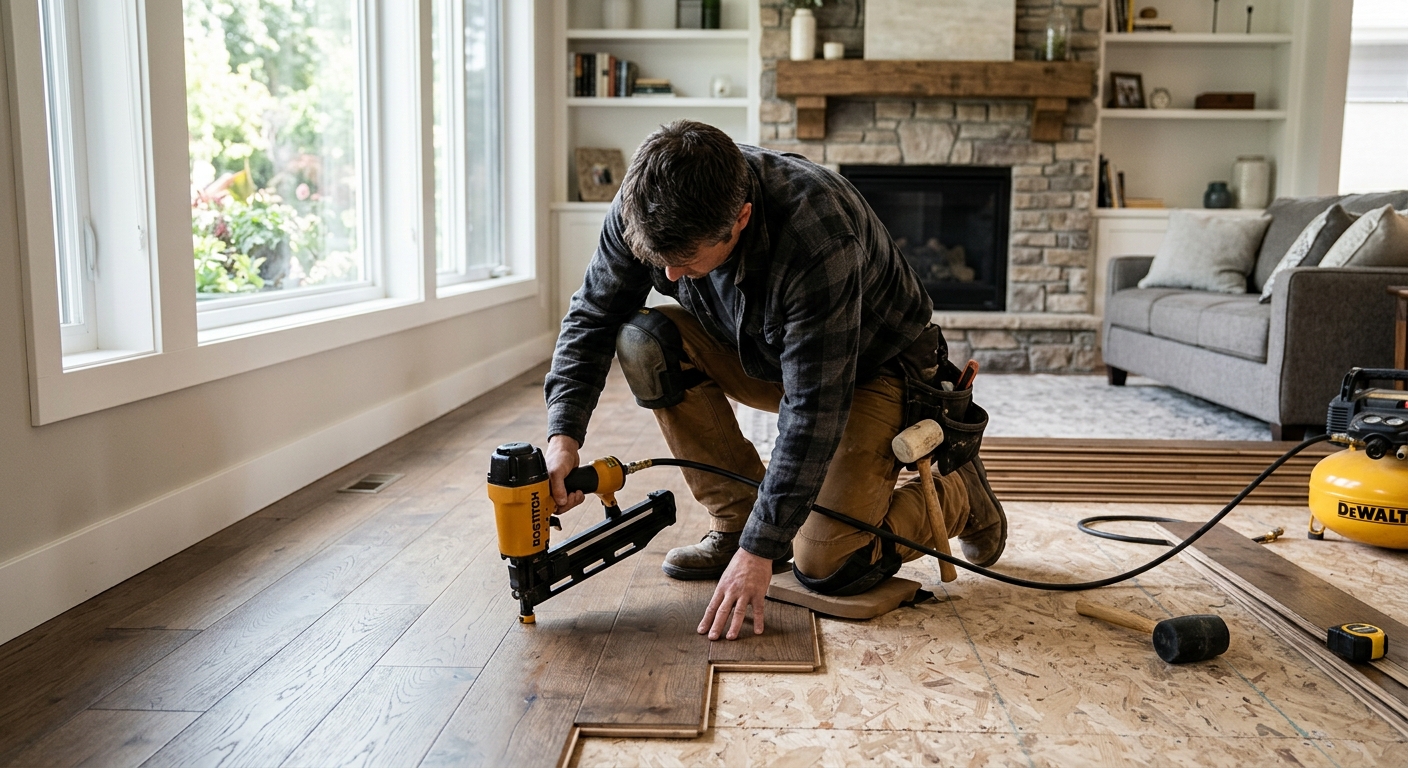
Flooring options and costs in Vancouver
In Vancouver, the right flooring choice starts with two realities: a wet, marine climate and an older housing base. With 43.0% of homes in the region built before 1981 (Statistics Canada, 2021 Census), many projects begin with uneven plywood or concrete that needs levelling, patching, or resurfacing before new flooring can be installed—often adding roughly $1–$3 per sq ft once materials and extra labour are counted. That’s one reason two quotes for “the same square footage” can land far apart in the Lower Mainland–Southwest: the subfloor condition and prep scope can be the hidden cost driver.
Vancouver’s indoor humidity swings are also meaningful. In winter and shoulder seasons, moisture vapour and occasional below-grade wicking in slab or basement spaces can cause cupping and gapping in solid wood if gaps/relative humidity aren’t managed. Because of this, we typically avoid solid hardwood below grade and recommend engineered hardwood or luxury vinyl plank (LVP) there—layered cores and resilient surfaces handle humidity better. In main living areas, solid hardwood remains popular, but we install it with proper expansion space and humidity control practices.
You’ll especially see strong demand in neighbourhoods like Mount Pleasant, where many homes are character-era (built earlier) and homeowners frequently update flooring in stages to match renovation schedules and tenant timelines. Use the table below to compare typical materials and budget ranges, then we’ll tailor the exact plan to your subfloor and moisture profile.
| Type |
Best Room |
Moisture Resistance |
Lifespan |
Price per sq ft |
| Solid hardwood (nail-down, above grade only) |
Living room, hallways (above grade) |
Low to moderate (humidity sensitive) |
25–50+ years |
$9 – $18 |
| Engineered hardwood (float or glue, above + on-grade) |
Living/dining, bedrooms (above or on-grade) |
Moderate to high (better with humidity) |
20–40+ years |
$10 – $16 |
| Laminate (click-lock, above-grade) |
Bedrooms, living rooms (dry areas) |
Moderate (not for wet basements) |
10–25 years |
$4 – $9 |
| Luxury vinyl plank / LVP (waterproof, any level) |
Kitchen, bathrooms-adjacent zones, basements |
High to very high (waterproof) |
15–25 years |
$5 – $10 |
| Porcelain / ceramic tile |
Kitchen, bathrooms, entries |
Very high (tile is water-safe) |
30–60+ years |
$10 – $20 |
| Carpet (broadloom or modular tile) |
Bedrooms, stairs (comfort/sound) |
Low to moderate (avoid chronic moisture) |
8–15 years |
$4 – $8 |
Prices are estimates only and vary by project scope, site access and material selection.
What affects the price of flooring in Vancouver
In Vancouver and the broader Lower Mainland–Southwest, even when homeowners choose the same flooring “type,” it’s common to see quote spreads of 30–50% for an otherwise similar-looking job across British Columbia. The biggest reasons are (1) how much prep your existing subfloor needs and (2) how the climate affects acclimation, moisture control, and protection materials. A solid hardwood job that needs moisture mitigation, subfloor levelling, and careful acclimation will cost more than one where the substrate is already flat and dry.
Technically, indoor humidity swings and below-grade moisture are the key drivers in this region. Solid hardwood expands and contracts with moisture content—so it cannot be glued or floated over concrete, and it performs poorly in basements where vapour moves through slab or where humidity is inconsistent. Engineered hardwood and LVP handle humidity and on-/below-grade applications far better. If your home has radiant heating (increasing in newer builds and colder inland pockets), that can narrow product choices; most solid hardwood and some laminate products need very careful specification to avoid floor movement.
Older regional housing stock (43.0% pre-1981, Statistics Canada, 2021 Census) frequently needs levelling or repair. In practice, that can add roughly $1–$4 per sq ft depending on how far out the floor is and whether we’re patching, resurfacing, or overlaying. For example, a 600 sq ft living area may land at the low end of the engineered hardwood band ($10/sq ft) if the subfloor is already flat, but can push toward the higher end ($16/sq ft) if extensive levelling and underlayment prep are required. Similarly, LVP can look “inexpensive” at about $5–$10/sq ft, but a basement with thick existing flooring, moisture remediation, and lots of cuts for drains and posts can move the project toward the top of the band. In short: the climate and subfloor condition determine how much work you pay for.
| Price Factor |
Why It Matters |
Cost Impact |
| Room area in sq ft |
Materials scale directly; labour efficiency changes with larger footprints |
Typical variation across bids due to crew setup and waste factor |
| Subfloor condition — levelling or repair needed before install |
Uneven plywood or concrete requires patching/levelling to protect click joints or joints |
Often adds roughly $1–$4 per sq ft in older homes |
| Moisture / below-grade install — rules out solid hardwood |
Vapour movement can damage solid wood and certain laminate systems |
May switch you to engineered hardwood or LVP; additional moisture barrier costs |
| Material choice — solid vs. engineered vs. LVP vs. tile |
Different product structures respond differently to Vancouver humidity and temperature |
Moves you across typical local bands (e.g., $9–$18 for hardwood vs. $5–$10 for LVP) |
| Removal and disposal of existing flooring |
Heavily glued-down flooring, old underlay, and debris removal add labour time |
Can significantly increase cost, especially for basements |
| Stair nosing / transitions — charged per step or per linear foot |
Transitions are labour-intensive and require correct profiles for movement gaps |
Adds cost even when the main floor area is unchanged |
| Radiant heat compatibility — limits material options |
Some products tolerate heat swings better than others |
May require specific underlayment or thicker engineered flooring, raising material cost |
| Installation method — float vs. glue-down vs. nail-down |
Prep, adhesive, and fastening systems differ widely |
Nail-down often needs above-grade conditions; glue-down can add adhesive and labour |
Permits & regulations in British Columbia
In British Columbia, installing new flooring typically does not require a building permit. Most surface-only work—like installing LVP click-lock, laminate click-lock, broadloom carpet, or nailing down solid hardwood on a properly prepared above-grade subfloor—is normally treated as finish work. However, permits can come up when flooring projects involve related work that affects building systems.
What usually does require a permit (or at least a contractor permit check) includes: electrical permits for modifications to in-floor heating circuits (new wiring, thermostat changes, or rewiring), structural permits when you’re doing major structural repairs to joists or beams, and any work tied to moisture remediation that involves engineered solutions or significant substrate changes requiring code compliance. In practice, if you’re repairing extensive subfloor rot, replacing load-bearing components, or altering electrical components tied to radiant heat, ask your contractor to confirm the permit requirements before work begins.
For condos, the bigger issue is not government permitting—it’s building rules. Many Vancouver-area condominium corporations restrict hard flooring on upper floors due to sound transmission requirements (STC/IIC). They may require specific underlays, limit the type of underlay used, or require board approval before installation. Always request approval in writing and keep documentation of the underlay and product system so you can comply with your corporation’s requirements.
To verify your contractor in Vancouver, ask for (1) their current business licence/registration details through the province’s contractor resources (where applicable), (2) liability insurance certificate naming you as additional insured (ask for the certificate of insurance, not just a policy number), and (3) proof they are covered under WSIB/WCB for work undertaken. When offered, request a clearance letter or coverage confirmation for the specific work site.
Best flooring for each room in your Vancouver home
Choosing flooring room-by-room matters more in Vancouver than in many other Canadian cities because the Lower Mainland–Southwest environment is consistently challenging for moisture balance. Living and dining areas are typically best with engineered hardwood or high-quality laminate: both provide warmth underfoot while tolerating minor seasonal humidity swings better than solid wood, especially when we maintain the right expansion gaps and acclimation practices. For master bedrooms, carpet is a strong comfort choice and reduces sound transmission, but it must be installed over a dry, properly prepped substrate.
For the kitchen, pick LVP for everyday spills and easy cleaning, or large-format porcelain tile for maximum water resistance and durability. In basements (finished), LVP is usually the clear winner: it’s waterproof, handles vapour movement and below-grade installs more reliably, and avoids many of the failure modes that happen with solid hardwood and most laminate systems. Bathrooms should be porcelain or ceramic tile with a proper waterproofing approach where required.
If your home has radiant heating, it’s increasingly common in newer Vancouver-area builds and should influence your material choice. Radiant heat works best with engineered wood, LVP, and tile; solid hardwood can be acceptable only with very careful product specifications and moisture/temperature control.
To show where the price difference makes sense: for a 250 sq ft basement, upgrading to waterproof LVP (commonly within the $5–$10/sq ft local band) can prevent expensive failures. In contrast, choosing solid hardwood at $9–$18/sq ft for a basement can lead to cupping and gapping that cost more to fix than the initial savings.
| Room |
Best Material |
Why |
Moisture Risk |
Price Band per sq ft |
| Living / dining room |
Engineered hardwood |
Warm feel with better humidity tolerance than solid; easier to maintain stable performance above grade |
Low to moderate |
$10 – $16 |
| Master bedroom |
Carpet or engineered hardwood |
Carpet adds comfort and sound absorption; engineered offers a quieter, warmer surface than tile |
Low |
$4 – $15 |
| Secondary bedrooms |
Laminate or LVP (where humidity varies) |
Laminate is budget-friendly; LVP is a safer choice if moisture conditions aren’t perfectly consistent |
Low to moderate |
$4 – $10 |
| Kitchen |
Luxury vinyl plank (LVP) or porcelain tile |
LVP handles spills; tile is extremely durable and easy to clean |
Moderate |
$5 – $20 |
| Basement (finished) |
LVP (waterproof) |
Resilient under vapour movement; avoids issues solid wood faces with below-grade moisture |
High (vapour wicking possible) |
$5 – $10 |
| Bathroom |
Porcelain / ceramic tile |
Waterproof surface system when installed correctly; long service life |
Very high |
$10 – $20 |
How to choose a flooring contractor in Vancouver
Start with verification. In British Columbia, ask for a current certificate of insurance for liability coverage and confirm workers are covered for workplace injury protection through WSIB/WCB (ask for proof/clearance for the project). Licensing requirements can vary by contractor structure and scope, so don’t stop at a business name—request their professional registration details or documentation they are eligible to perform the work you’re hiring for.
Then, get 2–3 itemised written quotes. You want a breakdown separating labour, material, underlay/moisture barrier, transitions/stair nosing, and removal/disposal. A proper quote should show what’s included and what’s not—especially subfloor assessment, levelling compounds, whether plywood repairs or patching are included, and whether acclimation time is accounted for. Clarify if permit pull is included (if you’re dealing with radiant heat electrical work, for example) and whether the contractor removes existing flooring and hauls it away.
Warranty matters too: ask for the workmanship warranty length and what product warranties cover (manufacturer warranty on the flooring is different from installation warranty). Also confirm whether warranties are transferable if you sell your home—many homeowners care about this for resale.
Finally, keep payment controlled. Avoid paying more than about 10–15% upfront; hold back the remainder until the job is complete, cleaned, and any punch list items are addressed. Request a start date and a realistic completion timeline in writing, including how weather and material lead times could shift the schedule.
- Ask for liability insurance and confirm the certificate covers the project address.
- Request proof of WSIB/WCB coverage (or clearance letter) for the specific work.
- Use itemised quotes: labour, materials, underlayment/moisture barrier, transitions, and disposal.
- Confirm whether subfloor levelling/patching is included or quoted separately after inspection.
- Get details on moisture testing, acclimation, and expansion gap handling for Vancouver humidity.
- Ask who supplies the underlay suited to your floor type (and radiant heat if applicable).
- Confirm removal scope: what gets pulled up, what gets hauled away, and disposal method.
- Review transition plan: stair nosings and door jamb undercutting should be defined.
- Check warranty terms in writing: workmanship coverage and manufacturer coverage.
- Clarify whether warranties require specific installation methods or maintenance.
- Set a payment schedule with a holdback until punch list completion.
- Request a written start/completion estimate and how delays are communicated.
Concrete red flags we see in Vancouver: contractors who won’t visit to inspect subfloor flatness before quoting, quotes that lump everything into one number without an itemised scope, no proof of liability/WSIB/WCB coverage, vague moisture handling (especially for basements/slabs), and warranties that are only “verbal” or don’t clearly define workmanship responsibility.
Frequently asked questions — flooring in Vancouver
What flooring works with radiant heat?
In Vancouver and the Lower Mainland–Southwest, radiant heating is increasingly common in newer homes, and it changes what “works” in practice. The safest choices are typically porcelain/ceramic tile, LVP, and many engineered hardwood products designed for radiant heat. Solid hardwood can be more temperamental because it’s more sensitive to seasonal humidity and temperature swings, so it must be the right thickness and species with the correct installation details. Laminate can work only when the product is rated for radiant heat and the underlayment is compatible. Always ask for the manufacturer’s radiant heat approval and the installer’s plan for acclimation and expansion gaps, especially during Vancouver’s humidity swings.
Engineered vs solid hardwood — what's the difference?
Solid hardwood is one piece of wood throughout and is usually installed nail-down on an above-grade subfloor. It responds noticeably to humidity changes, so it’s not the best choice for basements or on concrete slabs where moisture vapour can move. Engineered hardwood is layered, with a stable core and a real wood veneer top, so it tolerates humidity better and can be installed float or glue-down depending on the system. That’s why in Vancouver, we often steer below-grade projects toward engineered or LVP rather than solid. On the cost side, solid typically sits in the $9–$18 per sq ft local band, while engineered commonly lands around $10–$16 per sq ft depending on prep requirements and product quality (Statistics Canada, 2021 Census).
Do I need to level my subfloor first?
Usually, yes—at least to a certain standard. Even in newer Vancouver builds, subfloors can be slightly out of plane, but with 43.0% of homes built before 1981 (Statistics Canada, 2021 Census), older plywood and concrete unevenness is very common. If the floor isn’t sufficiently flat, click-lock joints can fail prematurely (laminate/LVP), and tile can crack or grout lines can become uneven. Leveling also matters for hardwood to reduce movement and squeaks. Many homeowners are surprised that levelling/patching can add roughly $1–$4 per sq ft once repairs and labour are accounted for. A good installer will inspect flatness, then quote whether levelling is included or priced after assessment.
What's the most durable flooring for pets and kids?
For pets and kids in Vancouver, durability is less about “scratch-proof marketing” and more about selecting a surface that handles impact, spills, and cleaning. For most households, LVP is a top choice: it’s resilient underfoot, easier to maintain than carpet, and waterproof, which helps if accidents happen in the kitchen or basement. If you want the hardest surface for claws and high traffic, porcelain tile is extremely durable, though it’s harder and colder underfoot unless you have radiant heat. Carpet can still work in bedrooms for comfort and sound, but it’s not ideal for basement humidity or frequent spills. Budget-wise, many LVP options fall around $5–$10 per sq ft, while tile often runs $10–$20 per sq ft depending on installation complexity and tile format.
How do I choose flooring for humidity in Vancouver?
Start by identifying your moisture risk zone: above grade living areas typically stay drier, but basements and on-grade concrete areas can experience vapour wicking and higher humidity. In Vancouver’s wet, marine climate, indoor humidity swings can also cause solid wood movement, which leads to cupping or gapping if the floor system isn’t specified correctly. For best reliability, we recommend engineered hardwood for above/on-grade spaces and waterproof LVP for basements and other higher-risk zones. Solid hardwood is usually best confined to above-grade rooms with controlled indoor humidity. If you’re choosing laminate, keep it above grade and use a system rated for your conditions. The right installer should also confirm acclimation steps and expansion gap requirements before fastening or laying planks.
Do condos restrict hard flooring?
Yes, often. In British Columbia, the installation itself may not require a building permit, but condominium corporations frequently regulate sound transmission performance and underlay requirements. Many Vancouver-area condos aim for specific STC/IIC outcomes and may restrict the type/thickness of underlay used under hardwood, tile, or floating floors on upper levels. They may also require written board approval before installation. Your practical next steps: review your condo’s declaration/bylaws, ask the corporation for their underlay or floor system requirements, and keep product/underlay documentation. If approval is needed, get it in writing before work starts—this prevents situations where a contractor finishes and the board later requires adjustments.