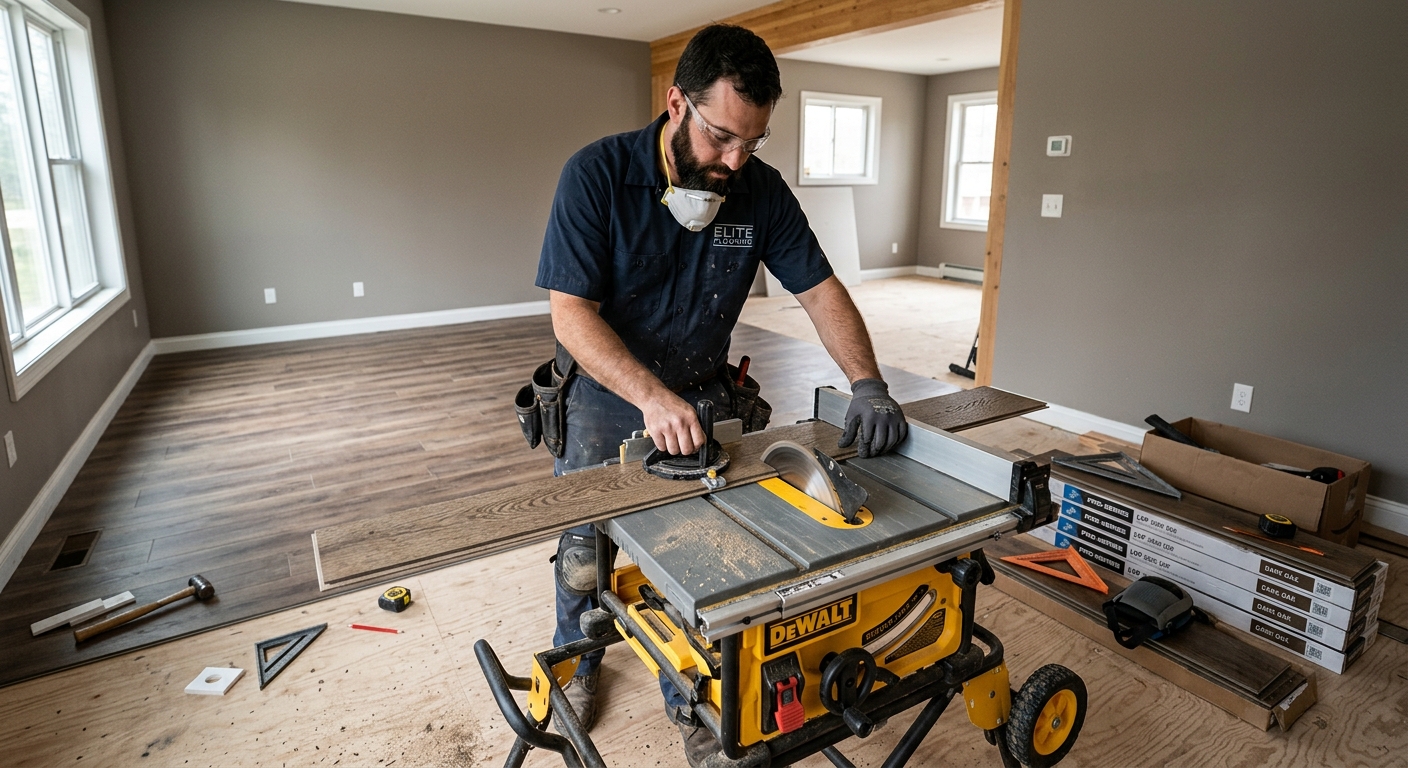
Flooring options and costs in Vedder Crossing
In Vedder Crossing, the right flooring choice comes down to balancing comfort, appearance, and the Lower Mainland–Southwest climate that drives pricing. With a population of 22,620 (Statistics Canada, 2021 Census), the area supports steady contractor capacity, but older housing stock is common in the broader Lower Mainland–Southwest—meaning more jobs start with subfloor repairs or levelling. In practice, that can add about $1–$3 per sq ft when plywood/OSB is uneven, or when you need a moisture barrier before any new surface goes down. Some projects also include spot repairs to concrete slabs or patching low areas, which pushes labour time up.
Moisture is the other big cost shaper. The region’s wet, marine climate brings indoor humidity swings, especially in winter and shoulder seasons, and moisture can wick through concrete in basement or slab-on-grade zones. Because solid hardwood expands and contracts with humidity, it’s generally not recommended below grade (and it can be difficult on concrete unless you meet very specific conditions). That’s why engineered hardwood and luxury vinyl plank (LVP) are popular value options: layered construction and moisture-tolerant cores handle humidity and minor temperature changes far better. If you’re in an area near Abbotsford—where contractors often see high demand for renovations tied to upgrades and resale—materials availability is good, but skilled labour still represents a meaningful portion of the total ticket.
Below is a practical cost comparison to help you quickly narrow options before you request quotes.
| Type |
Best Room |
Moisture Resistance |
Lifespan |
Price per sq ft |
| Solid hardwood (nail-down, above grade only) |
Main living areas |
Low to moderate (humidity sensitive) |
25–60 years (with proper care) |
$9 – $18 |
| Engineered hardwood (float or glue, above + on-grade) |
Living rooms, bedrooms |
Moderate to high (layered construction) |
20–35 years |
$8 – $16 |
| Laminate (click-lock, above-grade) |
Bedrooms, hallways |
Moderate (protect from standing water) |
10–25 years |
$4 – $10 |
| Luxury vinyl plank / LVP (waterproof, any level) |
Kitchen, entry, finished basements |
High to waterproof (in most products) |
15–25 years |
$5 – $12 |
| Porcelain / ceramic tile |
Bathrooms, kitchens, mudrooms |
Very high (waterproof after grout cure) |
25+ years |
$10 – $20 |
| Carpet (broadloom or modular tile) |
Bedrooms, stairs |
Low to moderate (avoid wet mopping) |
8–15 years |
$3 – $8 |
Prices are estimates only and vary by project scope, site access and material selection.
What affects the price of flooring in Vedder Crossing
Two homeowners in Vedder Crossing can receive very different quotes for what seems like the “same floor,” and the spread can be 30–50% across the Lower Mainland–Southwest (and across British Columbia) once you factor in subfloor conditions and labour complexity. In this region, indoor humidity swings and below-grade moisture risk are the key technical drivers. Solid hardwood expands and contracts with humidity, so it’s typically limited to above-grade installs and is not suitable over concrete basements. Engineered hardwood and luxury vinyl plank (LVP) handle humidity and below-grade applications far better, which helps prevent callbacks—yet they still require correct underlay and acclimation.
Cold inland pockets and some new builds with radiant heating also influence costs. Radiant heat compatibility can rule out certain solid hardwood specifications and some laminate products, meaning you may pay a bit more for the right build-up. Another major driver is older regional housing stock: uneven plywood or concrete commonly needs levelling, moisture barrier, or resurfacing. That work often adds roughly $1–$4 per sq ft, and it’s where quotes diverge most.
Here are a few real-world examples tied to Vedder Crossing conditions. If your basement is slab-on-grade with visible damp spots, an LVP install can stay in the $5–$12 per sq ft band, while a solid hardwood plan would likely be redesigned (or deferred) to protect the flooring. If your plywood subfloor has dips, levelling plus surface prep can move an engineered wood project from the lower end of the $8–$16 per sq ft range toward the higher end. If you’re converting an older room with multiple thresholds and stair transitions, stair nosing and transition labour can add noticeable cost even when square footage is modest.
Next, it helps to break pricing into the factors contractors price line-by-line, not just “materials vs labour.”
| Price Factor |
Why It Matters |
Cost Impact |
| Room area in sq ft |
Determines material quantity, waste factor, and labour hours |
Direct multiplier for both materials and install time |
| Subfloor condition |
Levelling/repair is required for flatness and warranty |
Often adds about $1–$4 per sq ft depending on scope |
| Moisture / below-grade install |
Rules out solid hardwood; needs moisture barriers or approved systems |
Can shift you to engineered/LVP or add remediation steps |
| Material choice |
Solid vs engineered vs LVP vs tile have different performance and labour demands |
Typical band difference of several dollars per sq ft (e.g., $4–$10 vs $10–$20) |
| Removal and disposal of existing flooring |
Demolition, hauling, and disposal fees add time and costs |
Can add a noticeable line item on top of flooring cost |
| Stair nosing / transitions |
Charged per step or per linear foot; adds labour and trim material |
Often increases project cost disproportionately in smaller rooms |
| Radiant heat compatibility |
Limits product options and requires correct underlay/specification |
May move you to higher-priced compatible products |
| Installation method |
Float vs glue-down vs nail-down changes prep, tools, and labour intensity |
Can change labour cost materially even with same material quality |
Permits & regulations in British Columbia
In British Columbia, most flooring installation work itself typically does not require a building permit. That said, associated work can trigger requirements depending on what your contractor plans to touch. For example, if you’re installing or modifying in-floor heating circuits, that electrical work can require permits and inspections. Similarly, any electrical component tied to radiant systems should be handled by (or through) the appropriate permitted trades.
Moisture remediation can also complicate things: if the scope involves structural subfloor repair (for instance, cutting out damaged sections, rebuilding joist bays, or major rebuilds), a permit may be required depending on how extensive it is. In condominiums, even when permits are not required, building rules often are. Many corporations restrict hard flooring because of sound transmission, and they may require specific underlay or thickness to meet sound standards (often discussed in terms of STC/IIC). Always review the condo declaration and request written board approval before installing hardwood or tile on upper floors in a multi-unit building.
To verify a contractor in Vedder Crossing: (1) check licensing status online through the appropriate provincial registry for flooring/trades under their business name; (2) ask for a current certificate of liability insurance and confirm the effective dates match your project; and (3) request evidence of coverage for workers (WSIB/WCB clearance letter or equivalent proof). A reputable contractor will provide documents promptly and match them to your exact scope (demo, install, and any subfloor repairs).
Best flooring for each room in your Vedder Crossing home
Choosing flooring room-by-room in Vedder Crossing means respecting how the Lower Mainland–Southwest climate behaves inside your home: humidity swings in winter and shoulder seasons can affect wood, while basements and slab-on-grade areas demand moisture-tolerant products. For living and dining areas, engineered hardwood or high-quality laminate are usually the best balance of warmth, look, and stability. In a primary bedroom, carpet is a comfortable option and also helps with sound—though it’s best kept dry and should not be steam-mopped. The kitchen benefits from luxury vinyl plank (LVP) or large-format porcelain tile because you’ll deal with water spills and frequent clean-ups.
Basements (especially finished slab or older crawl/joist setups) are where local conditions most often narrow your choices. Fully waterproof LVP is the clear winner: it can handle moisture vapour and the realities of below-grade installs that solid wood and many laminates struggle with. Bathrooms should be porcelain or ceramic tile only, installed with proper substrate and grout practices.
If your home has radiant heat (more common in newer builds inland pockets and across BC), focus on materials rated for higher temperatures. This often makes LVP, tile, and many compatible engineered products the easiest paths. As a cost reality check: if tile lands in the $10–$20 per sq ft band and LVP is closer to $5–$12 per sq ft, the price difference is usually justified in bathrooms for water performance, but it’s often not worth it in low-moisture zones like hallways when LVP can deliver a similar look and faster, flatter installation.
Use the table below to quickly match materials to room needs.
| Room |
Best Material |
Why |
Moisture Risk |
Price Band per sq ft |
| Living / dining room |
Engineered hardwood |
Warm feel with better humidity stability than solid wood |
Low to moderate (control indoor humidity) |
$8 – $16 |
| Master bedroom |
Carpet or engineered hardwood |
Carpet improves comfort and sound; engineered wood is durable and tidy |
Low |
$4 – $14 |
| Secondary bedrooms |
Carpet |
Comfort for kids/guests and helps with noise transfer |
Low |
$3 – $8 |
| Kitchen |
Luxury vinyl plank (LVP) |
Water-resistant, easy cleaning, and forgiving under daily spills |
Moderate (spills and wet cleaning) |
$5 – $12 |
| Basement (finished) |
Luxury vinyl plank (LVP) |
Handles below-grade moisture and slab conditions better than wood/laminate |
High |
$5 – $12 |
| Bathroom |
Porcelain / ceramic tile |
Excellent water performance and long service life |
Very high |
$10 – $20 |
How to choose a flooring contractor in Vedder Crossing
Start by confirming your flooring contractor in British Columbia is properly covered and accountable. For licensing, ask what legal business name they operate under and verify it through the provincial registry for the relevant trade category. For liability insurance, request a current certificate of insurance (COI) and make sure it covers general liability for flooring installation. For worker coverage, ask for proof of WSIB/WCB clearance (or equivalent documentation). If a contractor can’t provide documents quickly, that’s a major warning sign in any Greater Vancouver-area project where access, demo, and dust control are part of the job.
Next, get 2–3 itemised written quotes. You want a breakdown that separates product, underlay/moisture barrier, labour, removal/disposal, and transitions/stair nosing. Avoid “lump sum only” proposals because they hide scope changes that can add 10–20% later. Read the exclusions closely: is subfloor levelling included if the floor isn’t flat enough? Is the moisture barrier included where needed? Is the disposal of old flooring included and hauled to an approved site? Also confirm whether a permit is required for any radiant heating electrical work and whether the contractor coordinates it.
For warranty, check both workmanship and product coverage. Ask for the workmanship warranty length and whether it’s transferable if you sell. Finally, payment should be controlled: never pay more than about 10–15% upfront. Use progress payments tied to milestones, and hold back until the job is complete and cleaned. Demand a written start date and completion estimate—schedule clarity matters when humidity swings can impact acclimation and material performance.
- Provide COI (liability insurance) with matching project dates.
- Provide WSIB/WCB clearance or proof of coverage.
- Show a written scope: subfloor prep, underlay/moisture barrier, and flatness standards.
- Include disposal/hauled-away costs (or explicitly exclude them).
- List stair nosing and transition pricing per step or per linear foot.
- Specify acclimation requirements for wood/planks based on indoor conditions.
- Confirm moisture testing approach for slab/basement areas.
- Clarify what happens if the subfloor needs more levelling than expected.
- Ask whether radiant heat compatibility is confirmed for the exact product SKU.
- Request warranty terms in writing (labour + product) and who honours them.
- Keep payment schedule modest: 10–15% upfront, then milestone payments.
- Get start and completion dates in the contract, not just “estimated soon.”
Red flags in Vedder Crossing: vague scopes without subfloor prep details, no proof of insurance/coverage, refusal to itemise removal and transitions, promises of solid hardwood “in the basement” without moisture mitigation, or contracts that require large upfront payments with no holdback.
Frequently asked questions — flooring in Vedder Crossing
What is the best flooring for a high-traffic area in Vedder Crossing?
For high-traffic zones in Vedder Crossing (entryways, main hallways, and busy living spaces), luxury vinyl plank (LVP) or engineered hardwood are typically the most practical. LVP wins when your household involves lots of wet footwear, occasional spills, or you have slab-on-grade concerns—its waterproof construction handles the Lower Mainland–Southwest moisture reality better than solid hardwood. If you prefer a traditional wood look, engineered hardwood is a strong choice because it tolerates humidity swings better than solid wood when installed above grade and with correct acclimation and underlay. In cost terms, LVP often sits around the $5–$12 per sq ft band, while engineered hardwood commonly runs closer to the $8–$16 per sq ft band depending on wear layer and installation method. For the smoothest results, insist on proper subfloor flatness—especially in older homes.
How do I prepare my subfloor before new flooring?
Subfloor preparation is where many Vedder Crossing flooring projects succeed or fail. The contractor should start by checking flatness (to prevent movement, gaps, and squeaks) and address moisture risk—particularly over concrete or in basements where moisture can wick through slab. In practice, that may include scraping high spots, repairing dips, and installing an approved moisture barrier or underlayment system. For wood floors, they also confirm that the subfloor is solid enough for the selected installation method (nail-down vs glue-down vs floating). If levelling is required, it’s usually part of the quote only when scope is clearly written. Ask your contractor what flatness standard they target, whether they’ll test or visually assess moisture, and whether levelling and barriers are included. Proper prep helps keep warranties valid and reduces cupping/gapping when indoor humidity shifts.
Is cork or bamboo flooring a good choice in Vedder Crossing?
Cork and bamboo can look great, but in British Columbia—especially with the Lower Mainland–Southwest’s wet marine climate—you need to be selective. Cork is resilient and comfortable underfoot, but it can still be affected by standing water and humidity if the subfloor isn’t stable or well protected. Bamboo flooring is also a form of wood flooring, so it can react to moisture and temperature swings similarly to hardwood unless it’s specifically engineered/constructed for stability and installed correctly. In Vedder Crossing homes with basements or slab-on-grade areas, many contractors steer homeowners toward LVP or tile instead because those materials handle moisture far more reliably. If you love cork/bamboo, ask whether your product is engineered, the exact warranty conditions for below-grade use (if any), and what moisture barrier system is included. If the plan is for above grade only, it’s more manageable.
What is the difference between floating and glued-down flooring?
Floating floors are installed as click-lock planks/boards laid over an underlay, without mechanically fastening them to the subfloor. Because they “float,” they expand and contract within designed tolerances; they generally work well for many laminates and many engineered systems when installed over a suitable underlay and flat subfloor. Glued-down flooring is bonded to the subfloor using an adhesive, which can improve stability and reduce movement for certain products—especially where a fixed feel is desired. In humid British Columbia conditions, the key is matching the installation method to the product’s design: engineered wood and LVP are chosen for their moisture tolerance, but they still need correct prep and acclimation. Ask your contractor to specify the exact product and installation method, and confirm whether the method is compatible with radiant heat and any existing moisture conditions in your Vedder Crossing home.
What flooring holds up best to pets in a Vedder Crossing home?
For pets, the best flooring usually combines scratch resistance, traction, and a material that tolerates accidents. LVP is commonly the top pick in Vedder Crossing because it’s waterproof and easier to clean after urine or spills (and it won’t swell like some wood-based floors). When comparing costs, LVP often falls in the $5–$12 per sq ft band, while tile can be higher at $10–$20 per sq ft but is also very durable and waterproof. Engineered hardwood can work well if the home is above grade and you control indoor humidity, but it can be less forgiving if there’s frequent wetness. Carpet is comfortable and quiet, yet it’s harder to maintain if pets have accidents—especially in winter when humidity swings can slow drying. Whatever you choose, ask about wear layer thickness (for engineered/LVP) or the tile rating and grout sealing approach.
How do I fix squeaky floors in my Vedder Crossing home?
Squeaky floors are usually a subfloor issue, not a flooring surface issue. In Vedder Crossing and across older Lower Mainland–Southwest homes, squeaks often come from movement between joists and subfloor panels, or from fasteners that have loosened over time. Before replacing flooring, the first step is to locate the source: walk the area and identify whether the squeak is on a seam, near a joist, or under specific loads. A contractor may recommend tightening or adding fasteners from above or below (depending on access), or using shims to remove play. If you’re planning new flooring, insist that the contractor addresses squeaks during subfloor repair—otherwise the squeak can return and may telegraph through floating systems. If you’re in a condo or multi-unit building, also coordinate with board rules and sound requirements for underlay, since addressing squeaks sometimes changes what underlay you’re allowed to use.