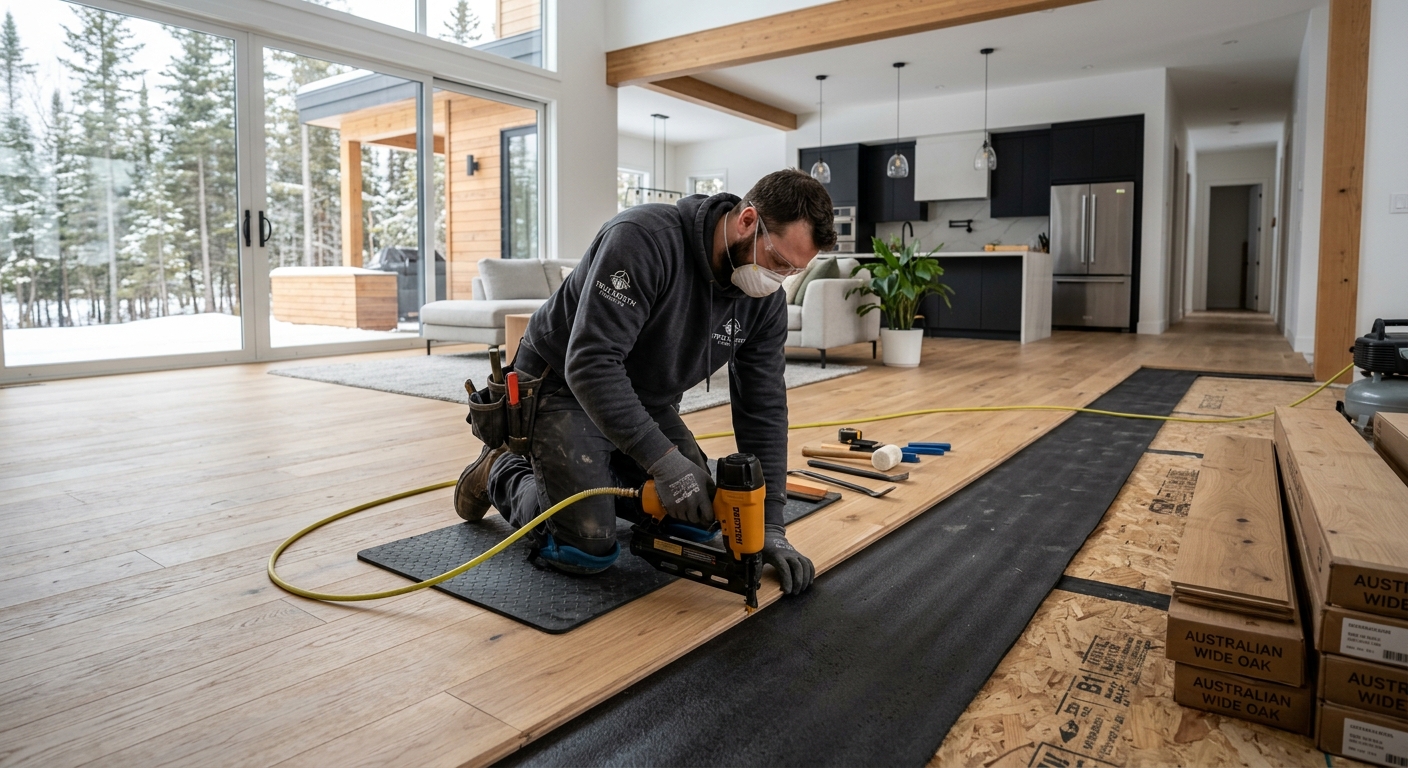
Flooring options and costs in Whonnock
Whonnock homeowners usually start with the same question: “What will this cost, and what holds up in our climate?” With a 2021 population of 3,444 (Statistics Canada, 2021 Census), the village sits within the busier Lower Mainland–Southwest market—so contractors are available, but scheduling and material lead times can shift quickly around wet-season demand. Just as important, many older Lower Mainland homes face subfloor irregularities; if your house has older plywood or concrete surfaces, expect levelling/repair before the new floor goes down—commonly around $1–$3 per sq ft, which can move a quote by a noticeable margin even when the flooring “choice” stays the same.
In the Lower Mainland–Southwest, our wet, marine climate brings indoor humidity swings in winter and shoulder seasons. That technical reality drives pricing because moisture control and acclimation affect how many hours the crew spends prepping, starring/patching, and planning expansion gaps. It also affects what products are realistic: solid hardwood is popular above grade, but below grade it can cup or gap; we typically steer basements toward engineered wood or luxury vinyl plank (LVP) because layered or PVC cores handle humidity and minor temperature movement far better. If your home is near the West Langley/Maple Ridge corridor (including the Whonnock area off Lougheed Highway), flooring work is especially in demand as more households refresh older interiors and finish basements.
Below is a practical comparison of the main materials you’ll see quoted in Whonnock, with typical price ranges for the Lower Mainland–Southwest tier.
| Type |
Best Room |
Moisture Resistance |
Lifespan |
Price per sq ft |
| Solid hardwood (nail-down, above grade only) |
Living/dining, bedrooms |
Low (not for basements or slabs) |
25–50 years |
$9 – $18 |
| Engineered hardwood (float or glue, above + on-grade) |
Main floor, hallways |
Medium–high (more tolerant) |
20–40 years |
$8 – $16 |
| Laminate (click-lock, above-grade) |
Busy rooms, offices |
Medium (varies by core + underlay) |
10–25 years |
$4 – $10 |
| Luxury vinyl plank / LVP (waterproof, any level) |
Kitchen, basement, entry |
High (waterproof cores) |
15–30 years |
$5 – $12 |
| Porcelain / ceramic tile |
Kitchen, bathrooms, mudrooms |
Very high (surface is waterproof) |
30–50+ years |
$10 – $20 |
| Carpet (broadloom or modular tile) |
Bedrooms, stairs (comfort) |
Low–medium (avoid below grade) |
7–15 years |
$4 – $12 |
Prices are estimates only and vary by project scope, site access and material selection.
What affects the price of flooring in Whonnock
Two quotes for the “same” flooring can easily land 30–50% apart across the Lower Mainland–Southwest and the wider province because material selection, site prep, and labour intensity vary from home to home. In Whonnock, the biggest technical reasons are our indoor humidity swings and the reality of moisture wicking through concrete in below-grade areas. Solid hardwood reacts to moisture/temperature movement—so it’s not something we install over typical basement slabs where moisture vapour is common. Engineered hardwood and LVP are priced higher than basic laminate, but they’re often the cheaper path overall because they avoid expensive redo work later.
Cold snaps are another consideration. Colder inland pockets and newer builds in the Lower Mainland region increasingly pair in-floor radiant heating with the flooring. That tends to rule out most solid hardwood and some laminate products unless they’re specifically rated for radiant heat. On top of that, older regional housing stock frequently needs levelling or repair; even a $1–$4 per sq ft change for subfloor prep can outweigh small differences in the finish grade you picked.
Here are concrete examples we see often in Whonnock: (1) If your main floor has uneven plywood, levelling can add several hours of labour per room, pushing a “mid-band” engineered hardwood install toward the upper end. (2) If a basement slab shows evidence of moisture, switching from solid hardwood (often specified at the $9–$18 band) to LVP (typically $5–$12) can prevent failure—meaning you spend once, not twice. (3) If stair transitions and thresholds need frequent matching, transitions can add noticeable cost even when the overall square footage stays the same.
| Price Factor |
Why It Matters |
Cost Impact |
| Room area in sq ft |
Material quantities and crew hours scale directly |
Typically the largest line item |
| Subfloor condition — levelling or repair needed before install |
Uneven plywood or rough concrete increases prep time |
Often adds about $1 – $4 per sq ft |
| Moisture / below-grade install — rules out solid hardwood |
Basement slabs and vapour drive flooring compatibility |
May shift product choice (solid → engineered/LVP) |
| Material choice — solid vs. engineered vs. LVP vs. tile |
Different wear layers, cores, and underlayment requirements |
Can swing totals by 20%+ depending on grade |
| Removal and disposal of existing flooring |
Tile, glue-down, and old underlay take longer to remove |
Commonly adds several hundred dollars or more |
| Stair nosing / transitions — charged per step or per linear foot |
Transitions are detail work, not “extra trim” |
Can add a meaningful fixed cost to the project |
| Radiant heat compatibility — limits material options |
Some products can warp or fail if not rated |
May move you into engineered/LVP/tile specs |
| Installation method — float vs. glue-down vs. nail-down |
Different adhesives, labour time, and flatness tolerances |
Nail-down often needs careful prep; glue-down can add time |
Permits & regulations in British Columbia
In British Columbia, the flooring install itself typically does not require a building permit—meaning you usually don’t need to pull a permit just to replace carpet, install LVP, or lay tile over an existing floor system. However, some associated work can trigger requirements. For example, if the project involves structural subfloor repair, modifications to framing, moisture remediation work that affects the building envelope, or work around in-floor heating circuits (especially electrical components), you may need permits and inspections connected to electrical or other regulated scopes. If your home includes radiant heat and the installer needs to alter wiring, confirm the electrical steps with the contractor before work begins.
In condominiums, separate from permits, the corporation’s rules on sound transmission (often communicated through STC/IIC expectations) can restrict underlay choices under hard flooring on upper floors. The condo declaration and board approval process can also matter—especially if you’re installing hardwood or tile. Always request written board approval and confirm the required underlay/specs before committing to materials.
To verify a contractor in Whonnock, start by confirming their BC registration and licensing (where applicable to their trade), then ask for a certificate of liability insurance showing current coverage, and request documentation for worker coverage (WSIB/WCB) where required. Lastly, ask for a clearance letter or equivalent proof of good standing if the contractor provides one routinely. A reputable contractor won’t hesitate to email these documents before you sign an agreement.
Best flooring for each room in your Whonnock home
In Whonnock, choosing the right floor is less about trends and more about matching each room’s moisture exposure, foot traffic, and comfort needs to the Lower Mainland–Southwest climate. Living and dining areas do best with warm, stable surfaces—engineered hardwood or high-quality laminate are common because they handle humidity swings better than solid hardwood while keeping the look of natural wood. For the master bedroom, homeowners often choose carpet for softness and sound control, or engineered hardwood if they prefer a harder surface.
The kitchen usually benefits from luxury vinyl plank (LVP) or large-format porcelain tile. LVP is forgiving if you get occasional spills, and tile is excellent where cleaning matters most; both reduce worries from condensation and tracked-in moisture. Basements (finished) are the main place where our climate matters most: the marine conditions plus moisture movement through concrete slabs is a common reality, so LVP is typically the clear winner—fully waterproof and more tolerant of minor vapour issues than solid wood or most laminate. Bathrooms should be porcelain or ceramic tile only, because even a “water-resistant” wood product is not the same as a properly installed tile waterproofing system.
If your rooms sit above in-floor radiant heating—more common in newer Lower Mainland builds—materials need to be rated for that heat profile. As a dollar example: if a basic laminate looks attractive at the $4–$10 band, but your basement plan relies on a concrete slab, spending at the LVP level (often $5–$12) is usually justified to avoid cupping, swelling, or failure from moisture vapour.
| Room |
Best Material |
Why |
Moisture Risk |
Price Band per sq ft |
| Living / dining room |
Engineered hardwood |
Stable look with better humidity tolerance than solid |
Low (control indoor humidity) |
$8 – $16 |
| Master bedroom |
Carpet or engineered hardwood |
Comfort and quieter sound, or stable hardwood feel |
Low |
$4 – $12 |
| Secondary bedrooms |
Carpet or laminate (higher-grade) |
Good value for daily traffic and easy maintenance |
Low |
$4 – $10 |
| Kitchen |
Luxury vinyl plank or porcelain tile |
Easy cleaning and strong performance against spills |
Medium (incidental spills/condensation) |
$5 – $20 |
| Basement (finished) |
Luxury vinyl plank (waterproof) |
Handles vapour and below-grade conditions far better |
High (vapour/moisture movement) |
$5 – $12 |
| Bathroom |
Porcelain / ceramic tile |
Durable, waterproof system when installed correctly |
Very high |
$10 – $20 |
How to choose a flooring contractor in Whonnock
Choosing the right contractor is the best way to control cost and avoid moisture-related failures in Whonnock. Start with verification: ask for proof of liability insurance (certificate of insurance with active coverage) and confirm worker coverage (WSIB/WCB). If the contractor uses subcontractors, ensure the subcontractors’ coverage is documented as well. For licensing/registration, check their standing through the appropriate BC online registry and confirm the trade aligns with what they’re doing on your project.
Then request 2–3 written quotes that are truly itemised. You want labour and materials broken out—subfloor levelling/patching, underlay (if required), removal and disposal, stair work, transitions, and any moisture testing or mitigation steps. Avoid lump-sum-only quotes where scope is vague. Read the scope line by line: what is excluded (e.g., old glue removal, concrete grinding, hauling)? Is disposal included? If permits are required for adjacent work like electrical changes for radiant systems, is that included or separate?
Warranty matters: confirm both the workmanship warranty length and what it covers, and separately confirm the product/manufacturer warranty terms (and whether they’re transferable when the home is sold). For payment schedule, don’t pay more than about 10–15% upfront; use progress payments and hold back until completion and punch-list items are done. Finally, get the start date and completion estimate in writing, including what triggers timeline changes (subfloor moisture results, backordered product, or weather delays).
- Verify BC trade standing/registration where applicable using the online registry.
- Ask for a current certificate of liability insurance and keep it on file.
- Request documentation for WSIB/WCB coverage (and subcontractor coverage if used).
- Get 2–3 itemised quotes: materials, labour, underlay, prep, disposal, and transitions.
- Confirm what “subfloor levelling” includes (patching vs. grinding vs. replacement).
- Ask how they handle indoor humidity acclimation for wood or engineered products.
- Request the moisture approach for basements (vapour/primer barrier or product compatibility).
- Check the transition plan for doorways and thresholds (charged per step/linear foot).
- Make sure waste removal and disposal are explicitly included.
- Confirm stair installation details (stair nosing type, tread depth allowances).
- Review warranty terms in writing: workmanship coverage, exclusions, and transferability.
- Use a payment schedule with 10–15% max upfront and a holdback until completion.
Red flags I see in Whonnock: a quote that doesn’t list labour vs materials; no mention of moisture testing or basement prep; refusing to provide insurance/coverage documents; asking for large upfront payments; and vague scope language like “we’ll sort it out” when levelling or disposal is likely needed.
Frequently asked questions — flooring in Whonnock
What flooring is best for a Whonnock basement?
For most finished basements in Whonnock and the wider Lower Mainland–Southwest, luxury vinyl plank (LVP) is usually the safest choice. Our marine climate and the way moisture vapour can move through concrete slabs means solid hardwood and many laminates tend to be higher risk for cupping, gapping, and odour issues. LVP’s waterproof core helps it tolerate humidity swings far better. If you want a wood look, engineered hardwood can work in some cases, but only when the system and subfloor preparation are specified for basement conditions. If your quote is looking at the hardwood band (often $9–$18 per sq ft), consider whether the added risk could cost you more if you need a redo. A good contractor will address vapour control and subfloor flatness before installation.
Can I install hardwood over concrete?
Yes, but “hardwood” matters. Solid hardwood is generally not recommended over typical concrete slabs in basements because it can react to moisture vapour and temperature movement. Over concrete, homeowners most often do better with engineered hardwood, which tolerates humidity changes better due to its layered construction. Even then, it’s essential to verify slab flatness and discuss moisture mitigation (such as appropriate primers/barriers) before the installation. For main living areas above grade, solid hardwood can be installed with expansion gaps and careful acclimation to help prevent gapping or cupping as indoor humidity swings happen in winter and shoulder seasons. If your plan is on a slab-on-grade or below grade in Whonnock, ask your contractor what exact product and installation method they’re proposing and whether it’s specified for concrete.
How long does flooring installation take?
Timelines vary based on square footage, subfloor prep, and how many transitions/stairs you have. In Whonnock, the Lower Mainland–Southwest scheduling is busy in peak seasons, but the bigger factor is prep: if we need levelling/patching or moisture-related prep (common with older homes), that can add days rather than hours. For a typical single main-floor room, installation might be a day or two, while a multi-room job can take several days across the whole crew schedule. Stair work and door jamb trimming also add time, especially if transitions must be matched carefully. Always ask for a start date and completion estimate in writing and confirm what happens if materials are delayed or moisture conditions require additional steps.
What flooring works with radiant heat?
Radiant heat compatibility is about product rating and installation method, not just “it will probably be fine.” In British Columbia, many newer homes increasingly use radiant heating, and that changes what you should choose. In general, engineered hardwood, LVP, and porcelain/ceramic tile are the most straightforward options because they handle heat cycling better than solid hardwood. Many laminate products can work, but only if they’re specifically rated for radiant heat and installed with the correct underlay and acclimation procedure. Solid hardwood over radiant needs very careful specification and humidity control; for most Whonnock basements and slab locations, solid hardwood is a high-risk fit. Ask your contractor for the product’s radiant heat documentation and the plan for the heating schedule during and after installation.
Engineered vs solid hardwood — what's the difference?
Solid hardwood is exactly what it sounds like: one continuous wood piece, typically installed above grade using a nail-down method. Engineered hardwood is constructed in layers (a stable core with a wood wear layer on top), which makes it more tolerant of humidity swings and temperature changes. That’s why engineered is commonly chosen for main floors where humidity varies, and it can be used on-grade in some cases. In basements in Whonnock, engineered may still be the better “wood look” option compared with solid, but it must be paired with correct moisture-vapour preparation. In contrast, solid hardwood is more sensitive and usually should not go over concrete slabs or below-grade areas. Price-wise, homeowners often compare the solid hardwood band (frequently $9–$18 per sq ft) to engineered options, which can land in a similar or slightly lower range depending on grade.
Do I need to level my subfloor first?
Often, yes—especially in older Whonnock homes or where you’re moving from thicker coverings to new hard surfaces like LVP, laminate, engineered, or tile. Even small high/low spots can telegraph through floating floors and can cause click-lock seams to fail prematurely. For glue-down systems, flatness is even more critical because adhesives don’t “bridge” unevenness reliably. When moisture is a factor (common in below-grade slabs), levelling and repair may also be part of the moisture approach—using patching/levelling compounds designed for the situation. A typical estimate is that levelling/repair can add about $1–$3 per sq ft, sometimes up to $4 per sq ft depending on the amount of correction needed. The right answer depends on your floor measurements, so ask your contractor how they’ll check flatness and what correction method they propose.