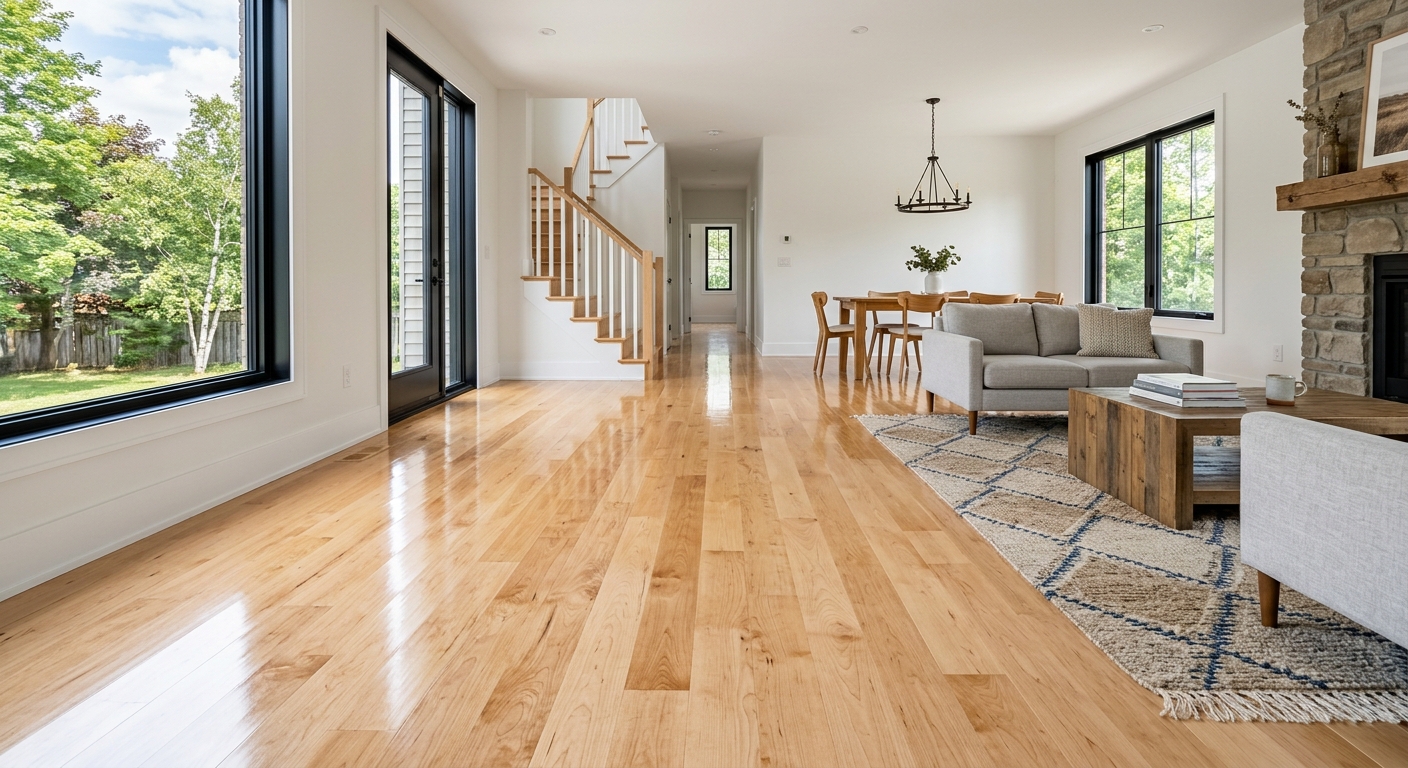
Flooring options and costs in Ingersoll
Ingersoll homeowners usually start by asking what it will cost to redo floors, and the honest answer is that pricing depends on product stability and the prep work your home needs. About 54.6% of homes in Ingersoll were built before 1981, and many of those older builds have uneven plank subfloors or past patchwork that requires levelling compound, smoothing, or even an OSB overlay before a finish surface can go down. With London-area winters and summer humidity swings, that prep matters just as much as the chosen material. In a mixed-humidity, cold-climate zone, moisture and temperature changes stress natural wood through seasonal gapping and cupping, and basements in particular tend to be more moisture-prone than above-grade rooms.
That’s why, in the London region, contractors more often steer clients toward engineered hardwood or luxury vinyl plank (LVP) for lower levels and rooms that see variable humidity. You’ll also hear more talk about radiant heat compatibility during planning, because properly rated engineered wood, LVP, tile, and many laminates tend to behave better over heating systems than traditional solid hardwood. Ingersoll’s older neighbourhoods and established pockets near downtown and along the Wharncliffe/Thamesford-area commuter routes are where we see the most retrofit demand—often tied to basement finishing, kitchen updates, and open-concept renovations.
Below is a practical comparison of the common flooring types we install in and around Ingersoll, including realistic per-square-foot budget ranges to help you read quotes before the details (like moisture mitigation and subfloor prep) are priced.
| Type |
Best Room |
Moisture Resistance |
Lifespan |
Price per sq ft |
| Solid hardwood (nail-down, above grade only) |
Main floor living spaces |
Low (not for basements) |
20–35 years |
$9,00 – $15,00 |
| Engineered hardwood (float or glue, above + on-grade) |
Living/dining, hallways |
Medium to high (more stable than solid) |
15–30 years |
$9,50 – $14,50 |
| Laminate (click-lock, above-grade) |
Bedrooms, living rooms |
Low to medium (avoid wet areas) |
10–20 years |
$4,50 – $9,00 |
| Luxury vinyl plank / LVP (waterproof, any level) |
Kitchen, basement, main floor |
High (waterproof surface) |
15–25 years |
$4,50 – $9,00 |
| Porcelain / ceramic tile |
Kitchen, bathrooms, entries |
Very high (when installed correctly) |
25–50 years |
$12,00 – $25,00 |
| Carpet (broadloom or modular tile) |
Bedrooms, family rooms |
Low to medium (needs dry subfloor) |
7–15 years |
$4,00 – $8,00 |
Prices are estimates only and vary by project scope, site access and material selection.
What affects the price of flooring in Ingersoll
In Ingersoll and the broader London-area market, two homeowners can get quotes that look nothing alike for the “same” flooring because the cost drivers aren’t just product price—they’re installation risk and moisture management. It’s common to see 30–50% differences between quotes when one contractor includes proper subfloor levelling, a vapour barrier/underlay package, and a detailed plan for below-grade conditions, while another assumes the existing surface is ready to accept finish flooring. In a mixed-humidity, cold-climate zone, that assumption can be expensive later: solid hardwood expands and contracts with indoor humidity and cannot be installed over concrete. Below grade, it performs poorly and can void warranties if moisture exceeds product limits.
Engineered hardwood and LVP handle temperature and humidity swings far better, so they’re often priced higher than laminate but with less risk. Colder Southwestern Ontario winters also mean many clients consider radiant heat, where most traditional solid hardwood is restricted and only certain engineered/LVP/tile and compatible laminates make the cut. Older housing stock (with 54.6% of homes built before 1981) frequently needs repair or levelling before any flooring goes down; in practice, that adds about $1–$4 per square foot depending on how uneven the subfloor is and whether we need an overlay. Basement work can push budgets further because moisture-prone slab-on-grade and foundation areas often require a vapour barrier/underlay system and careful sealing at edges.
For example, in a 500 sq ft project, shifting from laminate at roughly $4,50 – $9,00 to engineered hardwood around $9,50 – $14,50 can be worth it when your main concern is stability through humidity swings. Conversely, choosing LVP at $4,50 – $9,00 in a basement can save more than it costs versus “trying” solid wood where warranty risk is high—labour to replace warped materials often wipes out any initial savings.
| Price Factor |
Why It Matters |
Cost Impact |
| Room area in sq ft |
Material use and installation labour scale directly with coverage and waste |
Lowest per sq ft on larger, clear rooms; smaller jobs can cost 10–20% more |
| Subfloor condition |
Levelling/patching is often needed in older Ingersoll homes |
Typically adds about $1–$4 per sq ft for repair/levelling |
| Moisture / below-grade install |
Moisture management is required; solid hardwood is often ruled out |
May add vapour barrier/underlay/dehumidification guidance: commonly $1–$3 per sq ft |
| Material choice |
Solid vs engineered vs LVP vs tile changes complexity, underlay needs, and install method |
Can swing budgets across the local bands: about $4–$25 per sq ft depending on product |
| Removal and disposal of existing flooring |
Demo time, haul-away fees, and dust control are labour-driven |
Commonly adds $1–$3 per sq ft, higher if there’s tile/old adhesive |
| Stair nosing / transitions |
Steps and door transitions take more trim, measuring, and finishing |
Charged per step or linear foot; can add several hundred dollars on typical homes |
| Radiant heat compatibility |
Limits options and requires correct product ratings and acclimation |
May increase material cost; sometimes modest labour changes |
| Installation method |
Float, glue-down, and nail-down all require different prep, adhesives, and precision |
Glue-down and tile typically cost more labour than floating LVP/laminate |
Permits & regulations in Ontario
In Ontario, flooring installation itself typically does not require a building permit. That said, some flooring-related work absolutely can trigger permitting and inspections—especially when you touch electrical circuits or structural systems. For example, adding, modifying, or relocating radiant in-floor heating components (thermostats, power feeds, or new heating circuit wiring) generally falls under electrical permit requirements. If your project includes structural subfloor repair that affects load-bearing elements (rather than surface levelling or surface patching), permit requirements may apply. In most normal “surface flooring swap” jobs—removing old flooring, levelling the subfloor surface, installing vapour barrier/underlayment, and laying the new floor—permits are usually not required.
In condominiums, permits aren’t always the issue; restrictions are. Many condo corporations regulate noise and sound transmission (STC/IIC expectations), and that can mean specific underlay requirements under laminate and engineered products on upper floors. Before you install any new hard flooring in a unit, review the condo declaration and ask for board approval in writing, especially if you’re upgrading hardwood, engineered wood, tile, or adding underlayment changes.
To verify your contractor in Ingersoll, confirm they can legally work in Ontario and that paperwork is current: (1) check the Ontario licensing/registration status through the appropriate provincial online registry for the contractor’s category, (2) ask for a certificate of insurance showing liability coverage, and (3) confirm WSIB/WCB clearance or coverage evidence. A reputable contractor will send documents before work starts and include them in the job file.
Best flooring for each room in your Ingersoll home
Choosing the right flooring in Ingersoll comes down to three things: how the room handles moisture, how much traffic it gets, and how much comfort you want underfoot during cold winter mornings. In living and dining rooms, engineered hardwood or high-quality laminate are popular because they balance warmth and durability with better dimensional stability than solid wood when humidity swings. For the master bedroom, carpet is often the most comfortable option and helps with sound absorption—useful in 2-storey and multi-family layouts common around town. If you’re looking for a harder surface, engineered hardwood is usually the safer “wood look” choice.
For kitchens, you’ll usually see luxury vinyl plank (LVP) or large-format porcelain tile. LVP is waterproof on the surface and handles everyday spills better in a climate where indoor humidity can drift well outside ideal ranges. Basements are where the choice becomes non-negotiable: LVP is the clear winner for finished basements because it tolerates below-grade moisture conditions much better than solid hardwood and most laminate. Bathrooms should be porcelain or ceramic tile because it’s designed for wet areas, and the correct underlayment and grout sealing make the difference.
Radiant heat is increasingly common in Ontario renovations and new builds, and it influences your options. Products with confirmed radiant heat compatibility (many engineered wood and tile systems, and many LVP options) tend to perform better than traditional solid hardwood, which is often limited. As a real pricing example, upgrading from laminate around $4,50 – $9,00 to engineered hardwood around $9,50 – $14,50 can be justified in your main living areas when you want longer life and improved stability—especially in homes built before 1981 where subfloor prep often becomes part of the plan.
| Room |
Best Material |
Why |
Moisture Risk |
Price Band per sq ft |
| Living / dining room |
Engineered hardwood |
Warm appearance with better stability through seasonal humidity swings |
Low to medium (avoid wet mopping; protect at entrances) |
$9,50 – $14,50 |
| Master bedroom |
Carpet or engineered hardwood |
Comfort and sound control (carpet) or a durable wood look (engineered) |
Low (use proper underlay and keep subfloor dry) |
$4,00 – $9,00 |
| Secondary bedrooms |
High-quality laminate |
Budget-friendly and easy maintenance for day-to-day life |
Low (quick clean-up needed after spills) |
$4,50 – $9,00 |
| Kitchen |
Luxury vinyl plank (LVP) or porcelain tile |
Water resistance, easier cleanup, and better resilience to dropped items |
Medium (spills and humidity from cooking) |
$4,50 – $25,00 |
| Basement (finished) |
Luxury vinyl plank (LVP) |
Designed for moisture-prone, below-grade installs; less risk than solid wood |
High (vapour/moisture management is still important) |
$4,50 – $9,00 |
| Bathroom |
Porcelain / ceramic tile |
Superior wet-area performance when installed with correct underlayment and sealing |
Very high (water exposure) |
$12,00 – $25,00 |
How to choose a flooring contractor in Ingersoll
When you’re hiring a flooring contractor in Ingersoll, verify credentials before you sign—then verify the quote details after. Start with proof of Ontario licensing/registration for the contractor’s trade category (where applicable), liability insurance, and WSIB/WCB coverage. The practical approach is simple: ask for the certificate of insurance (and confirm the policy dates), request WSIB/WCB clearance (or coverage documentation), and confirm their licensing status using the relevant online registry. If they hesitate or provide outdated documents, that’s a signal.
Get 2–3 itemised, written quotes. You want a breakdown that separates labour and materials, not a single lump sum. Ask what’s included in each line item: subfloor prep, levelling compounds, underlayment/vapour barrier type, baseboards, transitions, stair work, removal, and disposal. A complete scope matters in older Ingersoll homes, where 54.6% were built before 1981 and hidden unevenness is common.
Warranty clarity is critical. Confirm the workmanship warranty length, the manufacturer/product warranty terms, and whether coverage is transferable if you sell your home. For payment, never pay more than about 10–15% upfront; hold a portion back until the job is complete and you’ve confirmed floor heights, transitions, and trim are finished. Also ask for a written timeline with a start date and completion estimate—delays often happen when moisture testing, levelling materials, or product lead times aren’t planned.
- Provide a clear itemised quote (labour + materials), including underlay/vapour barrier type.
- Spell out what subfloor prep is included and who is responsible for correcting existing defects.
- Confirm whether removal and disposal are included (and how much demo is expected).
- List stair nosing and transitions as separate line items (per step/per linear foot).
- State the acclimation plan for wood products (especially for engineered/solid).
- Ask about moisture testing and what happens if readings exceed product limits.
- Show you the product specifications for radiant heat compatibility if needed.
- Provide written warranty details: workmanship duration and manufacturer warranty terms.
- Confirm whether warranties require correct underlayment/adhesives used exactly as specified.
- Payment schedule: keep upfront payment within 10–15% and hold back until completion.
- Get start date and completion estimate in writing, including expected inspection or follow-up steps.
- Confirm jobsite protection (dust control, floor protection for ongoing construction).
Red flags to watch for in Ingersoll: they won’t provide insurance/WSIB documentation, they quote without addressing moisture/subfloor condition, they refuse to itemise prep and underlayment, they only offer a vague “one-price” scope, or they push for a large upfront payment with no signed scope and schedule.
Frequently asked questions — flooring in Ingersoll
How do I prepare my subfloor before new flooring?
In Ingersoll, subfloor preparation is usually the deciding factor between a flooring job that stays flat and one that develops problems later. First, the surface must be clean, dry, and flat. For older homes (many built before 1981), it’s common to find unevenness or old patchwork that needs levelling compound or sanding of high spots before installation. If you’re going over concrete or a slab-on-grade basement area, you may also need a vapour barrier and an underlayment system appropriate to your product—especially to protect warranties. Avoid installing over soft spots, loose planks, or moisture-affected areas. A good contractor will measure flatness, and if moisture is a concern, they’ll recommend the right moisture-control approach before any finish flooring goes down.
Is cork or bamboo flooring a good choice in Ingersoll?
Cork and bamboo can work in Ingersoll, but they aren’t always the best fit for every room. Cork is generally comfortable and can help with sound, and bamboo can provide a harder, wood-like look. The catch is moisture stability: our mixed-humidity, cold-climate swings can stress natural materials, especially in below-grade spaces. Cork is often best in above-grade rooms where humidity is controlled and spills are cleaned quickly. Bamboo’s performance depends heavily on the product build and whether it’s engineered vs solid. If you’re considering cork or bamboo for a basement, discuss engineered/water-resistant options and moisture-control requirements—otherwise, it’s usually safer to choose engineered hardwood or LVP. For reference, budget-friendly LVP commonly lands in the $4,50 – $9,00 range, while many natural-fibre options can approach engineered hardwood pricing once installed correctly.
What is the difference between floating and glued-down flooring?
Floating flooring means planks or panels aren’t mechanically fastened to the subfloor; they click together and “float” over an underlayment. Glued-down flooring is installed with adhesive, so the planks bond directly to the prepared subfloor surface. In Ontario’s temperature and humidity swings, floating installs can be a great choice for many engineered and laminate systems when the subfloor is properly flat and dry. Glued-down installation often provides a more rigid feel and can be selected for certain engineered products, but it requires strict prep and the correct adhesive. In basements or moisture-prone areas, what matters most is whether the product is rated for your installation type and moisture exposure—solid hardwood generally isn’t recommended, while engineered and LVP are designed for better dimensional stability. Always follow the manufacturer’s instructions for underlay and adhesive to avoid warranty issues.
What flooring holds up best to pets in a Ingersoll home?
For pets in Ingersoll, durability and scratch resistance matter as much as comfort. LVP is a common top choice because it’s waterproof on the surface and stands up well to everyday accidents and cleaning. If you want a wood look, engineered hardwood can work well in above-grade areas, but it still needs protection against extended moisture and sharp claw damage. Laminate is another option for budget-conscious installs, but it’s best when pet messes are cleaned promptly and the seams aren’t exposed to standing water. Carpet can be comfortable, but it typically stains more easily and can hold odours if moisture gets into the padding. For many homeowners, the price band makes the decision simple: LVP is often around $4,50 – $9,00 installed, which can be a better value than tile when you also want warmth underfoot. Choose thicker wear layers and realistic pet-traffic planning for best long-term results.
How do I fix squeaky floors in my Ingersoll home?
Squeaks usually come from movement between subfloor layers, or nails/screws that have loosened over time—not from the finish flooring itself. In Ingersoll’s older housing stock (including many homes built before 1981), squeaks are commonly tied to old boards, inadequate fasteners, or movement over joists. The most reliable fix is to identify the source by walking the floor and checking joist/subfloor movement from below if possible (or by opening a small section from above). Then the contractor can add fastening where appropriate—often using screws designed for subfloor-to-joist connection. Only after the structure is solid should new flooring be installed. If you replace flooring without addressing squeaks, the new material may remain stable but the underlying noise can persist. When you get quotes, ask whether the scope includes subfloor fastening and repair, not just levelling.
What is luxury vinyl plank and is it worth it in Ingersoll?
Luxury vinyl plank (LVP) is a layered vinyl floor with a wear layer on top. Many LVP products are waterproof on the surface, which is why it’s such a strong fit for Ingersoll homes—especially basements and rooms that see humidity swings. In our mixed-humidity, cold-climate conditions, LVP resists the cupping/warping risk that comes with solid hardwood, and it’s generally more forgiving when indoor humidity drifts beyond ideal ranges. It also performs well for radiant heat when the product is rated for it. Is it worth it? For many homeowners, yes—particularly if you want practical maintenance and moisture resistance. With local pricing commonly landing around $4,50 – $9,00 per sq ft installed, LVP can deliver excellent value versus tile in terms of comfort and install speed, while still outperforming laminate in real-life spill scenarios.