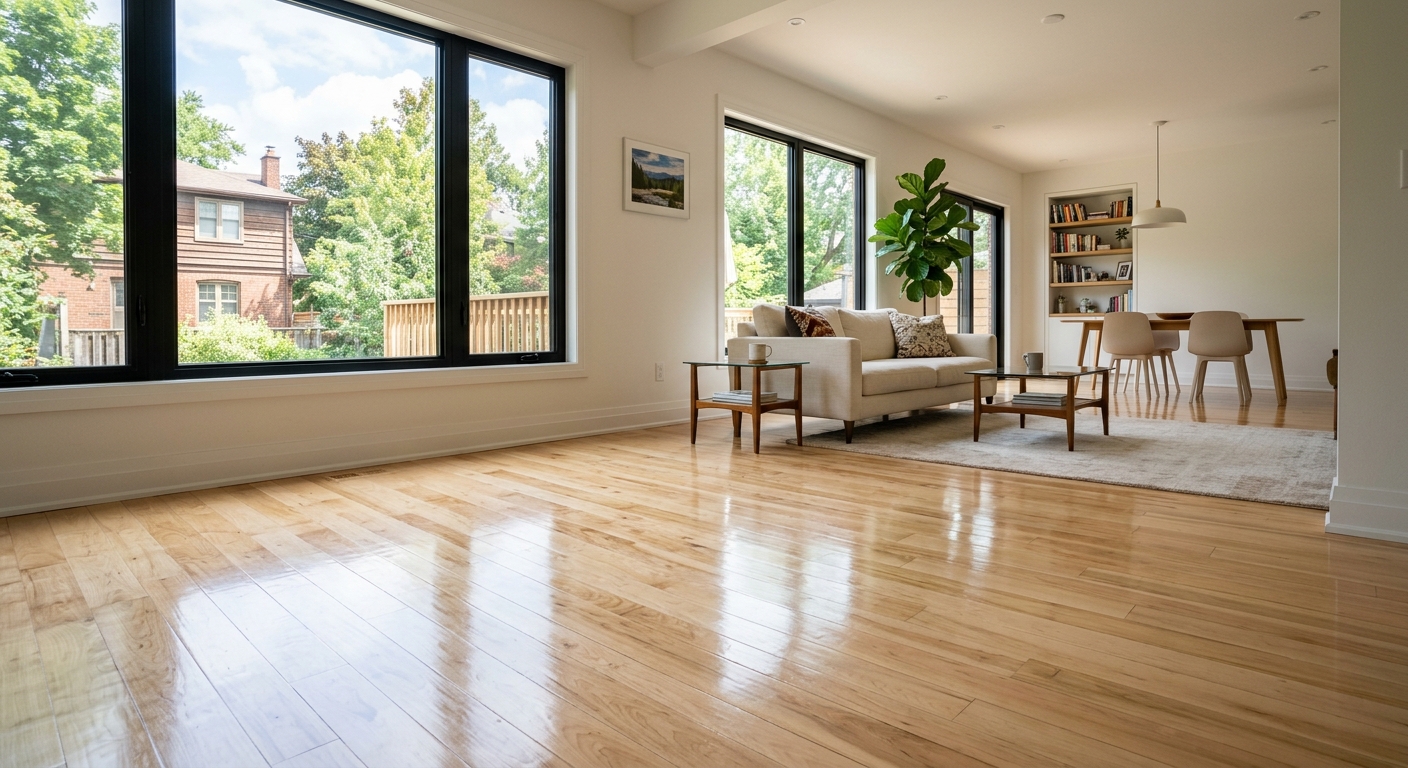
Flooring options and costs in Kincardine
Kincardine homeowners typically face a mix of older homes, uneven subfloors, and humidity swings that can turn an “easy” flooring job into a full prep-and-install project. With 12,268 residents and about 60.7% of homes built before 1981 (Statistics Canada, 2021 Census), many basements and main floors start out with subfloor repairs, levelling needs, or moisture control steps that increase total cost before you even pick a finish. In the Stratford–Bruce Peninsula area, indoor humidity can swing notably between winter and summer, and basement moisture is common—so material choice is a major cost driver.
That climate reality also affects availability and quoting. Contractors in and around Kincardine are used to steering clients toward engineered wood or luxury vinyl plank (LVP) for higher-humidity areas and below grade, because these products tolerate seasonal movement better than solid hardwood. The colder local conditions also make radiant floor heating a frequent renovation request; many solid hardwoods and low-end laminates won’t handle temperature cycling, which can narrow the product options (and change the price). If you’re working in neighbourhoods with more mature housing stock—like the older pockets near Harbourview and downtown core—expect more time spent on prep, transitions, and cleanup.
Below are practical Kincardine price bands for common flooring types, assuming typical residential conditions and basic subfloor preparation.
| Type |
Best Room |
Moisture Resistance |
Lifespan |
Price per sq ft |
| Solid hardwood (nail-down, above grade only) |
Main level living areas (not basements) |
Low to moderate; sensitive to humidity changes |
25–50 years |
$10 – $18 |
| Engineered hardwood (float or glue, above + on-grade) |
Living rooms, hallways, on-grade bedrooms |
Moderate to high; better with seasonal swings |
15–30 years |
$11 – $17 |
| Laminate (click-lock, above-grade) |
Bedrooms, living rooms (avoid basements) |
Low to moderate; limited tolerance for moisture |
10–20 years |
$4 – $10 |
| Luxury vinyl plank / LVP (waterproof, any level) |
Basements, kitchens, entry areas |
High; waterproof core |
15–25 years |
$6 – $14 |
| Porcelain / ceramic tile |
Kitchens, bathrooms, foyers |
Very high; handles wet conditions |
25–50 years |
$12 – $22 |
| Carpet (broadloom or modular tile) |
Bedrooms, rec rooms |
Moderate; avoid damp basements |
7–15 years |
$5 – $11 |
Prices are estimates only and vary by project scope, site access and material selection.
What affects the price of flooring in Kincardine
Two quotes for the “same” flooring can differ by 30–50% across Stratford–Bruce Peninsula and the wider Ontario market because prep work and compatibility requirements change from house to house. In Kincardine specifically, indoor humidity swings plus basement moisture mean contractors often price extra time for acclimation, moisture testing, and subfloor repair. With many dwellings in the area dating back before 1981 (Statistics Canada, 2021 Census), it’s also common to find floors that are out of level or have damaged sheathing that must be repaired or levelled before install.
Technically, humidity is a major driver: solid hardwood expands and contracts with indoor conditions and cannot be glued or floated over concrete; it also performs poorly in basements where moisture vapour is more likely. That’s why engineered hardwood and LVP are typically priced as the “do-it-right” options for higher-humidity areas. Colder-season renovations further matter because radiant floor heating is increasingly used in Ontario; many solid hardwoods and some budget laminates can’t handle temperature cycling, so you pay more for radiant-compatible products or adjust the system approach. Local labour availability and experience also affects pricing—teams that routinely prep older subfloors will price those steps into the quote instead of trying to cover surprises later.
Concrete Kincardine examples: (1) if your basement slab shows moisture or the subfloor needs repair, switching from solid hardwood to LVP can prevent callbacks and add value even if LVP sits at $6–$14 per sq ft; (2) levelling an older main floor can add about $1–$4 per sq ft in prep and materials—often enough to narrow the gap between laminate ($4–$10 per sq ft) and engineered wood ($11–$17 per sq ft) once you account for longevity and reduced risk.
| Price Factor |
Why It Matters |
Cost Impact |
| Room area in sq ft |
Material quantity and labour hours scale directly with square footage |
Typically the largest driver of total cost |
| Subfloor condition |
Levelling and repair may be required to get a flat, stable base |
Commonly adds $1–$4 per sq ft |
| Moisture / below-grade install |
Moisture vapour rules out solid hardwood and low-tolerance laminate |
May shift you to engineered/LVP or add vapour mitigation |
| Material choice |
Solid vs engineered vs LVP vs tile changes price and install requirements |
Often ranges by roughly $4–$12 per sq ft installed, depending on product |
| Removal and disposal of existing flooring |
Old flooring removal adds time, dust control, and disposal fees |
Can add a noticeable fixed cost to smaller rooms |
| Stair nosing / transitions |
Stairs require extra cutting, nosing profiles, and careful finishing |
Charged per step or per linear foot; increases project total |
| Radiant heat compatibility |
Not every product handles temperature cycling safely |
May increase material cost and underlayment requirements |
| Installation method |
Float vs glue-down vs nail-down affects subfloor prep and labour time |
Glue-down and tile generally increase labour and prep complexity |
Permits & regulations in Ontario
In Ontario, installing new flooring by itself usually does not require a building permit. That includes replacing carpet, laminate, LVP, engineered hardwood, or tile as a finish layer. Where permits can come into play is when the flooring project includes work that changes building systems or structure—especially electrical and some subfloor/structural remediation.
Typically NOT requiring a permit: removing existing flooring, installing a new subfloor underlayment, floating engineered wood, click-lock laminate, nail-down solid hardwood (on approved above-grade substrates), and setting LVP or tile as a finish. In most single-family projects, moisture mitigation like floor venting and adding approved underlay systems is treated as part of the install scope, not a permit-triggering change.
May require a permit: modifying or adding wiring for radiant in-floor heating controls; any electrical circuit work connected to in-floor heating; and structural subfloor repairs that involve joists or bearing elements beyond simple patching (contractors typically coordinate the right steps before starting). In condominiums, the larger constraint is usually the corporation’s rules: sound transmission requirements (STC/IIC) may restrict underlay choices and limit what you can install above carpet-free areas.
To protect yourself in Kincardine, verify the contractor’s Ontario business licence (municipal/local requirements may vary), and confirm they carry liability insurance and WSIB/WCB coverage. Ask for a current certificate of insurance and clearance letter—then check that the named insured and project address align with your job. For licence status, start with provincial/online business registries and any trade listing the contractor provides, and always keep copies with your quote.
Best flooring for each room in your Kincardine home
Kincardine homes feel the seasons—so the “best” floor depends on which rooms face humidity, spills, and temperature changes. For living and dining areas, homeowners usually want a warm look with durability. In this region, engineered hardwood or a high-quality laminate gives you comfort and easier day-to-day maintenance, while handling Kincardine’s indoor moisture swings better than solid hardwood. For master bedrooms, I often recommend carpet for comfort and sound absorption, especially where you want a quiet retreat; engineered hardwood is the alternative if you prefer a harder surface.
Kitchens and entryways are different: splash risk plus frequent cleaning make luxury vinyl plank (LVP) or large-format porcelain tile a smart choice. LVP offers waterproof performance where moisture can track in, and porcelain tile handles wet mopping and minor flooding better than wood products. Basements are where the Stratford–Bruce Peninsula climate shows up most—LVP is the clear winner in many finished basements because it tolerates moisture vapour and stays dimensionally stable. Solid hardwood and most laminate options can cup, gap, or swell if the basement environment is inconsistent.
Bathrooms should be porcelain/ceramic tile only, particularly around showers and wet zones. And if you’re renovating over in-floor heating (increasingly common in Ontario), choose radiant-compatible products: many engineered woods and LVP options work well, while many solid hardwood and low-end laminate products can fail under temperature cycling.
To see why the price difference can be justified: if you’re comparing laminate at $4–$10 per sq ft versus LVP at $6–$14 per sq ft, the extra cost often pays back in a basement install where waterproof performance reduces the likelihood of moisture-related callbacks—especially in older homes built before 1981 where prep and moisture control are frequently required.
| Room |
Best Material |
Why |
Moisture Risk |
Price Band per sq ft |
| Living / dining room |
Engineered hardwood |
Warm feel with better stability through seasonal humidity swings |
Low to moderate |
$11 – $17 |
| Master bedroom |
Carpet or engineered hardwood |
Carpet improves comfort and sound; engineered holds up better than solid in variable humidity |
Low |
$5 – $17 |
| Secondary bedrooms |
Laminate (radiant-compatible when required) or carpet |
Good value for everyday traffic if kept above-grade dry |
Low |
$4 – $10 |
| Kitchen |
Luxury vinyl plank (LVP) or porcelain tile |
Easy cleanup and strong performance under spills and wet mopping |
Moderate to high |
$6 – $22 |
| Basement (finished) |
Luxury vinyl plank (waterproof) |
Handles moisture vapour and below-grade conditions better than solid wood or most laminate |
High |
$6 – $14 |
| Bathroom |
Porcelain / ceramic tile |
Highest wet-zone reliability for showers, tubs, and frequent cleaning |
Very high |
$12 – $22 |
How to choose a flooring contractor in Kincardine
Choosing the right flooring contractor is mostly about verifying proof, not promises. In Ontario, ask for their current liability insurance and WSIB/WCB coverage (or the appropriate clearance/coverage proof). For how to check: request a certificate of insurance and confirm the policy is active and covers flooring installation activities; ask for a WSIB clearance letter showing the contractor is in good standing for the work they’ll perform. Also confirm the quote includes any necessary labour for moisture testing, levelling, and underlayment installation—especially important in Kincardine because older homes frequently need prep.
Get 2–3 itemised written quotes, not lump sums. A proper quote breaks down labour and materials (flooring, underlay/vapour barrier if applicable, levelling compound, patching/repair, transition pieces, removal and disposal, and stair work). Read the scope carefully: ask what’s excluded (for example, mould remediation, subfloor reconstruction, or electrical work for radiant systems). Confirm disposal is included if they’re tearing out existing flooring.
Warranty matters twice: workmanship warranty (how long they stand behind the install) and manufacturer warranty (what’s covered for the product). Ask whether warranties are transferable if you sell your home and whether acclimation and approved underlay were used. On payment schedule, never pay more than 10–15% upfront; hold back until the job is complete and any punch-list items are done. Finally, ask for a start date and completion estimate in writing so you can plan around deliveries and room access.
- Provide proof of liability insurance and WSIB/WCB clearance before scheduling.
- Use an itemised quote: labour, materials, underlay/levelling, transitions, and removal/disposal.
- Confirm subfloor expectations: “level within tolerance” and how they’ll fix low spots.
- Ask about moisture testing or moisture-mitigation steps for basements.
- Get radiant heat compatibility confirmed in writing if you have in-floor heating.
- Specify acclimation time for wood products (especially engineered) on delivery day.
- Clarify who supplies reducers, stair nosing, and finishing trim.
- Ask how they protect walls, stairs, and door jambs during installation.
- Confirm disposal and dumpster/haul-away costs are included or clearly priced.
- Require the warranty terms in writing: workmanship length and exclusions.
- Confirm payment schedule and holdback amount (10–15% max upfront).
- Ask for an on-site visit before quoting to check out-of-level conditions and access.
Red flags I see in Kincardine: quoting a complex basement job without discussing moisture control, using a single lump-sum “it depends” price, refusing to list underlay/levelling materials, offering large upfront payments (beyond 10–15%), and giving vague warranty language that doesn’t separate product coverage from workmanship.
Frequently asked questions — flooring in Kincardine
Can I install hardwood over concrete?
In Ontario and around Kincardine, you can install wood over concrete only in the right way and for the right product type. Solid hardwood (especially nail-down) generally isn’t installed directly over concrete slab. Solid boards are designed to move with consistent indoor humidity and typically need an above-grade application on a proper wood subfloor structure. If you have concrete, engineered hardwood is usually the better choice because it can be installed as a glue-down or float system on approved slabs, assuming the slab is dry and meets flatness requirements. For older Stratford–Bruce Peninsula homes, slab and subfloor moisture can be a factor, so your contractor should confirm moisture conditions before installation. If you want the look of hardwood with fewer risks, engineered hardwood costs often land around the $11–$17 per sq ft range versus $10–$18 for solid, but it’s frequently worth it for stability.
How long does flooring installation take?
Most Kincardine residential installs take anywhere from 1 to 5 days, depending on the flooring type and how much prep is needed. For example, click-lock laminate or floating engineered hardwood can progress quickly once the subfloor is ready. Tile and glue-down systems usually take longer due to additional prep and cure times, and stairwork can add days even on small jobs. In the Stratford–Bruce Peninsula area, older homes built before 1981 often need levelling/repair, and that prep time is what pushes schedules out. If your project includes moisture mitigation for a basement, plan extra time for testing and for materials to set properly. Ask your contractor for a written start date and completion estimate, and confirm how they handle drying/curing windows for levelling compounds.
What flooring works with radiant heat?
Radiant floor heating is popular in Ontario renovations, and in Kincardine you should treat it as a “product compatibility” test. Many solid hardwood products can be too sensitive to temperature cycling, and many low-end laminate options also aren’t designed for radiant systems. Typically, engineered hardwood, many luxury vinyl plank (LVP) products, and porcelain/ceramic tile are the safest categories when installed with the manufacturer’s approved underlayment (or thin systems where required). If you’re using radiant heat, you’ll want documentation from the flooring manufacturer confirming “radiant compatible” installation guidelines, including maximum heat settings and required underlay types. This matters because your installation method and underlay can affect performance. Your contractor should confirm these details before ordering—especially since older regional homes often already have (or are being retrofitted with) heating upgrades.
Engineered vs solid hardwood — what's the difference?
The biggest difference is how each product tolerates humidity and how it’s installed. Solid hardwood is one continuous layer of wood and is typically installed nail-down above grade. It expands and contracts more noticeably with seasonal moisture swings, so basements and concrete slabs are where it often struggles. Engineered hardwood is made of wood layers with a stable core, so it tolerates humidity changes better and can be installed on approved on-grade or slab conditions using float or glue-down methods. In Kincardine, where there are indoor humidity swings and older housing stock is common (Statistics Canada, 2021 Census), engineered is often the “safer hardwood look.” Budget-wise, solid hardwood is often in the $10–$18 per sq ft band, while engineered commonly lands around $11–$17 per sq ft, with the real-world decision depending on where you’re installing and whether radiant heat is involved.
Do I need to level my subfloor first?
In most Kincardine installs, yes—at least to a “flat enough” standard—because uneven subfloors lead to squeaks, gaps, joint separation, and premature wear. In the Stratford–Bruce Peninsula region, it’s common to find older floors out of level or with minor subfloor deterioration, especially in homes built before 1981 (Statistics Canada, 2021 Census). Whether you “must” level depends on the tolerance requirements of your chosen product, but reputable installers measure the floor before quoting. If levelling is needed, it can add labour and materials, often around $1–$4 per sq ft, and that’s why two quotes may differ even when the flooring looks the same. Also confirm moisture mitigation steps if you’re working on a basement—levelling without addressing moisture is a recipe for callbacks.
What's the most durable flooring for pets and kids?
For durability in Kincardine’s climate and day-to-day family life, luxury vinyl plank (LVP) is often the top pick because it’s waterproof, handles humidity better than wood floors, and resists many common spills and splashes. If you can keep it away from sharp impacts and use proper mats at entries, LVP typically holds up very well for kids and pet traffic. Porcelain/ceramic tile is also extremely durable for scratches and moisture, especially in kitchens and entryways, but it can be harder underfoot. Carpet is comfortable and good for sound, but in basements or damp areas it can be less forgiving. If you’re comparing price bands, LVP commonly sits around $6–$14 per sq ft, while tile is often $12–$22 per sq ft—so the best value comes down to where you’re installing. In many homes in this region, the “durable” choice isn’t just about wear; it’s about selecting the material that won’t react to moisture swings.