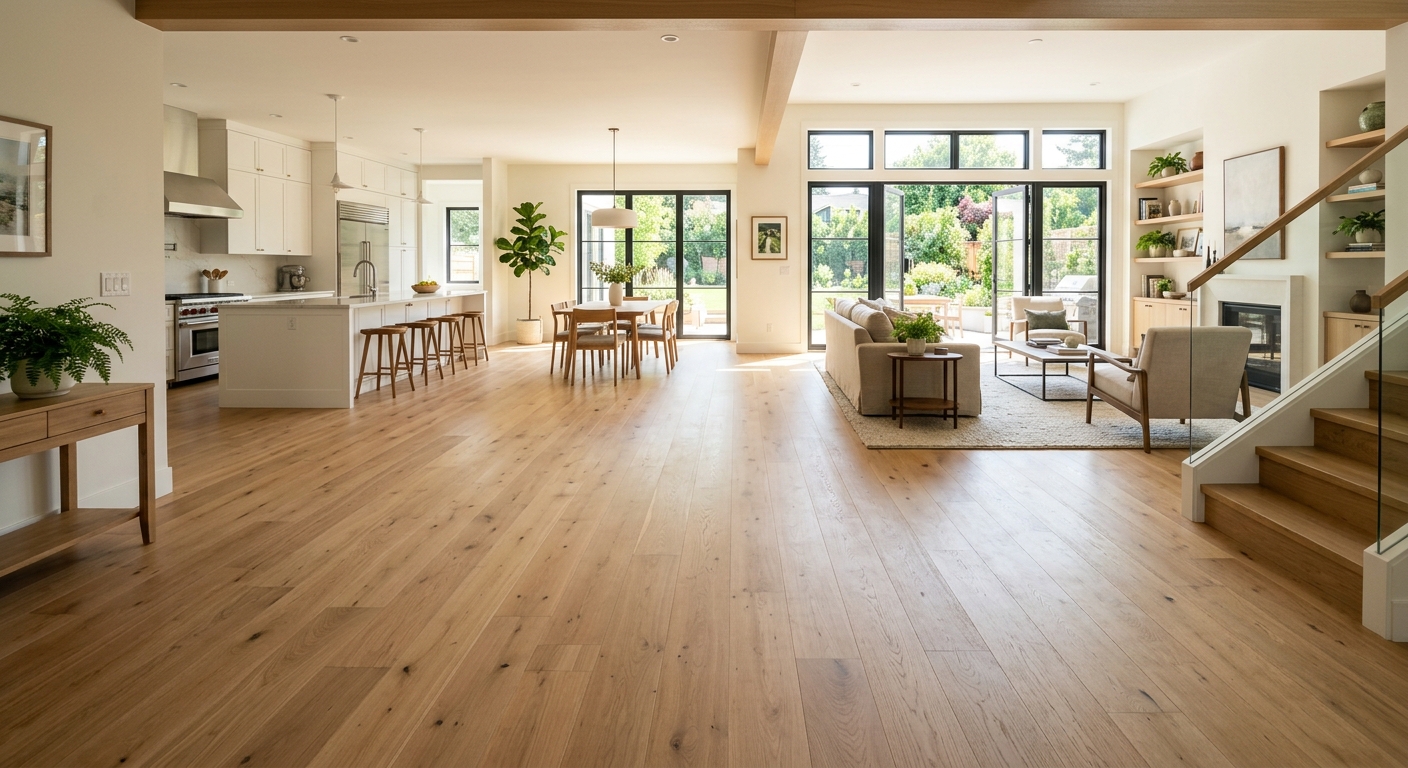
Flooring options and costs in Leamington
Leamington homeowners have a lot of choice, but the “right” flooring usually comes down to moisture control and how your home was built. With 58.7% of dwellings built before 1981, many houses start with older slabs or uneven subfloors, which often means levelling/patching or an OSB overlay before finish flooring goes down. That prep work is a major reason some bids come in higher even when the visible flooring material looks similar.
In the Windsor–Sarnia corridor, we typically see dry winter air paired with humid summers, and many basements sit over damp concrete. That’s why vapor barriers, moisture testing, and better underlayments matter here. Solid hardwood can expand and contract with humidity and generally shouldn’t be installed over concrete or in basements; engineered hardwood and waterproof luxury vinyl plank (LVP) handle these swings better and are often the safest choices in higher-humidity areas. If you’re installing over in-floor radiant heat—becoming more common in Southwestern Ontario—solid hardwood can be too restrictive, while engineered wood, tile, and some LVP systems are more compatible.
In Leamington, demand is especially steady in areas like the east end near Erie Street and the Leamington downtown corridor, where trades are busy with occupied-home renovations and basement finishing. Use the table below to compare typical installed price bands and what each material does best.
| Type |
Best Room |
Moisture Resistance |
Lifespan |
Price per sq ft |
| Solid hardwood (nail-down, above grade only) |
Living room, hallway (above grade) |
Low to moderate; not for basements |
20–35 years |
$10–$18 |
| Engineered hardwood (float or glue, above + on-grade) |
Main level, bedrooms (with proper underlayment) |
Moderate to good; tolerates humidity swings better |
15–30 years |
$10–$17 |
| Laminate (click-lock, above-grade) |
Living room, bedrooms (dry areas) |
Moderate; avoid high-humidity basements |
10–20 years |
$5–$10 |
| Luxury vinyl plank / LVP (waterproof, any level) |
Kitchen, main floor, finished basement |
High; waterproof core |
15–25 years |
$7–$14 |
| Porcelain / ceramic tile |
Kitchen, entry, bathrooms |
Very high; handles spills and humidity well |
25–50 years |
$12–$22 |
| Carpet (broadloom or modular tile) |
Bedrooms, finished basements (if moisture-controlled) |
Low to moderate; needs clean, dry subfloor |
8–15 years |
$7–$13 |
Prices are estimates only and vary by project scope, site access and material selection.
What affects the price of flooring in Leamington
In Leamington and the broader Windsor–Sarnia region, two quotes for what looks like the same “new flooring” can swing by 30% to 50%. The biggest reason is that the visible surface is only part of the job—prep work, moisture management, and subfloor corrections often change the labour and materials count. In a market where homeowners are actively maintaining and upgrading their homes (7,305 homeowner households, representing 69.3% of households), contractors get booked for both fresh installs and “fix-first” renovations where the subfloor needs attention before product goes down.
Technically, the region’s indoor humidity swings and below-grade moisture are the core cost drivers. Solid hardwood expands and contracts with humidity, and it’s not designed for direct or floating installs over concrete. In basements, it can perform poorly unless moisture levels are controlled, which is why engineered hardwood and waterproof LVP are so common. In colder areas with more radiant heat usage, material compatibility affects pricing: many solid wood products and some laminate options are less forgiving under cyclical heating.
Older housing stock frequently needs levelling or repair. Even a modest repair can add about $1 to $4 per sq ft in many homes depending on whether we’re patching low spots, addressing squeaks, or rebuilding a damaged subfloor. In one Leamington-style scenario—say, a 400 sq ft main floor—those prep steps can be the difference between a mid-band laminate/LVP install versus a premium tile or engineered hardwood job. It’s also common to see the total land closer to the $10–$18 hardwood band when moisture testing, upgraded underlayment, and subfloor corrections are required.
Next, the table breaks down the factors that most often change your final number.
| Price Factor |
Why It Matters |
Cost Impact |
| Room area in sq ft |
Material quantity and labour time scale with area |
Usually predictable; small jobs often cost more per sq ft |
| Subfloor condition |
Levelling/repair ensures flatness and prevents floor failure |
Often adds material + labour; commonly ~$1–$4/sq ft |
| Moisture / below-grade install |
Basements over concrete often need vapor control |
Can add testing, barriers, and premium underlayment |
| Material choice |
Solid vs. engineered vs. LVP vs. tile have different performance needs |
Hardwood typically higher than laminate/LVP |
| Removal and disposal of existing flooring |
Demo labour, haul-away, and hazardous materials checks |
Variable; increases with tile, thick adhesive, or multiple layers |
| Stair nosing / transitions |
Steps and doorways require tailored trim and finishing |
Charged per step or per linear foot |
| Radiant heat compatibility |
Limits product selection and affects install method |
May require approved underlayment or specific flooring type |
| Installation method |
Float vs. glue-down vs. nail-down changes prep and labour intensity |
Glue-down and nail-down often cost more than basic floating |
Permits & regulations in Ontario
In Ontario, installing new flooring itself usually does not require a building permit. That means a typical hardwood, laminate, LVP, tile, or carpet replacement is normally permit-free. However, some “associated work” can trigger permitting—especially where electrical components or structural changes are involved. For example, if your job includes adding, modifying, or repairing in-floor radiant heating wiring, you may need electrical permits and inspections. Similarly, if the scope includes structural subfloor repairs that go beyond simple patching (for instance, replacing significant framing or altering load-bearing elements), you may need additional approvals.
In condos and multi-unit buildings in Ontario, the bigger constraint is often the corporation’s rules: sound transmission requirements (STC/IIC) can restrict underlay selection on upper floors and may require specific assemblies for hardwood or tile. Always check the condo declaration and request written board approval before installing hard surface flooring above other units.
For Leamington homeowners verifying a contractor, start with licensing and credentials online, then confirm documentation before work begins. Ask for proof of Ontario liability insurance, plus WSIB/WCB coverage (or an acceptable exemption letter if applicable). Finally, request a certificate of clearance for current coverage when possible, and keep copies with your contract. This protects you if a worker is injured or if there’s unexpected property damage during prep, leveling, or installation.
Best flooring for each room in your Leamington home
Choosing the right flooring by room is the fastest way to avoid expensive replacement in Leamington. Our local pattern—dry winter indoor air with humid summers and frequent basement moisture concerns—means basements and kitchens need different materials than living areas. For living and dining rooms, engineered hardwood or high-quality laminate gives warmth and a stable look, especially when installed on a properly prepared, level substrate. In a master bedroom, carpet is still a comfort winner because it reduces sound and feels warmer underfoot.
In kitchens, go with luxury vinyl plank (LVP) or large-format porcelain tile. Both handle spills and routine cleaning far better than solid wood, and LVP’s waterproof core helps when water reaches the floor during busy seasons. For basements, LVP is usually the clear winner: waterproof products handle vapor better than solid hardwood and most laminate systems, which can swell or separate when moisture moves through concrete. Bathrooms should be porcelain or ceramic tile only—tile assemblies are designed for wet conditions.
Radiant heat compatibility matters too. If you’re adding or upgrading in-floor heating, engineered wood, tile, and certain LVP systems are typically easier to manage under cyclical heat, while most solid hardwood installs are more restrictive and can be at risk of gapping without strict controls.
Budget reality example: upgrading from laminate to LVP can be justified when you’re going into a finished basement. If laminate is coming in near the $5–$10 band, but LVP lands around $7–$14, that extra upfront cost often protects you from moisture-driven failures that are far more expensive to fix later.
| Room |
Best Material |
Why |
Moisture Risk |
Price Band per sq ft |
| Living / dining room |
Engineered hardwood |
Warm look with better humidity tolerance than solid |
Low to moderate (manage relative humidity) |
$10–$17 |
| Master bedroom |
Carpet or engineered hardwood |
Carpet adds comfort and sound control; engineered stays stable |
Low |
$7–$14 |
| Secondary bedrooms |
Laminate (above grade) |
Easy care and good durability in typical dry rooms |
Low |
$5–$10 |
| Kitchen |
Luxury vinyl plank (LVP) or porcelain tile |
Water-resistant underfoot and easier cleaning around spills |
Moderate (spills and washdowns) |
$7–$22 |
| Basement (finished) |
Waterproof LVP |
Best balance of moisture tolerance and stable performance over concrete |
High; vapor control is critical |
$7–$14 |
| Bathroom |
Porcelain / ceramic tile |
Built for wet conditions with long-term durability |
Very high |
$12–$22 |
How to choose a flooring contractor in Leamington
Choosing the right flooring contractor in Leamington isn’t just about the lowest line price—it’s about verifying they can handle the moisture and subfloor realities of local homes. First, confirm Ontario liability insurance. Ask for the insurance certificate naming the correct insured parties and ensure the policy is current for your project dates. Next, verify WSIB/WCB coverage: request proof of coverage (or an acceptable clearance/exemption letter if they’re not required). Don’t rely on verbal confirmation—ask for documents and keep copies.
Then get 2 to 3 itemised written quotes. You want a breakdown that separates labour (demo, prep, installation) from materials (underlayment, vapor barrier, adhesives/patching, transitions, stair nosing) and shows any allowances. Request whether moisture testing is included for basement work, and whether subfloor levelling/patching is included or billed separately if conditions are worse than expected.
Read the scope carefully for exclusions: Is removal and disposal included? Are old tack strips/baseboards included or protected? Is the work limited to above-grade areas only? Ask about waste removal and whether they’ll handle room-to-room transitions and stair finishing (often charged per step or per linear foot).
Confirm warranty terms. You should get a clear workmanship warranty (length and what’s covered) plus the manufacturer warranty for the flooring product and underlayments. Ask if it’s transferable to a new owner if you sell your home. For payment schedules, never pay more than 10% to 15% upfront; hold back a portion until the job is complete and punch-listed.
- Insurance certificate provided before signing
- WSIB/WCB clearance (or exemption letter) on request
- Written start date and completion estimate
- Moisture testing described for basements over concrete
- Subfloor flatness standard and repair method stated
- Underlayment and vapor barrier listed by product and thickness
- Removal/disposal included in the quote scope
- Transitions and stair nosing priced per step/linear foot
- Itemised labour + materials (not one lump-sum)
- Workmanship warranty length and process for claims
- Product acclimation and installation conditions stated
- Payment schedule with holdback until completion
Red flags I see in Leamington: contractors who refuse to provide insurance/WSIB documents, quotes that don’t mention moisture barriers for basement installs, “we’ll level it as needed” without pricing or flatness targets, vague scope with no line for transitions/stairs, and crews asking for large upfront payments beyond 10% to 15%.
Frequently asked questions — flooring in Leamington
How do I prepare my subfloor before new flooring?
In Leamington, good preparation is what prevents buckling, squeaks, and gaps later—especially with humid summers and damp concrete basements. First, the contractor should check the subfloor for levelness and firmness, then address high spots and low spots using patching or self-levelling compound (as needed). For concrete and below-grade areas, moisture testing is crucial before installing LVP, tile, or engineered products; when moisture is elevated, a properly installed vapor barrier and compatible underlayment become part of the solution. If your home is older (many built before 1981), it’s common to find uneven boards, failing OSB, or loose subfloor panels—repairing or adding plywood may be required before finish flooring. Ask your contractor to document prep steps in writing before work starts.
Is cork or bamboo flooring a good choice in Leamington?
Cork and bamboo can be comfortable and attractive, but in Leamington they require careful installation planning. Cork is naturally insulating and can help with sound, yet many products still behave like wood-based floors when moisture conditions are poor; basements over concrete are where cork can struggle unless the system is specifically rated for below-grade use and you have proven moisture control. Bamboo is similar to other wood products regarding humidity sensitivity—solid bamboo is generally less forgiving. If you’re installing on a main level and your home maintains stable indoor humidity, engineered bamboo or a well-rated cork floating system can work well. If your scope includes a finished basement, most homeowners are better served with waterproof LVP (often priced around $7–$14 per sq ft) or porcelain tile, rather than betting on cork/bamboo performance in a higher-humidity environment.
What is the difference between floating and glued-down flooring?
Floating flooring “rests” on top of an underlayment and connects to itself via click-lock seams (common with laminate and many LVP products). It expands and contracts more freely because it isn’t bonded to the slab or subfloor. Glued-down flooring is bonded directly to the substrate with adhesive—this is common for some engineered hardwood and certain vinyl systems—and it can reduce movement, but it increases the need for a clean, properly prepared subfloor and correct adhesive/matching moisture conditions. In Leamington, floating installs are often chosen for above-grade areas where moisture is controlled, while glued-down solutions can be excellent when the subfloor is flat and moisture is addressed. For basements, the key isn’t just method—it’s waterproof ratings, vapor control, and whether the product is approved for below-grade installs.
What flooring holds up best to pets in a Leamington home?
For pets in Leamington, durability and scratch resistance matter, but moisture tolerance matters too—because accidents happen and basements can be humid. Waterproof luxury vinyl plank is often the top pick: it’s typically easy to clean, resists everyday spills, and many LVP products have strong wear layers. You’ll usually see LVP installed around $7–$14 per sq ft depending on brand and prep. If you prefer a harder surface, porcelain tile is also very pet-friendly, though it can be colder and harder on joints. For hardwood, engineered hardwood can work if you choose a wear layer designed for pets and you keep humidity stable; solid hardwood is less forgiving in moisture-prone spaces. Avoid carpet in areas where moisture is common unless the basement is genuinely dry—wet subfloors can shorten carpet life quickly.
How do I fix squeaky floors in my Leamington home?
Squeaks usually come from movement between joists/subfloor panels, not from the finished flooring itself. Before new flooring goes down, the contractor should locate the source: common causes are loose screws/nails, warped boards, or gaps between subfloor layers. In older Leamington homes—especially those built before 1981—repairs often involve re-fastening subfloor boards, shimming where needed, and sometimes replacing damaged panels. If you’re planning engineered hardwood or LVP, fixing squeaks before installation prevents “hollow” feel and protects the floor system from ongoing stress. Tell your contractor you want the squeaks addressed during prep, not after; that affects both labour time and what materials are required. Once corrected, the new flooring should be installed on a properly level, firm base.
What is luxury vinyl plank and is it worth it in Leamington?
Luxury vinyl plank (LVP) is a resilient, multi-layer flooring with a wear layer on top and a waterproof core in many models. In Leamington’s Windsor–Sarnia climate—humid summers, dry winters, and frequent basement moisture concerns—LVP is often worth it because it tolerates humidity swings better than solid hardwood and it’s commonly rated for basement installations. That moisture tolerance can protect your investment, particularly where vapor barriers and upgraded underlayments are needed. Price-wise, LVP often lands around $7–$14 per sq ft installed, compared with carpet (often $7–$13) and solid hardwood (often in the $10–$18 band). If your project includes a finished basement or kitchen traffic, LVP’s “cleanup + moisture safety” benefits usually outweigh the slightly higher cost versus laminate.