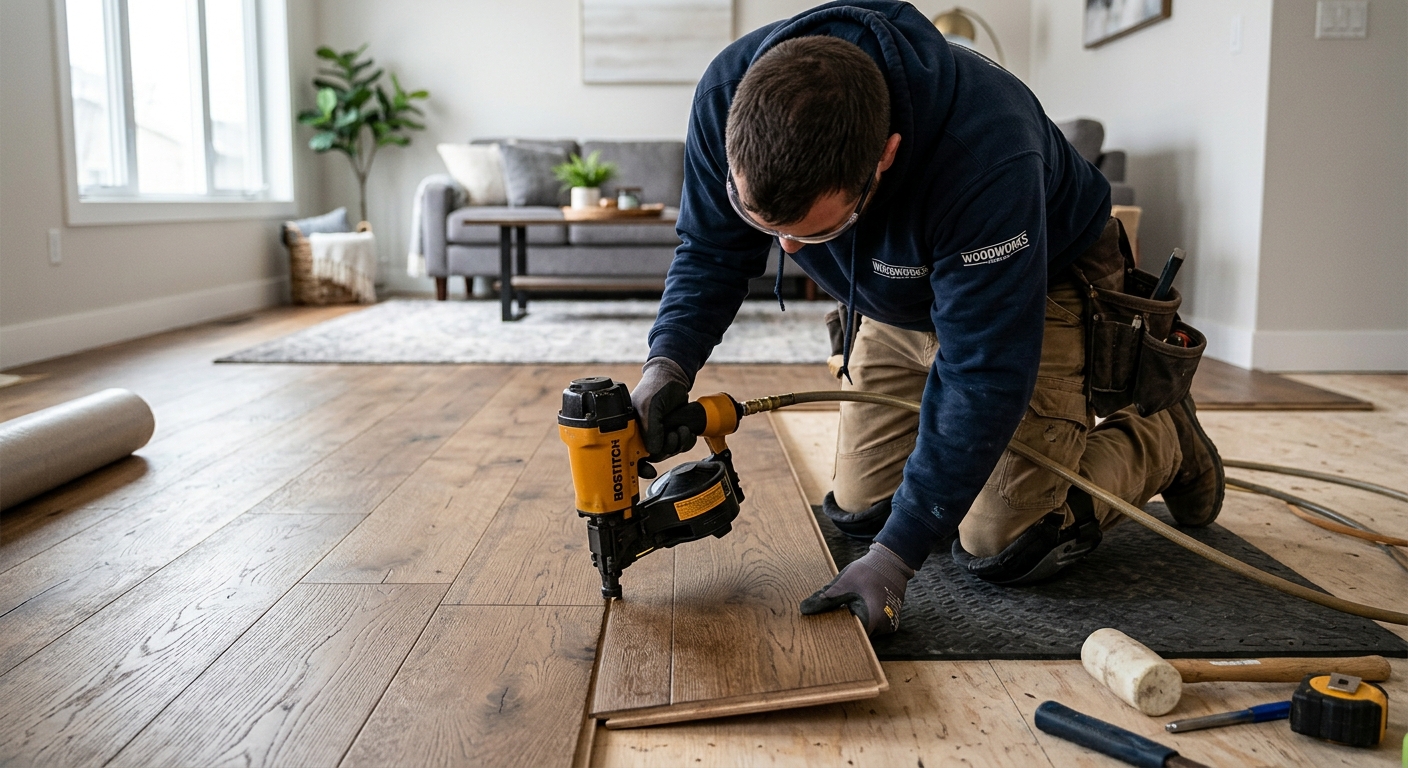
Flooring options and costs in Lincoln
Lincoln, Ontario is a great place to update floors, but costs can swing based on how your home handles moisture and thermal cycling. With 41.2% of Lincoln-area homes built before 1981 (Statistics Canada, 2021 Census), many jobs start with older subfloors—often requiring levelling, patching, or an OSB overlay before any new hard surface can sit flat. That prep is where “the same flooring” can end up quite a different budget, because it’s labour-intensive and sometimes needs additional underlayment and transition hardware.
In the Hamilton–Niagara Peninsula, winter indoor air is typically dry while summers are more humid, and basements can hold onto moisture vapour longer than homeowners expect. Because of that, solid hardwood (especially in below-grade areas) tends to be priced with limitations; engineered hardwood and luxury vinyl plank (LVP) are usually the safer bets for dimensionally stable performance. Also, colder conditions drive demand for radiant-heat-compatible products—engineered wood, most LVP, and many tile systems tolerate thermal cycling far better than traditional solid plank.
In Lincoln, demand is especially steady around the commercial-and-older residential mix near the downtown core and the older neighbourhood streets where families often convert from carpet to hard surface. If you’re moving from carpet to a floating engineered floor, plan for more than just the flooring—subfloor repair and transitions are common. Use the table below as a realistic installed price guide, then we’ll break down exactly what factors push your quote up or down.
| Type |
Best Room |
Moisture Resistance |
Lifespan |
Price per sq ft |
| Solid hardwood (nail-down, above grade only) |
Main living areas (no basement) |
Low to moderate (sensitive to seasonal humidity) |
20–35 years |
$9,–$18 |
| Engineered hardwood (float or glue, above + on-grade) |
Living spaces, bedrooms, some on-grade areas |
Moderate to high (more stable with humidity) |
15–30 years |
$9,–$18 |
| Laminate (click-lock, above-grade) |
Bedrooms, hallways, living areas |
Moderate (not waterproof; edge swelling risk) |
10–20 years |
$4,–$10 |
| Luxury vinyl plank / LVP (waterproof, any level) |
Kitchen, basement (finished), main floor on concrete |
High (waterproof core) |
10–25 years |
$4,–$10 |
| Porcelain / ceramic tile |
Bathrooms, kitchens, entries |
Very high (if properly set and grouted) |
20–50 years |
$10,–$22 |
| Carpet (broadloom or modular tile) |
Bedrooms, family rooms |
Low to moderate (sensitive to moisture underlay) |
7–15 years |
$4,–$9 |
Prices are estimates only and vary by project scope, site access and material selection.
What affects the price of flooring in Lincoln
In the Hamilton–Niagara Peninsula, quotes for the same square footage can differ by 30–50% because your home determines the “hidden” work: subfloor prep, moisture control, and how transitions and stairs are handled. Ontario-wide, labour rates and contractor availability also shift with seasonality—spring and early fall are busiest for hard-surface conversions, so scheduling can affect productivity and cost.
Technically, the biggest drivers in Lincoln are indoor humidity swings and below-grade moisture. Solid hardwood expands and contracts with humidity, so it can’t be installed over concrete and performs poorly in basements. Engineered hardwood and LVP tolerate humidity changes far better, which reduces risk and prevents the kind of callbacks that can make cheaper material choices cost more long-term. Cold weather also matters: radiant heat compatibility is increasingly requested, and it narrows what works (most solid hardwood and some laminate setups are less reliable over in-floor systems).
Older Lincoln housing stock means subfloor levelling or repair is frequent. A typical levelling/repair allowance can add about $1–$4 per sq ft, and in rougher cases you may see higher prep time. For example, choosing engineered hardwood near the middle of the band—around $9–$18 per sq ft—might look similar on paper to LVP at $4–$10 per sq ft, but engineered can be justified in living areas where you want warmth and a natural look. Conversely, if your basement has even minor moisture vapour, paying the LVP band ($4–$10 per sq ft) is often cheaper than trying to “make solid work.”
Concrete examples from recent Lincoln projects: (1) when carpet is removed from an older subfloor, patching and flattening are usually needed before hardwood or laminate; (2) when kitchens or entries are near exterior doors, wet-mop abuse and splash zones favour waterproof LVP or porcelain tile, reducing edge and grout maintenance.
| Price Factor |
Why It Matters |
Cost Impact |
| Room area in sq ft |
Directly changes material quantities, labour hours, and waste |
Higher areas typically lower cost per sq ft after minimum labour thresholds |
| Subfloor condition |
Levelling/repair is required to prevent gapping, squeaks, and joint failure |
Commonly adds roughly $1–$4 per sq ft in older Lincoln homes |
| Moisture / below-grade install |
Rules out solid hardwood; may require vapour barriers and specific underlay |
Can add $1–$5 per sq ft depending on remediation needs |
| Material choice |
Solid vs engineered vs LVP vs tile have different installation complexity |
Often shifts projects between $4–$10 and $10–$22 per sq ft bands |
| Removal and disposal of existing flooring |
Demolition time, disposal fees, and surface prep all add hours |
Typically increases overall budget more on carpet/old underlay builds |
| Stair nosing / transitions |
Stairs and height changes require matching profiles and extra labour |
Charged per step or per linear foot; can add noticeable line-item costs |
| Radiant heat compatibility |
Limits product selection and influences underlayment type |
Often increases material costs within the engineered/LVP/tile ranges |
| Installation method |
Float vs glue-down vs nail-down affects prep, drying time, and precision |
Glue-down and tile tend to cost more; float installs usually price leaner |
Permits & regulations in Ontario
In Ontario, replacing flooring by itself typically does not require a building permit. Most homeowner flooring swaps—like installing carpet, LVP, laminate, engineered hardwood, or tile on existing, non-structural subfloors—fall under normal trade work that doesn’t trigger permits. Where it can change is when your flooring project includes electrical or structural scope.
Permit-triggering work commonly includes: (1) installing or modifying in-floor heating systems that require electrical work; (2) any electrical additions tied to radiant heat controls (thermostats, wiring, or new circuits). If you’re changing the electrical setup, an electrical permit is often required by the electrical contractor. Structural subfloor repair can also require engineering or permit review only if it turns into load-bearing changes—most typical levelling and patching stays within standard flooring repair scope.
In condominiums, the bigger constraint is usually the building’s rules on noise and sound transmission. Hard flooring on upper floors often must meet specific sound performance expectations, which can require approved underlay and documentation for the board. Always review the condo declaration and request written approval before installing hardwood or tile.
To verify a Lincoln contractor, start by confirming their Ontario business registration and checking their trade credentials (where applicable). Next, ask for a certificate of insurance showing current liability coverage and clearance for your project. For labour standards coverage, request proof of WSIB/WCB coverage. Use the contractor’s COI document directly, and don’t rely on verbal assurances—then keep a copy for your records.
Best flooring for each room in your Lincoln home
In Lincoln homes, the “best” flooring isn’t just about looks—it’s about how the room experiences moisture, foot traffic, and comfort during winter-to-summer swings. Living and dining rooms typically benefit from engineered hardwood or high-quality laminate. Both options keep a warmer feel underfoot than tile and handle normal household humidity better than solid hardwood. For bedrooms, carpet remains a strong choice: it boosts comfort, reduces sound, and is a practical match for families who want quieter spaces.
Kitchens are a different story. Waterproof luxury vinyl plank (LVP) is often the most forgiving option for spills and frequent mopping, and large-format porcelain tile can also be excellent if you want maximum durability and easy cleaning. In basements (especially where there’s any past musty odour or visible condensation), LVP is usually the clear winner because its waterproof core tolerates below-grade moisture vapour far better than solid wood and most laminate systems. Bathrooms should be porcelain or ceramic tile only, because it’s designed for wet conditions when properly installed.
Radiant heat compatibility matters too. If you have in-floor heating (or plan to add it), engineered wood and most LVP systems generally work well when installed with the right underlayment and manufacturer-approved products; tile systems are also commonly used because they accept thermal cycling reliably.
To justify price differences: say you’re comparing tile at about $10–$22 per sq ft versus LVP at about $4–$10 per sq ft. If your main bathroom gets frequent water exposure, tile’s higher upfront cost is justified. But if you’re doing a large hallway where moisture risk is low, LVP can deliver 80% of the look-for-life value at a much lower installed cost.
| Room |
Best Material |
Why |
Moisture Risk |
Price Band per sq ft |
| Living / dining room |
Engineered hardwood |
Warm look with better stability for Lincoln’s humidity swings than solid |
Low to moderate |
$9,–$18 |
| Master bedroom |
Carpet or engineered hardwood |
Carpet adds comfort and sound control; engineered gives a harder-wearing option |
Low |
$4,–$18 |
| Secondary bedrooms |
High-quality laminate or carpet |
Laminate is cost-effective; carpet is ideal for kids’ rooms and quieter living |
Low |
$4,–$10 |
| Kitchen |
Luxury vinyl plank (LVP) or porcelain tile |
LVP handles spills and frequent cleaning; tile offers maximum stain and water resistance |
Moderate to high |
$4,–$22 |
| Basement (finished) |
Luxury vinyl plank (waterproof) |
Best fit for below-grade conditions and humidity vapour; reduces risk of warping |
Moderate to high |
$4,–$10 |
| Bathroom |
Porcelain / ceramic tile |
Designed for wet areas; long service life when installed to spec |
High |
$10,–$22 |
How to choose a flooring contractor in Lincoln
Choosing the right contractor in Lincoln starts with proof, not promises. In Ontario, ask for liability insurance and confirm they have WSIB/WCB coverage for their workers. For liability, request a certificate of insurance (COI) that lists the business name matching their contract; for WSIB/WCB, ask for their clearance documentation or coverage confirmation. A reputable flooring contractor won’t treat these as “extra”—they provide them as part of doing business safely and legally.
Next, get 2–3 itemised written quotes. You want a breakdown that separates labour, subfloor prep/levelling, underlayment/moisture barrier, transitions, stair work, and material supply. Avoid lump sums that don’t explain exclusions. Carefully check what’s included: is removal and disposal of existing flooring included? Are transitions (reducers, moulding, stair nosing) priced separately or included? If radiant heat is involved, confirm the underlayment and product compatibility requirements are stated in the scope.
Warranty is another key differentiator. Confirm the workmanship warranty length, whether it’s transferable if you sell the home, and what triggers coverage (for example, failure to follow moisture or acclimation steps). Payment schedule should be conservative—never pay more than 10–15% upfront; hold back a portion until the job is fully complete and clean.
Finally, demand a timeline in writing: start date, estimated completion date, and what happens if materials arrive late. In Lincoln’s seasonal market, good crews plan around dry-install conditions and subfloor drying times, especially when levelling or moisture remediation is needed.
- Ask for WSIB/WCB proof and verify the business name matches the quote.
- Request a current liability insurance certificate (COI) before work starts.
- Get at least two comparable quotes with the same scope items listed.
- Ensure the quote includes subfloor prep/levelling allowance (and what’s excluded).
- Confirm moisture barrier and underlayment products are named in writing.
- Check transition pricing: per linear foot or per step, with quantities stated.
- Ask whether removal and disposal of old flooring are included.
- Verify acclimation requirements for engineered/LVP/Laminate are included in the process.
- Confirm radiant heat compatibility is addressed for any affected rooms.
- Request a workmanship warranty (duration + what it covers) in the contract.
- Set payment terms: 10–15% maximum upfront; holdback until completion.
- Get a written start/completion timeline and a schedule for material delivery.
Concrete red flags to watch for in Lincoln: (1) refusing to provide COI/WSIB/WCB documentation; (2) quoting only “materials + install” with no mention of subfloor prep, levelling, or moisture barrier; (3) a payment request of 50%+ upfront without a signed scope and schedule; (4) no written warranty terms for workmanship; (5) vague timelines (“we’ll fit you in”) without start date and completion estimate.
Frequently asked questions — flooring in Lincoln
What is luxury vinyl plank and is it worth it in Lincoln?
Luxury vinyl plank (LVP) is a synthetic flooring designed with a waterproof core, topped with a decorative wear layer. In Lincoln and the broader Hamilton–Niagara Peninsula, it’s often worth it because basement moisture vapour and seasonal humidity swings are real cost drivers. Unlike solid hardwood, LVP can handle above-grade rooms and finished basements without the same expansion/contracting sensitivity. If you’re choosing between LVP around the $4–$10 per sq ft band and a harder surface like tile at about $10–$22 per sq ft, LVP frequently wins on value for large areas—especially where spill risk is common (kitchens, entries) or where you want a more forgiving feel than tile. For the best outcome, your installer should include the right underlay (as approved for your product) and confirm the subfloor is flat and dry.
How much does flooring cost in Lincoln?
In Lincoln, flooring cost typically depends on the product type and how much prep your subfloor needs. As a practical guide for installed work: hardwood flooring usually falls in the $9–$18 per sq ft range; laminate or vinyl plank is commonly around $4–$10 per sq ft; and porcelain/ceramic tile is often $10–$22 per sq ft. Carpet installation typically comes in around $4–$9 per sq ft depending on thickness and underlay. In older housing stock—41.2% built before 1981 (Statistics Canada, 2021 Census)—you may see additional levelling or repair allowances that push the final number above the “clean-room” average. If moisture remediation or moisture barriers are needed for a basement or on concrete, that can add cost too. The safest way to price accurately is an itemised quote that breaks out labour, prep, underlay/vapour barrier, transitions, and stair work.
Hardwood vs laminate vs vinyl plank — which is best?
“Best” depends on the room and your tolerance for humidity risk. In Lincoln’s seasonal swings, solid hardwood is best kept above grade; it can’t be glued or floated over concrete and tends to struggle in basements. Engineered hardwood is the closer alternative, but vinyl plank often brings the highest reliability where moisture vapour exists. Laminate can be a budget-friendly choice in low-moisture rooms, but it’s not waterproof and edges can swell if water gets under the seams. If you’re comparing value, LVP in the $4–$10 per sq ft band is hard to beat for kitchens and finished basements, while engineered wood in the $9–$18 per sq ft band is usually chosen for main-floor living areas where you want a natural look and warmth. If you have radiant heat, confirm product compatibility in the quote—some options and underlay combinations aren’t suitable.
What flooring is best for a Lincoln basement?
For a Lincoln basement, the most consistently successful choice is waterproof luxury vinyl plank (LVP), installed with the correct underlayment and moisture-control approach for your product. Basements here can experience moisture vapour even when they look “dry,” and that’s where solid hardwood and most laminate usually run into trouble. With LVP, the waterproof core is designed to tolerate the conditions that cause warping or cupping in traditional wood products. Your contractor should also verify the concrete/subfloor is flat and address any moisture issues before installation. Price-wise, LVP typically aligns with the $4–$10 per sq ft installed band, while tile can be more costly but very durable. If you’re considering carpet for a basement, you’ll need strong moisture controls and careful underlay selection—otherwise you risk odours and premature wear.
Can I install hardwood over concrete?
In most typical homeowner scenarios, you should not plan to install solid hardwood over concrete. Solid nail-down hardwood requires a suitable wood subfloor/structure and is generally limited to above-grade areas where humidity can be controlled. Also, solid hardwood is sensitive to moisture and dimensional movement, which makes concrete a risk unless the installation method and system are specifically designed for it. Engineered hardwood is the product most homeowners consider for concrete—depending on the system, it may be approved for glue-down or floating installations (with manufacturer requirements and correct underlayment/vapour barrier). For Lincoln homes with concrete slabs, the safest approach is to have a contractor assess the slab flatness and moisture conditions first, then select a compatible engineered or LVP system. If you’re also dealing with radiant heat, your product compatibility must be confirmed before installing any wood flooring.
How long does flooring installation take?
Installation time in Lincoln depends on room size, product type, subfloor prep, and how long moisture levelling/repairs take. For many typical residential jobs, hard-surface installations can be completed in days once prep is done, but older homes often add time for levelling, patching, and transition/stair details. If you’re replacing carpet, removal and disposal are usually the first step and can take a significant portion of the schedule, especially when tack strips and old underlay are involved. Tile generally takes longer than LVP or laminate due to layout, setting, and cure times. A good contractor will provide a written timeline that includes start date, estimated completion, and what the plan is if materials are delayed. As a ballpark, small rooms may be handled quickly, while whole-floor conversions typically require more planning—especially in a 41.2% pre-1981 home where prep is more common (Statistics Canada, 2021 Census).