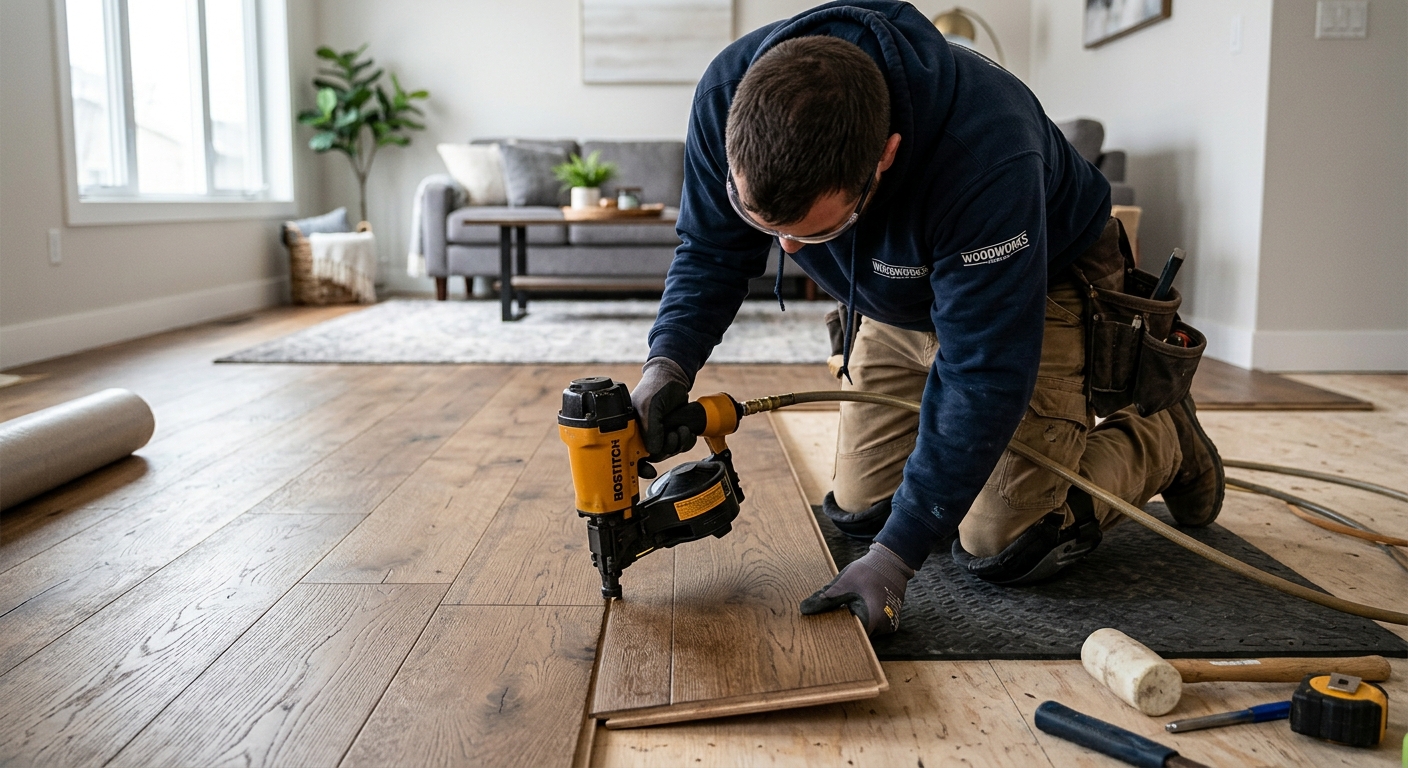
Flooring options and costs in Milton
Milton homeowners typically have a lot of solid, practical choices—then run into real-world costs once we factor in subfloor prep, humidity swings, and how old the home is. With 18.9% of dwellings built before 1981, many projects start with repairs: patching, levelling, and sometimes plywood replacement so the new floor stays flat and doesn’t fail early. Toronto-area humidity can swing noticeably through the seasons, which is why we usually recommend engineered hardwood or luxury vinyl plank (LVP) for most main-floor and condo-style installs. Solid hardwood can be beautiful, but it’s more sensitive to moisture and movement, especially over concrete or in basements.
Labour availability also matters here. Renovation demand around Milton and the Greater Toronto Area keeps crews busy, so installation rates and scheduling can be higher than in many other parts of Ontario. On top of that, older housing stock often means more time on moisture mitigation and transitions, and that can widen the spread between quotes for what looks like the same floor. If you’re working in areas with a lot of family remodels—like old Milton near Main Street or the downtown-adjacent neighbourhoods—demand is strong and timelines can move quickly once materials arrive.
Below is a realistic cost guide for common flooring types you’ll see in Milton, Ontario, so you can compare quotes apples-to-apples before the crew measures.
| Type |
Best Room |
Moisture Resistance |
Lifespan |
Price per sq ft |
| Solid hardwood (nail-down, above grade only) |
Living / dining (above grade) |
Low to moderate (humidity-sensitive) |
25–50 years |
$10 – $18 |
| Engineered hardwood (float or glue, above + on-grade) |
Living / bedrooms |
Moderate to high (better with humidity) |
20–40 years |
$9 – $16 |
| Laminate (click-lock, above-grade) |
Bedrooms, hallways |
Low to moderate (water can damage edges) |
10–20 years |
$4 – $8 |
| Luxury vinyl plank / LVP (waterproof, any level) |
Kitchen, finished basement |
High (waterproof core) |
15–25 years |
$5 – $10 |
| Porcelain / ceramic tile |
Kitchen, bathroom |
Very high (if installed correctly) |
25+ years |
$12 – $25 |
| Carpet (broadloom or modular tile) |
Master bedrooms |
Low to moderate (affected by moisture) |
7–15 years |
$5 – $11 |
Prices are estimates only and vary by project scope, site access and material selection.
What affects the price of flooring in Milton
In Milton, you can see the same “type of flooring” quoted far apart—often by 30–50%—because the expensive part is usually not the planks or tiles, it’s the prep and the install conditions. Toronto-area indoor humidity swings change how floors behave, so we plan for movement and moisture management instead of treating the subfloor like it’s always ready. Below-grade moisture is also a common reality in basements and semi-finished levels across the region, which pushes us toward engineered wood or LVP rather than solid hardwood. Solid hardwood also can’t be glued or floated over concrete, and in basements it’s a higher risk because of vapour and seasonal moisture pressure.
Two other cost drivers are common in Milton. First, older housing stock (including homes built before 1981) may need levelling or repair before any click-lock or nail-down floor can go in. In those cases, add about $1–$4 per sq ft for prep and patching, and sometimes more if we’re replacing subfloor panels. Second, if you’re installing over an existing floor, removal and disposal can run up quickly—especially when there’s multiple layers or stubborn adhesive. A practical example: for a main-floor install, switching from laminate in the $4–$9 band to engineered hardwood in the $9–$16 band can be justified if you’re paying the same levelling labour either way; the higher material cost buys you better long-term stability in a humid climate.
Radiant floor heating availability can also shift price and product choices. In colder stretches of Ontario and in newer custom builds, many owners add radiant heat, which pairs better with engineered wood and tile than with traditional solid hardwood—so the “best” option sometimes costs more upfront but avoids rework later.
| Price Factor |
Why It Matters |
Cost Impact |
| Room area in sq ft |
Material and labour scale directly with size |
Often the biggest line item; bigger rooms can reduce per-sq-ft install overhead |
| Subfloor condition |
Levelling/repair affects flatness and warranty acceptance |
Commonly adds $1 – $4 per sq ft (sometimes more on older homes) |
| Moisture / below-grade install |
Rules out solid hardwood; requires moisture-aware systems |
Can add $1 – $5 per sq ft for mitigation/underlayment; changes material band |
| Material choice |
Solid vs engineered vs LVP vs tile all install differently |
Typically shifts material range from $4 – $25 per sq ft depending on product |
| Removal and disposal of existing flooring |
Extra labour and hauling time |
Often $1 – $4 per sq ft depending on layers, glue, and access |
| Stair nosing / transitions |
Transitions add time and matching profiles |
Charged per step or per linear foot; can materially change total budget |
| Radiant heat compatibility |
Limits products and impacts underlayment selection |
May increase material cost; reduces risk by picking the right system |
| Installation method |
Float vs glue-down vs nail-down changes labour and subfloor prep |
Glue-down can be more labour-intensive; nail-down has strict moisture/flatness needs |
Permits & regulations in Ontario
In Ontario, installing new flooring as a standalone finish work typically does not require a building permit. That said, some flooring projects include related tasks that can trigger permit or code requirements—so it’s important to separate “the floor” from “what’s underneath and connected to it.” For example, if you’re doing structural subfloor replacement, major changes to framing, or moisture remediation that involves engineered systems, those associated works may need municipal review depending on scope. If radiant floor heating is added or altered, electrical permits can be required for the in-floor wiring and controls.
In condominiums, the rules are often the real constraint: corporations may restrict hard flooring on upper floors due to sound transmission. Even when hardwood or tile is permitted, you may need specific underlay or documentation that meets building requirements for impact sound (IIC/STC). Always check the condo declaration and request board approval in writing before installing hard surfaces above grade in a multi-unit building.
For your Milton home, the best way to verify your contractor is to take three steps before work starts: (1) confirm their Ontario licence/registration status through the appropriate online provincial/business registry resources, (2) request a certificate of liability insurance showing your contractor’s coverage, and (3) verify WSIB/WCB coverage information. Ask for the clearance letter (or documentation equivalent) and keep copies in your file—especially when demolition, subfloor repair, or moisture mitigation is included.
Best flooring for each room in your Milton home
Choosing the best flooring in Milton comes down to matching moisture behaviour, foot traffic, and comfort—then letting the Toronto-area climate guide your material stability. Living and dining rooms are often where homeowners want warmth and style, so engineered hardwood or high-quality laminate are common picks. In master bedrooms, carpet is still a great choice for comfort and sound absorption, but I recommend pairing it with good ventilation and avoiding it for areas exposed to seasonal dampness.
For kitchens, LVP or large-format porcelain tile usually makes the most sense. LVP’s waterproof core handles spills and routine cleaning without swelling, while porcelain tile is tough and stays stable when installed over properly prepared substrates. Basements are different: with below-grade moisture risk, LVP is the clear winner for finished spaces because it’s designed for high-humidity environments and can perform where solid wood and many laminates underperform.
Bathrooms should be porcelain or ceramic tile only, with correct underlayment and proper grout/seal practices. If you have (or plan to add) radiant floor heating—a growing trend in Ontario new construction—engineered wood, tile, and certain vinyl systems generally handle heat expansion more predictably than traditional solid hardwood. A quick budget reality check: moving from laminate in the $4–$9 band to engineered hardwood in the $9–$16 band can be worth it when the subfloor prep is already required—because you’re paying the same levelling labour either way, but you’re getting a more stable, longer-lasting floor for Milton’s humidity swings.
| Room |
Best Material |
Why |
Moisture Risk |
Price Band per sq ft |
| Living / dining room |
Engineered hardwood |
Warm look, better dimensional stability than solid in humid seasons |
Low to moderate (normal above-grade conditions) |
$9 – $16 |
| Master bedroom |
Carpet or engineered hardwood |
Carpet adds comfort and sound control; engineered wood adds durability |
Low (manage humidity for best results) |
$5 – $16 |
| Secondary bedrooms |
Luxury vinyl plank (LVP) or laminate |
Good value with good wear; LVP handles spills better |
Low to moderate (depends on household) |
$4 – $10 |
| Kitchen |
Luxury vinyl plank (LVP) or porcelain tile |
Easy cleaning and strong performance under spills and daily traffic |
Moderate (water exposure is routine) |
$5 – $25 |
| Basement (finished) |
Luxury vinyl plank (LVP) |
Waterproof core and better tolerance for below-grade conditions |
High (vapour and seasonal moisture pressure) |
$5 – $10 |
| Bathroom |
Porcelain / ceramic tile |
Stays stable with moisture when installed on a suitable system |
Very high (constant wet conditions) |
$12 – $25 |
How to choose a flooring contractor in Milton
To choose the right flooring contractor in Milton, start by verifying the basics—then move to the paperwork details that protect you if something goes wrong. First, confirm the Ontario licensing/registration status for the business, and ask for their liability insurance certificate before any demolition starts. Next, verify WSIB/WCB coverage: request proof (often via clearance letter or documentation) and keep it on file. If a contractor can’t provide current coverage documentation, don’t continue—subfloor repair and tile work can create slip hazards and hidden damage, and you want proper coverage.
Second, get 2–3 itemised written quotes. You want a breakdown that separates labour, materials, underlayment/moisture mitigation, removal and disposal, transitions/stair nosing, and any levelling/plywood repair. Avoid “all-in” numbers that don’t show what you’re paying for, because in Milton the prep scope is frequently where costs change. Read the scope carefully: is permit work included if radiant heating wiring adjustments are part of the project? Is disposal included, and how many layers are assumed for removal? Warranty terms should be explicit—workmanship warranty length, manufacturer warranty, and whether the warranty is transferable to a new homeowner.
Finally, payment schedule matters. Never pay more than 10–15% upfront; hold back remaining funds until the job is complete, cleaned, and any minor adjustments are done. Get a start date and completion estimate in writing, so schedule slippage doesn’t become “extra days” and surprise costs.
- Ask for their Ontario registration/licence details and verify them before signing.
- Request a current certificate of liability insurance.
- Confirm WSIB/WCB coverage with proof and keep copies.
- Get 2–3 itemised quotes (labour + materials, not lump sums).
- Written scope of work: what’s included vs excluded (levelling, subfloor repair, underlayment).
- Clarify removal and disposal: number of layers, hauling method, and bin fees.
- Ask how they assess moisture and flatness—what tests or checks do they do.
- Confirm transition/stair nosing pricing (per step or per linear foot) and product selections.
- Verify warranty: workmanship duration, manufacturer warranty, and transferability.
- Check schedule commitment: start date, install days, and completion timeline in writing.
- Payment terms: keep upfront to 10–15% and hold back on completion.
- Ask who will do the work: company installers vs subcontractors, and whether supervision is provided.
Red flags in Milton include: vague scopes that don’t mention subfloor prep or moisture mitigation; quotes that only show a total price with no per-room or per-line breakdown; refusing to provide insurance/WSIB/WCB documentation; pushing for large upfront payments; and starting work before you have a written timeline, warranty details, and material selections confirmed.
Frequently asked questions — flooring in Milton
Can I install flooring over existing tile in Milton?
Sometimes, but it depends on flatness, height transitions, and the type of new flooring. In Milton, tile can be installed over a sound, well-bonded surface, but subfloor preparation is still critical: if the tile has movement or high spots, click-lock laminate and LVP can fail at the seams over time. For engineered hardwood, we also watch height and movement closely due to the stability requirements in Ontario’s humidity swings. If you’re installing tile over tile, it must be properly assessed and bonded to the existing surface; adding height can affect door clearances. Cost-wise, tile projects commonly land in the $12–$25 per sq ft band, and levelling/patching to make the surface suitable can add to the scope. The safest approach is to have your contractor measure flatness and confirm the system they’re using before you commit.
What is the best flooring for a high-traffic area in Milton?
For high-traffic areas in Milton—think hallways, main living routes, and spaces near entryways—LVP and engineered hardwood are usually the best balance of durability and stability. LVP’s waterproof core handles everyday spills and wet-foot traffic better than many laminates, which can swell along edges if moisture penetrates. Engineered hardwood offers a more upscale look than laminate and handles seasonal humidity swings far better than solid wood in most above-grade situations. If you want the toughest surface overall, porcelain tile is excellent but more expensive and harder/colder underfoot. As a reference point, LVP often fits in the $5–$10 per sq ft range, while tile commonly sits in the $12–$25 per sq ft band. If you’re considering radiant heat in a newer home, tile and engineered options typically pair more predictably than traditional solid hardwood due to heat and expansion considerations.
How do I prepare my subfloor before new flooring?
Preparation is what prevents most premature failures, especially in older Milton homes. Many houses built before 1981 (Statistics Canada, 2021 Census) may need levelling, patching, and sometimes plywood replacement before a new floor is installed. The contractor should check flatness (not just “looks level”), verify the subfloor is solid and dry, and address any signs of moisture before committing to glue-down or finished flooring. For high-humidity basements, that often means moisture mitigation strategies and choosing a product designed for below-grade installs—like LVP—rather than assuming all flooring is the same. Typical prep can add about $1–$4 per sq ft when minor levelling or repair is needed, which is why two quotes can differ even when the flooring “looks” identical. Ask for the scope in writing: what exactly will be removed, levelled, or replaced.
Is cork or bamboo flooring a good choice in Milton?
Cork and bamboo can work, but they’re not our default recommendation for most Milton basements or areas with higher moisture exposure. Cork is comfortable underfoot and has some natural sound dampening, but like other natural materials it still needs a stable humidity environment. Bamboo is a plant-based product; it can be engineered for stability, yet it still responds to moisture more than waterproof vinyl. In Toronto-area homes, where indoor humidity swings happen across seasons and below-grade vapour can be an issue, we typically steer homeowners to engineered hardwood or LVP for broader reliability. If you’re set on cork or bamboo, insist on an engineered, properly rated product and confirm it’s suitable for your room level (above grade vs below grade) and subfloor conditions. For budgeting, you’ll want to treat these as “mid to premium natural materials,” often closer to hardwood pricing rather than the $4–$9 laminate/vinyl band.
What is the difference between floating and glued-down flooring?
Floating floors (common with click-lock laminate and many click together engineered products) are installed over an underlay with boards that don’t directly bond to the subfloor. The floor “floats,” allowing controlled movement as humidity changes. Glued-down flooring bonds the material to the subfloor using adhesive, which can improve stability when installed over a properly prepared, flat surface—especially for certain engineered products. In Milton’s environment, where humidity swings are real, floating systems can be forgiving when the product is designed for it, but the subfloor still needs to be flat and properly prepared. Glued-down installs require stricter moisture and flatness conditions and are usually chosen when the manufacturer’s instructions call for it. If radiant heat is involved, follow the product spec closely for allowable adhesives and thermal movement. The best approach is always to match the installation method to the product rating, not to choose based on price alone.
What flooring holds up best to pets in a Milton home?
For pets, the “best” option usually combines scratch tolerance, spill resistance, and manageable maintenance. In Milton, waterproof LVP is often the top choice because it handles accidents without swelling and stands up well to everyday traffic. Proper underlay and a wear layer thickness (for LVP) matter for claw marks and noise. Engineered hardwood can work too, especially with area rugs in high-scratch zones, but it’s more moisture-sensitive than vinyl and can be affected by tracked-in water from winter weather. Carpet is comfortable but tends to trap odours and can be harder to dry if accidents happen—so it’s riskier for many pet households unless you’re prepared for quick cleaning. Budget-wise, LVP typically falls into the $5–$10 per sq ft range, which is attractive compared with tile ($12–$25 per sq ft) or hardwood ($9–$18 in most bands) when you’re also planning for pet-proofing. Your contractor should also advise on transitions and edge sealing where moisture can enter.