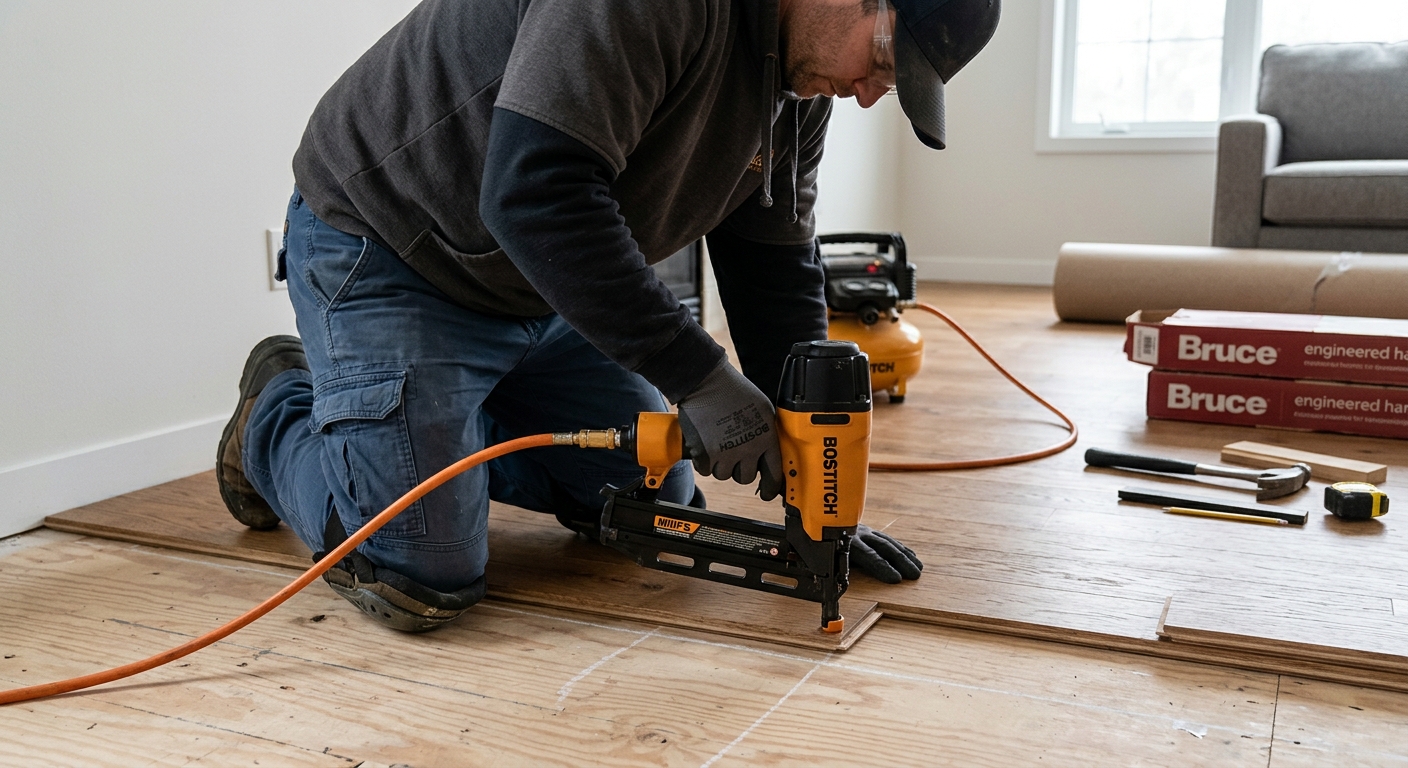
Flooring options and costs in Niagara Falls
Niagara Falls homeowners typically compare flooring options based on how materials perform through the region’s humidity swings and basement moisture. With 60.8% of homes in the Hamilton–Niagara Peninsula built before 1981 (Statistics Canada, 2021 Census), many projects start with subfloor levelling or repairs—especially when moving from carpet to hard surfaces. In practical terms, that preparatory work can add roughly $1–$4 per sq ft to the overall installed budget, before you even pick the finish. Costs are also shaped by the local demand around areas like the Clifton Hill / Lundy’s Lane corridor and nearby residential streets, where renovations are common and scheduling can be tighter in peak seasons.
Climate-wise, Niagara Falls winters bring dry indoor air, while summers can push indoor humidity up—creating expansion and contraction stress. That’s why solid hardwood (while beautiful) is best kept above grade, whereas engineered hardwood and luxury vinyl plank (LVP) are more dimensionally stable for on-grade and many basement situations. For colder homes or rooms with in-floor heating, radiant-heat-compatible products are in higher demand, and that typically nudges people toward engineered wood, LVP, and certain tile assemblies. If your existing base is out of level, you may see the biggest variation between quotes—more than the difference between two “similar” material brands.
Below are typical installed ranges you can use to sanity-check proposals before site measurement and detailed scope review.
| Type |
Best Room |
Moisture Resistance |
Lifespan |
Price per sq ft |
| Solid hardwood (nail-down, above grade only) |
Living / dining, main floor hallways |
Low–moderate (not suitable for below-grade) |
25–50 years |
$9–$18 |
| Engineered hardwood (float or glue, above + on-grade) |
Main floor bedrooms, offices |
Moderate to high (more stable with humidity) |
20–40 years |
$10–$18 |
| Laminate (click-lock, above-grade) |
Living spaces (dry zones only) |
Low–moderate (water damage if seams are exposed) |
10–25 years |
$4–$10 |
| Luxury vinyl plank / LVP (waterproof, any level) |
Kitchens, basements, main floors with pets |
High (waterproof core) |
15–25 years |
$6–$14 |
| Porcelain / ceramic tile |
Bathrooms, entryways, kitchens |
Very high (needs proper grout/sealing approach) |
30–50 years |
$10–$22 |
| Carpet (broadloom or modular tile) |
Bedrooms, stairs comfort zones |
Low (can hold moisture if basements are damp) |
7–15 years |
$4–$9 |
Prices are estimates only and vary by project scope, site access and material selection.
What affects the price of flooring in Niagara Falls
In the Hamilton–Niagara Peninsula, two quotes for what looks like the same floor can land 30–50% apart once you price the real scope: subfloor prep, moisture control, transitions, and removal/disposal. That spread isn’t unusual, because Niagara Falls and surrounding communities contain a large share of older housing—60.8% pre-1981 (Statistics Canada, 2021 Census)—where the base may be uneven, patched, or affected by past plumbing or basement seepage. Meanwhile, contractor availability and material handling costs can shift during busy renovation months near commercial corridors and rental-heavy areas.
Technically, indoor humidity swings and below-grade moisture are the main cost drivers. Solid hardwood expands and contracts with moisture; it also can’t be installed over concrete and performs poorly in basements. Engineered hardwood and LVP are far more dimensionally stable, and that stability is why they’re commonly chosen in moisture-prone areas. Colder-climate performance matters too: Ontario homes with radiant heat typically see better compatibility with engineered wood, many LVP products, and tile systems than with traditional solid hardwood. Finally, older subfloors often require levelling or repair—often adding $1–$4 per sq ft—before any “beautiful” flooring can be laid.
Here are a few Niagara Falls examples that move budgets up or down. Example one: going from carpet to hard surface on a slightly out-of-level main floor may add levelling compound and additional labour even if you choose laminate in the $4–$10 band. Example two: a finished basement with a history of dampness may push you away from carpet and most laminate toward LVP (often $6–$14) or tile; you’ll pay for moisture barrier and underlayment details, but you avoid premature edge swelling. Example three: if you select porcelain/ceramic tile in the $10–$22 band, the tile material cost and extra layout labour can quickly outweigh the difference versus engineered hardwood when the slab needs significant prep.
| Price Factor |
Why It Matters |
Cost Impact |
| Room area in sq ft |
Directly affects materials, cutting, and labour hours |
Typically lowers $/sq ft as area increases; small jobs cost more per sq ft |
| Subfloor condition — levelling or repair needed before install |
Uneven or damaged subfloors require prep to prevent squeaks and failure |
Commonly adds $1–$4 per sq ft in older Niagara Falls homes |
| Moisture / below-grade install — rules out solid hardwood |
Moisture can warp solid wood and damage laminate seams |
May shift you to engineered/LVP/tile and add vapour barriers; can raise total by 10–25% |
| Material choice — solid vs. engineered vs. LVP vs. tile |
Different cores, thicknesses, underlay systems, and installation tolerances |
Moves you within typical bands (e.g., LVP ~$6–$14 vs tile ~$10–$22) |
| Removal and disposal of existing flooring |
Old carpet tack strips, underlay, and glue can be labour-intensive |
Can add several dollars per sq ft depending on layers and haul distance |
| Stair nosing / transitions — charged per step or per linear foot |
Edges need proper profiles for safety and movement gaps |
Often becomes a hidden cost driver on stairs and multi-room plans |
| Radiant heat compatibility — limits material options |
Some products can overheat, hold expansion stress, or delaminate |
May increase material cost and require specific underlayment/adhesives |
| Installation method — float vs. glue-down vs. nail-down |
Prep level and labour time differ by system |
Glue-down and nail-down typically cost more than click-lock floating |
Permits & regulations in Ontario
In Ontario, installing new flooring by itself usually does not require a building permit. For most Niagara Falls homeowners, that means replacing carpet, installing laminate/LVP, or putting down hardwood/tile on a prepared subfloor is treated as a finish trade. However, permits can come into play when flooring work touches electrical systems or structural changes.
Work that typically does NOT require a permit: removing existing flooring, installing LVP/laminate/carpet, adding underlay and moisture barriers, fastening nailed hardwood above grade, or setting tile on an appropriate subfloor (with no electrical or structural alterations).
Work that may require permits (often electrical): installing or modifying in-floor heating components (thermostats, wiring, or circuit changes), and any electrical work associated with radiant heating systems. Also, if your scope includes structural subfloor replacement/engineering changes (for example, joist repairs beyond cosmetic patching), you may need the appropriate approvals depending on the nature of the work.
Step-by-step for Niagara Falls: (1) ask your contractor for their written scope of work, including whether they will touch radiant heat wiring; (2) verify contractor licensing/credentials and request proof of liability insurance and WSIB/WCB coverage; (3) for condominiums or multi-unit buildings, request board approval in writing where sound transmission rules apply—condos often restrict hard flooring on upper floors due to STC/IIC requirements and may mandate specific underlay systems.
Best flooring for each room in your Niagara Falls home
Niagara Falls homes need flooring that handles thermal cycling (cold winters and warm summers) and—where relevant—below-grade moisture pressure. For living and dining areas, engineered hardwood or high-quality laminate usually hits the best balance of warmth, looks, and practicality on an above-grade subfloor. In master bedrooms, carpet remains a strong comfort choice for sound and underfoot feel, especially on first and second floors where you want quieter daytime living.
In kitchens, the decision often comes down to cleanability and spill tolerance. Luxury vinyl plank (LVP) is a common win because it’s waterproof and forgiving if you drop cookware or deal with high-use traffic; porcelain or large-format ceramic tile is the other top choice, particularly if you like a crisp surface and easy maintenance. For basements, LVP is typically the clear winner: it’s waterproof, works well with moisture vapour conditions, and avoids the swelling risks that come with solid wood and many laminate installations. Bathrooms should be porcelain or ceramic tile only, due to water exposure and grout/wear realities.
Radiant heat compatibility is also increasingly popular in Ontario, so if you have in-floor heating (or plan for it), select products that are specifically rated for radiant heat. That can justify the price jump: for example, stepping from laminate in the $4–$10 range to engineered hardwood in the $10–$18 range may be worthwhile if the engineered product is rated for radiant heat and your installer can build a stable, level base without future squeaks or edge failures.
| Room |
Best Material |
Why |
Moisture Risk |
Price Band per sq ft |
| Living / dining room |
Engineered hardwood |
Warm look, stable through humidity swings, and suitable for above-grade floors |
Low to moderate (depends on HVAC and indoor humidity control) |
$10–$18 |
| Master bedroom |
Carpet or engineered hardwood |
Carpet improves comfort and sound; engineered matches a harder-wearing option without solid-wood basement limits |
Low (if no basement-level dampness transfers) |
$4–$18 |
| Secondary bedrooms |
Laminate (dry zones) or carpet |
Cost-effective durability above grade; carpet is best for comfort and noise reduction |
Low (avoid in naturally damp areas) |
$4–$9 |
| Kitchen |
Luxury vinyl plank (LVP) or porcelain tile |
Easy cleanup and strong spill tolerance; LVP stays forgiving underfoot |
Moderate (spills and washing cycles) |
$6–$22 |
| Basement (finished) |
Luxury vinyl plank (waterproof) |
Handles moisture vapour and below-grade conditions better than solid hardwood or most laminate |
High (use moisture-aware installation practices) |
$6–$14 |
| Bathroom |
Porcelain / ceramic tile |
Best long-term performance in wet conditions; complements heated floors if desired |
Very high (standing water exposure) |
$10–$22 |
How to choose a flooring contractor in Niagara Falls
Choosing a contractor in Niagara Falls starts with verification. In Ontario, you should request proof of liability insurance (for property damage and jobsite injuries) and WSIB/WCB coverage (for worker coverage). You should also confirm the contractor’s credentials through the appropriate online registry or professional listings, then match the business name on their quote to the insurance certificate. If they can’t provide documents quickly, that’s a warning sign.
Next, get 2–3 written quotes with an itemised breakdown—labour, prep/levelling compounds, underlayment/moisture barrier, transitions, removal and disposal, and any stair nosing. A lump sum quote can hide major scope differences, which is how you end up with a 30–50% gap versus another estimate. Confirm what’s included: permit pull (if radiant heating electrical work is part of scope), moving furniture, subfloor inspection and moisture treatment, and whether haul-away/disposal is included. For warranty, ask for both the workmanship warranty length and the manufacturer warranty terms, and confirm whether coverage is transferable to future owners.
Finally, protect your cash flow and timeline. Use a schedule where you never pay more than about 10–15% upfront; keep a holdback until the job is complete and clean. Get a written start date and a realistic completion estimate tied to material lead times—Niagara Falls renovations can slow down when popular products sell out.
- Request insurance certificate and WSIB/WCB clearance and verify the coverage dates
- Confirm the exact scope: levelling, moisture barrier type, underlayment, and transitions
- Ask whether radiant heat is rated/compatible with the flooring you’re purchasing
- Get a material allowance and verify the brand/model in writing
- Require itemised labour (demo, prep, layout, install, trim) instead of a single number
- Check whether furniture moving and floor protection are included
- Confirm removal and disposal method for carpet pad, tack strips, or old underlay
- Clarify stair nosing details (per step vs per linear foot) and edge profile system
- Ask about acclimation time for engineered wood/LVP products before installation
- Confirm caulking/expansion gap approach and transition spacing at doorways
- Request warranty details in writing: workmanship, exclusions, and how claims are handled
- Use a payment schedule with a holdback until final walkthrough and cleanup
Red flags to watch for in Niagara Falls: (1) “Too good to be true” pricing with no subfloor prep allowance; (2) quotes that don’t list underlayment/moisture barrier specifics; (3) no proof of WSIB/WCB or liability insurance; (4) avoiding in-writing timelines and start dates; (5) dismissing moisture concerns in basements without explaining the system they’ll use.
Frequently asked questions — flooring in Niagara Falls
What's the most durable flooring for pets and kids?
For most Niagara Falls families with pets and kids, luxury vinyl plank (LVP) or high-performance engineered hardwood are usually the most durable “all-rounders.” LVP is waterproof and tends to handle wet paw prints and occasional spills better than laminate or carpet, which can stain and trap odours if moisture sits. If you’re comparing price bands, LVP commonly lands in the $6–$14 per sq ft range installed (material quality and prep drive the final number). Engineered hardwood can also be very durable in main-floor areas, but it should stay above grade for the best results—solid hardwood is not a basement choice. If you have a finished basement, plan around below-grade moisture and vapour control first, then pick the floor.
How do I choose flooring for humidity in Niagara Falls?
Niagara Falls humidity swings matter most for projects that involve older homes, basements, or slab-on-grade installations. With many local houses built before 1981 (Statistics Canada, 2021 Census), subfloor conditions and moisture history are common variables that affect long-term performance. Solid hardwood expands and contracts and can’t be glued or floated over concrete; it also struggles in below-grade basements where moisture vapour pressure is higher. Engineered hardwood and LVP are more dimensionally stable and are designed for on-grade and many basement-ready installations when the correct moisture barrier/underlayment is used. If your contractor suggests carpet or laminate in a basement without a moisture plan, that’s a risk. Budget-wise, subfloor levelling and repair can add roughly $1–$4 per sq ft, so it’s worth including in your quote comparisons.
Do condos restrict hard flooring?
Yes—many condos in Ontario restrict or control hard flooring on upper floors because of sound transmission. While flooring installation itself generally doesn’t require a permit, condominium rules often require specific underlay materials and may mandate approval to meet STC/IIC standards. For Niagara Falls condo owners, the safest approach is to request board approval in writing before you install hardwood, tile, or LVP. Ask your contractor to provide the underlay system details they will use and confirm it matches the condo’s requirements. If your unit is above another residence, even “quiet” products may not qualify unless they’re installed with the correct underlay and technique. Keeping the paperwork organized is useful later if the board requests documentation.
How do I compare flooring quotes?
To compare quotes in Niagara Falls, you have to compare scope—not just the total. Ask for itemised pricing for labour, subfloor prep (levelling/repair), moisture barrier and underlayment, removal and disposal, transitions/stair nosing, and any specialty trims. Quotes that omit levelling or moisture protection often end up being misleadingly low. Make sure the material specs match: brand, thickness, wear layer (for LVP/laminate), and whether engineered hardwood is installed floating or glue-down. Then check the installation method: nail-down solid hardwood is above-grade only, while engineered and LVP are used where humidity stability matters. If one quote is using a $4–$10 laminate band but another is pricing engineered in the $10–$18 range, it’s not an apples-to-apples comparison—ask why and what you’re getting for the difference.
Can I install flooring over existing tile in Niagara Falls?
Often you can install over tile, but it depends on the condition and height constraints. In many Ontario homes, contractors will only go over existing tile if the tile is firmly bonded (no hollow spots), the surface is flat enough, and the subfloor height change works for your door clearances and transitions. If the tile is uneven, cracked, or loose, it may need removal, which increases labour and disposal costs. For LVP, many installers prefer a properly prepared substrate with an approved underlayment system; for tile, you usually need a suitable cementitious surface depending on the new floor type. Ask your Niagara Falls contractor to measure flatness and describe their prep steps in writing—don’t accept “we’ll just lay it over” without confirming moisture and bonding conditions. If moisture is a concern, preparation may be the real cost driver more than the floor material itself.
What is the best flooring for a high-traffic area in Niagara Falls?
For high-traffic areas—entries, main-floor hallways, and busy living spaces—LVP and porcelain/ceramic tile are often the best performers in Niagara Falls due to durability and easier maintenance. LVP is tough under everyday impacts and is generally more forgiving if there’s occasional water exposure from outdoor boots or seasonal slush. Tile is extremely wear-resistant and can last decades, though it’s a harder surface and typically costs more installed (often within the $10–$22 per sq ft band). Engineered hardwood can work well if your subfloor is well-prepped and you keep it above grade, but it’s not the best basement-ready option. For the most realistic “best choice,” pair the floor to the room’s moisture profile and plan for proper transitions—those details influence wear far more than homeowners expect.