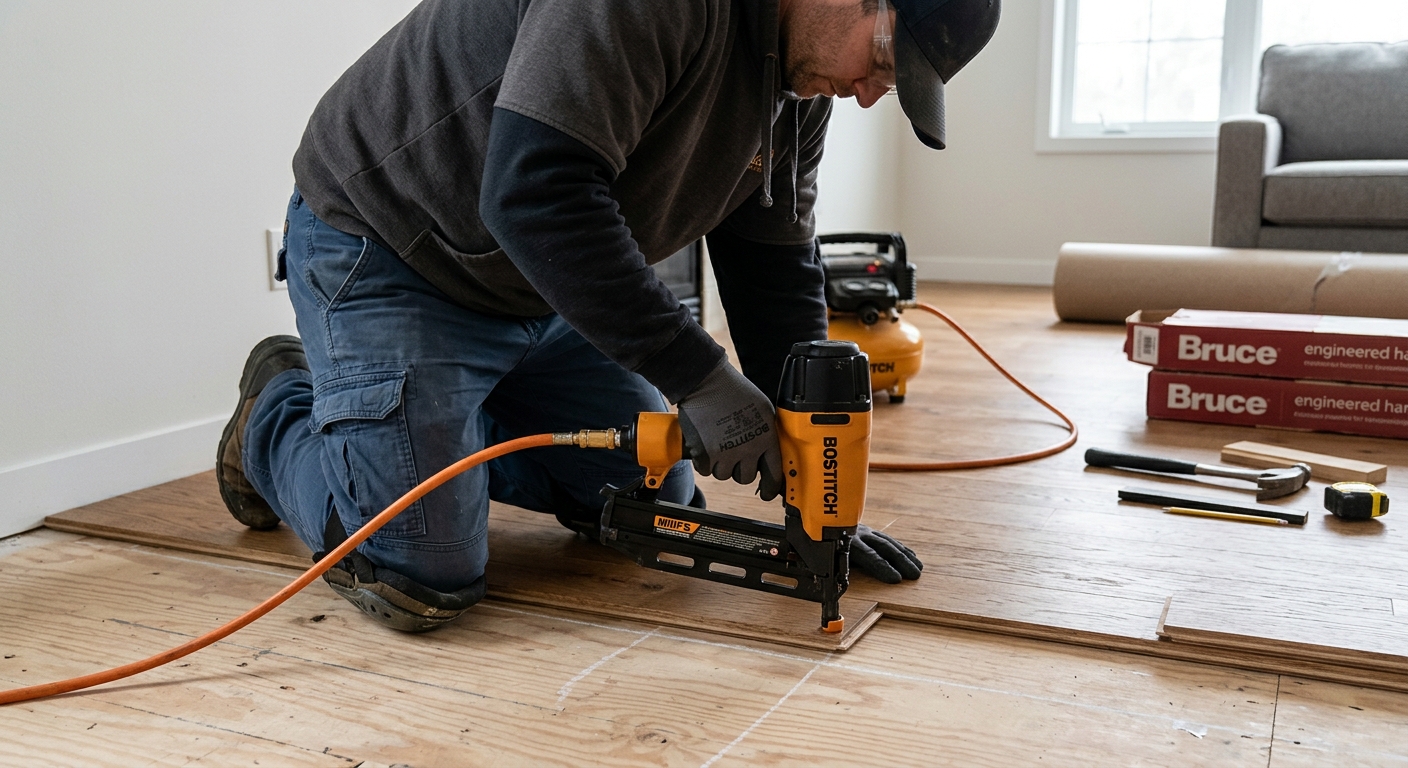
Flooring options and costs in Parkwoods-Donalda
Parkwoods-Donalda, Ontario has a steady mix of older ranch-style and mid-century homes, plus newer infill. In the 2021 Census, the area’s population is 34,805 (Statistics Canada, 2021 Census). That matters because many projects aren’t “just swapping floors” — they often start with subfloor preparation. Toronto-area housing stock commonly dates from the 1960s–1990s, so it’s typical to see plywood replacement, OSB patching, or full-sheet levelling before the finished flooring goes down. That prep can add meaningful cost even when you choose a mid-range surface like laminate or LVP.
Toronto’s indoor humidity swings across seasons also shape pricing. During winter, indoor air is frequently drier; in spring and fall, humidity rises and basements can feel damp around concrete edges. Solid hardwood looks premium, but it expands and contracts with moisture and is riskier over concrete or in basements. For most homeowners in Parkwoods-Donalda (especially condos and newer builds with tighter construction), engineered hardwood or luxury vinyl plank is the safer value. Labour availability and demand also push costs up in the Toronto market, where renovation timelines are busy and crews are scheduled tightly.
We see this trade especially in demand around Donalda Golf Course and the surrounding residential blocks, where homeowners often renovate around family-room expansions and open-concept layouts. Next, here’s a practical side-by-side of common options and what you can realistically expect to pay per square foot.
| Type |
Best Room |
Moisture Resistance |
Lifespan |
Price per sq ft |
| Solid hardwood (nail-down, above grade only) |
Living / dining (above grade) |
Low–moderate; moves with humidity |
20–40 years |
$10 – $18 |
| Engineered hardwood (float or glue, above + on-grade) |
Living areas, bedrooms |
Good; handles typical home humidity |
15–30 years |
$9 – $16 |
| Laminate (click-lock, above-grade) |
Bedrooms, hallways |
Moderate; avoid prolonged damp |
10–20 years |
$4 – $8 |
| Luxury vinyl plank / LVP (waterproof, any level) |
Kitchen, finished basement, main floor |
Very high; suitable for below grade |
15–25 years |
$5 – $9 |
| Porcelain / ceramic tile |
Kitchen, bathrooms |
Very high; water-tolerant |
25–50 years |
$12 – $25 |
| Carpet (broadloom or modular tile) |
Bedrooms, rec rooms |
Low–moderate; keep it dry |
7–15 years |
$5 – $11 |
Prices are estimates only and vary by project scope, site access and material selection.
What affects the price of flooring in Parkwoods-Donalda
In Parkwoods-Donalda and across the Toronto region, quotes for the “same” flooring can land 30–50% apart because the variable isn’t just the surface material — it’s the preparation and installation complexity. Two homes can both choose laminate, for example, but one needs levelling and plywood repair while the other is flat and clean. Toronto-area labour costs are also pushed higher by strong renovation demand and wage levels compared with many other parts of Ontario, so crews spend more time per job and scheduling affects pricing.
Technically, indoor humidity swings are the key driver. When humidity rises, solid hardwood expands and when humidity drops, it contracts. That’s why solid hardwood is generally limited to above-grade installs and why we usually avoid it for basements or directly over concrete. Engineered hardwood and luxury vinyl plank are built for dimensional stability and can work better for on-grade and below-grade conditions. In colder stretches of the region and in many newer custom builds, radiant floor heating is common; that typically supports engineered wood, tile, and certain vinyl products, while eliminating most traditional solid hardwood and some laminate setups due to heat and expansion.
Older regional housing stock also frequently needs subfloor levelling or repair. In practical dollar terms, that prep can add roughly $1–$4 per sq ft before you even see the “finished” flooring line item. For example, switching from laminate at $4 – $8 per sq ft to LVP at $5 – $9 can be a small upgrade, but only if the subfloor prep is already planned. Conversely, if levelling is needed anyway, you might justify tile in the kitchen because you’re paying for prep either way — and tile’s water tolerance reduces future replacement risk.
| Price Factor |
Why It Matters |
Cost Impact |
| Room area in sq ft |
Material and labour are both area-based |
Small rooms cost more per sq ft due to minimum labour |
| Subfloor condition |
Levelling, patching, or plywood replacement increases time |
Often adds about $1–$4 per sq ft |
| Moisture / below-grade install |
Determines whether solid hardwood is allowed |
May shift you to engineered wood or LVP |
| Material choice |
Solid vs engineered vs LVP vs tile changes both supply and method |
Hardwood/tile generally cost more than laminate/LVP |
| Removal and disposal of existing flooring |
Tear-out, dump fees, and underlayment removal add labour |
Can add a noticeable line item on older renovations |
| Stair nosing / transitions |
Special pieces and extra installs per step/transition |
Charged per step or per linear foot |
| Radiant heat compatibility |
Limits which products can handle heat cycling |
May increase material cost or remove cheaper options |
| Installation method |
Float vs glue-down vs nail-down affects labour and prep |
Nail-down and glue-down can be more labour-intensive |
Permits & regulations in Ontario
In Ontario, the flooring installation itself typically does not require a building permit. That said, some related work may. If your project includes structural subfloor repair, moisture remediation, or modifications that intersect with building services, you may need permits depending on scope. For example, if radiant floor heating requires work on electrical circuits (or if you’re adding/altering controls and wiring), electrical permits and inspections can apply. If you’re replacing damaged subfloor materials in a way that could affect structure, the municipality or your electrical/structural trades’ processes may require oversight.
In condominiums, permits are only part of the compliance story. The bigger hurdle is usually the building’s sound transmission requirements. Many condos use STC/IIC guidelines and require specific underlay under hard flooring on upper floors. Before installing hardwood or tile on above-grade unit floors, review the condo declaration and ask for written approval. For Parkwoods-Donalda homeowners in condo-style buildings, this step is often what prevents costly rework later.
To verify a contractor in Ontario, do three checks in order: (1) licensing/credentials where applicable, and confirm the company name matches the quotes and invoices; (2) liability insurance—ask for a current certificate of insurance; and (3) WSIB/WCB coverage for workers. You can also request a clearance letter (or equivalent proof) from the contractor and verify it aligns with your project dates. Keep everything in writing before work starts.
Best flooring for each room in your Parkwoods-Donalda home
In Parkwoods-Donalda, the “best” flooring is the one that tolerates Toronto’s seasonal humidity swings while fitting each room’s water exposure and daily traffic. For living and dining areas, engineered hardwood or high-quality laminate tends to be the sweet spot: it gives warmth underfoot without the same moisture sensitivity as solid hardwood. For bedrooms, carpet is still popular because it improves comfort and sound absorption, especially in family homes with upstairs foot traffic. In kitchens, we steer many homeowners toward luxury vinyl plank (LVP) or large-format porcelain tile. Both handle spills and frequent cleaning, and tile’s water tolerance is unbeatable for long-term durability.
Basements are where choices need to be conservative. Finished basements in older Toronto homes can face moisture vapour coming from concrete and colder slab conditions. LVP is usually the clear winner because waterproof products and the right underlayment approach handle below-grade conditions better than solid wood and most laminate. Bathrooms should be porcelain or ceramic tile only, with proper waterproofing and grout/grout line attention.
Radiant heat compatibility is increasingly common in Ontario new construction and custom renos. If you have in-floor heating, engineered wood, tile, and certain vinyl products typically pair better than traditional solid hardwood. A concrete example: if your kitchen finish is between laminate at $4 – $8 per sq ft and LVP at $5 – $9, that one-dollar-to-mid-range difference is often justified because LVP reduces the risk of swelling from frequent wet mopping and dropped packages—particularly in a neighbourhood where older homes may have tighter moisture control challenges.
| Room |
Best Material |
Why |
Moisture Risk |
Price Band per sq ft |
| Living / dining room |
Engineered hardwood |
Warm look, stable sizing vs solid wood in humidity swings |
Low; manage indoor humidity |
$9 – $16 |
| Master bedroom |
Carpet or engineered hardwood |
Comfort and noise reduction; or stable wood feel |
Low–moderate |
$5 – $11 |
| Secondary bedrooms |
Carpet (or laminate in high-traffic homes) |
Kid-friendly comfort and easier maintenance than bare floors |
Low |
$4 – $11 |
| Kitchen |
Luxury vinyl plank (or porcelain tile) |
Spill tolerance, fast cleaning, strong performance under wear |
Moderate–high |
$5 – $25 |
| Basement (finished) |
Luxury vinyl plank |
Waterproof options handle below-grade moisture better |
High (vapour + slab conditions) |
$5 – $9 |
| Bathroom |
Porcelain / ceramic tile |
Designed for wet areas; long service life |
Very high |
$12 – $25 |
How to choose a flooring contractor in Parkwoods-Donalda
Choosing the right contractor is the fastest way to avoid surprises in Parkwoods-Donalda. Start with Ontario coverage checks. Ask for proof of liability insurance (request the certificate and ensure it’s active for your project period). Then confirm WSIB/WCB coverage: request documentation that lists the company and is valid for the job, and ask for a clearance letter where applicable. A contractor who can’t provide current proof should be an automatic pause.
Next, require 2–3 itemised written quotes rather than a single lump sum. You want clear separation between materials, labour, subfloor levelling/repairs, underlay (if required), stair nosings/transitions, removal/disposal, and any moisture-mitigation work. Read the exclusions line-by-line: what’s not included, and what happens if the subfloor is worse than expected? For permits, confirm whether any permit pull for electrical or related work is included (if applicable) or handled by a different trade.
Warranty matters twice: workmanship and product. Verify the workmanship warranty length, how it’s delivered, and whether the coverage depends on using approved installation methods. Check the manufacturer’s warranty (and whether it’s transferable with a home sale). For payment, don’t front-load the project—never pay more than 10–15% upfront. Use a holdback that you release once the job is complete and cleaned. Finally, get a start date and completion estimate in writing, with a plan for material delivery delays.
- Provide current liability insurance certificate (matching the legal company name).
- Show WSIB/WCB coverage proof and/or clearance letter for active workers.
- Use itemised quotes: materials, labour, levelling/repairs, underlay, and disposal.
- Confirm what’s included in subfloor preparation (flattening, plywood replacement, patching).
- State the underlayment details for laminate/LVP and moisture/vapour control approach for basements.
- List stair nosing and transition pricing per step or per linear foot if applicable.
- Clarify removal scope: existing carpet pad, underlay, nails, staples, and adhesive.
- Document the warranty: workmanship terms, product warranty terms, and transferability.
- Request a detailed timeline and a completion target for punch-list walkthrough.
- Confirm protection plan for doors, walls, and HVAC vents during installation.
- Avoid large upfront payments; plan for a holdback until final completion.
- Get lead-time expectations for materials and who pays if selections arrive late.
Common red flags in Parkwoods-Donalda: (1) quoting only “material cost” without subfloor prep details, (2) refusing to itemise removal/disposal and stair/transitions, (3) offering a workmanship warranty but excluding normal humidity movement claims without explanation, (4) asking for full payment upfront or no holdback, and (5) giving verbal timelines with no written completion date or change-order process.
Frequently asked questions — flooring in Parkwoods-Donalda
How long does flooring installation take?
For most Parkwoods-Donalda homes, timeline depends on surface choice and prep. If your subfloor is already flat and you’re installing LVP or laminate, a typical main-floor room can be finished in a day or two. Engineered hardwood may take longer because of layout planning, acclimation, and the specific installation method (float vs glue-down). Basements add time if moisture mitigation or vapour control is needed, and older homes often require levelling/repairs first, which can stretch schedules. As a rule of thumb, expect about 1–3 days for installation per main-floor area, plus extra time for subfloor work and multi-day material acclimation. If you’re budgeting between $9 – $16 engineered hardwood and $5 – $9 LVP, the cheaper floor still takes similar time if the prep is the same.
What flooring works with radiant heat?
Radiant floor heating is increasingly common in Ontario, including new builds and custom renos around Parkwoods-Donalda. The best partners are typically porcelain/ceramic tile, engineered hardwood, and certain vinyl products that are rated for use over radiant heat systems. The reason is heat cycling: solid hardwood tends to expand/contract more sharply with temperature changes and is usually the riskiest choice over radiant systems unless your installer and product are specifically approved for it. Laminate can be hit-or-miss depending on its “radiant heat approved” rating and its underlay compatibility. When planning, ask your contractor to confirm the exact product rating and installation specs (including underlayment type and any recommended temperature ramp). Done correctly, engineered wood and tile usually provide the most stable comfort profile under radiant heat.
Engineered vs solid hardwood — what's the difference?
Solid hardwood is one continuous piece of wood and generally performs best above grade, where humidity is more stable. In Parkwoods-Donalda, Toronto-area indoor humidity swings can make solid floors more reactive, and solid wood is also higher risk over concrete slabs or in basements. Engineered hardwood uses multiple wood layers with a plywood-like core, which helps it resist seasonal movement. That’s why engineered floors are commonly used above grade and can be installed on-grade (and sometimes in controlled below-grade scenarios), provided the subfloor and moisture conditions are managed. If you’re deciding between budgets around $10 – $18 for solid hardwood and $9 – $16 for engineered, the engineered option often provides a better “fit-for-purpose” in Toronto’s moisture reality — especially in homes that need levelling or have concrete exposure.
Do I need to level my subfloor first?
In most Toronto-area renovations, you should at least plan for the possibility. Even small dips and high spots can cause click-lock failures, squeaks, and premature wear—especially with laminate and floating floors. Older housing stock common to the Toronto region often needs plywood replacement or levelling, particularly where an earlier floor system has shifted over time. In practice, levelling can be a major cost driver: prep may add around $1–$4 per sq ft depending on what’s wrong and how far it needs to be corrected. If your contractor finds moisture issues, that can add further steps and can change the material choice (for example, steering away from solid hardwood in below-grade areas). The right approach is a subfloor assessment before you lock in the product selection and installation method.
What's the most durable flooring for pets and kids?
For pets and kids in Parkwoods-Donalda, durability usually means: scratch resistance, stain resistance, and safe performance during everyday spills. Luxury vinyl plank (LVP) is often the top choice because many waterproof products handle accidents without swelling and are easier to clean than carpet or wood. Carpet can still be a good option for comfort, but it’s harder to recover from repeated wet incidents and can trap odours if moisture isn’t addressed quickly. Laminate can work too, but it’s more sensitive to prolonged damp. If you want a “durable-and-fast” solution, LVP in the typical $5 – $9 range often wins value. For maximum long-term durability in wet areas, porcelain tile can be excellent—just note it’s harder and may require area rugs for comfort.
How do I choose flooring for humidity in Parkwoods-Donalda?
Humidity is the Toronto-area reality, and Parkwoods-Donalda is no exception. Indoor moisture can swing through the seasons, and below-grade spaces can face additional vapour movement. Start with room location: basements and concrete-adjacent areas should generally steer you toward waterproof systems like LVP, not solid hardwood or moisture-sensitive laminate. For main floors, engineered hardwood is often the safer wood choice because it’s built to handle normal home humidity variation better than solid wood. Also plan for proper acclimation, correct underlayment, and a subfloor that’s flat and properly prepared. If you’re installing over concrete, ask about moisture testing and vapour control steps. Your final decision should reflect both the moisture conditions and your lifestyle goals—comfort, easy cleaning, and long-term stability.