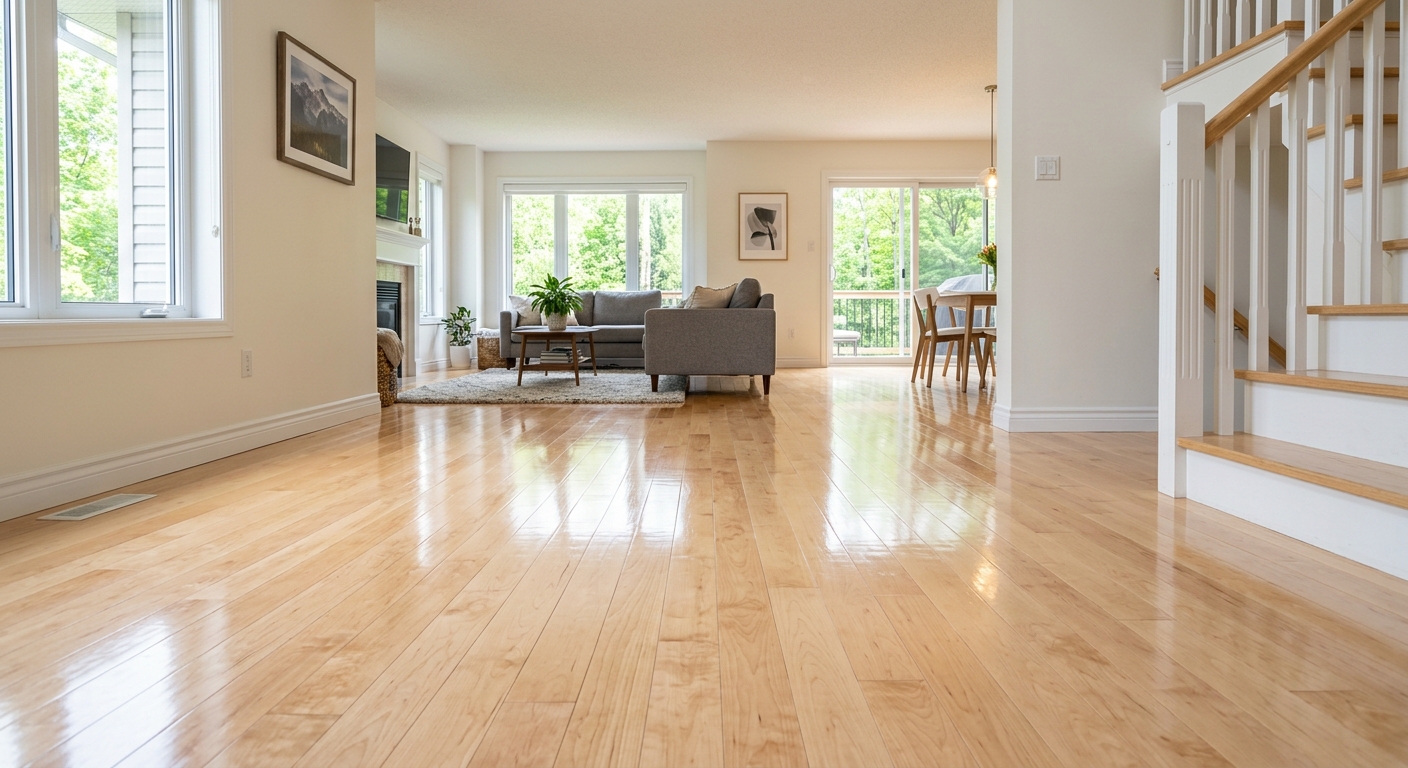
Flooring options and costs in Stoney Creek
Stoney Creek homeowners usually face a quick decision: choose a flooring type that can handle our humidity swings and the reality that many houses here are older. With a population of 76,382 (Statistics Canada, 2021 Census), the local market keeps a steady flow of installers, but the most common pricing swings come from what’s happening under the surface. In many Hamilton–Niagara Peninsula neighbourhoods—especially where mid-century homes are common—carpet-to-hard-surface upgrades often require subfloor levelling or minor repair before the new material goes down, and that can add roughly $1–$4 per sq ft to the install. Climate-wise, winters bring dry indoor air and summers bring more moisture, which is why solid hardwood is typically restricted to above-grade areas. Basements and concrete slabs are where engineered hardwood and luxury vinyl plank (LVP) usually outperform.
Demand is particularly strong around Waterdown-facing corridors and older pockets closer to central Stoney Creek, where renovations are frequent and basements get finished. Contractors also see high material turnover because buyers want options that tolerate thermal cycling; colder Ontario winters and radiant heating in newer builds steer many projects toward radiant-compatible engineered wood, LVP, and tile.
Use the table below to compare typical installed ranges for common flooring choices in the Hamilton–Niagara Peninsula. After that, the next sections break down why your quote can land at the low end or high end of these bands.
| Type |
Best Room |
Moisture Resistance |
Lifespan |
Price per sq ft |
| Solid hardwood (nail-down, above grade only) |
Living rooms, dining rooms, hallways (dry areas) |
Low (susceptible to seasonal expansion/contraction) |
30+ years with correct conditions |
$9,–$18 |
| Engineered hardwood (float or glue, above + on-grade) |
Living rooms, bedrooms, finished main floors |
Medium to high (more dimensionally stable) |
20–30 years depending on wear layer |
$10,–$17 |
| Laminate (click-lock, above-grade) |
Bedrooms, hallways, low-splash areas |
Low to medium (moisture can damage edges) |
10–20 years |
$4,–$10 |
| Luxury vinyl plank / LVP (waterproof, any level) |
Kitchen, main floor, finished basements |
High (waterproof core, better with below-grade) |
15–25 years with proper installation |
$6,–$12 |
| Porcelain / ceramic tile |
Bathrooms, kitchens, mudrooms |
High (when installed over correct underlayment) |
25+ years |
$10,–$22 |
| Carpet (broadloom or modular tile) |
Bedrooms, stairs (comfort-first) |
Medium (needs good vapour control in basements) |
8–15 years |
$4,–$9 |
Prices are estimates only and vary by project scope, site access and material selection.
What affects the price of flooring in Stoney Creek
Even when two homeowners in Stoney Creek want “the same” flooring, quotes across the Hamilton–Niagara Peninsula can easily vary by 30–50%. That’s rarely because of the top-line material; it’s because the region’s climate and older housing stock create extra work underfoot. Hamilton–Niagara homes often see indoor dryness in winter and higher humidity during summer, and that seasonal movement matters for solid wood. It also matters for the subfloor: many installations start with levelling, repair, or moisture management before a single plank is set. Where moisture barriers and underlayments are required—especially on concrete slabs or below grade—your cost moves toward the higher end of the bands, even before you upgrade the finish.
Technically, solid hardwood expands and contracts with humidity, so it cannot be glued or floated on concrete and typically isn’t the best choice for basements. Engineered hardwood and luxury vinyl plank (LVP) are more dimensionally stable and better suited for above-grade on-grade areas and finished basements. Colder regions also push demand for radiant-heat-compatible flooring; this limits some traditional options. On top of that, older regional floors frequently need subfloor levelling or repair, commonly adding $1–$4 per sq ft.
Concrete examples from this area: (1) moving from carpet to hard surface in a typical older Stoney Creek layout often adds levelling and patching—so an LVP job that might start in the $6–$12/sq ft range can climb if multiple low spots and squeaks require prep; (2) a basement install where moisture testing shows vapour pressure can shift a project toward LVP or tile and away from solid hardwood that would need conditions we can’t guarantee below grade. Finally, radiant heating rooms tend to cost more in labour planning (testing and compatible underlay), but the savings come from avoiding rework later.
| Price Factor |
Why It Matters |
Cost Impact |
| Room area in sq ft |
More square footage increases materials, carrying time, and labour hours |
Direct driver; small rooms can price higher per sq ft due to minimum charges |
| Subfloor condition |
Levelling, patching, and repair are often needed in older homes |
Typically adds about $1–$4/sq ft for prep in many Stoney Creek projects |
| Moisture / below-grade install |
Below grade and concrete slabs require moisture control; solid hardwood is restricted |
Can shift you to LVP/tile and add barrier/underlayment costs |
| Material choice |
Solid vs. engineered vs. LVP vs. tile have different tolerances, layers, and install complexity |
Moves your project across bands (e.g., $4–$10 for laminate vs. $10–$22 for tile) |
| Removal and disposal of existing flooring |
Disposal fees and subfloor cleaning affect both time and cost |
Higher if glue-down carpet or tile is present |
| Stair nosing / transitions |
Trim, nosing, and matched transitions are labour-intensive and may be priced per step |
Often priced per linear foot or per step; can noticeably raise total |
| Radiant heat compatibility |
Not all materials tolerate in-floor heating thermal cycling |
May add compatible underlayment or limit material selection (cost changes accordingly) |
| Installation method |
Float, nail-down, and glue-down methods require different prep and labour time |
Glue-down and complex patterns typically increase labour cost |
Permits & regulations in Ontario
In Ontario, the flooring installation itself usually does not require a building permit. However, related work can trigger permit requirements. For example, if your project involves structural subfloor repair that alters framing or significant structural elements, or if moisture remediation requires substantial repairs to building assemblies, that associated work may require permits depending on scope and how it’s classified. In-floor heating is another common trigger: if you’re modifying electrical circuits or adding/altering wiring for radiant systems, electrical permits may be required.
For multi-unit buildings, the bigger “rule set” often comes from condo requirements rather than general flooring permits. Condo corporations commonly set standards for sound transmission (STC/IIC) and may require specific underlay under hard surface floors on upper levels. Before you install hardwood or tile above grade in a condominium, review the declaration and request written board approval where required. Getting that step wrong can lead to costly removal after the fact.
To verify your contractor in Stoney Creek, do it in a straightforward sequence: (1) confirm the installer’s Ontario business registration and any trade credentials they claim; (2) ask for a certificate of insurance showing general liability with the correct named insured and coverage limits; (3) request proof of WSIB/WCB coverage (or an acceptable clearance letter, where applicable) and confirm it covers flooring installation work; and (4) ensure these documents match the company you’re contracting with.
Best flooring for each room in your Stoney Creek home
Choosing flooring by room helps Stoney Creek homeowners avoid expensive mistakes, especially where humidity and temperature swing can stress materials. Living and dining areas benefit from warmth and a refined look: engineered hardwood or high-quality laminate works well because they handle normal seasonal movement better than solid wood. For comfort and sound absorption, many homeowners choose carpet in the master bedroom; in older homes, it can also help reduce echo in larger spaces.
In kitchens, the repeated spills and frequent mopping push the best performers toward luxury vinyl plank (LVP) or large-format porcelain tile. LVP’s waterproof construction handles everyday moisture better, while tile stays durable if installed correctly over a suitable underlayment system. Basements are the make-or-break area in our region: fully waterproof LVP is typically the clear winner for finished basements because it tolerates moisture vapour and below-grade conditions far better than solid wood and most laminate. Bathrooms are straightforward—porcelain or ceramic tile only—because grout and underlayment choices protect the subfloor.
If you have (or are planning) radiant heat, select materials that are specifically compatible. Colder Ontario winters make radiant systems increasingly popular, and that compatibility protects you from gaps, buckling, or delayed heat transfer problems. As a quick price justification example: in many Stoney Creek projects, LVP can land around $6–$12 per sq ft, while tile frequently starts near $10–$22 per sq ft—so spending more on tile in a bathroom or entry is usually worth it, while saving that budget on bedrooms with engineered hardwood or carpet often makes better sense.
| Room |
Best Material |
Why |
Moisture Risk |
Price Band per sq ft |
| Living / dining room |
Engineered hardwood |
Warm look with better stability through seasonal humidity swings |
Low (above grade) when humidity is controlled |
$10,–$17 |
| Master bedroom |
Carpet or engineered hardwood |
Carpet adds comfort and sound damping; engineered wood keeps a cleaner feel |
Low (above grade), moderate if humidity is high |
$4,–$17 |
| Secondary bedrooms |
Laminate or engineered hardwood |
Laminate is budget-friendly; engineered wood holds up better long-term |
Low (above grade) |
$4,–$17 |
| Kitchen |
Luxury vinyl plank (LVP) or porcelain tile |
LVP handles spills and cleaning; tile stays rigid and water-resistant |
Medium to high (wet mops and occasional overflow) |
$6,–$22 |
| Basement (finished) |
Luxury vinyl plank (waterproof) |
Best dimensionally stable choice for below-grade conditions and vapour risk |
High (below grade and concrete contact) |
$6,–$12 |
| Bathroom |
Porcelain / ceramic tile |
Hard-wearing and water-resistant when installed over the right prep system |
High (water exposure and humidity) |
$10,–$22 |
How to choose a flooring contractor in Stoney Creek
In Stoney Creek and across Ontario, the best flooring contractors make verification easy. Start with licensing/qualification where applicable for their trade and business, then confirm liability insurance: ask for a current certificate of insurance and ensure it includes general liability coverage and the correct company name. Next, verify WSIB/WCB coverage—request proof of coverage or a valid clearance letter. Don’t accept “we’re covered” without documentation.
Then get 2–3 itemised written quotes. The quote should separate labour, removal/disposal, subfloor prep (levelling/repair), underlayment/moisture barrier, transitions, and installation method. Avoid a lump-sum number that skips details; it’s where misunderstandings start. Check the scope carefully: what’s excluded (baseboards, haul-away, moving heavy furniture), is the permit pull included when required for electrical/radiant modifications, and is disposal included? For warranties, confirm both product warranty and workmanship warranty length, how long the coverage lasts, and whether it’s transferable if you sell your home.
Payment schedules matter. A safe approach is never paying more than 10–15% upfront, and using a holdback until the job is complete and you’ve inspected it. Finally, get a start date and completion estimate in writing; for flooring in our climate, prep time (moisture checks, levelling cures) can affect the timeline.
- Request insurance certificate and confirm the listed address matches the contracting company.
- Ask for WSIB/WCB proof or clearance letter before work begins.
- Get an itemised quote: labour, materials, prep, underlayment/moisture barrier, transitions.
- Confirm whether furniture moving is included and how it’s handled.
- Ask what subfloor conditions trigger extra costs (self-levelling limits, patching policy).
- Ensure removal and disposal are specified (carpet underlay, old glue, nails/staples).
- Verify stair work is priced clearly (nosing and matching nosing for hard surfaces).
- Confirm transitions between rooms and floor heights (reducers, T-moldings, thresholds).
- Review warranty terms in writing: workmanship duration and product coverage conditions.
- Use a reasonable payment schedule (10–15% max upfront; holdback until completion).
- Confirm radiant heat compatibility details in the quote if applicable.
- Get a written schedule: start date, expected completion window, and cure/prep times.
Red flags to watch for in Stoney Creek: quotes that are not itemised, no proof of WSIB/WCB or liability insurance, unclear exclusions for subfloor levelling or moisture barriers, “we can install solid hardwood in a basement” without moisture controls, and payment requests that exceed 15% upfront or refuse a completion holdback.
Frequently asked questions — flooring in Stoney Creek
Hardwood vs laminate vs vinyl plank — which is best?
In Stoney Creek, the “best” choice depends mostly on moisture risk and where you’re installing. Solid hardwood is beautiful, but it’s best kept to above-grade rooms; our winter dryness and summer humidity swings can cause movement, and basements are a problem area. Laminate is budget-friendly and popular for bedrooms, often landing in the $4–$10 per sq ft band installed, but it’s more vulnerable if water gets into seams. Luxury vinyl plank (LVP) is usually the most forgiving for Ontario homes because it’s waterproof and tolerates humidity and below-grade conditions better—commonly $6–$12 per sq ft installed, depending on thickness and underlayment. If you’re deciding quickly: main floor comfort/looks = engineered or solid wood above grade; kitchens and basements = LVP or tile for peace of mind.
What flooring is best for a Stoney Creek basement?
For a basement in Stoney Creek, the safest go-to is waterproof LVP, assuming the subfloor is prepared and any moisture issues are addressed. Below grade basements face higher vapour pressure and occasional dampness, and that’s where solid hardwood and most laminate tend to fail first—edges swell, boards can lift, and you can get odours if moisture is trapped. Tile is also a strong basement option, but it can be more expensive in material and labour (often within the $10–$22 per sq ft installed range), and it’s heavier. LVP generally provides the best balance of stability, easier maintenance, and lower risk. The key is moisture control: a proper barrier/underlayment plan and a contractor who won’t just “cover it up” without checking the substrate.
Can I install hardwood over concrete?
It depends on the type of hardwood and the concrete condition. True solid hardwood (nail-down) is typically restricted to above-grade applications; it’s not recommended to nail down over concrete slabs in standard residential practice, and solid wood’s movement with humidity can create problems if the slab is cold or has moisture. Engineered hardwood is the more realistic option over concrete, because it’s more dimensionally stable and can be installed as a floating or glue-down system based on the product instructions. Before any wood goes down, you should have the slab checked and ensure the right moisture testing and underlayment plan is used. If your installer is telling you “solid hardwood over concrete will be fine” without a moisture plan, that’s a high-risk answer.
How long does flooring installation take?
Typical residential timelines in Stoney Creek range from a couple of days for a small main-floor job to about a week for larger areas with stairwork and significant subfloor prep. Prep is what often extends the schedule: removing old flooring, levelling uneven sections, and letting patching/levelling materials cure can add time. Moisture barrier installation and radiant-heat coordination can also affect sequencing. If you’re moving from carpet to hard surface, plan for more prep than you might expect, particularly in older homes where the subfloor isn’t perfectly flat. A good contractor will provide a written start date, an estimated completion window, and explain cure times—so you’re not surprised by delays.
What flooring works with radiant heat?
Radiant heat compatibility is about the flooring’s tolerance for thermal cycling and the product’s installation instructions. In Ontario, engineered hardwood and many LVP systems are commonly used because they handle temperature changes better than traditional solid hardwood. Tile also works well with radiant heat because it’s rigid and responds predictably to temperature changes, though correct underlayment and thinset methods matter. Laminate can work if the manufacturer explicitly approves it for radiant heat, but not all products are suitable—some can warp or separate when heated. The key step is choosing flooring that’s rated for radiant systems and having an installer follow the manufacturer’s acclimation and underlayment requirements. If your quote doesn’t mention radiant compatibility, ask before you commit.
Engineered vs solid hardwood — what's the difference?
Solid hardwood is one continuous piece of wood (installed nail-down in most residential situations) and it relies on stable indoor humidity. In Ontario—especially with winter dryness and summer humidity—solid hardwood can move, so it’s usually limited to above-grade rooms. Engineered hardwood is built in layers, with a plywood or fibre core topped by a hardwood wear layer, which makes it more dimensionally stable. That stability is why engineered flooring is the common choice when homeowners want a hardwood look near on-grade concrete or in areas where moisture conditions are more variable. In terms of pricing, both can overlap, but engineered often lands in the $10–$17 per sq ft installed band while solid hardwood frequently sits higher within the $9–$18 per sq ft range depending on grade and complexity. The best difference for homeowners: engineered is typically the safer bet for Ontario temperature swings.