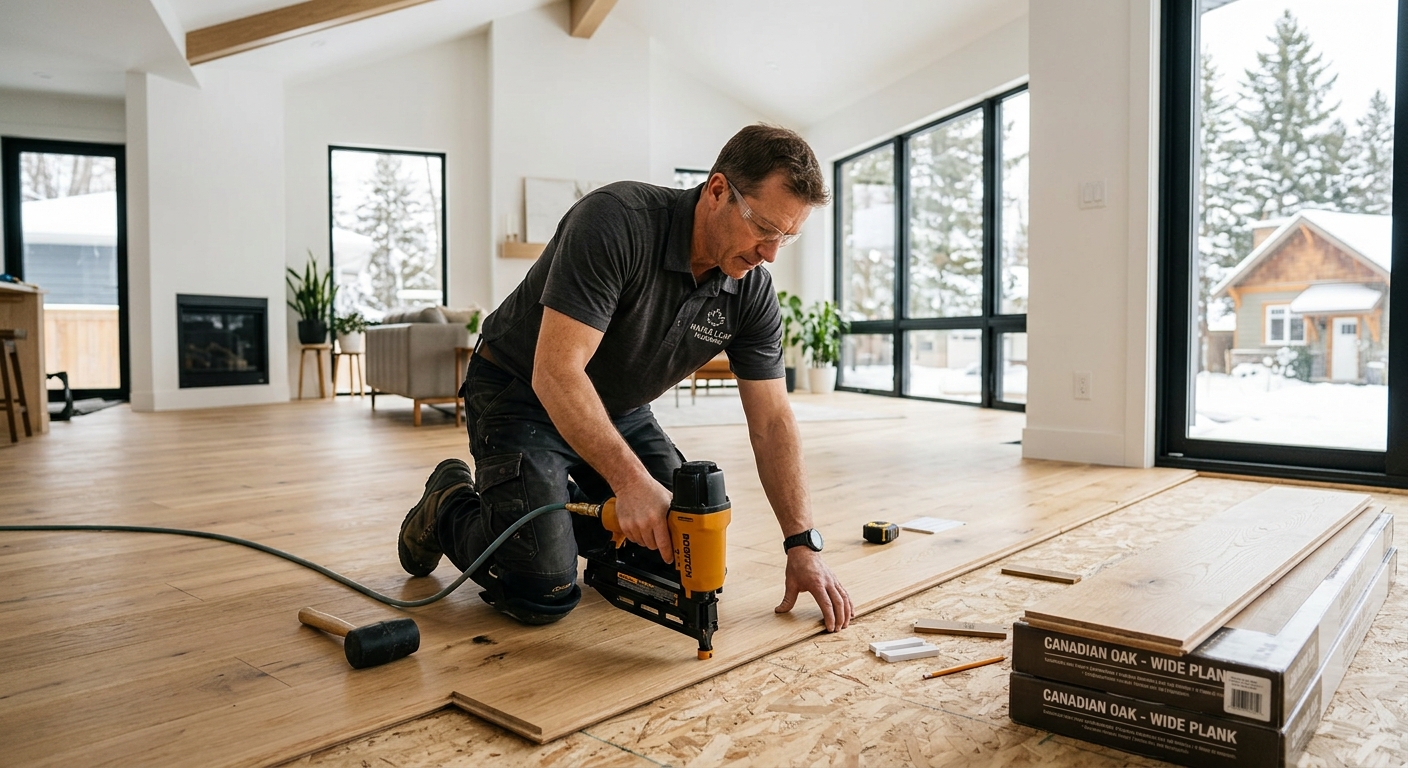
Flooring options and costs in West End
In West End, choosing flooring is as much about moisture and subfloor condition as it is about style. With Toronto’s wide indoor humidity swings across seasons, many homes see expansion in winter and shrinkage in summer—so the “same” floor can behave differently from one condo or infill build to the next. West End is also served by a lot of older housing stock: Toronto-area neighbourhoods around areas like Runnymede and the Bloor–Ossington strip often have subfloors that were laid or patched decades ago, and it’s common to see levelling compound, plywood replacement, or moisture mitigation before installation. In practical terms, that prep work can add budget even when the finished floor is mid-range.
On top of that, labour demand is high and contractor availability can affect scheduling and pricing. For homeowners planning a renovation, it helps to know the typical price bands for this market tier: hardwood usually starts higher because of premium materials and careful installation, while laminate and luxury vinyl plank often win on value and dimensional stability. If you’re in a space over concrete or thinking about an area where moisture can show up (entryways, kitchens, finished basements), engineered hardwood or waterproof LVP is often the safer first choice.
To ground the conversation, here are realistic per-square-foot ranges for the most common flooring options in West End. Next, we’ll break down the specific factors that swing quotes in Toronto-area projects.
| Type |
Best Room |
Moisture Resistance |
Lifespan |
Price per sq ft |
| Solid hardwood (nail-down, above grade only) |
Living / dining (above grade) |
Low; sensitive to humidity swings and cannot be used on concrete/basements |
25–50 years |
$11–$18 |
| Engineered hardwood (float or glue, above + on-grade) |
Living, dining, bedrooms |
Medium to high; handles seasonal humidity better and tolerates on-grade installs |
20–40 years |
$9–$16 |
| Laminate (click-lock, above-grade) |
Bedrooms, hallways |
Low to medium; water-resistant only to spills if underlayment is correct |
10–25 years |
$4–$8 |
| Luxury vinyl plank / LVP (waterproof, any level) |
Kitchens, finished basements, multi-use spaces |
High; waterproof core, suitable for below-grade when installed over proper vapour management |
15–25 years |
$5–$9 |
| Porcelain / ceramic tile |
Bathrooms, kitchens, foyers |
Very high; handles moisture well but needs good subfloor support and crack control |
25–50 years |
$12–$25 |
| Carpet (broadloom or modular tile) |
Bedrooms, rec rooms |
Medium; can be risky if vapour/moisture is present without mitigation |
5–15 years |
$5–$11 |
Prices are estimates only and vary by project scope, site access and material selection.
What affects the price of flooring in West End
In West End (Toronto-area), two quotes for the same square footage can differ by 30–50% because the “hard costs” are similar but the “job conditions” are rarely identical—especially with Ontario’s humidity swings and older subfloors. Material choice is only one piece. A contractor’s scope often changes based on whether they must level the existing surface, replace damaged plywood, manage vapour on concrete, or build sound-control underlay for condos. Also, labour rates in the Greater Toronto Area are pushed up by renovation demand and higher general construction wages.
Technically, the indoor humidity swings across seasons are a major driver. Solid hardwood expands and contracts with moisture; it’s also risky over concrete and doesn’t belong in most basements. Engineered hardwood and luxury vinyl plank handle humidity better and are specifically designed for below-grade and high-humidity installs. If your West End home sits over concrete (common in many condos and some mid-century builds) or has any basement moisture history, you’ll often see the quote steer away from solid wood and toward engineered or waterproof vinyl. In colder parts of the region, radiant floor heating is also increasingly used in newer custom homes; that tends to pair better with engineered wood, tile, and certain vinyl systems than with traditional solid hardwood because of heat and expansion considerations.
Concrete examples we see in West End: (1) a 600 sq ft living/dining with minor low spots might need only levelling compound, but a warped subfloor can trigger plywood replacement before installation—adding meaningful cost. (2) a finished basement at 400 sq ft commonly needs vapour mitigation under LVP; if the existing slab is not prepared, the prep bill can rise quickly. Even at mid-range pricing, you can feel it—moving from laminate around $4–$8 toward engineered hardwood around $9–$16 can be justified if it avoids future cupping or failures caused by moisture movement. (Statistics Canada, 2021 Census) shows the Toronto area’s population base includes 4,142 people in the West End profile, supporting the consistent renovation demand that keeps crews busy.
| Price Factor |
Why It Matters |
Cost Impact |
| Room area in sq ft |
Larger areas change how crews mobilize and how materials are purchased |
Low to moderate variance; often the biggest driver numerically |
| Subfloor condition — levelling or repair needed |
Old plywood gaps, nail pops, dips, and rot must be corrected for flatness |
Can add roughly $1–$4 per sq ft in older homes |
| Moisture / below-grade install — rules out solid hardwood |
Vapour barriers and slab prep are critical for concrete and basements |
Often shifts product choice to engineered or LVP and adds prep labour |
| Material choice — solid vs. engineered vs. LVP vs. tile |
Different products have different installation tolerances and labour complexity |
Hardwood and tile typically cost more than laminate and LVP |
| Removal and disposal of existing flooring |
Demo time, underlayment removal, and landfill fees vary |
Often a noticeable line item for glued-down or tile |
| Stair nosing / transitions — charged per step or per linear foot |
Edging and transitions require extra materials and precision cuts |
Can increase total cost quickly on multi-level homes |
| Radiant heat compatibility — limits material options |
Heat and expansion considerations affect acceptable flooring types and underlays |
May raise cost if you need a specific engineered system |
| Installation method — float vs. glue-down vs. nail-down |
Method changes subfloor prep and labour time |
Glue-down or nail-down is usually more labour-intensive than floating |
Permits & regulations in Ontario
In Ontario, installing flooring itself typically does not require a building permit. You generally can proceed with replacing existing flooring (for example, laminate, engineered hardwood, LVP, or carpet) without pulling a permit—provided you are not altering structural members or doing work that touches regulated building systems. The exceptions are usually tied to associated work that triggers electrical or other approvals: if your scope includes in-floor heating circuits (new work, wiring changes, or alterations to the electrical system), electrical permits and inspections are often required. Similarly, if moisture remediation involves substantial subfloor or structural repairs, your contractor may need to follow additional requirements depending on what’s being repaired.
Condominium rules are another big consideration in West End. On upper floors, many corporations restrict or require specific underlay or sound-control measures to meet building sound transmission expectations. In practice, that often means you should confirm required underlay for hard flooring and, in many buildings, request approval in writing before installing hardwood or tile on concrete/above-grade units where residents share walls and floors.
Step-by-step, verify your contractor before work begins:
- Confirm licensing/registration status applicable to their trade (when relevant) using the appropriate Ontario online registry details provided to you.
- Request a certificate of insurance for liability (and the specific project name/address if available).
- Ask for proof they carry WSIB/WCB coverage for workers involved in the flooring scope.
- Get copies of clearance letters or coverage verification where offered.
- Confirm the condo’s written requirements and required underlay/installation method in your contract.
Best flooring for each room in your West End home
In West End, the “best” flooring depends on traffic, comfort, and how the room behaves with Ontario’s seasonal moisture swings. For living and dining areas, engineered hardwood is a common winner because it keeps the look of hardwood while tolerating humidity changes better than solid wood. If you prefer a lower-cost option, high-quality laminate can work above grade when the underlayment and subfloor flatness are right.
For bedrooms, homeowners often choose carpet for comfort and sound absorption, especially in condo settings. Where you want easier cleaning, engineered hardwood also performs well in bedrooms—provided the install stays above grade and the subfloor is prepped correctly. In kitchens, luxury vinyl plank (LVP) is usually the most forgiving choice: it handles splashes, stays more stable near seasonal humidity changes, and is easier to maintain than wood. If you want a long-life, water-proof surface, large-format porcelain tile is also excellent, but it requires a properly prepared base to avoid cracked grout or lippage.
Basements are where Toronto homeowners feel the climate the most. For finished basements, LVP is the clear winner because it’s waterproof and designed for below-grade installs. Traditional solid hardwood is risky in basements, and many laminate products aren’t intended for ongoing moisture vapour. Bathrooms should be porcelain/ceramic tile only. If you have or plan radiant floor heating, it generally pairs better with engineered wood, tile, and certain vinyl products; traditional solid hardwood is usually limited due to heat and expansion requirements.
Example: if your main floor is 500 sq ft, switching from laminate around $4–$8 to engineered hardwood around $9–$16 can make sense when it reduces the chance of movement-related issues—particularly in spaces with HVAC changes or seasonal humidity swings.
| Room |
Best Material |
Why |
Moisture Risk |
Price Band per sq ft |
| Living / dining room |
Engineered hardwood |
Warm look with better humidity tolerance than solid wood |
Low to medium (depends on HVAC and seasonal swings) |
$9–$16 |
| Master bedroom |
Carpet or engineered hardwood |
Carpet adds comfort and sound control; engineered keeps cleaning easier |
Low |
$5–$14 |
| Secondary bedrooms |
Laminate (above grade) or carpet |
Good value for daily traffic; choose quality underlayment for stability |
Low |
$4–$11 |
| Kitchen |
Luxury vinyl plank (LVP) or porcelain tile |
Water tolerance and easy wipe-down performance |
Medium (spills and condensation near exterior doors) |
$5–$25 |
| Basement (finished) |
Luxury vinyl plank (waterproof) |
Designed for below-grade installs and vapour-management scenarios |
High (vapour and seasonal basement humidity) |
$5–$9 |
| Bathroom |
Porcelain / ceramic tile |
Non-porous, long-lasting surface for wet zones |
High |
$12–$25 |
How to choose a flooring contractor in West End
Choosing the right contractor in West End comes down to proof, clarity, and coverage—not just price. Start with Ontario licence/registration where applicable to their trade, then verify liability insurance and workers’ compensation coverage (WSIB/WCB) for the installers who will be on your site. Ask for a certificate of insurance and confirmation of clearance/coverage so you’re not left holding the risk if something goes wrong. A legitimate flooring crew should be comfortable providing documentation quickly.
Next, get 2–3 itemised written quotes. You want line items that separate material and labour, include removal/disposal, and state what’s included in subfloor prep. Look for a breakdown of: flattening/levelling compound, plywood replacement (if needed), underlay/vapour barrier details, transitions and stair nosings, and any baseboard work. Be wary of a lump sum that doesn’t explain scope—it’s where surprises happen.
Warranty matters in Toronto’s moisture conditions. Confirm the workmanship warranty length, whether the manufacturer warranty depends on approved installation steps, and if warranties are transferable if you sell the home. Payment should be staged: never pay more than 10–15% upfront, and hold back a portion until the job is complete and cleaned. Finally, lock the timeline in writing with a start date and a completion estimate.
- Ask for WSIB/WCB proof and confirm it covers the exact installers on your project.
- Request liability insurance with your project address listed if possible.
- Get an itemised quote (materials vs labour) with square-footage assumptions.
- Confirm whether subfloor levelling is included or billed separately.
- Require details on vapour barrier/underlayment type and thickness.
- Verify removal and disposal is included (and what flooring is being removed).
- Confirm transitions, stair nosing, and edge finishing are priced per step/linear foot.
- Ask how they measure flatness before install and what tolerance they meet.
- Request product model numbers, wear layer (for LVP/laminate), and thickness.
- Confirm warranty terms in writing (workmanship + manufacturer product warranty).
- Agree on a payment schedule with a holdback until final walkthrough.
- Get a written start and completion timeline, including weather-sensitive scheduling notes.
In West End, red flags include: quotes that aren’t itemised, no written scope for subfloor prep, refusal to provide WSIB/WCB clearance proof, missing product model numbers, and “low upfront” promises that still ask for more than 10–15% without a clear schedule and contract.
Frequently asked questions — flooring in West End
What is the difference between floating and glued-down flooring?
Floating floors are installed so the boards attach to each other (usually click-lock) but not rigidly to the subfloor. That gives a bit of movement, which can help with minor expansion and contraction during Toronto’s humidity swings. Glued-down flooring (common in some engineered and certain vinyl systems) is adhered to the subfloor, which typically improves stability on well-prepped surfaces but requires stricter flatness and correct adhesives. In West End, the choice often depends on your base: if you’re above grade and your slab or subfloor is stable, floating engineered or LVP can be cost-effective. If your installer needs maximum stability over a prepared surface, glue-down systems may be recommended. Cost-wise, you’ll commonly see engineered hardwood around $9–$16, while LVP often lands around $5–$9, with prep scope being the bigger swing factor than method alone.
What flooring holds up best to pets in a West End home?
For pets, homeowners in West End usually get the best long-term result from luxury vinyl plank (LVP) or high-quality laminate above grade. LVP is waterproof, more forgiving with accidents, and it handles day-to-day paw traffic without the same humidity sensitivity as solid hardwood. If you’re choosing engineered hardwood, it can work well, but it still needs correct installation and moisture control—especially if the home has seasonal humidity changes or if you have any basement access near entry zones. For real “stress test” durability, look for thicker wear layers in LVP/laminate, solid backing, and strong installation. Carpet can be comfortable, but pet stains and odours are a bigger maintenance challenge in humid Toronto seasons unless you’re confident in stain management. If you want a safe baseline, LVP in the $5–$9 range is commonly the best balance of performance and repairability.
How do I fix squeaky floors in my West End home?
Squeaks are usually a framing or subfloor movement issue—not a flooring “surface” problem. In older Toronto-area homes, gaps between joists and subfloor, loose subfloor fasteners, or a low spot that flexes underfoot can cause squeaks. The right fix is to identify the squeak path and tighten or re-fasten the subfloor to the joists. In many West End renovations, that work happens before new flooring goes in, because you don’t want to cover a problem that will reopen after install. Contractors often start by isolating the squeak areas, then plan whether they need to add screws, address transitions, or replace damaged plywood. If you’re installing engineered hardwood or laminate, proper subfloor prep can reduce new movement noise. If you’re seeing a lot of prep and subfloor repair, expect the quote to shift upward; levelling/repair in older homes can add roughly $1–$4 per sq ft even before you choose a final finish.
What is luxury vinyl plank and is it worth it in West End?
Luxury vinyl plank (LVP) is a vinyl product designed with a waterproof core and a protective wear layer on top. In West End, it’s often worth it because Toronto’s seasonal humidity swings and basement vapour concerns can make traditional wood and some laminate a risk. LVP generally handles moisture better, which is why it’s commonly chosen for kitchens, foyers, and finished basements where spills and vapour happen. It’s also typically faster and less sensitive to humidity movement than solid hardwood. You’ll still need the right underlayment/vapour strategy and a flat subfloor for the best results. Price-wise, LVP commonly falls around $5–$9 per sq ft in this market tier, which can be a smarter value than laminate when you want a true waterproof floor for below-grade zones.
How much does flooring cost in West End?
Flooring cost in West End depends on product type, subfloor prep, and job complexity, but you can use the market tier bands as a starting point. In general, laminate and LVP tend to be the most budget-friendly, commonly around $4–$9 per sq ft depending on the product and labour scope. Hardwood options are higher: engineered hardwood often lands around $9–$16 while solid hardwood typically sits in the higher range around $11–$18 because of material and careful install requirements. Tile is usually the premium choice for wet areas and can be roughly $12–$25 per sq ft once you factor in labour and transitions. Subfloor levelling, plywood repair, removal/disposal, and stairs can swing the final number significantly, especially in older Toronto housing stock.
Hardwood vs laminate vs vinyl plank — which is best?
There isn’t one winner for every West End home, but there is a best match to your moisture risk and budget. Hardwood (especially solid) is best for above-grade living areas where humidity is controlled; Toronto’s indoor humidity swings can make solid hardwood move more, and it’s generally not the right choice over concrete or in basements. Engineered hardwood is often the best hardwood compromise because it tolerates humidity better and is more practical on on-grade and properly prepared subfloors. Laminate is a good value for above-grade rooms, but it’s not as forgiving if moisture gets underneath—so it’s less ideal for basements. Vinyl plank (LVP) is often the safest option for kitchens and finished basements because it’s waterproof and designed for below-grade/high-humidity installs. If you’re deciding between tiers, laminate around $4–$8 can be a smart starting point, while LVP around $5–$9 is frequently worth the small upgrade when your plan includes moisture-prone areas.