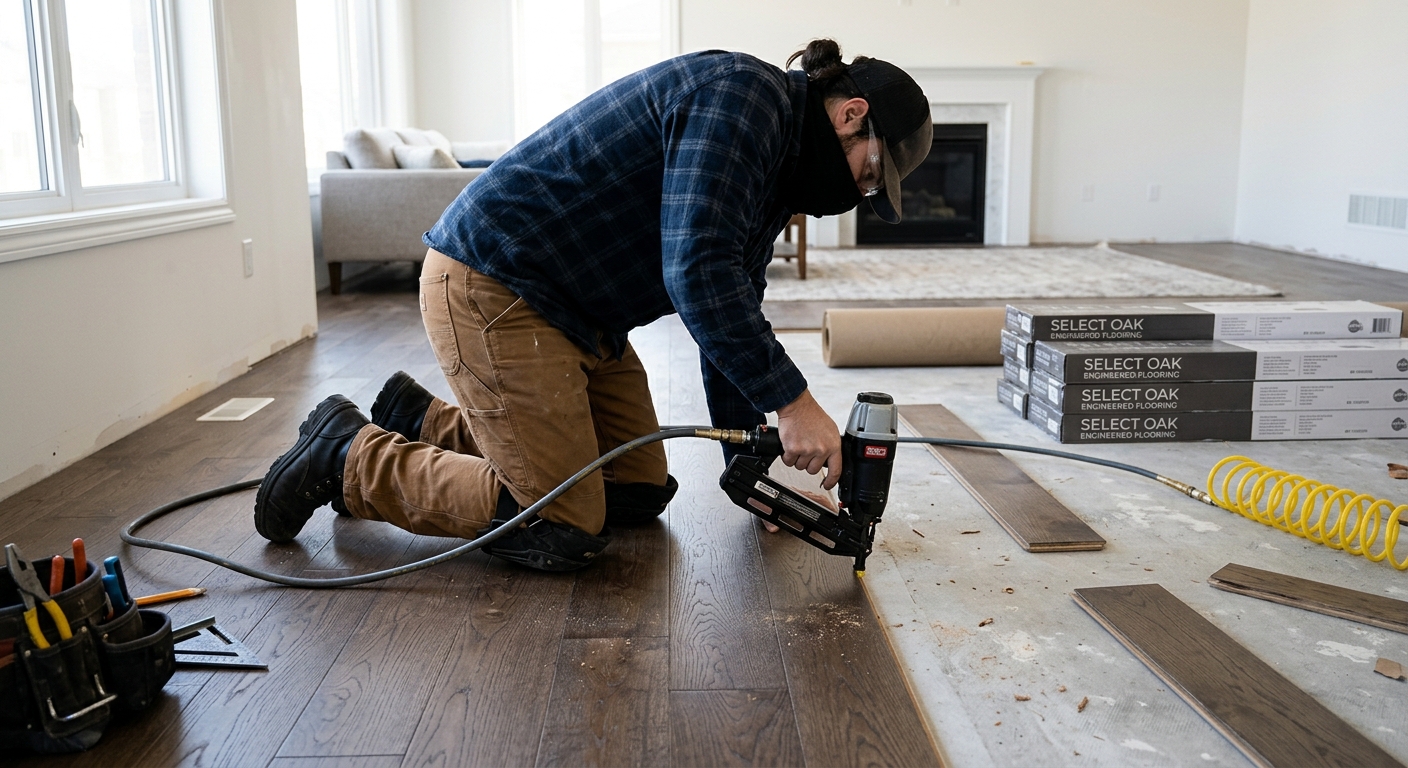
Flooring options and costs in Arbour Lake
Arbour Lake homeowners typically start their search with a simple question: what will the floor cost to install, and what will it handle season after season? With Arbour Lake’s population at 10,335 (Statistics Canada, 2021 Census), contractor scheduling is often busiest in late spring and summer, when families plan renovations around school calendars. Just as importantly, many older Calgary-area homes require extra prep—levelling or patching subfloor surfaces before new finishes can lay flat—especially around transitions and areas that have been repaired over time. In fact, it’s common to see labour and prep add roughly $1–$3 per sq ft when plywood is uneven or when concrete slabs have surface defects that must be addressed before tile or click-lock products go down.
Calgary’s dry, cold prairie climate brings large humidity swings through the year. That matters for material stability and adhesion choices. Solid hardwood can expand and contract with indoor humidity and is also a poor choice over basement concrete in Arbour Lake. Engineered hardwood and waterproof luxury vinyl plank (LVP) handle humidity changes far better, and they’re also more practical around below-grade conditions where moisture migration can show up. If you live near the more established shopping and residential pockets in Arbour Lake (where older infill renovations are common), flooring contractors are frequently in-demand for replacement work and stair/trim updates, too.
Use the table below to compare typical material-only price bands and the “best fit” rooms, then we’ll break down what drives the total quote in Section 2.
| Type |
Best Room |
Moisture Resistance |
Lifespan |
Price per sq ft |
| Solid hardwood (nail-down, above grade only) |
Living / dining |
Low to moderate (needs stable indoor humidity) |
25–50 years |
$8 – $15 |
| Engineered hardwood (float or glue, above + on-grade) |
Living / bedrooms |
Moderate to good (stable core; avoid standing water) |
20–40 years |
$10 – $16 |
| Laminate (click-lock, above-grade) |
Bedrooms / hallway |
Moderate (okay for everyday spills; poor for wet areas) |
10–25 years |
$3 – $7 |
| Luxury vinyl plank / LVP (waterproof, any level) |
Kitchen / basement |
High (waterproof surface; protect seams) |
15–25 years |
$5 – $11 |
| Porcelain / ceramic tile |
Bathrooms / entry |
High (resistant to water; grout needs upkeep) |
20–50 years |
$6 – $12 |
| Carpet (broadloom or modular tile) |
Bedrooms / stairs |
Low (not for basements or wet-prone zones) |
8–15 years |
$4 – $9 |
Prices are estimates only and vary by project scope, site access and material selection.
What affects the price of flooring in Arbour Lake
In Arbour Lake, it’s not unusual to see quotes for the “same” floor vary by 30–50% across Calgary and surrounding Alberta communities. The difference usually isn’t the product sticker price—it’s how your job is prepared, how complicated the install is, and how your home’s conditions interact with the climate. With Alberta’s large indoor humidity swings, contractors price with stability in mind: solid hardwood can expand and contract with seasonal changes, so it typically isn’t used over basement concrete, and it requires careful acclimation and subfloor flatness. By contrast, engineered hardwood and luxury vinyl plank handle humidity swings and below-grade realities far better, so they’re commonly priced and specified for Calgary-area basements.
Below-grade moisture is another key driver in the Calgary region. Basements often see moisture migration through concrete, so installers may include vapour-control measures or choose fully waterproof systems such as LVP/SPC instead of solid wood. Older housing stock frequently needs subfloor levelling or repair—commonly a $1–$4 per sq ft swing depending on how out-of-level the surface is. The same is true for tile: ceramic and porcelain are particularly sensitive to flatness, so levelling work and crack isolation may be budgeted.
Two practical Arbour Lake examples: if your main floor has aged plywood with transitions between rooms, levelling and feathering could add a few dollars per sq ft before you even buy the material. If you’re finishing a basement where concrete shows damp spots or must be protected from vapour, the quote may look higher at first, but choosing LVP often avoids the bigger risk costs that come with solid hardwood failures. That’s why many homeowners compare mid-range laminate/vinyl plank at roughly $3 – $7 per sq ft to engineered hardwood around the $10 – $16 band—then decide where the performance upgrade is actually worth paying for.
| Price Factor |
Why It Matters |
Cost Impact |
| Room area in sq ft |
Materials and labour scale with square footage and waste percentage. |
Small rooms can cost proportionally more due to mobilization and trimming. |
| Subfloor condition |
Uneven surfaces require levelling/repairs for a stable, flat install. |
Typically adds about $1–$4 per sq ft depending on how far out-of-flat the substrate is. |
| Moisture / below-grade install |
Basements and slab conditions can affect adhesives and underlay selection. |
Can increase costs; solid hardwood is usually ruled out, while LVP/SPC adds protection and prep steps. |
| Material choice |
Solid vs engineered vs LVP vs tile changes both material cost and installation method. |
Moves the project price band dramatically (e.g., LVP mid-range vs tile and engineered). |
| Removal and disposal of existing flooring |
Demolition time, haul-away, and cleaning affect labour hours. |
Often a significant add-on if there’s tile, thick underlay, or glued-down flooring. |
| Stair nosing / transitions |
Stairs and custom transitions require more cutting and fabrication. |
Frequently charged per step or per linear foot; can noticeably raise the final total. |
| Radiant heat compatibility |
Some materials tolerate radiant heat better than others. |
May limit options to specific engineered/tolerant systems and include additional prep. |
| Installation method |
Float-down, glue-down, and nail-down each need different prep and labour. |
Glue-down and nail-down often add more labour and substrate requirements than click-lock. |
Permits & regulations in Alberta
In Alberta, most flooring installation work itself does not require a building permit. That includes typical replacement of finished flooring—such as removing old carpet or laminate and installing new LVP, engineered hardwood, laminate, carpet, or tile on top of an existing subfloor—provided the work does not alter structure or mechanical systems.
Where permits can come into play is when the project includes associated work that changes electrical or building systems. For example, if you’re upgrading or altering in-floor heating circuits (including thermostats, wiring changes, or modifications to electrical runs), electrical permitting and inspection may be required. If you discover moisture damage that leads to structural subfloor repair (for instance, replacing significant framing or engineered components), the scope can also shift and may require additional approvals depending on what’s being modified.
For condominiums in the Calgary area, the biggest practical “rule” is often the corporation’s sound-transmission requirements. Floors installed on upper floors may be restricted to specific underlay materials and assembly designs to meet STC/IIC targets, and the board may require written approval before work starts. Always review the condo declaration and request approval in writing before installing hard flooring like hardwood or tile.
To verify your contractor in Arbour Lake, confirm three things step-by-step: (1) Alberta licence/registration—check the contractor’s professional standing through the appropriate online sources; (2) liability insurance—request a certificate of insurance naming you (or the project address) as applicable; and (3) WSIB/WCB clearance—ask for the clearance letter and verify it matches the legal business name on the quote.
Best flooring for each room in your Arbour Lake home
Choosing the right floor for each room in Arbour Lake means matching material performance to moisture risk, foot traffic, and comfort—especially in a climate with dry winters, variable humidity, and occasional basement moisture migration through concrete. For living and dining areas, engineered hardwood or a higher-quality laminate can deliver the warmth of wood looks without the same humidity sensitivity as solid hardwood. In the master bedroom, many homeowners prefer carpet for softness and sound absorption; if you want a hard surface, engineered hardwood is the safer “wood option” than ¾-inch solid oak over any area that could see seasonal swings.
In kitchens, go with luxury vinyl plank (LVP) or large-format porcelain tile. LVP is especially forgiving for routine spills and quick cleanup, while porcelain tile handles wet mopping well. For basements (finished or becoming finished), LVP is the clear winner in our market: it’s waterproof at the surface and more tolerant of vapour/moisture conditions that can exist below grade. Solid hardwood and most laminate struggle in these environments. Bathrooms should be porcelain or ceramic tile only—tile is built for wet zones and repeat cleaning.
Radiant heat compatibility matters too. If you have in-floor heating (common in newer Calgary-area builds and renovations), select products rated for radiant systems; this often rules out traditional solid hardwood and some laminate assemblies. One concrete cost example: if tile at about $6 – $12 per sq ft means additional levelling for flatness, you may find LVP starting in the $5 – $11 range is a better overall value for the same square footage—particularly in basements where moisture management is already part of the job.
| Room |
Best Material |
Why |
Moisture Risk |
Price Band per sq ft |
| Living / dining room |
Engineered hardwood |
Warm look with better stability through Alberta’s humidity swings. |
Low (unless you have frequent wet entry tracking) |
$10 – $16 |
| Master bedroom |
Carpet or engineered hardwood |
Carpet adds comfort and sound reduction; engineered stays practical if you prefer hard flooring. |
Low |
$4 – $9 |
| Secondary bedrooms |
Carpet (or quality laminate) |
Comfort and durability for everyday family use; easier to maintain than tile in bedrooms. |
Low |
$3 – $9 |
| Kitchen |
Luxury vinyl plank (LVP) or porcelain tile |
LVP resists spills and is easier on knees; tile handles heavy cleaning and water. |
Moderate to high (spills, sink, wet mopping) |
$5 – $12 |
| Basement (finished) |
LVP / SPC (waterproof) |
Best match for below-grade conditions; more stable over concrete and moisture vapour. |
High |
$5 – $11 |
| Bathroom |
Porcelain / ceramic tile |
Water-ready performance and long-term durability when installed on a proper substrate. |
High |
$6 – $12 |
How to choose a flooring contractor in Arbour Lake
When you’re hiring a flooring contractor in Arbour Lake, start with proof—not promises. In Alberta, verify liability insurance and request your contractor’s WSIB/WCB clearance letter (or equivalent proof of coverage). You should also ensure they’re properly registered for the work they’re performing and that the certificate of insurance matches the legal business name on the quote. Ask for copies before work begins and confirm the coverage dates are current.
Next, get 2–3 itemised written quotes with a line-by-line breakdown: labour hours, material supply, underlay/vapour protection, levelling products, trim/stair work, and disposal/haul-away. Avoid lump-sum offers unless they clearly list inclusions and allowances. Read the scope for what’s excluded: moving appliances, removing and reinstalling baseboards, repairing subfloor damage, permit pulls (if any electrical work is triggered), and whether levelling is included or charged separately.
Warranty matters on two fronts. Confirm the workmanship warranty length (and what voids it), plus the manufacturer warranty for the product. Ask whether the warranty is transferable if you sell your home—some product warranties only cover the original purchaser.
For payment, don’t let the deposit drift high: never pay more than 10–15% upfront. Hold back the remainder until the job is fully complete, cleaned, and any transition, stair edging, or caulking touch-ups are done. Finally, require a start date and completion estimate in writing so you can plan around weather delays and material lead times.
- Verify Alberta registration/standing before booking a site visit.
- Request and review liability insurance certificate (match legal business name).
- Ask for WSIB/WCB clearance letter and confirm it’s current.
- Get 2–3 itemised quotes (materials + labour + prep + disposal).
- Confirm what underlay/vapour barrier is included for LVP/SPC or laminate.
- Ask whether levelling/patching is included and the method they’ll use.
- Check how stairs and transitions are priced (per step vs per linear foot).
- Ensure transitions at doorways and between rooms are included in scope.
- Clarify removal and disposal: what’s hauled away and where.
- Confirm warranty: workmanship term, product term, and transferability.
- Agree on payment schedule—10–15% max upfront, holdback until completion.
- Get the schedule in writing: start date and target completion date.
Concrete red flags I see in Arbour Lake: (1) quotes that don’t mention levelling or moisture protection for basements; (2) no written scope for stairs, transitions, and disposal; (3) a refusal to provide insurance/coverage proof; (4) asking for large deposits (well beyond 10–15%); or (5) vague timelines like “as soon as possible” with no start/completion estimate.
Frequently asked questions — flooring in Arbour Lake
What flooring holds up best to pets in a Arbour Lake home?
For most pet owners in Arbour Lake, waterproof luxury vinyl plank (LVP/SPC) is the practical winner because it resists accidents and cleans up quickly. Look for thicker wear layers and click systems designed for daily traffic; that helps with claw marks and keeps seams looking tidy. Engineered hardwood can also work if you choose a durable wear layer, but it’s not as forgiving as LVP if urine or frequent wet mopping happens. Carpet may feel comfortable, yet it can be harder to fully recover from repeat stains and odours—especially in homes with any basement moisture concerns. Budget-wise, many homeowners land in the mid-range LVP band around $5 – $11 per sq ft, which often balances comfort, durability, and accident-proof performance.
How do I fix squeaky floors in my Arbour Lake home?
Squeaks usually come from movement between joists/subfloor layers, not from the top flooring surface itself. In Arbour Lake homes (including older stock), squeaks often appear when the subfloor loosens on fasteners or when humidity swings loosen dimensional fit over time. The most reliable fix is to identify whether the squeak is in a specific area and then re-secure the subfloor—commonly by adding screws/fasteners into joists from above or through access points. If the squeak is trapped under carpet or floated flooring, sometimes the solution involves lifting the floor section rather than patching blindly. Before replacing everything, ask a contractor to locate squeaks first; in many cases, correcting the subfloor can prevent future noise after you install a new surface.
What is luxury vinyl plank and is it worth it in Arbour Lake?
Luxury vinyl plank (LVP) is a layered, click-lock or glue-down flooring system with a waterproof wear surface. In Arbour Lake and the broader Calgary area, it’s especially popular because Alberta’s dry-cold climate creates big indoor humidity swings and basements can experience moisture vapour through concrete. LVP handles those realities better than solid hardwood and most laminate because it tolerates moisture and is dimensionally more stable. It’s often worth it when you want a clean, wood-like look without the performance risk of solid wood in below-grade areas. If you’re comparing price bands, laminate/vinyl can start lower, but higher-quality LVP typically lands in the $5 – $11 per sq ft range—often a smart upgrade for kitchens and finished basements where spills and moisture are common.
How much does flooring cost in Arbour Lake?
Typical flooring costs in Arbour Lake depend on product type, prep needs (like levelling), and how much work is involved in removal, transitions, and stairs. As a baseline, laminate/vinyl plank materials often sit around $3 – $7 per sq ft for budget-to-mid options, while tile commonly runs about $6 – $12 per sq ft and solid hardwood is often higher, roughly $8 – $15 per sq ft. Keep in mind that Alberta’s housing stock in the Calgary region frequently means extra prep—subfloor levelling or repair can add meaningful cost. For more accurate budgeting, request an itemised quote that separates materials from labour and includes moisture protection where applicable, especially if you’re renovating a basement.
Hardwood vs laminate vs vinyl plank — which is best?
“Best” depends on room and risk level. Solid hardwood is beautiful, but in Alberta (including Arbour Lake) it performs best above grade and requires stable indoor humidity. Laminate is usually the most budget-friendly option, and it’s fine for bedrooms and hallways, but it’s less forgiving if spills or wet mopping happen often. Luxury vinyl plank (LVP/SPC) is typically the most versatile because it’s waterproof and handles Alberta’s moisture realities better—especially on concrete and in finished basements. If you want a practical comparison: engineered hardwood or laminate can work for main floors, but for basements and kitchens, LVP is usually the safest choice. Cost-wise, hardwood tends to land in the higher $8 – $15 range, while LVP commonly sits around $5 – $11 per sq ft, often delivering better long-term risk reduction.
What flooring is best for a Arbour Lake basement?
For most Arbour Lake basements, waterproof luxury vinyl plank (LVP/SPC) is the best all-around choice. The Calgary region’s climate and below-grade conditions can include moisture vapour migrating through concrete, and that’s exactly where solid hardwood and many laminate assemblies struggle. LVP’s waterproof surface helps protect against spills and cleaning routines, and it generally tolerates the dimensional changes that can occur with seasonal humidity swings. If your basement has radiant heat, confirm the specific product rating for radiant installations, but LVP is commonly selected for radiant-friendly assemblies. On price, many homeowners see basement LVP projects fall within the mid-range $5 – $11 per sq ft band; if levelling is needed on the slab or subfloor, your contractor should spell out that prep line item separately so you understand the true total.