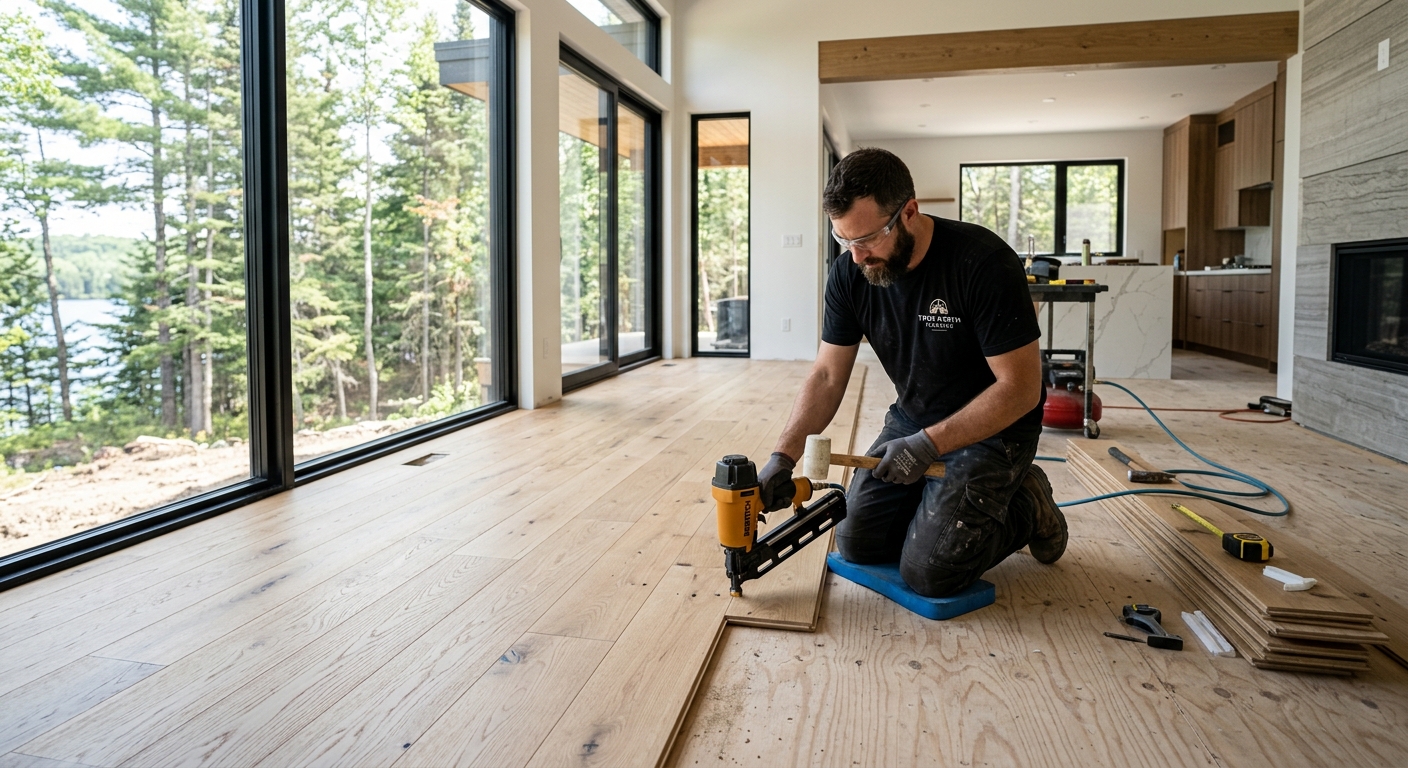
Flooring options and costs in Vermilion
In Vermilion, choosing the right flooring is about more than looks—you’re working with cold winters, temperature swings, and the moisture risks that show up in basements and lower-level layouts. With 54.6% of local homes built before 1981, many renovations start with older subfloors and patchy flatness, which can mean levelling and prep before any new finish is installed. In practice, that prep step is often where costs rise quickly, especially when the crew has to correct dips, screw pops, or damaged plywood.
In the Camrose–Drumheller area, contractor availability and material pricing can also shift depending on what’s in demand: waterproof resilient flooring and radiant-compatible assemblies tend to get booked first. Vermilion homeowners typically lean toward engineered hardwood or luxury vinyl plank (LVP) because they tolerate dimensional change better than solid hardwood—important when indoor humidity swings through the heating season. The other cost driver is scope complexity: removing existing flooring, managing transitions, and prepping uneven subfloors can add time even when the finish material is inexpensive.
Trade activity is especially steady around the residential core and near the downtown services, where many owners update older walkways and entryways during spring renovations. If you’re planning a full main-floor refresh, the quickest way to compare quotes is to look at the finish type and the expected “all-in” budget range, then confirm the prep scope with your contractor—before you sign. Use the comparison table below to anchor your expectations by material type and typical per-square-foot pricing.
| Type |
Best Room |
Moisture Resistance |
Lifespan |
Price per sq ft |
| Solid hardwood (nail-down, above grade only) |
Living / dining (dry areas) |
Low (above grade only) |
20–35 years |
$10–$18 |
| Engineered hardwood (float or glue, above + on-grade) |
Living / dining, bedrooms |
Medium to high (with proper underlayment) |
15–30 years |
$8–$16 |
| Laminate (click-lock, above-grade) |
Bedrooms, living rooms (dry) |
Low to medium (not for standing water) |
10–20 years |
$4–$10 |
| Luxury vinyl plank / LVP (waterproof, any level) |
Kitchen, basement (finished) |
High (waterproof core) |
15–25 years |
$6–$12 |
| Porcelain / ceramic tile |
Kitchen, bathroom |
High (with proper grout/installation) |
25–50 years |
$12–$28 |
| Carpet (broadloom or modular tile) |
Master bedroom, stairs |
Low (needs dry conditions) |
8–15 years |
$4–$8 |
Prices are estimates only and vary by project scope, site access and material selection.
What affects the price of flooring in Vermilion
In Vermilion and across the Camrose–Drumheller region, the same “average-sized” flooring job can come in 30–50% apart depending on prep requirements and installation method—not just the product you pick. That’s because older housing stock is common locally: with 77.0% of households owning, many renovations involve occupied homes where dust control, staggered workdays, and extra care around thresholds can increase labour time. Also, many basements in older builds have moisture-vapour concerns that change what’s considered an acceptable underlayment system.
Technically, indoor humidity swings matter. Solid hardwood expands and contracts with moisture and cannot be installed over concrete or in basement environments; that limitation is a common reason quotes differ when one contractor proposes solid wood and another steers you toward engineered wood or waterproof LVP. In colder Alberta homes, radiant heat compatibility is another constraint: some rigid underlays and certain laminate constructions can interfere with heat transfer, limiting your options. Older regional subfloors frequently need levelling or repair before flooring goes down; even a modest correction can add $1–$4 per square foot to the labour and materials budget.
Here are a few practical examples that move pricing up or down in Vermilion. If your existing floor has uneven dips, you may see additional levelling and more underlayment (raising overall cost even when laminate itself is in the $4–$10 band). If you switch from laminate to LVP in a basement because of moisture vapour, your material cost rises, but you avoid failure risks and rework. Conversely, if your subfloor is already flat and dry and your layout is straightforward (few transitions), a tile job can be more cost-effective than expected—especially where you avoid costly underlayment builds. Finally, stair work and transitions can change the numbers quickly, particularly when matching to tile or changing heights between levels.
| Price Factor |
Why It Matters |
Cost Impact |
| Room area in sq ft |
Materials and labour scale with surface size |
Usually the largest driver; small rooms often cost proportionally more |
| Subfloor condition |
Levelling/repair is required for a flat, long-lasting finish |
Often adds $1–$4 per sq ft in older homes |
| Moisture / below-grade install |
Determines whether solid hardwood is excluded |
Can require waterproof systems (LVP) and moisture-rated underlayments |
| Material choice |
Product price bands vary widely (wood/tiling vs resilient) |
Hardwood/Tile are typically $10–$18 and $12–$28 respectively; LVP/Laminate often lower |
| Removal and disposal of existing flooring |
Time, hauling, and surface prep depend on what’s there |
Can add a meaningful fixed labour cost even for small areas |
| Stair nosing / transitions |
Trim, nosings, and matching heights are labour-intensive |
Charged per step or per linear foot; easy way to increase budget |
| Radiant heat compatibility |
Not all underlayments transfer heat reliably |
May require specific underlay systems; can change material selection |
| Installation method |
Glue-down, float, and nail-down require different prep and labour |
Nail-down often needs above-grade conditions; glue-down adds prep/adhesive considerations |
Permits & regulations in Alberta
In Alberta, a flooring installation itself typically does not require a building permit. However, associated work can trigger permit requirements depending on what your project includes. For example, if the scope involves electrical changes—like adding, relocating, or modifying in-floor heating circuits—an electrical permit may be required. If your flooring project includes structural subfloor repair that goes beyond simple patching (for instance, replacing load-bearing components or significant structural changes), permits and inspections can become relevant. In multi-unit buildings, condo policies can effectively require approvals even when the work is not “permitted” under building code.
Here’s how a Vermilion homeowner can verify your contractor is set up correctly, step by step. First, confirm the company’s Alberta licence status using the appropriate online registry search tools the province provides for regulated trades (if the contractor performs work that falls under a regulated category). Next, request a current certificate of insurance—specifically liability coverage—and verify the certificate is in force for your project date range. Also ask for WSIB/WCB clearance if the contractor employs workers; you should receive clearance documentation or a clearance letter. Finally, for condos, request the board approval in writing and ask what underlay or sound control system is required for hard surfaces on upper floors to meet the building’s sound transmission expectations.
Best flooring for each room in your Vermilion home
In Vermilion, the “best” flooring by room is usually the one that matches moisture exposure, traffic, and comfort needs without fighting Alberta’s winter indoor conditions. Living and dining spaces get the most day-to-day wear, so engineered hardwood or a high-quality laminate can deliver the look and warmth you want while tolerating seasonal movement better than solid wood. For bedrooms, many homeowners choose carpet for comfort and quieter footsteps; an alternative is engineered hardwood where you want easier cleaning.
Kitchens benefit from luxury vinyl plank (LVP) or large-format porcelain tile because spills, snow-melt tracked in at entrances, and occasional standing water are realistic. LVP is often a practical win in Alberta homes because it’s waterproof and comfortable underfoot compared to stone, and it handles the moisture-vapour variability common in lower levels. In finished basements, LVP is usually the clear choice: solid hardwood is sensitive to moisture and should generally be limited to above-grade areas, while most laminate fails faster if moisture gets behind the panels. Bathrooms should be porcelain or ceramic tile only, installed over a properly prepared substrate with correct waterproofing details as required by the assembly.
For radiant heat homes (in-floor systems), you’ll want radiant-compatible assemblies. That can rule out some solid hardwood and underlay combinations. As a budget example, if you compare laminate in a kitchen at roughly $4–$10 per square foot to porcelain tile at about $12–$28, the price gap can be justified if your kitchen has frequent spills and you want a long service life that won’t be affected by moisture—especially in an older Vermilion home where prep work is already part of the plan.
| Room |
Best Material |
Why |
Moisture Risk |
Price Band per sq ft |
| Living / dining room |
Engineered hardwood |
Warmth and real-wood look with better seasonal stability |
Low (dry, above-grade typical) |
$8–$16 |
| Master bedroom |
Carpet or engineered hardwood |
Comfort and sound control (carpet) or easy maintenance (engineered) |
Low |
$4–$16 |
| Secondary bedrooms |
Laminate (click-lock) |
Cost-effective durability for everyday traffic when kept dry |
Low |
$4–$10 |
| Kitchen |
Luxury vinyl plank (LVP) or porcelain tile |
Water resistance and easier cleanup |
Medium to high (spills, meltwater near entries) |
$6–$28 |
| Basement (finished) |
Luxury vinyl plank (waterproof) |
Handles below-grade moisture vapour and resists warping |
High |
$6–$12 |
| Bathroom |
Porcelain / ceramic tile |
Best long-term moisture performance with proper installation |
High |
$12–$28 |
How to choose a flooring contractor in Vermilion
Choosing the right flooring contractor in Vermilion is about verifying credentials and clarity in the quote—not just finding the lowest number. Start by confirming Alberta insurance and worker coverage. Ask for a current certificate of insurance for liability and make sure the coverage is active for the period of your work. If the contractor employs installers or sub-trades, request WSIB/WCB clearance documentation (or a clearance letter) and verify it’s current—don’t accept “we’re covered” without paperwork.
Next, get 2–3 itemised written quotes with a proper breakdown. You want line items for materials (underlayment, transitions, adhesive/fasteners where applicable) and labour (prep, levelling, installation method, removal, disposal). A lump-sum quote is harder to compare when older homes require extra prep. Read the scope carefully: what’s included in subfloor levelling, moisture mitigation (if needed), stair work, and transitions? Is disposal included? Are permits included if electrical work is triggered by in-floor heating?
For warranty, confirm both workmanship and product warranty terms. Ask whether the workmanship warranty is offered by the installer and how long it lasts, and whether the product warranty is tied to the original purchaser (and whether it’s transferable). On payment schedule, keep control: never pay more than 10–15% upfront, and use a holdback until the job is complete and defects are corrected. Finally, get the start date and completion estimate in writing so you can plan around Alberta weather and scheduling.
- Ask for a current liability insurance certificate and check dates before work starts.
- Request WSIB/WCB clearance documentation (or letter) if they employ workers.
- Get 2–3 itemised quotes: labour + materials + underlayment/patching/level-labour.
- Confirm removal scope: what gets removed and where debris is hauled.
- Specify subfloor prep: flatness targets, levelling/repair items, and who handles them.
- For basements, ask what moisture/vapour mitigation system is planned before LVP goes down.
- Clarify installation method: nail-down vs glue-down vs float, and why that choice fits your slab/subfloor.
- Make transitions explicit: stair nosing, T-molds, reducers, and who supplies them.
- Request radiant heat compatibility confirmation in writing if you have (or plan) in-floor heat.
- Review warranty details: workmanship length, exclusions, and how claims are handled.
- Use a payment plan with a holdback until final walkthrough and punch list completion.
- Confirm timeline and access conditions (doors, power, parking) in the written scope.
Red flags in Vermilion include: refusing to provide insurance/WSIB clearance paperwork, quoting without explaining subfloor prep or flatness expectations, giving only a lump-sum number with unclear exclusions, pressuring you for large upfront deposits, and promising a “universal” install method (like solid hardwood over potentially cool/damp areas) without checking moisture conditions.
Frequently asked questions — flooring in Vermilion
Engineered vs solid hardwood — what's the difference?
Solid hardwood is typically installed nail-down and is best kept above grade. In Alberta’s winter conditions, solid boards expand and contract with humidity, so it’s a poor fit for basements or concrete slabs where moisture vapour can move through. Engineered hardwood is built in layers, so it tolerates movement better and can be installed over more subfloor types (often float or glue methods), provided the assembly is correct. For many Vermilion homes—especially those built before 1981 that may have older subfloors—engineered hardwood is the practical compromise between real wood appearance and easier long-term stability. In budget terms, solid hardwood often sits around the $10–$18 per square foot band, while engineered typically lands a bit lower depending on the brand and wear layer.
Do I need to level my subfloor first?
Usually, yes—at least to the extent required for a flat, stable finish. Flooring doesn’t “bridge” dips the way some homeowners expect. In older Vermilion homes, uneven plywood, patchwork repairs, or localized dips are common, and that can cause gaps in click-lock laminate, noise in floating floors, or premature wear in tile. Level-labour may be included or excluded depending on your quote, which is why itemised scope matters. If you’re planning a hardwood or LVP install, ask your contractor to describe how they’ll check flatness, what levelling products they’ll use, and where repairs stop and removals start. As a rough local expectation, levelling/repair work commonly adds about $1–$4 per square foot in older housing stock when prep is needed.
What's the most durable flooring for pets and kids?
For most Vermilion families with pets and kids, luxury vinyl plank (LVP) is the durability sweet spot because it’s waterproof and easier to clean than many alternatives. It also handles the moisture realities of basements and entry traffic better than laminate, which can struggle if moisture reaches the seams. If you prefer a hard surface with long life, porcelain tile is also extremely durable, but it can be harder underfoot and more demanding to install correctly over an uneven subfloor. Carpet can be comfortable, but it stains more easily and needs fast cleaning after accidents. In terms of price bands, LVP often falls around $6–$12 per square foot, while porcelain tile is commonly $12–$28. If your priorities are mess resistance and less worry about spills, LVP is typically the most “set and forget” option for busy households.
How do I choose flooring for humidity in Vermilion?
Humidity choice starts with location: above-grade living areas versus basements. In Vermilion, heating seasons create swings indoors, and basements can add moisture vapour risk even when they look dry. That’s why solid hardwood is generally limited to above-grade rooms, while engineered hardwood and LVP tolerate humidity changes much better when installed with the right underlayment and proper prep. Laminate is acceptable only if the room stays dry and water won’t sit—standing water is where failures start. When comparing quotes, ask how each material handles subfloor moisture and what underlayment is proposed. If radiant heat is present or planned, also confirm that your selected underlay won’t block heat transfer. In older homes (like the large share built before 1981), correct subfloor repair/levelling can be a humidity-related durability factor, not just a smoothness issue.
Do condos restrict hard flooring?
Often, yes—especially in multi-unit buildings in Alberta where sound transmission rules are managed by the condominium corporation. Even though flooring installation itself typically doesn’t require a permit, condo bylaws and the declaration can restrict hard flooring on upper floors. Your board may require specific underlay, sound control upgrades, or proof of compliance with sound ratings (commonly expressed as STC/IIC expectations). Before installing hardwood or tile, ask for the condo’s written requirements and obtain board approval in writing. This is particularly important if you’re switching from carpet to a hard surface, because the impact noise can change. For practical planning in Vermilion, build in time for approvals and confirm in your contract that the correct underlayment system is included—otherwise, you may pay to remove and reinstall if the board rejects the install method.
How do I compare flooring quotes?
Compare quotes like-for-like. Ask for itemised pricing: materials (including underlayment/adhesives), labour, removal, transitions, and disposal. Don’t compare only totals, because one contractor may exclude prep, stair work, or levelling—then those costs show up later. Confirm the installation method (nail-down, glue-down, or float) and whether it matches your subfloor and moisture risk. For Vermilion homes, ensure the scope addresses older housing realities: subfloor condition, prep, and below-grade moisture planning. Also confirm warranty terms for workmanship and product (and whether claims are transferable). Use price bands as a reality check: hardwood is often around $10–$18 per square foot, tile about $12–$28, and LVP/laminate generally sit lower. Finally, verify Alberta liability insurance and WSIB/WCB clearance documentation before the first payment.