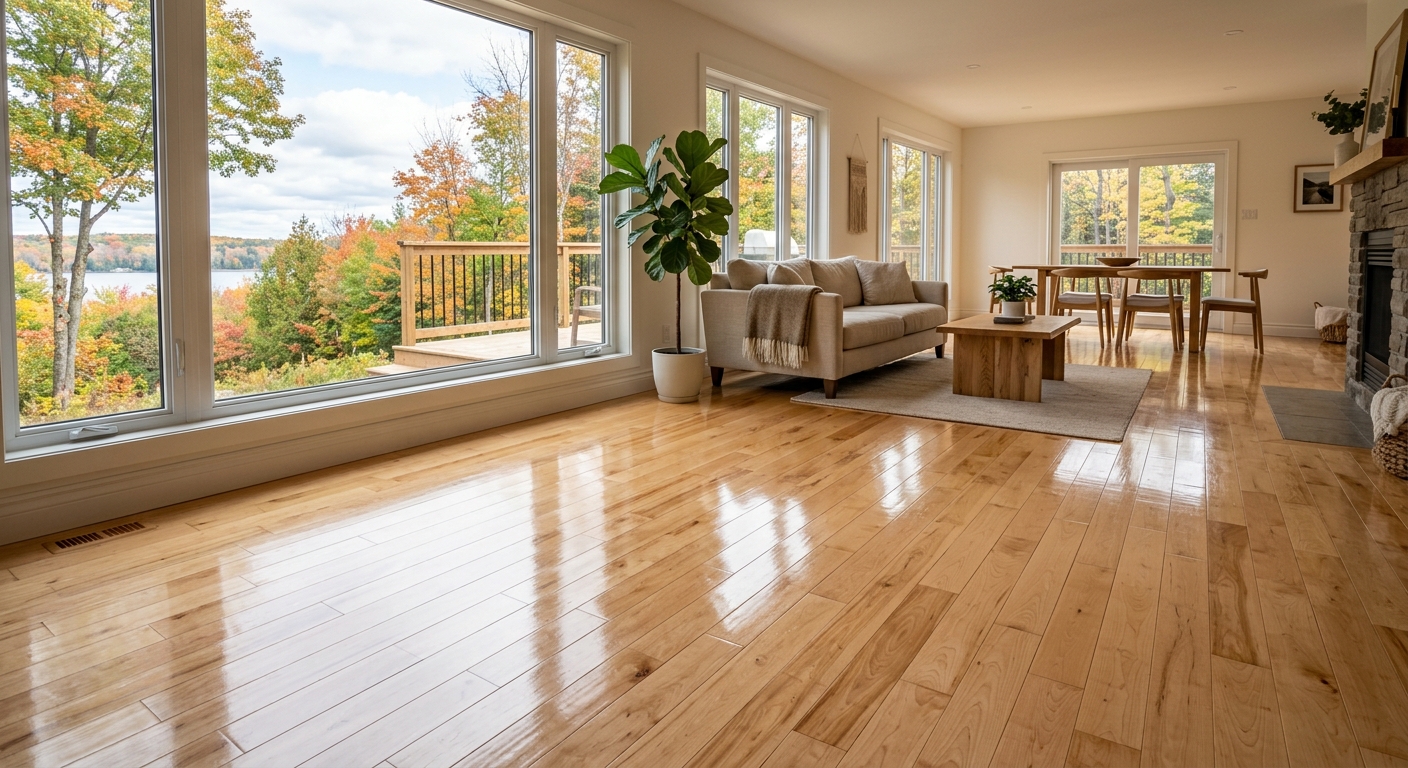
Flooring options and costs in Barrhead
Barrhead homeowners typically have two very different things to balance: comfort and moisture resilience. With 4,320 residents and 65.1% of households owning their homes, many projects are “stay put” renovations—done once, done right—especially as 53.4% of homes in the area were built before 1981. That older housing stock often means uneven subfloors, patches from past upgrades, or dated underlay, which can add real preparation cost before any new surface goes down.
In the Edmonton economic region, indoor humidity swings and basement moisture are consistent cost drivers. Solid hardwood can be excellent on the main floor, but it expands and contracts with humidity; it also isn’t a basement-friendly choice because it generally shouldn’t sit on concrete or below-grade moisture conditions. Because of that, the most common upgrades here are engineered hardwood and luxury vinyl plank (LVP): both handle seasonal movement better, and LVP is also waterproof—an advantage in finished basements where vapour and dampness are more likely to show up.
Radiant heat compatibility is another factor: many homes are laid out so a portion of the system ties into kitchen or bathroom zones, and cold winters make warm floors a big selling point. In Barrhead, trades availability can also affect pricing—when multiple crews are booked tightly around Edmonton/Strathcona County timelines, scheduling and labour premiums can apply. You’ll often see flooring demand spike in mature neighbourhood pockets where older basements get finished (and where existing floors are due for replacement), making preparation and moisture testing part of the quote conversation. Next, compare the typical ranges by material and room use.
| Type |
Best Room |
Moisture Resistance |
Lifespan |
Price per sq ft |
| Solid hardwood (nail-down, above grade only) |
Main level living spaces |
Low to moderate (humidity-sensitive; avoid basements) |
25–60 years |
$10,–$25 |
| Engineered hardwood (float or glue, above + on-grade) |
Living rooms, hallways, bedrooms |
Moderate (better for humidity and on-grade slabs) |
20–40 years |
$9,–$20 |
| Laminate (click-lock, above-grade) |
Secondary bedrooms, offices |
Moderate (water-resistant top, but edges can swell) |
10–25 years |
$4,–$8 |
| Luxury vinyl plank / LVP (waterproof, any level) |
Kitchen, main level, finished basements |
High (waterproof core; tolerates basement conditions better) |
15–25 years |
$4,–$8 |
| Porcelain / ceramic tile |
Bathrooms, kitchens |
High (waterproof when properly installed) |
20–50 years |
$5,–$15 |
| Carpet (broadloom or modular tile) |
Bedrooms, stairs where softness matters |
Low (can hold moisture; protect subfloor) |
8–15 years |
$4,–$8 |
Prices are estimates only and vary by project scope, site access and material selection.
What affects the price of flooring in Barrhead
In Barrhead, two quotes for the “same” flooring can easily differ by 30–50% across the Edmonton region because the hidden work is rarely identical. Contractors may be pricing different product grades, different underlay systems, and different amounts of prep—especially in older homes. Homes built before 1981 are more likely to have uneven boards, worn OSB, or older subfloor assemblies that need patching before installation can start. When that prep gets missed in a rough estimate, the final cost rises when the crew is already on site.
Technically, the big drivers are indoor humidity swings and below-grade moisture. Solid hardwood expands and contracts with seasonal humidity; it’s also generally not installed over concrete or in basements in typical residential practice. That’s why, in this region, engineered hardwood and LVP are often recommended: their layered construction and stable cores tolerate normal seasonal movement far better. For colder winters, radiant heat compatibility also matters—many solid hardwood installs are restricted, and some laminate products are limited when used with in-floor heat. In practical terms, that can shift you from a $10–$25/sq ft hardwood plan to an $4–$8/sq ft laminate or LVP plan, or to higher-end engineered wood when the goal is a long-life finish.
Cost examples I see in Barrhead: (1) If your joists are uneven and the crew needs levelling compounds or subfloor repair, plan on about $1.50–$4.00/sq ft for preparation. (2) If you’re finishing or renovating a basement where moisture vapour is a concern, LVP’s waterproof build can prevent callbacks and costly replacements; while tile can also be durable, it’s usually heavier and often more labour-intensive. (3) Removing old flooring and hauling it away can add time—particularly if you’re switching from carpet pads, glued vinyl, or tile.
| Price Factor |
Why It Matters |
Cost Impact |
| Room area in sq ft |
Material and labour scale directly with square footage |
Higher area generally lowers per-sq-ft labour rate |
| Subfloor condition |
Levelling or repair may be required for a flat, stable base |
Commonly adds about $1.50–$4.00/sq ft for prep |
| Moisture / below-grade install |
Solid hardwood is generally unsuitable; moisture management is critical |
Can shift you from $10–$25/sq ft hardwood to $4–$8/sq ft LVP |
| Material choice |
Solid, engineered, LVP and tile differ in grade and installation system |
Major driver of total cost; highest spread is often hardwood vs LVP |
| Removal and disposal of existing flooring |
Time increases with glued down products and underlay removal |
Often a noticeable add-on vs “new build” scenarios |
| Stair nosing / transitions |
Trims, nosings, and reducers are usually priced per step or linear foot |
May add hundreds of dollars depending on number of stairs |
| Radiant heat compatibility |
Cold climates favour heated floors; not all materials are approved |
May require engineered wood or LVP; can remove low-cost options |
| Installation method |
Float, glue-down, or nail-down changes labour, prep and adhesive systems |
Glue-down and some tile systems increase labour compared with click-lock |
Permits & regulations in Alberta
In Alberta, a typical flooring replacement usually does not require a building permit. Installing flooring (whether it’s LVP, laminate, engineered hardwood, tile, or carpet) generally falls under finishing work, and a permit is typically not triggered by the floor surface itself.
Where permits can come into play is when flooring projects involve other trades and systems. For example: (1) in-floor heating work that touches electrical circuits may require an electrical permit; (2) structural subfloor repair (joist replacement, significant framing modifications) may require the appropriate permits depending on the scope; (3) moisture remediation that involves plumbing drains or other building envelope corrections can also trigger other approvals depending on what’s being corrected; and (4) any electrical components associated with heating mats or thermostats should be treated as permit-worthy.
If you live in a condominium, rules are different than a typical house: the corporation’s by-laws often require approvals for hard surface floors because of sound transmission. For upper floors, restrictions may reference acoustic performance (often framed as STC/IIC expectations) and may require specific underlay systems.
For verifying your contractor in Barrhead: check that the company is properly registered/licensed for the work they perform, request a certificate of insurance (liability), and confirm their coverage for workplace injury protection (WSIB/WCB) where applicable. Ask for clearance letters if they have them. Also insist on an itemised contract and written scope before work begins, so responsibility for prep and any required permits is clear.
Best flooring for each room in your Barrhead home
Choosing flooring room-by-room is how Barrhead homeowners get both durability and comfort in a climate with real seasonal swings. Living and dining areas are usually best with engineered hardwood or high-quality laminate: they deliver warmth underfoot and handle everyday movement better than solid wood when indoor humidity shifts. For master bedrooms, carpet remains a strong choice where comfort and sound absorption matter most—especially on second floors where noise travels. If you want a harder surface in bedrooms, engineered hardwood is often the middle ground between appearance and stability.
Kitchens and entry areas take the most abuse from water tracked in during winter. In Barrhead, luxury vinyl plank (LVP) is a practical first pick because it’s waterproof and forgiving when spills happen, and it’s easier to keep clean than porous materials. If you want a “premium and durable” look, large-format porcelain tile can also work well, particularly when sealed and installed to the correct substrate standard. Basements are where LVP really earns its reputation: fully waterproof cores and dimensional stability suit below-grade installs, where solid hardwood and most laminate products are a poor match for typical vapour conditions.
Bathrooms should be porcelain or ceramic tile only, because it’s the best match for splash zones. And for rooms over in-floor heating—which is increasingly popular in Alberta new construction—focus on radiant-compatible products: most LVP and many engineered hardwood systems are designed for this, while solid hardwood options are more restricted.
To make it concrete: if your living area is 400 sq ft, switching from laminate at about $4–$8/sq ft to engineered hardwood at roughly $9–$20/sq ft can be a $2,000–$6,000 difference. That’s justified when you want a longer service life and a more stable finish through Edmonton-region humidity swings.
| Room |
Best Material |
Why |
Moisture Risk |
Price Band per sq ft |
| Living / dining room |
Engineered hardwood |
Warm look with improved stability in seasonal humidity swings |
Low to moderate (maintain consistent indoor humidity) |
$9,–$20 |
| Master bedroom |
Carpet |
Comfort and sound absorption; helps reduce footstep noise |
Low (as long as subfloor stays dry) |
$4,–$8 |
| Secondary bedrooms |
Luxury vinyl plank (LVP) |
Durable and easy to clean for kids/pets; stable under normal household swings |
Low to moderate |
$4,–$8 |
| Kitchen |
Luxury vinyl plank (LVP) |
Waterproof and resilient against spills and tracked-in winter moisture |
Moderate (spills happen; LVP handles them better) |
$4,–$8 |
| Basement (finished) |
Luxury vinyl plank (LVP) |
Waterproof core; best fit for Edmonton-region below-grade conditions |
High (without proper mitigation) |
$4,–$8 |
| Bathroom |
Porcelain / ceramic tile |
Best performance in wet zones when properly installed |
High |
$5,–$15 |
How to choose a flooring contractor in Barrhead
Picking the right flooring contractor in Barrhead is mainly about verifying three things: credentials, the scope, and the quality controls that prevent callbacks. Start with Alberta verification: ask whether they’re properly registered/licensed for the work they’re doing, and request proof of liability insurance. Next, confirm workplace injury coverage (WSIB/WCB) for the crew handling your project—don’t rely on verbal assurances; ask for documentation. For in-floor heating or any electrical-connected items, confirm who will do the electrical portion and whether permits are handled where required.
Then get 2–3 itemised written quotes. The quote should break labour and materials separately (including underlayment, adhesives, transitions, stair nosing, and patch/levelling materials if needed). Avoid “all-in” totals with unclear exclusions. Pay close attention to what’s included: subfloor levelling minimums, moisture mitigation approach, removal and disposal, and whether the contractor will provide floor protection during trim/painting.
Warranty matters too. Ask for both workmanship warranty length and the manufacturer product warranty—plus whether coverage is transferable if you sell your home. Payment scheduling should be conservative: never pay more than 10–15% upfront. Use a holdback until the job is fully complete and snag lists are resolved. Finally, request a written start date and an estimated completion timeline so you can plan around weather and deliveries.
- Request liability insurance certificate and verify the dates match your project window.
- Confirm WSIB/WCB coverage for installers (and ask for proof).
- Insist on a written scope: prep, levelling, underlayment, and transition details.
- Ask what’s included in moisture handling (vapour barrier/primer/patch system) for basements.
- Get an itemised line for stair nosings and reducers—per step or per linear foot.
- Verify whether radiant heat is supported for the exact product being quoted (model-specific).
- Confirm removal and disposal of old flooring is included (and how it will be hauled).
- Ask how they handle subfloor flatness—what method and what acceptance standard is used.
- Check the underlayment specified for laminate/LVP (and whether it matches the manufacturer).
- Read the warranty language: workmanship vs product, and what voids coverage.
- Review payment schedule: expect 10–15% max deposit and a holdback until completion.
- Get start/completion dates in writing, plus what happens if materials arrive late.
Concrete red flags in Barrhead: a quote that skips subfloor prep details, vague moisture statements (“it’ll be fine” without a plan), no written warranty terms, refusal to provide insurance/coverage documentation, and payment requests that front-load most of the cost before any material is installed.
Frequently asked questions — flooring in Barrhead
What flooring holds up best to pets in a Barrhead home?
For pets in Barrhead, LVP is usually the most trouble-free option because it’s waterproof and resilient against the everyday “accidents” that happen around winter boots, bowls, and busy households. A good LVP system also tolerates the Edmonton-region humidity swings better than solid hardwood, reducing the chance of gapping over time. If you prefer a softer surface, carpet can work, but you need to protect the subfloor and choose a pet-friendly, tightly woven product with good backing. On the main floor, engineered hardwood can be durable too, but it’s more sensitive to prolonged moisture and humidity than LVP. Price-wise, many homeowners compare LVP at roughly $4,–$8 per sq ft versus engineered hardwood closer to $9,–$20 per sq ft when they want the best mix of comfort and durability.
How do I fix squeaky floors in my Barrhead home?
Squeaks usually come from movement between subfloor layers or between the subfloor and the joists—not from the finished flooring itself. In Barrhead’s older housing stock (over half built before 1981), squeaks are often tied to aged fasteners, loose sheathing, or slight deflection. The practical fix is to address the source before you install new flooring: tighten or replace fasteners, add blocking where needed, and make sure the subfloor is properly flattened. If you’re renovating, we often recommend investigating under existing material first; ripping up after a new install is more expensive. When sound issues are minor and you’re staying with a floating floor, careful underlayment choice can help, but it won’t correct structural movement. If squeaks are severe, plan to treat it as subfloor repair work—part of what can add preparation costs before new flooring, especially when levelling is required.
What is luxury vinyl plank and is it worth it in Barrhead?
Luxury vinyl plank (LVP) is a layered floor covering with a stable core and a wear layer designed to resist scuffs and daily wear. In Barrhead and the broader Edmonton economic region, it’s often worth it because it handles indoor humidity swings better than solid hardwood, and it’s a strong choice for basements where below-grade moisture vapour is common. LVP’s waterproof construction also means small spills and routine cleaning are far less risky than with materials like laminate or carpet. It’s also frequently compatible with radiant heat systems where manufacturer instructions are followed. Cost-wise, many LVP projects land in the $4,–$8 per sq ft range, which is typically more budget-friendly than engineered hardwood at around $9,–$20 per sq ft. For many homeowners, that combination of durability and moisture resilience is why LVP is the default “safe bet” in older homes with basements.
How much does flooring cost in Barrhead?
Flooring cost in Barrhead depends on material choice and how much prep your subfloor needs. As a rough guide, laminate and LVP commonly price in the $4,–$8 per sq ft range, while porcelain/ceramic tile often falls around $5,–$15 per sq ft and engineered hardwood is commonly about $9,–$20 per sq ft. Solid hardwood typically sits higher at about $10,–$25 per sq ft, and it’s best kept above grade. In the Edmonton economic region, older homes (like many built before 1981) often need levelling or subfloor repair before install; that prep frequently adds roughly $1.50–$4.00 per sq ft. Also, removal and disposal of existing floors, stairs, and transitions can change totals quickly. Because Barrhead homeowners often renovate both main floor and basement, moisture-related prep can be a major budget driver—so the itemised quote matters as much as the unit price.
Hardwood vs laminate vs vinyl plank — which is best?
If your goal is the most moisture-tolerant performance for Barrhead’s real-world basement conditions, vinyl plank (LVP) is usually best—especially when the project includes below-grade or you expect humidity swings. Laminate can look great, and it’s typically budget-friendly at about $4,–$8 per sq ft, but its edges can swell if water gets underneath, and it’s generally not a basement-first choice. Hardwood (solid) offers a premium feel and long lifespan, but it’s humidity-sensitive and is best installed above grade; it’s also usually not the first choice over concrete slabs. Engineered hardwood often sits between the two: it provides that hardwood look with better stability than solid, often around $9,–$20 per sq ft. In short: choose solid hardwood for stable, above-grade rooms; choose engineered for a more resilient hardwood experience; choose LVP for moisture-prone areas like finished basements.
What flooring is best for a Barrhead basement?
For a Barrhead basement, the best choice is usually LVP. It’s waterproof, handles the humidity and vapour conditions typical of below-grade spaces better than solid hardwood, and it’s more forgiving when the subfloor isn’t perfect. This matters because older homes in the area are more likely to have basement moisture management challenges, and the Edmonton-region indoor humidity swings can amplify seasonal movement. LVP also pairs well with radiant heat where installed properly. Tile is another strong basement option—especially in wet or utility-adjacent areas—but it tends to involve more labour and heavier substrate prep. Carpet in basements is riskier because it can retain moisture and is harder to dry out. If your basement is fully finished, plan to invest in proper underlayment/vapour strategy and subfloor flatness; even with LVP, levelling prep can add about $1.50–$4.00 per sq ft when needed. Most basement remodels land around $4,–$8 per sq ft for LVP plus any prep you require.