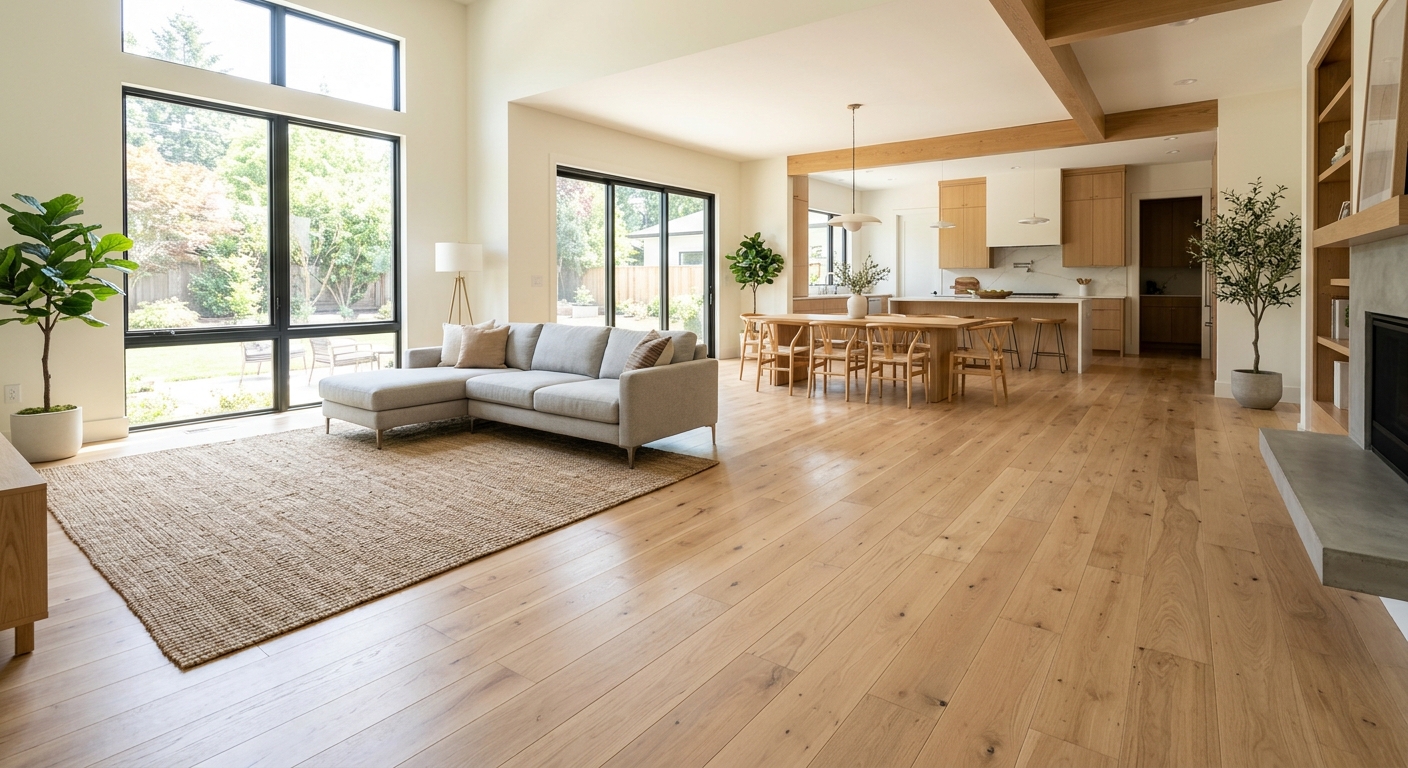
Flooring options and costs in Westwood
Flooring in Westwood, Alberta is typically priced in line with the Calgary economic region, but your exact quote can swing based on site conditions and climate demands. Westwood’s small community profile (Population: 3,315 as of the 2021 Census, Statistics Canada) often means fewer crews available for short-notice work, so scheduling and access can matter. Just as importantly, many nearby Calgary-area homes sit in mixed, older housing stock—those vintage surfaces (aged plywood, transitions between rooms, or inconsistent concrete) commonly need subfloor levelling or repair before a new finish goes down. In practice, that prep step can add roughly $1–$4 per sq ft, depending on how out-of-flat the substrate is and how many transitions you have.
Calgary’s dry, cold prairie climate brings large seasonal humidity swings, which is a major cost driver. Solid hardwood expands and contracts with indoor humidity and isn’t the right choice over concrete or in basements; it can fail with moisture migration. That’s why local contractors in Westwood steer many homeowners toward engineered hardwood or luxury vinyl plank (LVP) for stability, and porcelain/ceramic tile for wet areas. If you’re in the higher-turnover zones near neighbourhood commercial strips and busy family corridors (for example, the Westwood–Calgary commute side of the area), trades often see steady demand for kitchens, main-floor living spaces, and basement conversions—projects that pair durability with moisture-safe materials.
Below is a practical cost comparison you can use as a baseline before you request itemised quotes.
| Type |
Best Room |
Moisture Resistance |
Lifespan |
Price per sq ft |
| Solid hardwood (nail-down, above grade only) |
Living / dining on main floor |
Low (humidity-sensitive; not for basements) |
20–35 years |
$8–$15 |
| Engineered hardwood (float or glue, above + on-grade) |
Living / dining, hallways, master bedrooms |
Medium to high (more stable than solid) |
15–30 years |
$9–$14 |
| Laminate (click-lock, above-grade) |
Bedrooms, living areas with controlled humidity |
Low to medium (surface water only) |
10–20 years |
$3–$7 |
| Luxury vinyl plank / LVP (waterproof, any level) |
Kitchen, main floor, finished basement |
High (waterproof core; handles vapour better) |
15–25 years |
$4–$9 |
| Porcelain / ceramic tile |
Kitchen, bathroom, entries |
High (surface- and spill-resistant when set correctly) |
25–50 years |
$6–$12 |
| Carpet (broadloom or modular tile) |
Bedrooms, stairways with comfort needs |
Low to medium (avoid basements unless well-controlled) |
8–15 years |
$3–$7 |
Prices are estimates only and vary by project scope, site access and material selection.
What affects the price of flooring in Westwood
Even when two homeowners in the Calgary area choose the same product line, quotes can differ by 30–50%. In Westwood, that usually comes down to the technical details that affect labour time: substrate flatness, moisture risk, transitions, and whether stair work and trim reinstallation are included. The other big driver is climate. Calgary’s dry winters and humid summers create large indoor humidity swings, which impacts adhesion (for glue-down products), gapping allowances, and how carefully installers must acclimate materials. In turn, labour scheduling and installer availability can change timelines—sometimes raising costs simply because premium crews are booked.
Solid hardwood expands and contracts with indoor humidity, so it typically can’t be glued or floated over concrete and performs poorly in basements. That one constraint alone can reshape your entire budget. Engineered hardwood and LVP handle humidity and below-grade applications far better, which is why they often price more predictably in moisture-prone homes. In homes with colder-region radiant heat, many homeowners also avoid most solid hardwood and some laminate options because temperature cycling can cause uneven movement or joint stress.
Older housing stock around Westwood often needs levelling or repair—commonly $1–$4 per sq ft—especially where main-floor plywood has worn low spots or where concrete is wavy. Ceramic and porcelain tile are particularly sensitive to flatness, so levelling and sometimes crack isolation membranes can add cost. For example, a basement kitchen refresh might stay closer to $4,000 – $9,000 for LVP when the slab is reasonably flat, while the same footprint using porcelain tile can climb toward $6,000 – $14,000 once levelling, backer/underlayment choices, and careful layout are included.
Practically, one project may cost less because the room is already flat and access is easy; another rises because moisture mitigation, more prep, and stair/transition work are required to finish to the same standard.
| Price Factor |
Why It Matters |
Cost Impact |
| Room area in sq ft |
Materials and labour scale directly with surface area |
$/sq ft multipliers can add up quickly on multi-room jobs |
| Subfloor condition |
Levelling/repair is required for a flat, clean install surface |
Often adds roughly $1–$4 per sq ft in Alberta when needed |
| Moisture / below-grade install |
Solid hardwood is humidity-sensitive and not ideal over concrete |
May switch you to engineered hardwood or waterproof LVP; reduces failure risk |
| Material choice |
Solid vs engineered vs LVP vs tile changes labour complexity and underlay needs |
Tile and hardwood typically cost more than laminate/LVP for supply + install |
| Removal and disposal of existing flooring |
Demolition is labour-intensive and affects clean-up time |
Can add several hundred to multiple thousands depending on substrate |
| Stair nosing / transitions |
Stairs require specialized cutting, matching, and finishing |
Charged per step or per linear foot; increases the total fast |
| Radiant heat compatibility |
Some materials can move or perform poorly under temperature cycling |
May require specific underlay or limit product selection |
| Installation method |
Float vs glue-down vs nail-down affects prep, time, and tolerances |
Glue-down and tile installs usually take longer and cost more |
Permits & regulations in Alberta
In Alberta, installing new flooring itself typically does not require a building permit. That means most hardwood, engineered hardwood, laminate, LVP, carpet, and tile replacement projects—when you’re not altering the structure—are handled as standard renovations. However, associated work can trigger permits depending on scope. For example, if your project includes structural subfloor repair, any moisture remediation that involves significant substrate rebuilding, or changes to in-floor heating circuitry, electrical permits may be required for the electrical portion of the work. In other words: flooring replacement is usually “no permit,” but anything that touches wiring circuits, alters supporting structures, or requires electrical sign-off may.
For condominiums, the bigger compliance factor is often the corporation’s internal rules on sound transmission (STC/IIC expectations) and underlay requirements. Hard flooring on upper floors frequently needs specific underlay and approved installation practices. Before you start, review your condo declaration and request board approval in writing—especially if you’re installing engineered hardwood or tile on an upper level.
How to verify your contractor in Westwood: first, confirm the installer/contractor is properly registered/licensed if applicable to their trade work. Next, ask for a certificate of insurance showing liability coverage. Finally, verify WSIB/WCB coverage (as applicable to Alberta employers/contractors) by requesting a clearance letter or proof of account standing. Ask for all documents before signing the contract, and match names on the insurance/clearance paperwork to the company on your quote.
Best flooring for each room in your Westwood home
Choosing the right floor in Westwood is mostly about matching material stability to moisture behaviour, traffic patterns, and comfort—especially with Calgary’s wide humidity swings and cold winter storage conditions. Living and dining rooms typically do best with engineered hardwood or a high-quality laminate: both give you a warm, finished look, while engineered hardwood tolerates humidity changes better than solid oak. In master bedrooms, carpet remains a top comfort choice (sound absorption and underfoot warmth), but engineered hardwood also works well if you keep humidity reasonably stable.
For kitchens, the safer route in this climate is luxury vinyl plank (LVP) or large-format porcelain tile. LVP’s waterproof core is forgiving of spills and day-to-day splashes, and porcelain tile is ideal where cleaning and water exposure are constant. In finished basements, LVP is usually the clear winner over solid hardwood and most laminate because basements in the Calgary region often experience moisture vapour migration through concrete. Bathrooms should be porcelain or ceramic tile only—if water is in the room, tile is the right foundation when properly installed and sealed.
If you have radiant heat (or plan to add it), choose products that explicitly say they’re compatible with in-floor heating systems. This can limit solid hardwood options and influences underlay selection. For a budget example, switching from laminate (~$3,000 – $7,000 range depending on size and prep) to waterproof LVP often costs more upfront, but it’s commonly justified in Westwood basements where moisture is the difference between a long-lived install and premature edge failure.
| Room |
Best Material |
Why |
Moisture Risk |
Price Band per sq ft |
| Living / dining room |
Engineered hardwood |
Warm look with better humidity stability than solid |
Low to medium (main-floor, controlled conditions) |
$9–$14 |
| Master bedroom |
Carpet or engineered hardwood |
Comfort and quieter feel; engineered option stays stable |
Low (typical bedroom use) |
$3–$14 |
| Secondary bedrooms |
Laminate or engineered hardwood |
Durable for kids/guests; easier maintenance than carpet |
Low (avoid standing water) |
$3–$12 |
| Kitchen |
Luxury vinyl plank (LVP) or porcelain tile |
Handles spills and frequent cleaning |
Medium to high (regular water exposure) |
$4–$12 |
| Basement (finished) |
Luxury vinyl plank (LVP) |
Waterproof and more tolerant of below-grade vapour |
High (concrete moisture migration risk) |
$4–$9 |
| Bathroom |
Porcelain / ceramic tile |
Built for wet environments when set and grouted properly |
High (direct water exposure) |
$6–$12 |
How to choose a flooring contractor in Westwood
When you’re hiring a flooring contractor in Westwood, start by verifying Alberta coverage and paperwork. Ask for their certificate of insurance (liability) and confirm they have active WSIB/WCB coverage where applicable—request a clearance letter or proof of account standing rather than a verbal assurance. Make sure the company name on the certificate matches the contracting name on the quote.
Next, get 2–3 itemised written quotes. You want a labour + materials breakdown, not a single lump sum that hides whether levelling, underlay, trim work, or stair finishing is included. Read the scope carefully: what is included for subfloor prep, is there a moisture testing step, is old flooring removal and disposal covered, and are transitions handled with matching trims? Confirm whether any permits are included if electrical sign-off is required for radiant heating circuit changes or related work. In condo situations, ask who is responsible for confirming underlay requirements.
Warranty matters. Require the workmanship warranty length in writing, and separate it from the manufacturer product warranty. Also ask if the warranty is transferable to subsequent owners. For payments, never pay more than 10–15% upfront; use a holdback until the final walk-through and punch list are complete. Finally, lock in a written start date and a realistic completion estimate.
- Request proof of liability insurance and confirm the policy is current.
- Ask for WSIB/WCB clearance documentation (where applicable) before work begins.
- Ensure the quote includes subfloor levelling/repair scope or clearly states exclusions.
- Confirm underlay choices for LVP/laminate and sound-control requirements for condos.
- Check whether acclimation time is included for hardwood/engineered products.
- Verify removal and disposal are included (and what’s removed: underlay, staples, nails).
- Have stair nosing and transitions priced per step/linear foot if stairs are involved.
- Get a written start date and completion window, not just a “when materials arrive” note.
- Confirm transitions to tile/doorways include matching trims and finishing details.
- Clarify warranty: workmanship period, product warranty terms, and any exclusions.
- Use a payment schedule with only 10–15% upfront and a holdback until completion.
- Ask for a final clean-up plan and how dust control will be handled during prep.
Red flags we see in Westwood: quotes that are “all-in” without listing levelling or underlay, contractors who won’t provide insurance/WSIB/WCB paperwork, vague timelines with no start date, and workmanship warranties that are shorter than the industry norm or missing entirely. Also watch for installers who suggest skipping acclimation for engineered hardwood or who minimize subfloor flatness requirements for tile.
Frequently asked questions — flooring in Westwood
Can I install hardwood over concrete?
In Westwood, Alberta, it’s usually not as simple as “yes” or “no.” Solid hardwood typically isn’t recommended over concrete—especially if the slab is below grade or shows signs of moisture. Solid hardwood needs a wood-based installation environment (often nail-down above grade) and it’s sensitive to humidity swings. If you want the hardwood look but you’re working over concrete, engineered hardwood is commonly the safer choice because it’s more dimensionally stable. That said, concrete flatness is critical for any wood product; out-of-level slabs can create squeaks, gaps, or telegraphing under tile. If you’re considering tile, porcelain is also sensitive to flatness, but it tolerates moisture well when installed with the right system. Budget-wise, solid hardwood usually lands in the $8–$15 supply/installation band, while switching to engineered hardwood often sits in a similar but more stable range depending on prep.
How long does flooring installation take?
Timelines in Westwood vary mainly by surface prep and how many rooms are involved. A straightforward main-floor laminate or LVP install on a reasonably flat substrate can move quickly once materials arrive, while projects that need levelling or subfloor repair add days. If you’re installing engineered hardwood, installers will also include acclimation time and extra care around transitions. Tile installs can take longer because layout, leveling, and grout curing timelines affect the schedule. A typical multi-room job commonly falls into a short “one to a few days” window for LVP or laminate, but could extend to a week or more when prep is heavy (for example, when concrete or plywood requires significant smoothing and additional underlayment). The dry/cold Calgary climate also influences drying expectations after prep, especially if moisture remediation is part of the plan.
What flooring works with radiant heat?
Radiant heat compatibility is one of the most common questions we get in Alberta, especially with newer construction and renovations tied to comfort improvements. Many homeowners in Westwood are surprised that not every finish is suitable for temperature cycling. In general, LVP and tile are often the easiest matches because they tolerate temperature changes better and are available in systems designed to handle radiant heat. Engineered hardwood can be compatible when the manufacturer explicitly approves it for radiant applications and the correct underlay/moisture requirements are followed. Most solid hardwood is more limited due to movement and stability concerns over heat cycles; some solid products simply won’t be warranted for radiant. Laminate can work in some cases, but only when the product is rated for radiant heat and installed with the right underlay. If radiant heat is involved, ask your contractor to confirm product compatibility in writing before you approve materials—this helps avoid costly callbacks.
Engineered vs solid hardwood — what's the difference?
The difference is mainly stability and installation flexibility. Solid hardwood is one continuous piece of wood and is very sensitive to indoor humidity swings. In Westwood and the Calgary region, that matters because winters are cold and dry and summers bring humidity changes—so solid hardwood is typically limited to above-grade areas with stable conditions. Engineered hardwood is built in layers, which makes it much more dimensionally stable and better suited to environments with relative humidity variation. It’s also often the preferred “hardwood look” over concrete or on-grade slabs when compared with solid. From a practical budgeting perspective, solid hardwood generally falls in the $8–$15 band, while engineered hardwood commonly sits close to that range depending on thickness, wear layer, and prep scope. If your project includes a basement, engineered hardwood plus careful moisture-aware prep is usually safer than solid.
Do I need to level my subfloor first?
In most Westwood flooring projects, some level of subfloor preparation is essential—but how much depends on the product you’re installing. Laminate and LVP are more forgiving than tile, but they still require a reasonably flat surface to prevent noise, joint stress, and premature wear. Tile (ceramic and porcelain) is the least forgiving: it demands a very flat substrate to avoid cracked grout lines or loose tiles. Older regional housing stock often needs levelling or repair—especially where plywood has aged unevenly or where concrete isn’t perfectly smooth—adding roughly $1–$4 per sq ft when corrective work is required. If you’re quoted a tile or engineered hardwood install without any mention of flatness checks, ask how the contractor plans to address high spots/low spots and what happens if the substrate is out of tolerance.
What's the most durable flooring for pets and kids?
For pets and kids in Westwood, durability is a combination of scratch resistance, stain resistance, and how the floor handles accidents. Waterproof LVP is often the top practical choice because it stands up to spills and day-to-day mess, and it’s generally easier to clean than carpet. With Calgary’s climate swings, LVP’s stability and moisture tolerance also help in homes with variable humidity, and it’s especially common for finished basements where moisture vapour can be an issue. If you prefer a “natural” feel, engineered hardwood is durable, but you’ll still want quick cleanup for wet events and you may avoid it in basements with high moisture migration risk. Tile is also very durable and can be excellent for heavy traffic areas, but it needs careful subfloor prep to prevent cracking. In price terms, LVP often aligns with the $4,000 – $9,000 style project range depending on size and prep, while carpet installation is usually positioned lower—around the $3–$7 band—though it can be harder to maintain if accidents occur.