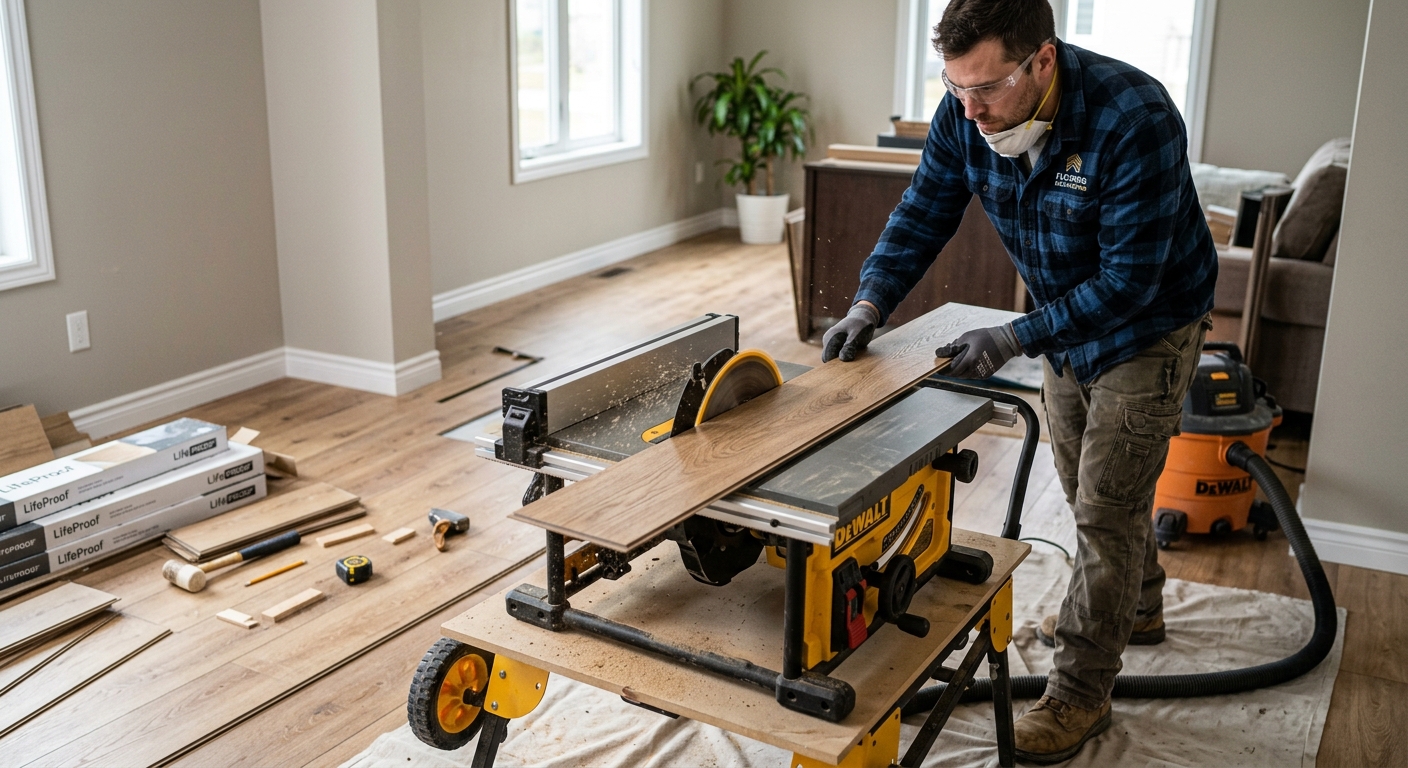
Flooring options and costs in Cold Lake
Flooring in Cold Lake is all about choosing the right material for how this climate behaves—seasonal temperature swings, indoor humidity drift, and the occasional basement moisture problem. With older housing stock (30.8% of homes built before 1981, Statistics Canada, 2021 Census), many jobs start with patching, levelling, or underlayment work so the finished floor doesn’t end up uneven. That prep step is one reason you’ll see bigger differences between quotes than homeowners expect, especially when the subfloor is out of level or has damaged OSB or concrete.
In the Wood Buffalo–Cold Lake region, flooring costs are also influenced by what installers are seeing most often: concrete slabs that need moisture-aware underlayment, basements that can’t be treated like above-grade space, and cold-room comfort where radiantly heated floors are becoming more common. If you’re updating an older single-detached home (65.7% of dwellings are single-detached, Statistics Canada, 2021 Census), expect labour time for demolition, inspection, and transitions—particularly around doorways and stair edges. In busy pockets such as the Downtown / Fortis area and along main corridors near schools and services, we typically see strong demand for engineered wood and waterproof LVP because they’re more forgiving with site conditions than solid hardwood.
Below are realistic installed ranges for typical Cold Lake projects, then we’ll break down the main cost drivers that swing pricing between contractor quotes.
| Type |
Best Room |
Moisture Resistance |
Lifespan |
Price per sq ft |
| Solid hardwood (nail-down, above grade only) |
Main living areas |
Low to moderate (not for basements or slabs) |
20–40 years |
$10 – $25 |
| Engineered hardwood (float or glue, above + on-grade) |
Living rooms, hallways, bedrooms |
Moderate to high (depends on core + underlayment) |
15–35 years |
$12 – $25 |
| Laminate (click-lock, above-grade) |
Bedrooms, living areas |
Low to moderate (water can swell edges) |
10–25 years |
$5 – $12 |
| Luxury vinyl plank / LVP (waterproof, any level) |
Kitchens, basements, main floor |
High to waterproof (with proper flashing at transitions) |
15–25 years |
$6 – $14 |
| Porcelain / ceramic tile |
Bathrooms, kitchens, entries |
High (grout upkeep required) |
25–50 years |
$8 – $22 |
| Carpet (broadloom or modular tile) |
Bedrooms, stairs |
Moderate (needs dry installation and stain protection) |
7–15 years |
$4 – $10 |
Prices are estimates only and vary by project scope, site access and material selection.
What affects the price of flooring in Cold Lake
Two quotes for the same “room and a half of flooring” can vary by 30–50% across Wood Buffalo–Cold Lake and other parts of Alberta because the scope often changes behind the scenes. Contractors may price different levels of subfloor prep, moisture control, and transitions—even when the finish product looks identical. In Cold Lake specifically, indoor humidity swings and basement moisture are the technical drivers: solid hardwood expands and contracts with relative humidity, and it simply isn’t the right choice for below-grade spaces or concrete slabs. Engineered hardwood and luxury vinyl plank handle humidity changes and on-grade/below-grade conditions far better, so they’re frequently cost-effective once you account for what doesn’t get replaced later.
Cold-climate comfort matters too. If you’re installing over radiant heat or in rooms that stay colder, radiant-compatible products can limit options. That means you might pay a little more for the correct underlayment and a compatible flooring build-up, even if the material itself is similar in price. For older local housing stock (30.8% built before 1981, Statistics Canada, 2021 Census), it’s also common to see subfloor levelling or repair add roughly $1–$4 per sq ft, which can be the difference between “upgrade” and “full renovation.”
Concrete examples from typical Cold Lake jobs: in basements with past moisture events, using waterproof LVP with proper edge detailing can keep the install smooth, whereas solid hardwood can lead to call-backs. In areas with known out-of-level subfloors, levelling may push you toward engineered or LVP installs because they tolerate minor irregularities better than nail-down hardwood.
| Price Factor |
Why It Matters |
Cost Impact |
| Room area in sq ft |
More floor coverage increases materials and labour time. |
Generally scales directly with the area. |
| Subfloor condition — levelling or repair needed |
Older floors often need patching to avoid hollow spots and gapping. |
Commonly adds $1 – $4 per sq ft. |
| Moisture / below-grade install — rules out solid hardwood |
Moisture vapour and humidity swing damage finishes that aren’t designed for it. |
May shift you to engineered or LVP for savings long-term. |
| Material choice — solid vs. engineered vs. LVP vs. tile |
Different build-ups require different underlayments and install methods. |
Can move pricing into the $6 – $25 per sq ft range depending on material. |
| Removal and disposal of existing flooring |
Demo time and haul-away fees vary with flooring type. |
Often adds a noticeable line item versus “new build” installs. |
| Stair nosing / transitions — charged per step or per linear foot |
Edges and trim detail work is labour-intensive. |
Can add several hundred to over a thousand dollars to a job. |
| Radiant heat compatibility — limits material options |
Not all products tolerate heat cycles; incorrect installs can void warranties. |
May increase underlayment/installation costs. |
| Installation method — float vs. glue-down vs. nail-down |
Method affects prep, time, and moisture control. |
Glueless float or waterproof systems are often faster than full glue-down prep. |
Permits & regulations in Alberta
In Alberta, installing a standard floor finish typically does not require a building permit. Where projects can trigger permits is when the flooring job includes associated work—especially anything electrical or structural. For example, repairing or altering electrical circuits (including making changes to in-floor heating wiring or controls) may require electrical permitting. Major structural subfloor work—like joist replacement or significant framing repairs—can also fall into regulated scope depending on what’s being changed. The safe rule for homeowners in Cold Lake: if your contractor says they’re “just installing flooring,” that usually won’t need a permit; if they’re moving wiring, adding circuits, or rebuilding structural supports, ask what permits (if any) apply before work begins.
For condos and multi-unit buildings, regulations often come from the building’s rules rather than municipal permitting. Sound transmission is a big factor: hard flooring on upper floors may require specific underlay or installation methods to meet the building’s STC/IIC targets. Always review the condo declaration and ask for board approval in writing—especially if you’re installing hardwood or tile above grade in a multi-unit structure.
Before hiring in Cold Lake, verify your contractor’s Alberta licence status (where applicable), request liability insurance and confirm WSIB/WCB coverage. Check online for the applicable contractor registry, then confirm the insurance certificate matches the legal name/address of the company, and ask for a clearance letter where the province/insurer requires it. Keep copies in your files so the documentation is there if anything goes wrong.
Best flooring for each room in your Cold Lake home
Choosing the right flooring by room matters in Cold Lake because the risk profile changes from day to day: kitchens see water and foot traffic, basements can experience vapour, and bedrooms need comfort. For living and dining rooms, engineered hardwood or high-quality laminate often balances warmth, durability, and easier maintenance than solid hardwood. Engineered wood is generally the better match when your home has seasonal humidity swings, since it’s less likely to cup or split than solid boards.
In master bedrooms, carpet is still a strong choice for comfort and sound absorption—especially if you want a quieter home. If you prefer hard surface, engineered hardwood works well. For kitchens, luxury vinyl plank (LVP) or large-format porcelain tile are practical wins because they handle splashes and easier cleaning; tile also tolerates the occasional wet floor from a tracked-in snow melt.
Basements (finished) are where Cold Lake homeowners usually benefit most from waterproof LVP. Fully waterproof products handle moisture vapour better than solid wood and most laminate systems, which can swell at seams if moisture gets through. Bathrooms should be porcelain or ceramic tile only, with correct waterproofing practices at wet-area edges.
Radiant heat compatibility is a smart check for rooms with in-floor heating. Many solid hardwood options are more sensitive to heat cycling, so engineered or radiant-approved products are commonly used. If you’re deciding between options, a realistic example: moving from a $6–$12 per sq ft laminate band to an $8–$22 per sq ft tile band is usually justified in kitchens or bathrooms when you want long-term water resistance and low maintenance—not when the budget is tight for main living areas.
| Room |
Best Material |
Why |
Moisture Risk |
Price Band per sq ft |
| Living / dining room |
Engineered hardwood |
Warm underfoot with better humidity tolerance than solid in Alberta seasons. |
Low to moderate |
$12 – $25 |
| Master bedroom |
Carpet or engineered hardwood |
Carpet adds comfort and reduces noise; engineered keeps it durable. |
Low |
$4 – $15 |
| Secondary bedrooms |
Laminate or carpet |
Great value for daily traffic; carpet helps with sound. |
Low |
$4 – $12 |
| Kitchen |
LVP or porcelain tile |
Water-friendly and easy to maintain under busy family use. |
Moderate |
$6 – $22 |
| Basement (finished) |
Waterproof LVP |
Designed for below-grade moisture conditions; reduces risk versus wood. |
High |
$6 – $14 |
| Bathroom |
Porcelain / ceramic tile |
Highest water tolerance for wet areas when installed correctly. |
High |
$8 – $22 |
How to choose a flooring contractor in Cold Lake
Hiring the right flooring contractor in Cold Lake comes down to proof, paper, and a scope that matches what you want to get installed. First, verify Alberta coverage and legitimacy: ask for their certificate of insurance (liability) and confirm it’s active for the job dates, then confirm WSIB/WCB coverage with a clearance letter or current status documentation. If the contractor won’t provide documentation, that’s a red flag—especially in Alberta where jobsite injuries and property damage claims can become complicated fast.
Next, require 2–3 itemised written quotes instead of a single lump-sum number. You want a breakdown that shows labour, removal/disposal, subfloor prep/levelling, underlayment or moisture barriers, trim and transitions, and any stair work. Scope clarity matters: ask if permit pull (when required) is included, whether patching is included or capped, what moisture remediation steps are proposed, and whether materials include matching stair nosings and transition mouldings.
Warranty matters too. Ask for the workmanship warranty length in writing, confirm product warranty terms, and check whether the warranty is transferable to you as the homeowner. Finally, keep the payment schedule conservative: don’t pay more than about 10–15% upfront, and hold a balance until the job is complete and punch list items are finished. Get the start date and estimated completion timeline in writing so scheduling changes don’t become “surprise delays.”
- Ask for proof of active liability insurance and WSIB/WCB coverage before the first day on site.
- Request an itemised quote showing labour, materials, underlayment/moisture system, and trim/transitions.
- Confirm who is responsible for site protection (plastic, masking, floor protection) during prep and install.
- Ask how they assess moisture (especially below-grade) and what they do if moisture is detected.
- Verify subfloor levelling method and limits (what’s included, what’s extra).
- Clarify removal scope: full demo, underlay removal, and disposal/haul-away fees.
- Check stair work details: nosing style, edge finishing, and whether mouldings are included.
- Request transition details at doorways and between rooms (and whether they supply matching reducers).
- Confirm acclimation requirements for engineered wood or plank products before installation.
- Ask for warranty documentation: workmanship duration, product warranty, and transferability.
- Discuss timeline: a written start date and target completion date, plus weather-sensitive contingencies.
- Use a payment schedule with a small deposit only; holdback until the punch list is complete.
Concrete red flags we see in Cold Lake: contractors who won’t provide insurance/WSIB/WCB documentation, quotes that omit disposal or stair/transitions, refusal to show moisture or subfloor prep plan, vague warranties (no written workmanship terms), and “all-inclusive” pricing that still changes after demo with no documented explanation.
Frequently asked questions — flooring in Cold Lake
How long does flooring installation take?
In Cold Lake, installation time depends on room count, the condition of the subfloor, and whether moisture prep is needed—especially for basements. A typical above-grade room (say 300–500 sq ft) for floating LVP or laminate often goes quickly once demolition is done, but if levelling/patching is required, expect extra time. Tile and hardwood tend to take longer due to transitions, layout, and more detailed finishing work. If you’re comparing material choices, remember that a laminate or LVP install may land closer to the quicker end of scheduling, while tile can add days for setting and cure time. Always get a written timeline that includes demo, subfloor prep, acclimation (for wood/plank), and final trim.
What flooring works with radiant heat?
For radiant heat in Alberta, the key is compatibility: not every product is designed for in-floor heating cycles. In Cold Lake, we typically steer homeowners toward radiant-approved engineered hardwood or specific LVP/laminate systems where the manufacturer confirms usage with radiant heat. Solid hardwood is more sensitive to heat cycling and is often restricted above concrete or in radiant setups, which is why many radiant projects skip nail-down solid. Make sure your contractor checks the product’s installation instructions for underlayment type, maximum heat setting, and acclimation. A contractor who can’t point to those written specs (or tries to install without confirming them) is taking unnecessary risk with both comfort and warranty coverage.
Engineered vs solid hardwood — what's the difference?
Solid hardwood is one piece of wood and moves with humidity—great when it’s installed correctly above grade, but it’s less forgiving for homes with seasonal humidity swings or any below-grade moisture risk. Engineered hardwood is built with layers (a stable core plus a hardwood wear layer), so it tolerates environmental changes better and can be a better fit in Cold Lake when basements are part of the plan. Because so many local homes are older (30.8% built before 1981, Statistics Canada, 2021 Census), engineered is also commonly chosen when subfloors need levelling and patching, and when homeowners want a finish that’s less likely to react to minor site variation. In pricing, engineered often overlaps the $12–$25 per sq ft band, while solid hardwood is commonly in the $10–$25 per sq ft installed range depending on prep and transitions.
Do I need to level my subfloor first?
Often, yes—especially in older Cold Lake homes where unevenness can show up after flooring goes down. If the subfloor is out of level or has dips/high spots, you can get gaps, hollow sounds, or premature wear. For floating systems like LVP or laminate, small imperfections are sometimes manageable, but significant variation still needs correction for a clean finish. For tile, levelling is critical for flatness and proper thinset coverage. Contractors may charge $1–$4 per sq ft for levelling or repair depending on scope, which is why it’s important to compare itemised quotes. The best contractors will measure flatness and tell you what’s included (patching only vs full levelling) before materials are ordered.
What's the most durable flooring for pets and kids?
For many Cold Lake families, waterproof LVP is the most practical “durable” choice because it resists water spills, tracks less if installed with tight seams, and handles everyday impacts better than many laminate floors. Tile is also very durable, especially in entryways and kitchen/bath zones, and it’s easy to clean, but it can be harder and colder underfoot without comfort steps. Carpet can be durable with the right fibre and stain treatment, but it doesn’t like repeated moisture exposure, and it can hold odours if spills aren’t cleaned promptly. If you’re comparing price bands, LVP commonly sits around $6–$14 per sq ft installed, while tile is often $8–$22 per sq ft installed—so the “best” option depends on whether you need waterproof performance (kids/pets + busy spills) or maximum surface toughness.
How do I choose flooring for humidity in Cold Lake?
Humidity in Cold Lake matters because wood-based products can react to seasonal changes, and basements add moisture vapour risk. Start by identifying where the flooring will go: above grade living spaces can often handle engineered hardwood or quality laminate, while basements are where waterproof performance becomes the deciding factor. Solid hardwood is the most sensitive—so it’s typically limited to above-grade installations. Engineered hardwood and LVP are better performers when there are indoor humidity swings, and LVP is the go-to where vapour or occasional basement moisture is a concern. Also make sure your contractor uses the correct underlayment and moisture barrier system and follows manufacturer acclimation requirements. A thoughtful prep plan can prevent future gapping or cupping, which is especially important in older homes where the subfloor may not be perfectly flat.