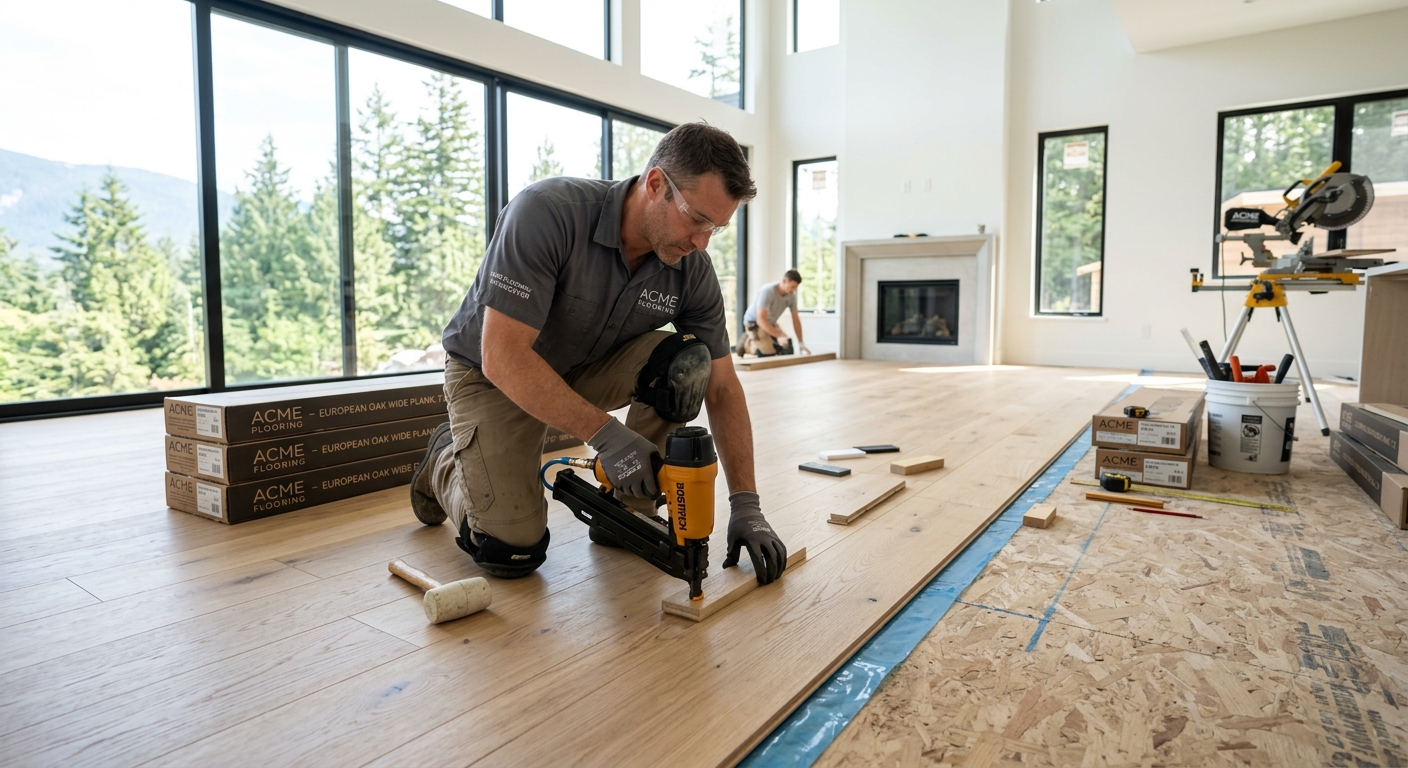
Flooring options and costs in Silver Springs
Flooring decisions in Silver Springs, Alberta usually start with budget, but they quickly shift to performance—especially in a dry, cold prairie climate with big seasonal humidity swings. Silver Springs’ total population is 8,570 (Statistics Canada, 2021 Census), and that size shapes the contractor rhythm: you may find fewer crews than in larger Calgary neighbourhoods, so scheduling and material lead times can influence the final invoice. Another cost driver is older housing. In many Calgary-area communities, aged subfloors and uneven concrete are common, and levelling/prep is often what pushes “same room, different quote” pricing—especially if the installer needs to correct out-of-flat surfaces before tile or hard surface flooring goes in. In practice, subfloor repair/levelling can add roughly $1–$3 per sq ft depending on how out-of-level the existing surface is, and it’s a frequent line item in basements and main-floor transitions.
Calgary trades also price for realistic job conditions: removal and disposal of existing flooring, stair work, and trim reinstallation. Over below-grade slabs, solid hardwood and many traditional installs are a poor match because humidity migration and temperature change can stress the wood. That’s why Silver Springs homeowners commonly choose engineered hardwood, luxury vinyl plank (LVP) or SPC for stability, while reserving porcelain/ceramic tile for wet rooms and carpet for bedrooms. With those realities in mind, the table below gives typical cost ranges by product type so you can compare bids apples-to-apples—then fine-tune the numbers based on your room size and prep scope.
| Type |
Best Room |
Moisture Resistance |
Lifespan |
Price per sq ft |
| Solid hardwood (nail-down, above grade only) |
Living / dining (above grade) |
Low to moderate (humidity sensitive) |
25–40 years |
$8–$15 |
| Engineered hardwood (float or glue, above + on-grade) |
Living rooms, bedrooms, halls |
Moderate to high (more stable than solid) |
15–30 years |
$7–$14 |
| Laminate (click-lock, above-grade) |
Bedrooms, living rooms |
Low to moderate (not ideal for floods) |
10–20 years |
$3–$7 |
| Luxury vinyl plank / LVP (waterproof, any level) |
Kitchen, basement, main level |
High (waterproof cores) |
15–25 years |
$5–$10 |
| Porcelain / ceramic tile |
Bathrooms, entry, kitchen accents |
High (properly grouted) |
25–50 years |
$6–$12 |
| Carpet (broadloom or modular tile) |
Primary and secondary bedrooms |
Low (needs dry installation) |
7–15 years |
$3–$8 |
Prices are estimates only and vary by project scope, site access and material selection.
What affects the price of flooring in Silver Springs
Even when homeowners request “the same flooring,” quotes across the Calgary region can swing by about 30–50% because contractors price for risk, prep, and how your existing floor system behaves. In Silver Springs, the technical drivers are humidity swings and below-grade moisture movement. Solid hardwood expands and contracts with indoor humidity and generally cannot be glued or floated over concrete; it’s also a risky choice in basements where moisture vapour can migrate through slabs. Engineered hardwood and luxury vinyl plank (LVP/SPC) handle relative humidity changes far better, which is why they’re common in prairie basements. Calgary’s cold winters also make radiant heat compatibility a real selection limiter—many homeowners with in-floor heating choose engineered hardwood, LVP/SPC, or specific laminates, while most traditional solid hardwood installs are restricted. That product limitation can change both material and labour costs.
Older regional housing stock frequently needs levelling or repair before install. If prep adds $1–$4 per sq ft, the difference shows up fast: on a 400 sq ft basement, that’s $400–$1,600 before you buy a single box of flooring. Practical examples from Silver Springs jobs: (1) an out-of-flat concrete slab—tile crews may budget extra thinset, smoothing compounds, and crack isolation membranes, raising per-sq-ft pricing; (2) transitions between aged plywood and newer subfloor patches—levelling becomes mandatory to prevent click-lock floating floors from joint failure; and (3) stair work—new stair nosing and matched treads/trim can add cost even when the square footage is modest. In short, if you’re comparing, say, laminate at $3–$7 versus LVP at roughly $5–$10, the “why” is often the prep and underlayment choices needed to make the product perform through Alberta winters.
| Price Factor |
Why It Matters |
Cost Impact |
| Room area in sq ft |
Materials scale directly; labour scales with edges, cuts, and waste |
Small rooms may cost proportionally more |
| Subfloor condition |
Levelling, patching, and flatness are required for hard surfaces |
Often adds about $1–$4 per sq ft |
| Moisture / below-grade install |
Solid hardwood is humidity sensitive; concrete vapour risks delamination or cupping |
Usually favours engineered/LVP/SPC; may add vapour barriers |
| Material choice |
Solid vs engineered vs LVP vs tile changes preparation and installation method |
Hardwood and tile typically cost more than laminate/vinyl |
| Removal and disposal of existing flooring |
Disposal fees, patching after demo, and protecting trim affect labour time |
Can be a significant portion of the quote |
| Stair nosing / transitions |
Stairs require careful measuring and custom finishing |
Charged per step or linear foot |
| Radiant heat compatibility |
Not all products are rated for heating systems |
May increase material selection cost |
| Installation method |
Float, glue-down, and nail-down have different labour and subfloor requirements |
Can shift labour cost and prep demands |
Permits & regulations in Alberta
In Alberta, the act of installing typical flooring does not usually require a building permit. Most homeowners in Silver Springs only need to worry about permits when the flooring project includes associated work that affects structure, wiring, or plumbing. For example, structural subfloor repair (like significant joist work or major rebuild of a damaged subfloor) may require permits or inspections depending on scope, and moisture remediation that involves substantial remediation systems can trigger additional compliance steps. If your project includes modifications to electrical circuits for in-floor heating, that can require an electrical permit. In multi-unit buildings, condominiums often have stricter requirements than the average single-family home—especially around sound transmission.
Condominium corporations commonly restrict or require specific underlay on upper floors to meet sound standards (often discussed as STC/IIC expectations). Before installing hardwood or tile above grade in a condo, review the condo declaration and ask the board for approval in writing, including the product and underlay details.
Step-by-step, verify your contractor before work begins: (1) confirm the flooring contractor’s Alberta licence/registration status where applicable using the government-facing registry search tools; (2) request a certificate of insurance showing general liability and ensure the coverage is active for your project dates; (3) ask for WSIB/WCB clearance information where applicable—don’t rely on “we’re covered” emails; and (4) keep copies of the certificate and clearance letter for your records. If a contractor can’t provide proof quickly and clearly, it’s usually a sign to move on.
Best flooring for each room in your Silver Springs home
In Silver Springs, the best flooring is the one that matches room-specific moisture, traffic, and comfort—while surviving Alberta’s dry winters and humid swings. For living and dining areas, engineered hardwood or high-quality laminate are popular because they deliver warmth underfoot without the same humidity restrictions as traditional solid wood. In master bedrooms, carpet is often the comfort winner: it adds sound control and warmth on colder mornings. For kitchens, choose luxury vinyl plank (LVP) for everyday spills and fast cleanup, or porcelain tile if you want maximum water resistance and a more “forever” finish. In basements, the clear default in this region is LVP or SPC: fully waterproof designs handle moisture vapour and below-grade conditions far better than solid hardwood or most laminate. Bathrooms should be porcelain or ceramic tile only, with correct installation practices to protect grout lines and subfloor integrity.
Radiant heat compatibility also matters in Alberta. If a room sits over in-floor heating, you’ll want products rated for temperature change—engineered hardwood and LVP/SPC are commonly suitable when installed per manufacturer specs. Here’s a cost example: upgrading from laminate around $3–$7 to LVP roughly $5–$10 might cost an extra $2 per sq ft. In a 300 sq ft kitchen, that’s about $600 more, and it’s usually justified by spill tolerance and easier maintenance in a dry-cold climate where tracked-in grit and quick cleanups are constant.
| Room |
Best Material |
Why |
Moisture Risk |
Price Band per sq ft |
| Living / dining room |
Engineered hardwood |
Warm look, stable through humidity swings, durable for daily traffic |
Low to moderate (keep interior humidity consistent) |
$7–$14 |
| Master bedroom |
Carpet or engineered hardwood |
Carpet offers comfort and sound absorption; engineered keeps a hard-floor feel |
Low (no direct water exposure) |
$3–$10 |
| Secondary bedrooms |
Laminate (higher-grade) or carpet |
Laminate is budget-friendly and easy to maintain; carpet softens acoustics |
Low |
$3–$8 |
| Kitchen |
Luxury vinyl plank (LVP) or porcelain tile |
LVP handles spills well; tile offers maximum cleanability and longevity |
Moderate (spills, occasional splashes) |
$5–$12 |
| Basement (finished) |
LVP (waterproof) |
Best stability over concrete and reduced risk from moisture vapour |
High if slab moisture migrates |
$5–$10 |
| Bathroom |
Porcelain / ceramic tile |
Designed for wet environments; long service life when installed correctly |
High (direct water exposure) |
$6–$12 |
How to choose a flooring contractor in Silver Springs
Choosing the right flooring contractor in Silver Springs comes down to proof, clarity, and workmanship responsibility—not just the lowest per-sq-ft number. Start with Alberta licensing/registration where applicable and insist on documentation. Ask for: (1) general liability insurance certificate (confirm coverage dates); (2) WSIB/WCB clearance information where applicable to your project and the contractor’s workers; and (3) evidence the contractor is actively insured for the scope they’re pricing. If a contractor avoids paperwork or gives vague statements like “we’re covered,” that’s a red flag.
Next, get 2–3 itemised, written quotes that break down labour and materials separately (and include underlay/vapour barriers, prep, and fastening details). A lump-sum number hides where costs will rise. Read the scope line by line: what’s excluded (subfloor replacement, levelling compounds, trim rebuild, disposal), whether permits are included if your project triggers electrical work, and whether stair work is priced per step or by linear foot.
Warranty matters too. Ask for the workmanship warranty length, whether it covers labour only or includes related fixes, and whether product warranties are transferable. Finally, use a responsible payment schedule: never pay more than 10–15% upfront and hold back funds until the job is substantially complete and you’ve inspected transitions, edges, and flatness. Get your start date and completion estimate in writing so schedule surprises don’t turn into expensive change orders.
- Confirm insurance certificate is current before scheduling material deliveries.
- Request WSIB/WCB clearance documentation (where applicable) and keep a copy.
- Ask for proof of experience with basements and below-grade moisture—especially for LVP/SPC installs.
- Get quotes that list prep items (levelling/patching) as separate line items.
- Require flatness expectations—tile installers should mention crack isolation/underlayment decisions.
- Ensure disposal/removal is included or clearly excluded.
- Ask how stairs and transitions will be finished and priced (per step/linear foot).
- Verify radiant heat compatibility if you’re installing over in-floor heating.
- Confirm underlay/vapour barrier type and thickness meet the manufacturer’s requirements.
- Ask who supplies trim, stair nosing, and matching transitions (materials and labour).
- Keep payment milestones tied to inspections and completion, not verbal promises.
- Get start date, end date target, and change-order process in writing.
Red flags we see in Silver Springs include: refusing to provide insurance/clearance documentation, offering only a vague “all-in” price without itemised prep, skipping flatness checks for tile or ignoring subfloor patching needs, starting without written scope/specs for underlay/vapour barriers, and pressuring for large upfront payments.
Frequently asked questions — flooring in Silver Springs
What is the difference between floating and glued-down flooring?
Floating flooring (like many click-lock laminate or some engineered designs) isn’t fastened to the subfloor. It typically uses an underlay and “clicks” together, allowing the planks to move slightly with temperature and humidity. Glued-down flooring is bonded directly to the subfloor using the manufacturer’s approved adhesive, which reduces movement but demands a very clean, stable, properly prepped surface. In Alberta winters, humidity swings can be dramatic, so the installation method matters. Over concrete slabs in Silver Springs basements, floating systems can work better when paired with the right waterproof product (like LVP/SPC), while solid hardwood is generally not the right approach. If your contractor quotes savings but won’t explain flatness and moisture protection, ask more questions.
What flooring holds up best to pets in a Silver Springs home?
For most pet owners in Silver Springs, waterproof LVP/SPC is the best balance: it stands up to accidents far better than carpet, and it won’t swell from puddles the way laminate can. Look for thicker wear layers and a protective top coat; cheaper click vinyl can show scratches sooner, especially with claws. If you prefer a hard floor like engineered hardwood, choose a high-durability wear layer and understand you still need to manage moisture and wipe spills quickly—pet water and long exposure can create problems in high-humidity seasons. Carpet can work for comfort, but it’s higher risk in homes with frequent spills or if pet water gets tracked. Budget-wise, you’ll often see vinyl at around $5–$10 per sq ft, versus laminate around $3–$7, and the extra cost is usually justified for real-life pet wear and moisture tolerance.
How do I fix squeaky floors in my Silver Springs home?
Squeaks usually come from movement—joists rubbing, subfloor fasteners loosening, or an underlayment gap rather than from the finished flooring itself. In Silver Springs homes (especially older stock around Calgary), squeaks are often tied to aged plywood or transitions where patches weren’t properly fastened. The best fix is diagnosing before replacing: lift a small section if possible, check joist spacing, and look for missing nails/screws or loose subfloor panels. In many cases, tightening screws/fasteners back into the joists solves it. If the squeak is widespread, the contractor may recommend subfloor repair before installing new flooring, which can add $1–$4 per sq ft in prep depending on how much patching/levelling is required. If you’re installing tile, flatness and subfloor stability are even more critical because movement can crack grout and tile.
What is luxury vinyl plank and is it worth it in Silver Springs?
Luxury vinyl plank (LVP) is a vinyl flooring product with a stable core and a wear layer designed to resist scratches and stand up to everyday water exposure. In Silver Springs and the Calgary region, it’s often worth it because it’s dimensionally more stable through cold winters and humidity swings, and it’s typically safer for below-grade conditions than solid hardwood. Basements with concrete slabs can see moisture vapour migration, and that’s where LVP/SPC products reduce risk—solid wood and many laminates are more likely to warp or fail when moisture is present. The trade-off is that quality varies: a budget LVP may dent sooner, while better wear layers last longer. In cost terms, many homeowners compare laminate at about $3–$7 per sq ft to LVP around $5–$10, and the extra usually pays back in moisture tolerance, easier cleanup, and fewer callbacks for basement problems.
How much does flooring cost in Silver Springs?
Flooring cost in Silver Springs depends on the product and the prep required, not just the material choice. Broadly, you can expect hardwood flooring to land around $8–$15 per sq ft, while laminate and vinyl plank often come in lower at roughly $3–$7 (laminate) and $5–$10 (LVP). Tile typically sits around $6–$12 per sq ft, and carpet is commonly budgeted with installation add-ons. What pushes the final project higher is usually subfloor levelling/repair, especially in older Calgary-area housing where concrete or plywood may be out of flatness. That prep can add about $1–$4 per sq ft. Removal and stair work also add cost. Get an itemised quote so you can see whether your contractor is pricing only product, or also moisture protection, levelling compounds, and disposal.
Hardwood vs laminate vs vinyl plank — which is best?
There isn’t a single “best” for Silver Springs because the right choice depends on room moisture and your tolerance for seasonal movement. Solid hardwood looks great, but in Alberta’s humidity swings and especially in basements, it’s typically restricted to above-grade installs. Engineered hardwood is often a practical upgrade if you want the wood look with better stability. Laminate is usually the budget play (around $3–$7 per sq ft), but it’s not the best bet for basements or heavy spill areas since it can struggle if moisture gets under the seams. Vinyl plank (LVP/SPC) is often the best all-around performer for kitchens and finished basements because it’s waterproof and handles below-grade conditions more safely. In many Silver Springs homes, a basement floor that starts with LVP is easier to maintain and less risky than starting with hardwood or laminate—so for “best overall,” vinyl is usually the winner when moisture is a concern.