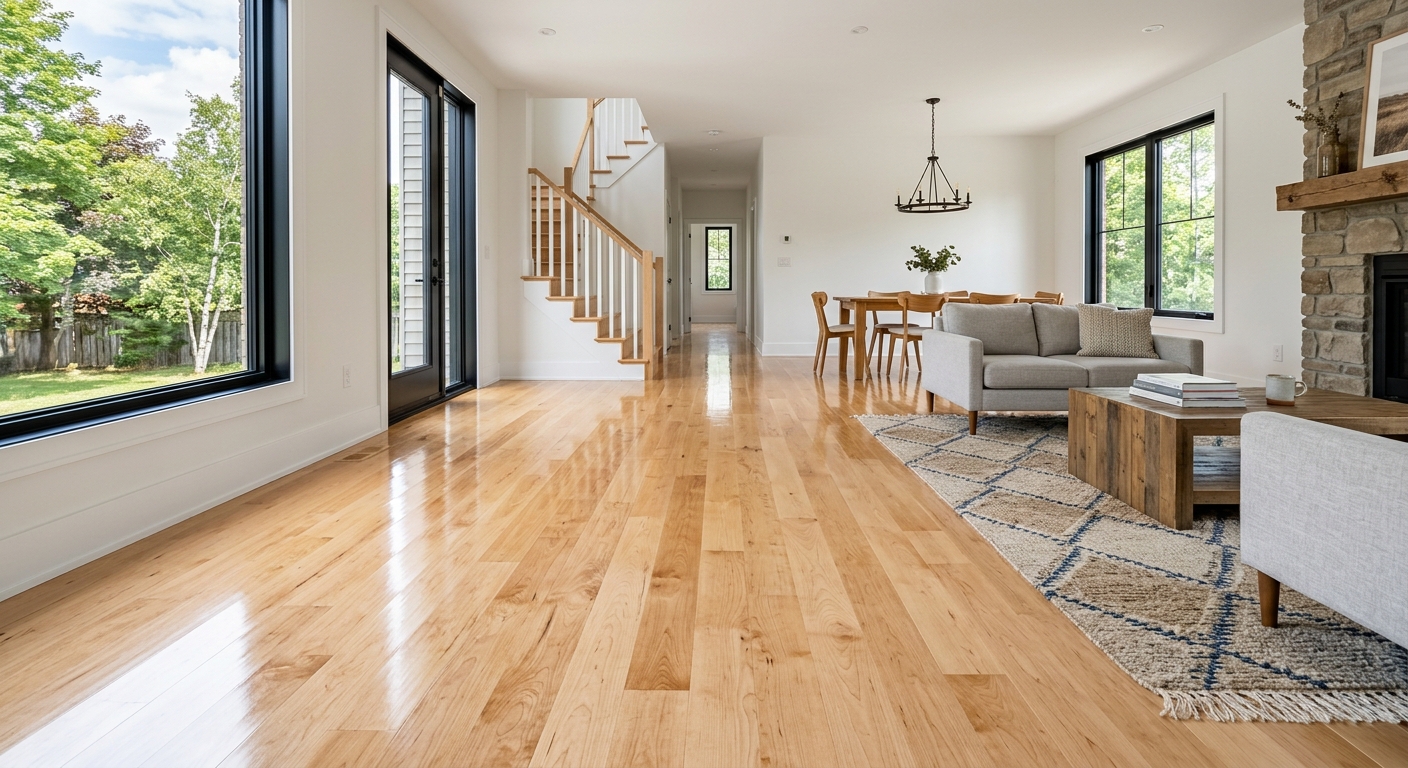
Flooring options and costs in St. Paul
Flooring in St. Paul, Alberta is all about matching the product to the site conditions you actually live with. With 5,863 residents and 1,560 homeowner households (Statistics Canada, 2021 Census), you’ll see a steady mix of upgrades and new finishes rather than one-off, luxury-only installs. Just as important, 56.7% of homes in the area were built before 1981 (Statistics Canada, 2021 Census), which often means older subfloors, patching, and sometimes levelling or underlayment upgrades before a modern finish goes down. That prep work is one of the main reasons two quotes can land far apart.
In the Wood Buffalo–Cold Lake economic region, costs are driven by humidity swings, seasonal temperature changes, and the reality that basements can have moisture vapour even when they look “dry.” For above-grade areas, engineered hardwood and high-quality laminate are popular because they handle normal indoor movement better than solid hardwood. For below-grade rooms, luxury vinyl plank (LVP) is commonly chosen because it’s waterproof and tolerant of the installation environment. In colder-room comfort planning—especially where homeowners are exploring radiant heat—product compatibility can also change the cost because not every flooring type is rated for it.
Labour availability and prep complexity also affect pricing around key areas like the core residential streets near downtown St. Paul, where many jobs are retrofit work inside established homes. With that in mind, here’s a realistic comparison of typical installed material price ranges for common options, then we can fine-tune based on your room count and subfloor condition.
| Type |
Best Room |
Moisture Resistance |
Lifespan |
Price per sq ft |
| Solid hardwood (nail-down, above grade only) |
Living areas, bedrooms (above grade) |
Low to moderate (not for basements or concrete) |
20–30 years |
$10–$25 |
| Engineered hardwood (float or glue, above + on-grade) |
Main floor living, hallways, some on-grade rooms |
Moderate to high (better with humidity than solid) |
15–25 years |
$11–$24 |
| Laminate (click-lock, above-grade) |
Bedrooms, living rooms (where moisture is controlled) |
Moderate (not ideal for below-grade) |
10–20 years |
$5–$12 |
| Luxury vinyl plank / LVP (waterproof, any level) |
Basements, kitchens, main floors |
High (waterproof core) |
15–25 years |
$7–$18 |
| Porcelain / ceramic tile |
Bathrooms, kitchens (and entryways) |
Very high when properly grouted and sealed (as needed) |
25–50 years |
$8–$22 |
| Carpet (broadloom or modular tile) |
Bedrooms, rec rooms (comfort-focused) |
Low to moderate (protect from damp subfloors) |
8–15 years |
$4–$8 |
Prices are estimates only and vary by project scope, site access and material selection.
What affects the price of flooring in St. Paul
In Wood Buffalo–Cold Lake, it’s common to see the same “type” of flooring priced 30–50% differently once you include the full installation reality. Location within Alberta affects availability and unit rates, but the bigger swing usually comes from the technical drivers: humidity behaviour in the home, moisture risk at or below grade, and how much subfloor correction is required. On older St. Paul properties—especially those built before 1981—uneven boards, soft spots, and patch repairs can turn a straightforward install into levelling, underlayment, and additional labour.
Solid hardwood is the most sensitive option: it expands and contracts with humidity and cannot be glued or floated directly over concrete. In a basement or over damp-prone slabs, it typically performs poorly and will often void expectations if moisture isn’t managed. Engineered hardwood and LVP handle humidity and below-grade installations far better, which is why they’re frequent upgrades in this region. If you’re installing in colder rooms or near in-floor heating, radiant-compatible flooring choices can also adjust cost, because fewer product lines meet the temperature and emission requirements.
Concrete examples you’ll notice in St. Paul quotes: (1) A 500 sq ft main floor with minor subfloor high spots may price near the lower end of laminate or engineered bands, but if levelling is required, costs often move toward the upper end of the $10–$25 hardwood band and the $11–$24 engineered range. (2) A finished basement that needs a waterproof system and good vapour management can keep you in the LVP world, rather than pushing you toward the higher-sensitivity hardwood approach. (3) Tile can look similar in material cost, but add-on work—underlayment, floor flatness, and transitions—often pushes installed pricing toward the $8–$22 tile band.
| Price Factor |
Why It Matters |
Cost Impact |
| Room area in sq ft |
More flooring increases materials, cutting, and time |
Low to high; bigger jobs usually get better per-sq-ft pricing |
| Subfloor condition — levelling or repair needed |
Flatness affects locking systems, nail-down performance and tile setting |
Often adds $1–$4 per sq ft depending on the amount of correction |
| Moisture / below-grade install — rules out solid hardwood |
Moisture management dictates product choice and additional layers |
Can shift you from solid (higher risk) to engineered/LVP (more reliable) |
| Material choice — solid vs. engineered vs. LVP vs. tile |
Different cores and installation systems change labour and underlayment needs |
Solid and tile typically land at the top of their local bands; LVP often sits mid-range |
| Removal and disposal of existing flooring |
Tear-out takes time; disposal fees apply |
Can add several hundred dollars to over a thousand depending on build-up |
| Stair nosing / transitions |
Steps and floor-to-floor height changes require trim or custom pieces |
Charged per step or per linear foot; commonly overlooked |
| Radiant heat compatibility |
Only certain products can handle surface temperature changes safely |
May require higher-grade materials or revised underlay selection |
| Installation method — float vs. glue-down vs. nail-down |
Prep, adhesives, and fastening systems change labour time and product tolerances |
Glue-down and nail-down often cost more than float-down in labour and prep |
Permits & regulations in Alberta
In Alberta, installing flooring itself generally does not require a building permit. What often changes the requirement is the scope behind the finish—particularly when you’re repairing subfloors in a way that impacts structure, correcting moisture conditions that involve remediation work, or tying into electrical systems. For example, if you’re adding or modifying an in-floor heating system, that can trigger electrical permitting requirements because it involves wiring and circuit work. If you uncover damage that needs structural repairs (for instance, joist replacement or major subfloor reconstruction), expect permit or at least a trades coordination check.
In condominiums, the bigger “rules” are usually from the building corporation, not the province: sound transmission requirements (often discussed in terms like STC/IIC performance) and approved underlay systems can restrict or require specific materials when installing hard flooring on upper floors. Always review the condo declaration and obtain board approval in writing before installing hardwood or tile above-grade in a multi-unit building.
For your St. Paul project, verify your contractor’s Alberta credentials and coverage step-by-step:
- Ask for a valid Alberta licence number (if applicable to the contractor’s trade scope) and verify via the province’s online registry search.
- Request a Certificate of Insurance showing general liability and confirm the policy is active for the job dates.
- Confirm WSIB/WCB coverage status and ask for proof of clearance or account details before work starts.
- Get everything in writing: scope, materials, moisture steps, and warranty terms.
Best flooring for each room in your St. Paul home
Choosing the best flooring in St. Paul comes down to three things: moisture exposure, daily traffic, and comfort in colder seasons. For living and dining areas, homeowners usually want warmth underfoot without constant maintenance. Engineered hardwood or quality laminate are the most balanced choices here: they handle normal indoor humidity better than solid wood and install cleanly over prepared subfloors. For bedrooms, carpet is still a strong option because it adds sound control and soft comfort—especially helpful in older homes where ceilings and floor systems can transmit impact noise.
Kitchens typically see spills and frequent damp mopping, so luxury vinyl plank (LVP) or large-format porcelain tile are usually the most forgiving. In basements (and other lower-level spaces), LVP is the clear winner in this region: it’s waterproof, tolerant of moisture vapour, and far less sensitive to seasonal moisture swings than solid hardwood or most laminate. Bathrooms should be porcelain or ceramic tile only, because it’s water-resilient and designed for wet-area cleaning.
Radiant heat compatibility matters in Alberta because supplemental heat is increasingly common in remodels and new builds. Many solid hardwood products may not be compatible with certain radiant applications, and some laminate lines require specific installation instructions, so you’ll want the product spec confirmed before buying.
Example: if your main floor is 600 sq ft, moving from mid-range laminate (often near the $5–$12 band) to engineered hardwood (commonly within $11–$24 installed) can be justified when you expect longer ownership and want a more natural look. The money is usually “earned back” through longevity and less risk from humidity movement in Wood Buffalo–Cold Lake’s climate.
| Room |
Best Material |
Why |
Moisture Risk |
Price Band per sq ft |
| Living / dining room |
Engineered hardwood |
Warmth and appearance with better humidity tolerance than solid |
Low to moderate (manage indoor humidity) |
$11–$24 |
| Master bedroom |
Carpet or engineered hardwood |
Comfort and sound control (carpet) or easy-care warmth (engineered) |
Low (above-grade only) |
$4–$18 |
| Secondary bedrooms |
Laminate (high-quality) or carpet |
Good value for day-to-day traffic; carpet adds comfort for kids |
Low |
$5–$12 |
| Kitchen |
Luxury vinyl plank (LVP) or porcelain tile |
Resists spills and frequent cleaning; holds up to kitchen activity |
Moderate (spills possible) |
$8–$22 |
| Basement (finished) |
Luxury vinyl plank (LVP) |
Waterproof core for below-grade moisture vapour conditions |
Moderate to high |
$7–$18 |
| Bathroom |
Porcelain / ceramic tile |
Designed for wet cleaning and long-term durability with proper install |
High |
$8–$22 |
How to choose a flooring contractor in St. Paul
For a flooring project in St. Paul, the fastest way to avoid expensive surprises is to verify coverage and compare quotes properly. Start by confirming Alberta requirements and common trade expectations. Ask your contractor for proof of Alberta licence status (if their scope requires it), general liability insurance, and their WSIB/WCB coverage. To check: use the province’s online registry for licence verification (when applicable), request an insurance certificate for your specific job dates, and confirm WSIB/WCB clearance or account details before work begins. A contractor who can’t provide documentation quickly is usually a sign to slow down.
Next, request 2–3 itemised written quotes. Not a lump sum—break labour and materials separately (including underlayment, adhesives, levelling compound, transitions, and stair work). Read the exclusions: disposal, trim undercutting, subfloor repairs, and whether the price includes removing old flooring. If permits or electrical work are required for radiant heat modifications, the quote should clearly state who is responsible.
Warranty matters too: confirm workmanship warranty length, the manufacturer’s product warranty terms, and whether warranties are transferable if you sell. For payment, never pay more than 10–15% upfront; hold back a portion until the job is complete and the final cleanup is done. Finally, get a start date and completion estimate in writing, and ask what happens if materials are delayed.
- Use written scope for subfloor prep: levelling, patching, or underlayment thickness.
- Ask what happens if moisture is found during prep (plan and cost rules).
- Confirm exactly which underlay is included for laminate and LVP.
- Verify transitions and stair nosing are quoted per step/linear foot.
- Ensure removal and disposal fees are listed separately.
- Confirm baseboard/trim handling: reuse vs. replacement, and who does it.
- Get the manufacturer’s model names and colour codes in the contract.
- Ask how radiant heat compatibility is confirmed for the product you want.
- Check that caulking, gap spacing, and expansion details are covered.
- Request the workmanship warranty in writing (not just verbal).
- Set a payment schedule tied to milestones, not just “progress.”
- Confirm the site protection and cleanup plan before installation starts.
Red flags in St. Paul include quotes with no subfloor prep line items, “installed” pricing that omits stair transitions, pressure to pay the bulk upfront, no proof of insurance/WSIB/WCB on request, and vague timelines like “within a couple of weeks” without a start/completion date.
Frequently asked questions — flooring in St. Paul
What's the most durable flooring for pets and kids?
For most St. Paul families with pets and kids, waterproof LVP is the durability winner because it resists everyday spills and easier cleanup, especially in basements or play areas. If you’re staying on the main floor, engineered hardwood is also a strong choice for a more natural look, but it still needs attention to humidity and prompt spill cleanup. Carpet can be comfortable, yet it shows wear faster with heavy traffic and pet accidents unless you choose a high-density option and keep moisture under control.
Durability usually lines up with realistic cost: LVP is commonly found in the $7–$18 per sq ft range installed locally, while engineered hardwood often lands in the $11–$24 band. The “best” pick is the one matched to your moisture risk—solid hardwood in a below-grade space is a frequent mistake in older St. Paul housing stock (56.7% built before 1981, Statistics Canada, 2021 Census).
How do I choose flooring for humidity in St. Paul?
Humidity drives expansion and contraction, and Alberta winters can create big indoor swings when homes cycle heating on and off. In St. Paul, that means you should treat humidity as a technical design factor, not an afterthought. Solid hardwood is the most sensitive: it should stay above grade and needs the room to be within the manufacturer’s humidity range. It also cannot be glued or floated over concrete in the way engineered products are handled, so basements are usually not a good fit.
Engineered hardwood and LVP are built for higher tolerance. For below-grade areas where moisture vapour can occur even without visible leaks, LVP is typically the safest installed option. If you’re budgeting, laminate often sits lower (commonly $5–$12), but if your moisture control isn’t reliable in a basement, those savings don’t hold up over time. For colder-room comfort or radiant heat, confirm compatibility in the product spec before installation.
Do condos restrict hard flooring?
Yes, many condominiums in Alberta restrict or require approval for hard flooring on upper levels because of sound transmission. In St. Paul, this usually comes through the building corporation’s rules and the specific underlay requirements that support sound performance goals (often referenced with STC/IIC concepts). Even if the flooring itself doesn’t need a permit, installing it without approval can lead to delays, rework, or required removal of non-compliant underlay.
Before you buy, ask the condo board or management office what underlay is approved for your unit’s floor type and whether they require a specific installation method. If you’re planning tile or hardwood, request written confirmation and keep it with your contract. Also remember that older multi-unit buildings can have different subfloor assemblies, so flatness prep and transition details can affect both cost and compliance.
How do I compare flooring quotes?
Comparing quotes in St. Paul is mostly about reading what’s included. Start by asking for itemised pricing: labour, materials, underlayment, adhesive/fasteners, levelling compound, transitions, and stair work. Don’t accept a “total installed” number without scope details, because subfloor prep can swing cost dramatically in older homes.
Then compare apples to apples: confirm product names and grades, not just “engineered” or “vinyl.” Check whether removal and disposal are included, whether undercutting trim is included, and whether disposal fees are separate. Also confirm warranty terms—workmanship warranty length and manufacturer warranty coverage—and whether any conditions apply to humidity, radiant heat, or below-grade installs.
Use the local bands as sanity checks: for example, if one quote places hardwood near the $10–$25 installed range but omits levelling or moisture prep, it’s likely not comparable.
Can I install flooring over existing tile in St. Paul?
Sometimes, but it depends on the tile’s condition, the thickness build-up, and the flooring system you’re installing. Many homeowners ask this because tear-out is expensive and messy, yet tile can be a suitable base only when it’s properly bonded, reasonably level, and not shifting. For floating laminate or LVP, contractors often consider it if flatness is within the product requirement; for tile-over-tile, you must also think about height transitions and door clearance.
Where moisture is a concern—particularly on lower levels or exterior-facing slabs—tile might be stable but can still trap moisture beneath. In St. Paul’s climate and older housing stock, moisture vapour can complicate installation choices, so the contractor should check for flatness and recommend whether a self-levelling compound or underlayment is needed.
If your existing tile is cracked or uneven, removal may be the best path. Expect higher site-prep cost if levelling is required before you can start the finish.
What is the best flooring for a high-traffic area in St. Paul?
For high-traffic areas—entries, hallways, and main living paths—LVP and engineered hardwood are usually the strongest performers when installed correctly. LVP wins for moisture tolerance and spill cleanup, which matters in a colder-climate town where tracked-in snow and salt are common. Engineered hardwood can also hold up well and gives a more natural look, but it relies on good humidity conditions and appropriate installation over properly prepared subfloors.
Carpet is comfortable in bedrooms and rec rooms, but in hallways it tends to mat or wear unevenly faster with constant foot traffic and grit. Tile is extremely durable and easy to clean, yet it can be colder underfoot unless you pair it with radiant heat or a system designed for that environment.
Budget-wise, you’ll often see LVP around the $7–$18 installed range and engineered hardwood in the $11–$24 band in St. Paul. The best decision comes from how your home handles moisture vapour and from whether your installer corrects the subfloor before laying the finish.