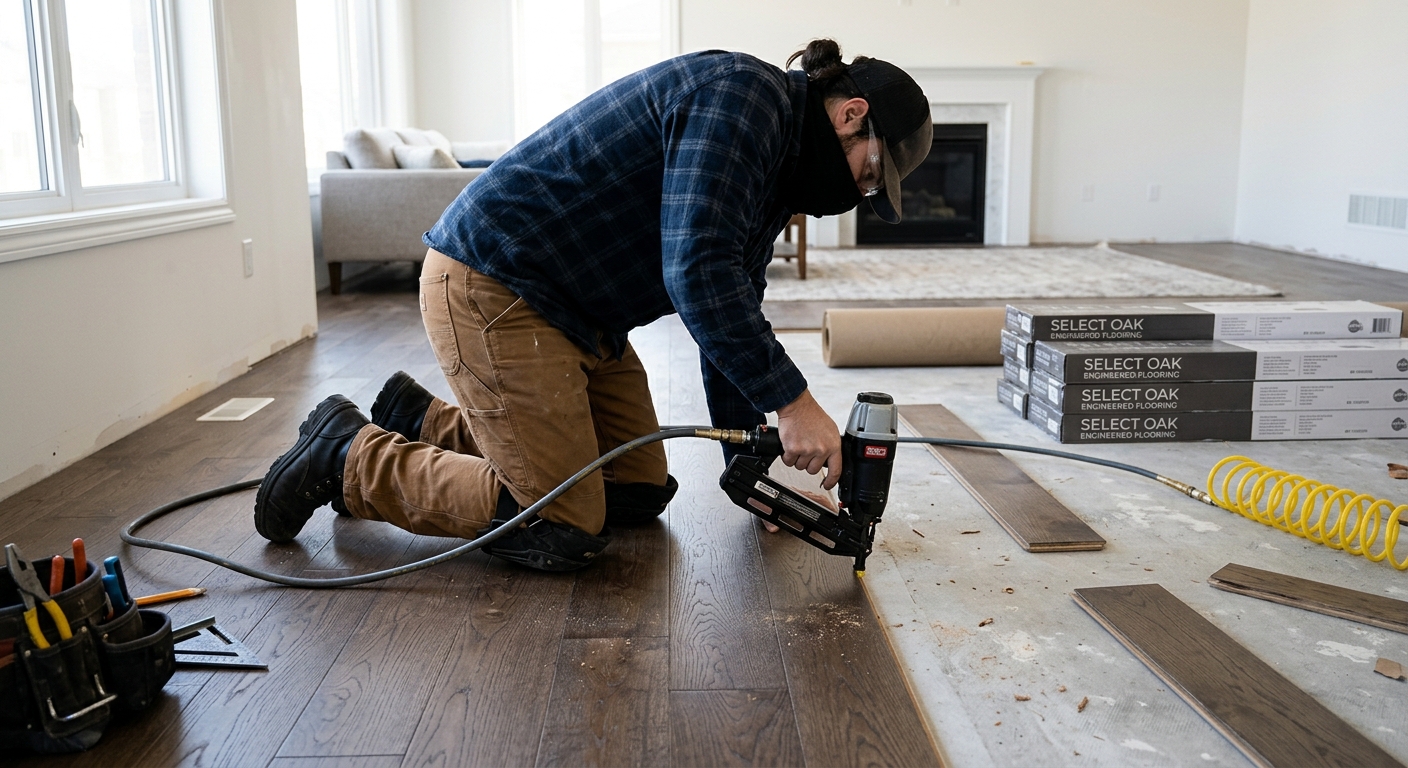
Flooring options and costs in Swan Hills
Swan Hills is a small community in northwest Alberta where flooring pricing depends as much on how the home “breathes” as it does on the product on top. With 64.3% of homes built before 1981, many projects start with an older subfloor and patchy flatness—levelling and repair are common before any new finish goes down. That extra prep is one reason why the same material can land in a very different installed range from one quote to the next. Homeowners also tend to value comfort, since winter can be long and indoor conditions swing between dry heating seasons and more humid shoulder periods.
In the Athabasca–Grande Prairie–Peace River region, contractors plan for seasonal humidity swings and the reality of basement moisture risk. That’s why, in practice, engineered wood and luxury vinyl plank (LVP) are usually chosen for main floors with large temperature changes and for below-grade rooms. Solid hardwood is typically kept to above-grade areas only, because it responds to moisture and can buckle or gap when conditions shift. Radiant heat compatibility matters too: in many newer homes (and renovations), underfloor heating is used for cold-weather comfort, which influences what materials can be installed safely.
You’ll also see extra demand around the core residential streets where families renovate older houses—people doing main-floor refreshes often book installs in late fall to get ahead of winter schedule pressure. From there, the clearest way to compare apples-to-apples is the installed cost ranges below.
| Type |
Best Room |
Moisture Resistance |
Lifespan |
Price per sq ft |
| Solid hardwood (nail-down, above grade only) |
Living / dining (above grade) |
Low to moderate (must stay dry) |
25–50 years |
$10–$20 |
| Engineered hardwood (float or glue, above + on-grade) |
Main floor, hallways |
Moderate to good |
20–40 years |
$9–$17 |
| Laminate (click-lock, above-grade) |
Bedrooms, living rooms (dry areas) |
Moderate (edges can fail if wet) |
10–25 years |
$4–$12 |
| Luxury vinyl plank / LVP (waterproof, any level) |
Kitchen, basements, main floor |
High (waterproof core) |
15–25 years |
$5–$14 |
| Porcelain / ceramic tile |
Bathrooms, entries, kitchens |
High (when set and grouted correctly) |
25–50 years |
$12–$25 |
| Carpet (broadloom or modular tile) |
Bedrooms, stairs (comfort) |
Low to moderate (avoid chronic moisture) |
7–15 years |
$3–$8 |
Prices are estimates only and vary by project scope, site access and material selection.
What affects the price of flooring in Swan Hills
In Swan Hills and across the Athabasca–Grande Prairie–Peace River region, it’s common to see the same “type” of flooring quote land 30–50% apart once you account for prep work, subfloor condition, and whether moisture mitigation is required. Even though the product may fit one of the standard Alberta price bands (for example, laminate/vinyl typically sits lower than hardwood and tile), the installed total swings because contractors in older housing stock often have to do more than just lay boards.
The technical drivers are straightforward. Indoor humidity swings matter because solid hardwood expands and contracts with moisture—so it’s a poor choice for basements and for slabs that show moisture. That’s why engineered hardwood and LVP are usually selected for below-grade or moisture-prone areas: they handle seasonal movement better. In colder Alberta homes, radiant heat compatibility is another cost-shaper; many installations require specific underlay and products rated for in-floor heat, which can push material pricing up compared with non-rated alternatives.
Older regional homes also frequently need subfloor levelling or repair before new flooring can be installed flat. In practical terms, that can add roughly $1–$4 per sq ft to the job, depending on how much plywood/OSB repair, patching, or re-fastening is needed. For example, a simple above-grade laminate install might stay near the $4–$12 per sq ft band if the subfloor is solid and level, while the same footprint upgraded to LVP may come closer to the $5–$14 per sq ft range once you include moisture-proof underlayment and more labour for longer planks in tighter corners.
Local scheduling and contractor availability also affect pricing. When crews are booked for winter-ready basements, main-floor jobs may be booked at different times—sometimes affecting mobilization costs and how quickly a contractor can allocate labour. Finally, removal and stairs can narrow or widen the price gap quickly in older houses.
| Price Factor |
Why It Matters |
Cost Impact |
| Room area in sq ft |
Material and labour scale directly with square footage |
Large projects lower per-sq-ft labour; small jobs cost more per sq ft |
| Subfloor condition |
Levelling/repair prevents bounce and gaps |
Typically adds about $1–$4 per sq ft in older homes |
| Moisture / below-grade install |
Solid hardwood performs poorly; needs dry conditions |
Rules out solid hardwood and often adds moisture mitigation steps (varies by product) |
| Material choice |
Solid vs engineered vs LVP vs tile changes both product and prep |
Hardwood and tile commonly sit in higher bands (up to $10–$20 for hardwood; $12–$25 for tile) |
| Removal and disposal of existing flooring |
Old flooring adds labour and landfill fees |
Can add a noticeable one-time cost, especially with tile/adhesive residue |
| Stair nosing / transitions |
Stairs and transitions require extra cuts and finishing |
Often charged per step or per linear foot; commonly increases total by hundreds |
| Radiant heat compatibility |
Not all underlay/products tolerate heat cycling |
Can increase material cost when an in-floor heat-rated product is required |
| Installation method |
Float, glue-down, or nail-down changes labour and subfloor prep |
Nail-down and glue-down usually require more precise subfloor prep than basic click-lock |
Permits & regulations in Alberta
In Alberta, installing new flooring on its own typically does not require a building permit. Most flooring work—such as removing old flooring, levelling a wood subfloor, installing LVP, laminate, carpet, or nailing/locking floors above grade—falls under standard renovation scope and is generally handled without permits.
Where permits can come into play is when flooring projects include associated work that touches building systems or requires trades. For example: (1) structural subfloor repair that changes framing (not just patching), (2) moisture remediation involving engineered drainage or significant vapour barrier systems over concrete, and (3) in-floor heating electrical circuits can require electrical permits depending on how the system is modified. In condominiums, even when no permit is required for the flooring itself, the corporation’s rules on sound transmission (STC/IIC) can restrict the underlay and sometimes require board approval before installation above grade.
For Swan Hills homeowners, the verification process should be step-by-step. First, ask for the contractor’s proof of Alberta licensing (as applicable to their trade) and confirm their name is correct on any invoice. Second, request a certificate of liability insurance showing you as the property owner if possible, and verify coverage limits. Third, ask for WSIB/WCB coverage evidence—insist on current clearance/coverage documentation. You can also request these documents by email before signing, and confirm clarity by checking the contractor’s business details through official online resources where available. Lastly, for condo units, request board approval in writing before installing hardwood or tile on floors where sound ratings apply.
Best flooring for each room in your Swan Hills home
Choosing flooring room-by-room is the fastest way to avoid expensive mistakes in Swan Hills. The Athabasca–Grande Prairie–Peace River climate brings cold winters and humidity swings, and a lot of homes here are older (with 64.3% built before 1981), so subfloor flatness and moisture sensitivity can vary widely between rooms. For living and dining areas, many homeowners choose engineered hardwood or a high-quality laminate: both deliver a warm feel while better tolerating typical seasonal movement than solid wood. If you want maximum underfoot comfort and quiet, engineered wood is the premium middle ground.
In master bedrooms, carpet is still a strong choice in Alberta because it improves warmth and reduces sound transfer, especially in older construction. In kitchens, go with LVP or large-format porcelain tile—they handle spills and easy cleaning. For basements (where below-grade moisture and vapour can be issues), the clear winner is LVP. Solid hardwood and many laminates are not a good match for basements because they can swell with moisture exposure and can fail at seams.
Bathrooms should be porcelain or ceramic tile only, with proper waterproofing and correct grout/system selection. Where your home has radiant heat, confirm the product and underlay are compatible; this increasingly shows up in Alberta renovations and new builds, and it can limit what you can install safely.
To put cost into perspective: in many projects, switching from laminate in a main-floor living area near the $4–$12 per sq ft band to engineered hardwood may add several dollars per square foot, but it can be justified if you want a longer lifespan (often 20–40 years) and better performance against humidity swings.
| Room |
Best Material |
Why |
Moisture Risk |
Price Band per sq ft |
| Living / dining room |
Engineered hardwood |
Warm look with better seasonal movement tolerance |
Low to moderate (depends on humidity control) |
$9–$17 |
| Master bedroom |
Carpet or engineered hardwood |
Comfort in winter; quiet and cosy feel |
Low (avoid spills and chronic humidity) |
$3–$17 |
| Secondary bedrooms |
Luxury vinyl plank (LVP) |
Durable for kids/pets and easier to maintain |
Low to moderate |
$5–$14 |
| Kitchen |
LVP or porcelain tile |
Spill-friendly and straightforward daily cleaning |
Moderate (wet zones and sink leaks possible) |
$5–$25 |
| Basement (finished) |
LVP (waterproof) |
Handles below-grade moisture risk better than wood |
Moderate to high (vapour and dampness can occur) |
$6–$14 |
| Bathroom |
Porcelain / ceramic tile |
Water-resistant when installed with proper system |
High |
$12–$25 |
How to choose a flooring contractor in Swan Hills
Picking the right contractor is what turns a “good deal” into a floor that looks right and performs for years—especially in Swan Hills, where older homes and moisture sensitivity can add hidden labour. Start with Alberta compliance. Ask for liability insurance (request the certificate and check the effective dates) and proof of WSIB/WCB coverage—you want current documentation, not “we’re covered” statements. If your project involves associated trades (like electrical work for radiant systems), confirm the electrician is licensed and insured for that scope as well. For licensing and registration details, request their business information and confirm accuracy, then verify through official online sources where applicable.
Next, get 2–3 itemised written quotes rather than a single lump sum. You want labour and materials broken out: flooring product, underlay/vapour control, levelling/repairs, transitions, stair labour, and disposal. Read the scope carefully for what’s excluded—common exclusions are moving heavy appliances, patching drywall, dealing with asbestos-containing materials, and any subfloor reconstruction if rot is found after removal. Also confirm whether permits are included (if any are required for associated work) and whether disposal is included or billed separately.
Warranty matters in Alberta winters and humidity swings. Ask for the workmanship warranty length (how long they stand behind installation), the manufacturer warranty terms, and whether warranties are transferable if you sell the home. For payment, avoid large deposits; a safe rule is never more than 10–15% upfront, and hold back until the job is complete and snagged. Finally, insist on a written timeline with a start date and completion estimate.
- Provides proof of liability insurance and WSIB/WCB coverage before starting.
- Itemises labour vs materials (and doesn’t hide levelling or transitions in “misc.”).
- Shows product spec sheets including wear layer (for LVP), AC rating (for laminate), and radiant compatibility.
- Confirms subfloor moisture/flatness approach and how they handle uneven or weakened boards.
- Includes underlay/vapour barrier details by floor type (especially for basements).
- Specifies stair nosing materials and costs per step or per linear foot.
- States removal and disposal terms clearly (what gets hauled away, what stays).
- Lists transition trims and whether new moulding is included or reused.
- Provides a workmanship warranty in writing and a clear definition of coverage.
- Offers an installation schedule in writing, including where they start and how they stage work.
- Does not pressure you with large upfront payments or “cash discount only” tactics.
- Addresses radiant heat requirements in the quote (rated products and correct underlay).
Red flags to watch for in Swan Hills: (1) they can’t explain why engineered wood or LVP is recommended over solid hardwood for basements, (2) they quote a cheap install without discussing subfloor levelling/repair, (3) they won’t provide insurance/WSIB/WCB documentation, (4) no written scope or warranty details, and (5) they dismiss moisture/vapour control as “not important” in below-grade areas.
Frequently asked questions — flooring in Swan Hills
How much does flooring cost in Swan Hills?
In Swan Hills, installed flooring cost usually lines up with Alberta’s typical price bands, but your final number depends heavily on subfloor prep and moisture mitigation. For example, laminate or vinyl plank often comes in around $4–$12 per sq ft, while LVP waterproof options commonly land nearer $5–$14 per sq ft once you include proper underlayment and labour. Hardwood and tile are higher: solid hardwood typically follows the $10–$20 per sq ft band, and porcelain/ceramic often sits in $12–$25 per sq ft. With older housing stock (64.3% built before 1981), levelling or repair can add roughly $1–$4 per sq ft, which is why two quotes for the same square footage may differ noticeably. (Statistics Canada, 2021 Census)
Hardwood vs laminate vs vinyl plank — which is best?
“Best” depends on moisture risk and the room’s function. Solid hardwood is beautiful, but in Alberta (including Swan Hills) it should generally be kept to above-grade, stable-dry areas because it expands and contracts with humidity. Laminate is cost-effective (often in the $4–$12 per sq ft band), but it’s more vulnerable if water gets into seams or if the subfloor is damp. Vinyl plank—especially quality LVP with a waterproof core—is usually the most forgiving choice for variable indoor conditions and for basements, often fitting the $5–$14 per sq ft range. If you want a wood look with better stability, engineered hardwood is a strong compromise for main floors. For any choice, the biggest success factor is the condition and flatness of the subfloor before install.
What flooring is best for a Swan Hills basement?
For Swan Hills basements, LVP is typically the best practical choice because it’s waterproof and can handle the reality of below-grade vapour and occasional dampness. Solid hardwood and most laminate products can struggle when moisture exposure happens, and that can show up as edge swelling, gapping, or premature failure. A finished basement also benefits from proper vapour control and a well-prepared subfloor—especially important in homes built before 1981, where subfloor condition can vary. Budget-wise, basement LVP projects often land within the local LVP range of about $6–$14 per sq ft depending on labour complexity, levelling needs, and transitions. If you’re adding a bathroom in the basement, tile becomes the safer system. (Statistics Canada, 2021 Census)
Can I install hardwood over concrete?
You can sometimes install engineered hardwood over concrete, but solid hardwood is the more problematic option. In Swan Hills, concrete floors can be affected by moisture vapour, and solid nail-down hardwood needs consistently dry conditions because it can swell or cup if moisture is present. Engineered hardwood is often preferred because it tolerates humidity changes better and can be installed with the right glue-down system (or approved floating method depending on product). Before any hardwood goes down over concrete, contractors typically address flatness and may use a vapour barrier strategy. If you’re considering solid hardwood, treat it as an above-grade-only choice unless your contractor confirms the slab’s moisture conditions and the installation method matches the manufacturer requirements.
How long does flooring installation take?
Timelines vary by square footage, room layout, and how much prep is required. For a typical main-floor install, a crew might complete installation in a few working days, but older Swan Hills homes often require additional time for subfloor levelling or repair after the old flooring is removed. If there are stairs and transitions, add time for precise cutting and finishing. Basement work can take longer because moisture control details and careful underlayment placement matter. Also note that product acclimation time may be recommended by manufacturers for LVP and wood products. For a realistic expectation, ask your contractor for a written start date and completion estimate that includes removal/disposal, subfloor prep, installation, and trim/transition finishing—so you don’t end up waiting on “extra days” that weren’t included in the scope.
What flooring works with radiant heat?
Radiant heat compatibility is essential in cold Alberta homes, and it can limit your flooring options. In general, you’ll want products specifically rated for in-floor heating and installed using the manufacturer’s approved underlay (for click-lock systems) or the correct setting method (for tile). Many solid hardwood installations are restricted because wood movement can be sensitive to heat cycling; engineered hardwood and many laminates may be allowed only if the product is rated and the installation meets temperature/humidity requirements. LVP can work well when it’s explicitly approved for radiant heat and installed with the correct underlayment. The best approach in Swan Hills is to tell your contractor exactly what radiant system you have and request written confirmation in the quote that the selected product is rated for it. That avoids warping, gapping, or warranty problems.