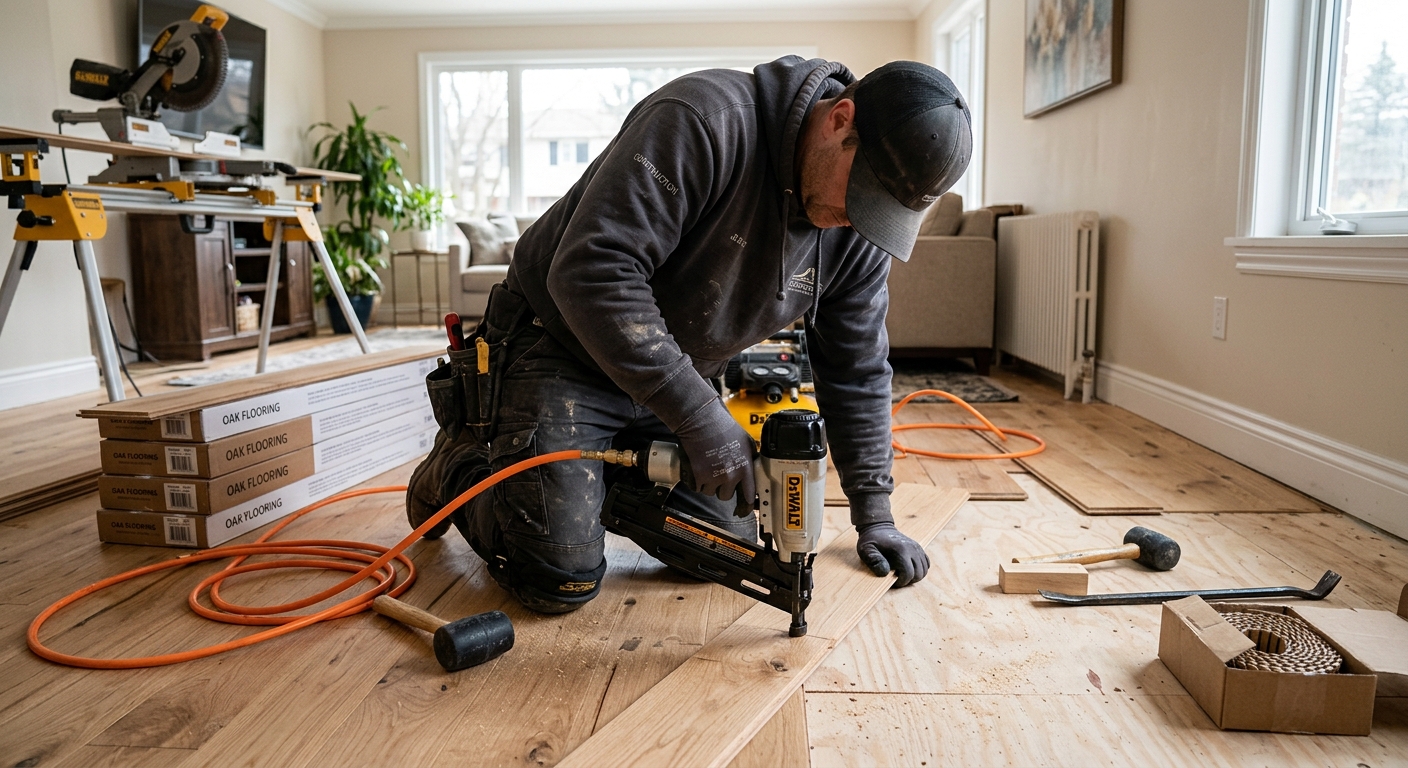
Flooring options and costs in Wembley
In Wembley, Alberta, the right flooring choice depends as much on comfort and moisture control as it does on looks. With 46.4% of homes built before 1981 (Statistics Canada, 2021 Census), many renovations start with a reality check: older subfloors often need levelling or repair before new flooring can go down. That prep work can add noticeable labour, especially if an OSB overlay, patching, or fastener repairs are required. Homeowner households make up 84.5% of households (Statistics Canada, 2021 Census), which is why long-wear products and dependable installation methods tend to be the priority.
In the Athabasca–Grande Prairie–Peace River region, seasonal humidity swings and cold snaps push homeowners toward materials that tolerate movement. That typically increases the popularity of engineered hardwood and luxury vinyl plank (LVP), particularly for main floors where moisture can creep in near entryways and basements. Contractors also tend to be busy around “turnover season” when people finish basements or refresh older home interiors—so pricing can swing based on availability, crew scheduling, and how much subfloor work is found once the old flooring is removed. If you’re in the process of updating older housing stock near the busy core of town, it’s common to hear about added costs for flattening uneven joists and preparing for underfloor heat compatibility.
Below are realistic installed price ranges for Wembley, Alberta, to help you compare options before you request quotes.
| Type |
Best Room |
Moisture Resistance |
Lifespan |
Price per sq ft |
| Solid hardwood (nail-down, above grade only) |
Main floors (above grade) |
Low (sensitive to humidity; not for basements) |
25–50 years with correct conditions |
$10 – $20 |
| Engineered hardwood (float or glue, above + on-grade) |
Living areas, bedrooms |
Medium to high (handles humidity better) |
20–40 years |
$9 – $18 |
| Laminate (click-lock, above-grade) |
Bedrooms, living rooms |
Medium (water-resistant core; needs careful sealing) |
10–25 years |
$4 – $12 |
| Luxury vinyl plank / LVP (waterproof, any level) |
Main floor, hallways, basements |
High (waterproof core; best for moisture variability) |
15–25 years |
$6 – $14 |
| Porcelain / ceramic tile |
Kitchen, bathrooms, foyers |
High (excellent against spills) |
25–50 years |
$12 – $25 |
| Carpet (broadloom or modular tile) |
Bedrooms, stairs |
Low to medium (avoid in very damp zones) |
8–15 years |
$3 – $8 |
Prices are estimates only and vary by project scope, site access and material selection.
What affects the price of flooring in Wembley
In Wembley and across the Athabasca–Grande Prairie–Peace River region, you can see the same flooring “type” quoted 30–50% apart because the hidden work isn’t identical—especially with older homes. Differences show up in subfloor flattening, moisture mitigation, labour scheduling, stair complexity, and removal/disposal. Even when the material line item looks similar (for example, LVP vs. laminate), the installation method and preparation often determine whether you’re at the low end of the range or the high end.
Technically, indoor humidity swings are one of the biggest cost drivers in this region. Solid hardwood expands and contracts with humidity, and it cannot be glued or floated over concrete; it also performs poorly in basements where moisture vapour is more likely. For that reason, many Wembley projects shift toward engineered hardwood or waterproof LVP, which better tolerate movement and below-grade conditions. If your home has radiant heat (common in colder Alberta homes), that can also narrow material choices and influence underlayment and install method.
Older housing stock built before 1981 often means uneven or weakened subfloors. When we correct those issues—level patches, fastener upgrades, or OSB overlay—the cost can rise by roughly $1–$4 per sq ft, depending on how extensive the repair is. For example, choosing tile in wet-prone areas may cost more upfront (often aligning with the $12–$25 per sq ft band), but it can be justified when you want fewer call-backs for water damage. Meanwhile, LVP frequently comes in lower than tile and can still deliver long service life when moisture is a concern.
| Price Factor |
Why It Matters |
Cost Impact |
| Room area in sq ft |
More square footage increases both materials and labour hours. |
Direct driver; larger jobs often reduce per-sq-ft labour slightly. |
| Subfloor condition — levelling or repair needed before install |
Worn OSB/plywood, dips, and squeaks require prep to prevent failure. |
Often adds $1–$4 per sq ft in older Wembley homes. |
| Moisture / below-grade install — rules out solid hardwood |
Basements and ground-contact areas need waterproof tolerance. |
May shift you to LVP (higher prep efficiency) vs. redesigning material. |
| Material choice — solid vs. engineered vs. LVP vs. tile |
Different materials carry different base costs and install requirements. |
Can swing the installed total substantially (e.g., tile vs. LVP). |
| Removal and disposal of existing flooring |
Glue-down products, underlay, and old debris add labour and dump fees. |
Common hidden add-on; increases when there’s lots of adhesive. |
| Stair nosing / transitions — charged per step or per linear foot |
Stairs need mouldings, edging, and careful finishing. |
Upcharges are typical; transitions often add up quickly. |
| Radiant heat compatibility — limits material options |
Heat can affect dimensional stability and underlayment performance. |
May require specific underlay and acclimation procedures. |
| Installation method — float vs. glue-down vs. nail-down |
Prep level, adhesives, and tolerances differ by method. |
Nail-down and glue-down typically cost more than basic floating. |
Permits & regulations in Alberta
In Alberta, installing new flooring by itself typically does not require a building permit. That said, associated work can change the permitting picture. If your project includes electrical components—such as modifying or adding in-floor heating circuits, or altering wiring—an electrical permit may be required under Alberta’s electrical rules. Similarly, structural or subfloor changes that go beyond simple patching (for example, major framing repairs) may trigger additional approvals depending on scope. For most straightforward installs (LVP, laminate, engineered hardwood, tile set on approved substrates), homeowners generally proceed without a permit.
In condominiums (if applicable in your Wembley area), the building or unit corporation often regulates sound transmission and underlay selection. For hard surface floors, underlayment can be required to meet specific sound performance targets (often discussed in STC/IIC terms). The practical step is to review the condo declaration and request board approval in writing before installing hardwood or tile on upper floors, even if you’re only changing materials.
To verify your contractor in Wembley, I recommend a simple checklist: (1) confirm the licence/registration listed for the company where applicable (and any trade designations they claim), (2) request a certificate of liability insurance before work starts, (3) ensure they have WSIB/WCB coverage where required for their workers, and (4) ask for a clearance letter or proof of coverage documentation. A reputable flooring contractor should provide these documents quickly and clearly—before you sign or pay deposits.
Best flooring for each room in your Wembley home
For Wembley homes, the best flooring is the one that matches each room’s moisture exposure, traffic, and comfort needs—while still handling Alberta’s temperature and humidity swings. In living and dining areas, engineered hardwood or high-quality laminate usually hits the sweet spot: you get warmth and a “wood look” without the same humidity sensitivity as solid hardwood. In bedrooms, carpet is often the most comfortable option in winter because it keeps floors warmer and muffles sound; engineered hardwood is also a solid choice if you prefer easier maintenance.
Kitchens deserve a tougher material. Luxury vinyl plank (LVP) with a waterproof core is commonly the practical winner in this region because spills and wet boots happen, and waterproof construction helps reduce edge-swelling risk. If you want a more “forever” finish and you’re okay with colder underfoot temps, large-format porcelain tile is another top performer—just plan for grout maintenance and consider radiant-compatible underlayment if you have in-floor heat. For basements (finished), LVP is usually the clear winner: it tolerates moisture vapour and below-grade conditions far better than solid wood and most laminate. Bathrooms should be porcelain or ceramic tile only, since these surfaces are designed for recurring water exposure.
Where radiant heat is present, ask your installer about radiant-compatible flooring systems. Many solid hardwoods are limited with underfloor heat, while engineered products and the right underlayment choices can be more suitable. In terms of pricing, it’s normal for tile to cost more—often aligning with the $12–$25 per sq ft band—yet LVP may still win for basements because you reduce moisture-related risk without matching tile-level pricing (often closer to $6–$14 per sq ft installed, depending on product and prep).
| Room |
Best Material |
Why |
Moisture Risk |
Price Band per sq ft |
| Living / dining room |
Engineered hardwood |
Warm, attractive, and more forgiving than solid hardwood during humidity changes. |
Low (unless near exterior doors or damp crawl/entry zones) |
$9 – $18 |
| Master bedroom |
Carpet or engineered hardwood |
Carpet adds comfort and sound control; engineered hardwood offers easier cleaning. |
Low |
$3 – $14 |
| Secondary bedrooms |
Laminate (or carpet for comfort) |
Laminate is durable for daily use; carpet is warmer for kids’ rooms and winter mornings. |
Low |
$4 – $12 |
| Kitchen |
Luxury vinyl plank (LVP) or porcelain tile |
LVP handles everyday spills well; tile is highly durable and water resistant. |
Medium to high (spills and wet cleaning) |
$6 – $25 |
| Basement (finished) |
Luxury vinyl plank (waterproof) |
Best fit for moisture vapour tolerance and below-grade stability. |
High |
$6 – $14 |
| Bathroom |
Porcelain / ceramic tile |
Tile is designed for wet environments and withstands cleaning products. |
High |
$12 – $25 |
How to choose a flooring contractor in Wembley
Choosing a flooring contractor in Wembley is mostly about verifying workmanship risk and protecting yourself from job delays or scope surprises. Start with credentials: ask whether the company has the required WSIB/WCB coverage for its workers, and request proof (often a clearance letter or current coverage document). For liability, ask for a certificate of insurance that shows the contractor is covered to work at your address. If the contractor advertises licensing or trade-related registrations, ask for the exact details and confirm what the listing covers.
Next, get 2–3 itemised written quotes—not a single lump-sum. You want labour and materials broken out so you can compare the same underlay, the same prep level, and the same installation method. Read the scope line-by-line: what’s included for subfloor levelling, moisture mitigation, stair nosing, transitions, and trim? Confirm whether old floor removal and disposal are included, and whether the quote covers levelling materials or only “basic patching.” Ask for the warranty details in writing: workmanship warranty length and what’s covered, plus the manufacturer product warranty terms (and whether the warranty is transferable).
For payment, don’t do large upfront transfers. A practical rule is never more than about 10–15% upfront; use a holdback until the job is complete and the final walkthrough is done. Also demand a start date and completion timeline in writing. In small markets like Wembley, scheduling matters—real timelines prevent the “materials arrive later, job stalls” issue.
- Request proof of WSIB/WCB coverage and liability insurance before signing.
- Confirm the address coverage on the insurance certificate (not just a generic COI).
- Ask for an itemised quote with labour, materials, and disposal clearly separated.
- Verify what’s included for subfloor levelling (and the expected prep standard).
- Confirm moisture mitigation steps if the basement has historical dampness.
- Check whether stairs and transitions are priced per step or per linear foot.
- Ask for underlay details for laminate and any required radiant-compatible systems.
- Get confirmation of acclimation timeframes for engineered wood and LVP/Laminate.
- Confirm waste removal and dump fees are included (or stated as an extra).
- Review warranty: workmanship coverage length and product warranty conditions.
- Set payment terms with a small deposit and a holdback until completion.
- Obtain start date and completion estimate in writing.
Red flags I see too often in Wembley: quotes that skip subfloor prep details, installers who won’t show insurance/coverage documents, a “no warranty” or unclear warranty statement, change orders that aren’t explained before extra work happens, and payment requests that exceed roughly 10–15% upfront.
Frequently asked questions — flooring in Wembley
What flooring holds up best to pets in a Wembley home?
For most Wembley households with pets, luxury vinyl plank (LVP) is the easiest “set it and forget it” option. Waterproof cores resist everyday accidents better than laminate, and they’re typically warmer underfoot than tile in winter. If you’re comparing costs, LVP commonly lands around the mid range of the local bands (often close to $6 – $14 per sq ft installed), which can be a practical balance versus tile. For hardwood, engineered hardwood can work if humidity is controlled, but I still prefer LVP in active pet areas, especially near entryways where wet paws and snowy tracking are common. Whichever product you choose, ask your installer about proper base prep and transitions—small gaps can trap moisture and cause issues over time.
How do I fix squeaky floors in my Wembley home?
Squeaks usually point to movement between subfloor layers or between joists and decking—not the finished flooring. In Wembley’s older housing stock (46.4% built before 1981), squeaks are often amplified when the subfloor has loosened fasteners or the plywood/OSB has started to wear. The best fix is to address the source: tighten screws where appropriate, assess joist spacing, and level or patch the deck so the new flooring stays solid. If you’re planning new floors anyway, ask whether the contractor will include subfloor inspection and repair as part of prep. A solid plan helps prevent a new floor from “locking in” squeaks, which can be very difficult to fix after install.
What is luxury vinyl plank and is it worth it in Wembley?
Luxury vinyl plank (LVP) is a vinyl flooring system with a layered construction and, in waterproof lines, a core designed to resist moisture from spills and damp conditions. In Wembley and the Athabasca–Grande Prairie–Peace River region, LVP is often worth it because basements and seasonal humidity swings can challenge solid hardwood and many laminate installations. LVP also tends to install faster than tile, which helps keep labour predictable when crews are scheduling multiple projects. In price terms, LVP commonly falls within the region’s typical installed range for vinyl plank (often around $6 – $14 per sq ft, depending on brand and prep). If your home has a history of basement moisture or you want a lower-risk option for daily life, LVP is usually a strong value.
How much does flooring cost in Wembley?
Installed flooring costs in Wembley depend on the material, room size, subfloor prep, and how much removal and transitions are required. As a starting point, local installed bands are typically widest on hardwood and tile, and lower on laminate/vinyl and carpet because of install speed and product availability. For example, tile often lands around $12 – $25 per sq ft installed, while LVP usually sits around $6 – $14 per sq ft for typical residential projects. Carpet installation is commonly in the $3 – $8 per sq ft range. The biggest variable is prep: if older subfloors need levelling or repair, that work can move you toward the high end of the range. Always compare itemised quotes so the prep scope is truly apples-to-apples.
Hardwood vs laminate vs vinyl plank — which is best?
“Best” depends on where the flooring is going and how your home handles moisture. In Wembley, solid hardwood is best kept to above-grade areas because it expands and contracts with indoor humidity and performs poorly in basements. Engineered hardwood is usually the compromise if you want a wood look with better tolerance for humidity swings. Laminate can be a budget-friendly choice (often within the $4 – $12 per sq ft installed range), but it’s still more sensitive to standing water and edge seepage than waterproof vinyl. Vinyl plank (especially waterproof LVP) is often the most forgiving option for busy households, basements, and moisture-variable zones. If you have radiant heat, ask about radiant compatibility for your chosen flooring and underlay.
What flooring is best for a Wembley basement?
For most Wembley basements, waterproof luxury vinyl plank (LVP) is the top recommendation. Basements can experience moisture vapour and cold-weather temperature swings, and LVP’s waterproof construction helps reduce swelling risk around seams and edges. Solid hardwood is generally a poor fit for below-grade conditions, and many laminate products are also not the best choice when moisture is a concern. If you’re planning a finished basement, the key is not just the product—it’s the prep. Ask contractors about subfloor condition, vapour management steps if needed, and whether the installation method is appropriate for the substrate. Cost-wise, LVP often comes in around the $6 – $14 per sq ft band, and that can be a smarter total investment than options that are more likely to fail if moisture conditions shift.