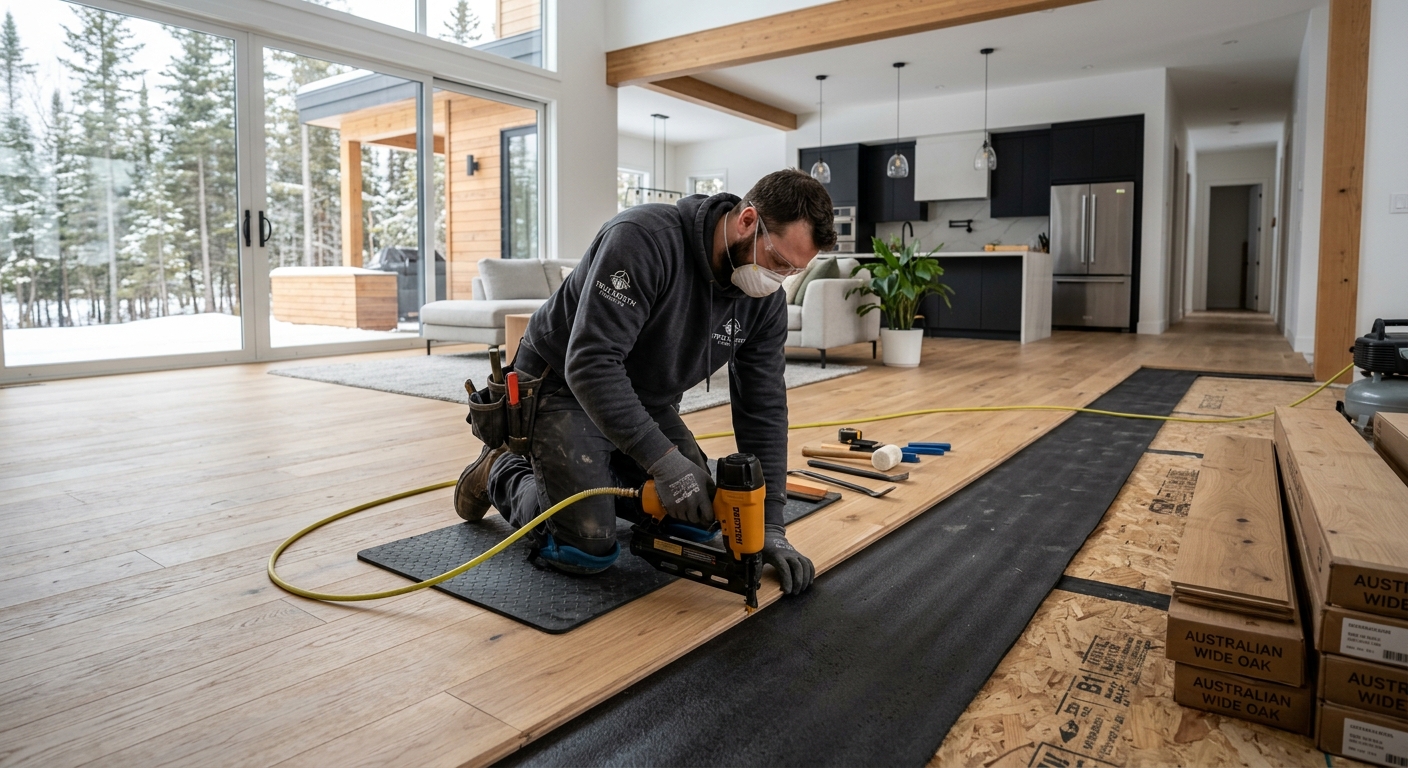
Flooring options and costs in Devon
Devon homeowners typically face flooring decisions shaped by local housing stock and Edmonton-area climate swings. With 46.6% of homes built before 1981, many basements and main floors begin with uneven subfloors or older underlayment layers, which often means levelling, patching, or an OSB/plywood overlay before the finished floor goes down. That prep work commonly adds roughly $1.50–$4.00 per sq ft, and it’s one of the biggest “hidden” reasons two quotes for the same square footage can differ. In Devon (population 6,545), trades are busy in the Edmonton economic region, and that demand can affect lead times—especially during spring/summer when most homeowners aim to finish before winter humidity returns.
Technically, the Edmonton region regularly sees indoor humidity swings and basement moisture pressure. Solid hardwood is sensitive to those changes: it expands and contracts with humidity and it generally shouldn’t be installed below grade or directly over concrete slabs. That’s why engineered hardwood and luxury vinyl plank (LVP) are the most common choices in Devon. If your home has in-floor heating, you’ll also find radiant-compatible materials reduce risk of product damage, and many LVP and engineered options are designed to tolerate that application when installed to spec.
In Devon, we often see the highest demand for basement-ready flooring in established areas close to schools and busier service corridors—where families renovate before winter. From there, the best next step is comparing typical product price ranges so you can budget accurately in your kitchen, living spaces, and basement.
| Type |
Best Room |
Moisture Resistance |
Lifespan |
Price per sq ft |
| Solid hardwood (nail-down, above grade only) |
Living / dining, hallways (not basements) |
Low to moderate (sensitive to humidity) |
25–50 years |
$10 – $25 |
| Engineered hardwood (float or glue, above + on-grade) |
Living areas, bedrooms, some main-floor hallways |
Moderate to good (handles humidity better) |
20–40 years |
$9 – $22 |
| Laminate (click-lock, above-grade) |
Living rooms, bedrooms (dry zones) |
Moderate (not ideal for below grade) |
10–25 years |
$4 – $8 |
| Luxury vinyl plank / LVP (waterproof, any level) |
Kitchen, main floor, basement, rec rooms |
High (waterproof core options) |
10–25 years |
$5 – $13 |
| Porcelain / ceramic tile |
Kitchen, bathroom, entries |
Very high (with proper grout/seal) |
25–50+ years |
$5 – $15 |
| Carpet (broadloom or modular tile) |
Bedrooms, stairs (comfort) |
Low to moderate (needs dry conditions) |
7–15 years |
$4 – $10 |
Prices are estimates only and vary by project scope, site access and material selection.
What affects the price of flooring in Devon
In Devon, you’ll often see total flooring renovation budgets swing by 30–50% for the “same” room simply because subfloor prep, moisture risk, and installation method change what’s required on-site. Even when two contractors quote the same square footage, their numbers can differ based on how they handle existing floor removal, how much levelling is needed, and whether the material selection is truly suitable for below-grade conditions. Edmonton-area supply and scheduling also matters—labour availability and seasonal demand can affect how quickly a crew can mobilize, which influences the overall labour component.
The key technical cost drivers in this region are humidity swings and below-grade moisture. Solid hardwood expands and contracts with indoor humidity and performs poorly in basements; it generally shouldn’t be installed over concrete slabs. Engineered hardwood and LVP are better suited because layered construction and stable cores tolerate seasonal movement and minor slab moisture variations when installed to manufacturer requirements. In colder stretches, radiant heat compatibility also becomes important: it limits which materials you can use over hydronic or electric systems, and that can steer you toward LVP, many engineered hardwood lines, or tile.
Concrete Devon examples: (1) An older home built before 1981 often needs patching and levelling—at roughly $1.50–$4.00 per sq ft—before an engineered plank or click-lock product can sit flat without noise or gapping. (2) If you’re converting a basement suite into a finished rec room, waterproof LVP might cost more per sq ft than basic laminate, but it can avoid moisture-related callbacks that cause early replacement. As a baseline, homeowners commonly budget in the $4–$8/sq ft range for laminate/vinyl plank material tiers, while hardwood-style options often land in the $10–$25/sq ft band depending on species and thickness.
| Price Factor |
Why It Matters |
Cost Impact |
| Room area in sq ft |
Materials scale directly, and labour time increases with coverage and layout complexity |
Major (base of every quote) |
| Subfloor condition — levelling or repair needed before install |
Uneven concrete/wood causes lippage, hollow spots, and premature wear |
Often +$1.50–$4.00/sq ft for prep in older homes |
| Moisture / below-grade install — rules out solid hardwood |
Basements and below grade need waterproof or engineered solutions and correct vapour strategies |
Can shift the project from $10–$25/sq ft hardwood to $5–$13/sq ft LVP or higher tile specs |
| Material choice — solid vs. engineered vs. LVP vs. tile |
Different products have different installation requirements and warranty expectations |
Moderate to major (material bands drive most of the variance) |
| Removal and disposal of existing flooring |
Underlay, staples, glue residue, and haul-away time affect labour |
Moderate (can add several hundred to over a thousand depending on type) |
| Stair nosing / transitions — charged per step or per linear foot |
Stairs and doorways require special trims and accurate spacing |
Moderate (easy to underestimate during budgeting) |
| Radiant heat compatibility — limits material options |
Not all floors tolerate heat cycling and temperature restrictions |
Moderate (may increase material selection cost) |
| Installation method — float vs. glue-down vs. nail-down |
Prep level, adhesives, and labour intensity vary |
Moderate (glue-down and tile are typically more labour-intensive) |
Permits & regulations in Alberta
In Alberta, installing new flooring itself typically does not require a building permit. That said, certain related work can trigger permitting or code requirements. For example, if your project includes electrical modifications for in-floor heating (new thermostat wiring, changes to circuits, or adjustments that connect to electrical components), that may require an electrical permit and work by a qualified electrician. If there are structural subfloor repairs—like joist replacements, significant framing changes, or remediation work that changes load paths—those situations can also require additional approvals depending on scope. In condominiums, the building’s corporation often has specific rules around sound transmission, underlay, and installation practices for hard surface floors.
Here’s how a Devon homeowner can verify a contractor before signing:
- Check the contractor licence status through the Alberta consumer/licensing registry listings (use their legal business name).
- Request a current Certificate of Insurance showing liability coverage.
- Confirm WSIB/WCB coverage if the contractor indicates they use employees/subcontract labour covered under provincial workplace rules.
- Ask for proof of clearance/standing documents when applicable (they should be able to provide it).
- Verify their warranty policy in writing, including what is covered and timelines for callbacks.
For condos, review the declaration and ask for board approval in writing—especially if you’re planning hardwood or tile on upper floors, where impact noise can become a dispute without the correct underlayment and installation method.
Best flooring for each room in your Devon home
Choosing flooring in Devon is mostly about matching the product to moisture exposure, traffic, and how your home handles winter indoor humidity and basement vapour. Living and dining areas usually benefit from engineered hardwood or a high-quality laminate: both provide a warm look without the same humidity sensitivity as solid hardwood. In a colder Alberta climate, bedrooms can also go carpet for comfort and sound control, while engineered plank remains a strong choice if you prefer the cleaner look and you maintain indoor humidity.
In kitchens, waterproofing and ease of cleaning matter. LVP is a practical go-to because it resists spills and handles minor moisture better than laminate, and it installs faster than many tile jobs. For bathrooms, porcelain or ceramic tile is the most reliable option because it tolerates wet conditions and daily cleaning—just ensure proper installation and grout management. Basements are where Edmonton-area conditions really separate products: finished basements routinely have more humidity pressure, so LVP is the clear winner. Solid hardwood and most laminate typically struggle here because they’re not designed for below-grade moisture behaviour.
Radiant heat compatibility is increasingly common in Alberta homes. When a room sits over hydronic or electric heating, it usually nudges you toward tile, most LVP options that explicitly allow radiant systems, or engineered hardwood models within their temperature limits. As a cost example, a project might pair laminate at the $4–$8/sq ft tier with engineered at roughly $9–$22/sq ft. If the main difference is that laminate is above-grade only, moving to engineered can be justified when you want better dimensional stability across a connected layout and fewer issues when humidity shifts.
| Room |
Best Material |
Why |
Moisture Risk |
Price Band per sq ft |
| Living / dining room |
Engineered hardwood |
Warm look with better humidity tolerance than solid; good for long use |
Low to moderate (manage indoor humidity) |
$9 – $22 |
| Master bedroom |
Carpet or engineered hardwood |
Carpet improves comfort and sound; engineered keeps a clean, durable finish |
Low |
$4 – $14 |
| Secondary bedrooms |
Luxury vinyl plank (LVP) |
Comfortable underfoot, easy cleanup, and forgiving for family life |
Low |
$5 – $13 |
| Kitchen |
Luxury vinyl plank (LVP) or large-format porcelain tile |
Water resistance and simple maintenance for spills and frequent traffic |
Moderate (spills) |
$5 – $15 |
| Basement (finished) |
Luxury vinyl plank (waterproof) |
Built for humidity swings and below-grade conditions; reduces callbacks |
High (vapour and minor moisture pressure) |
$5 – $13 |
| Bathroom |
Porcelain / ceramic tile |
Best wet-area performance and long-term durability when installed correctly |
High |
$5 – $15 |
How to choose a flooring contractor in Devon
When you’re hiring a Devon flooring contractor, start with verification and paperwork—because the quality gap shows up most in prep, moisture handling, and warranty follow-through. In Alberta, confirm your contractor’s business licensing status and ask for a current Certificate of Insurance (liability coverage). If they use employees or subcontractors, you should also request proof of WSIB/WCB coverage or standing documents, depending on their structure and labour model. Never assume: a reputable installer can provide these details quickly.
Then request 2–3 written, itemised quotes—labour and materials separated, not a lump sum. The scope should spell out removal and disposal, subfloor assessment (and whether levelling/patching is included), underlay/vapour strategies for your basement conditions, transition details at doorways and stair steps, and whether permits (if any) are included—particularly if the job involves any electrical or in-floor heating work that could require a permit. Look for warranty terms: workmanship warranty length, product/manufacturer warranty coverage, and whether warranties transfer to you if you sell your home.
For payment scheduling, keep upfront deposits modest—typically no more than 10%–15%—and hold back funds until the work is complete and you’ve done your final walkthrough. Get a start date and a realistic completion estimate in writing; in Devon, winter readiness matters, so timelines should align with drying/curing requirements for any patching or adhesives.
- Ask for licence/business number and verify the legal entity on the quote matches insurance.
- Request a current Certificate of Insurance and confirm it covers flooring installation activities.
- Verify WSIB/WCB clearance/coverage documents for employees/subcontract work.
- Get 2–3 itemised quotes with labour broken out separately from materials.
- Confirm removal and disposal is included (old carpet, underlay, staples, glue).
- Require a subfloor prep description: levelness targets, patching, and underlayment type.
- For basements, ensure the quote addresses moisture vapour strategy and waterproof products.
- Ask how transitions and stair nosing are priced (per step vs per linear foot).
- Check if the quote includes trimming around vents, posts, and door jamb undercuts.
- Confirm manufacturer names, model numbers, and warranty terms for the exact product.
- Review payment schedule: no large upfront payment; define holdback conditions.
- Get the work schedule in writing, including cure/installation sequencing requirements.
In Devon, red flags I see with lesser-quality crews include: quotes that don’t mention subfloor condition or moisture strategy, unusually low pricing that omits levelling/underlay, vague warranty language (no workmanship duration), requests for large deposits (well over 15%), and missing proof of insurance or WSIB/WCB coverage when they claim to be a “fully insured” company.
Frequently asked questions — flooring in Devon
Engineered vs solid hardwood — what's the difference?
Solid hardwood is a single piece of wood installed nail-down on approved subfloors, and in Alberta it should generally stay above grade. It responds more noticeably to indoor humidity changes, which is a real factor in Devon homes where winter heating can dry the air. Engineered hardwood is made in layers, so it tolerates seasonal movement better and is typically more forgiving on on-grade installs. For Edmonton-area humidity swings and basement moisture pressure, engineered is usually the safer “hardwood look” choice. If you’re budgeting, solid hardwood projects often land in the $10–$25/sq ft band, while engineered hardwood commonly sits closer to $9–$22/sq ft depending on thickness and wear layer.
Do I need to level my subfloor first?
In many Devon homes—especially those built before 1981—yes, some degree of levelling or patching is usually required. The reason is simple: floors installed over uneven surfaces can develop noise, gaps at joints, and uneven wear. For floating floors like laminate or most click-lock products, flatness is critical to prevent movement and failure of the locking system. For engineered and glue-down systems, your installer should still evaluate high and low spots so the finish sits properly and transitions look clean. Levelling/panel overlay or patching commonly adds roughly $1.50–$4.00 per sq ft when discovered during prep. The best quotes explicitly describe subfloor prep targets and what they include.
What's the most durable flooring for pets and kids?
For pets and kids in Devon, durability depends on where the flooring lives—main floor vs basement. In family-heavy areas, waterproof LVP is often the safest practical choice because it resists spills and can better handle the humidity swings that can occur in homes connected to basements or with frequent seasonal transitions. A lot of homeowners choose LVP for its clean-up ease and dimensional stability, often budgeting in the $5–$13/sq ft range depending on thickness and brand. Carpet can be comfortable, but it stains more easily and needs careful maintenance to prevent odours. Tile is extremely durable but can be harder on dropped items and usually costs more once you include labour.
How do I choose flooring for humidity in Devon?
Start by thinking “location” and “vapour.” In Devon and the broader Edmonton region, humidity swings and basement moisture pressure are the reasons solid hardwood struggles below grade. Solid hardwood expands and contracts with indoor humidity and generally isn’t recommended over concrete or for basement installs. Engineered hardwood and LVP are preferred because their construction tolerates more movement and their installation methods are easier to align with manufacturer requirements. For basements, choose fully waterproof LVP and ensure your installer follows vapour management guidance. If you’re comparing options, remember that switching from a humidity-sensitive product to LVP can cost more per sq ft than basic laminate ($4–$8/sq ft), but it often prevents premature replacement due to cupping, gapping, or joint separation.
Do condos restrict hard flooring?
Yes, condos in Alberta often do restrict hard flooring—less because of the flooring itself and more due to sound transmission rules. The corporation’s requirements may specify underlay type, impact sound reduction needs, and sometimes approvals before installation. Even when installation itself doesn’t require a building permit, the condominium rules can. If you’re installing hardwood or tile in a unit above another suite, request board approval in writing and use the approved underlayment system. This matters because Edmonton-area winter conditions can also affect subfloor movement; using the wrong underlay can increase noise and cause disputes. Always check your condo declaration and ask your contractor for documentation that matches the corporation’s specifications.
How do I compare flooring quotes?
Compare quotes line-by-line, not just the total. For a Devon project, make sure each quote includes: removal and disposal, the exact material model (not just “similar”), underlay/vapour strategy, and whether subfloor levelling/patching is included. Confirm labour scope for transitions and stair nosing, since those can change pricing quickly. Ask whether disposal is included and whether any permits are required for related work (for example, electrical changes for in-floor heating can trigger permitting). Finally, compare warranty terms: workmanship warranty length and whether the manufacturer warranty is tied to proper installation. If one quote is in the $10–$25/sq ft hardwood band and another is in the $4–$8/sq ft laminate band, the difference is usually more than materials—it’s often the prep and moisture suitability.