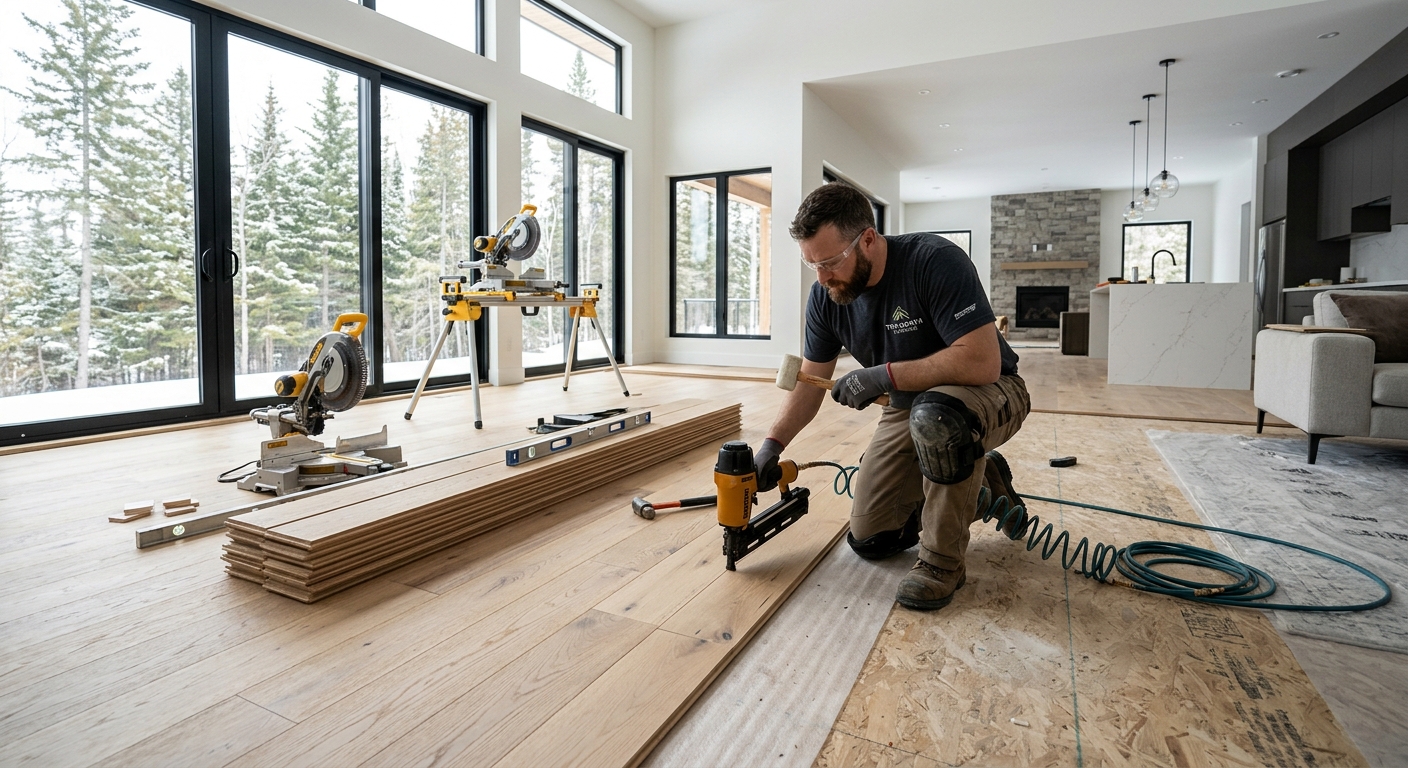
Flooring options and costs in Duncan
Duncan, British Columbia has a lot going for flooring: many comfortable character homes, and a steady demand from homeowners who want durable, warm surfaces without fighting moisture. With 61.3% of homes built before 1981 (Statistics Canada, 2021 Census), many projects start with older subfloors—often uneven plywood or patchy concrete—so plan for levelling and repair before installation. That’s one reason you may see a wider quote range on the same product than you would in newer regions.
On Vancouver Island and the Coast, the day-to-day climate is a big cost driver. Coastal humidity swings can push indoor relative humidity above the ideal 35–55% band, and below-grade spaces can add chronic dampness. That’s why contractors in Duncan usually steer customers toward engineered hardwood and luxury vinyl plank (LVP) when basements, crawlspaces, or concrete slabs are involved. Solid hardwood can still be a great choice on main floors, but we typically avoid it for concrete and high-moisture basements.
Labour availability is also a factor: Duncan and nearby communities around Ladysmith and Chemainus pull from the same contractor pools, so schedule timing can affect labour rates. In older neighbourhood pockets—especially closer to the more established residential areas where 1980s-and-earlier builds are common—subfloor fixes are especially in demand. Once those prep items are scoped, you can compare options side-by-side in the budget table below.
| Type |
Best Room |
Moisture Resistance |
Lifespan |
Price per sq ft |
| Solid hardwood (nail-down, above grade only) |
Main living areas (no slab/basement) |
Low to moderate (humidity-sensitive) |
25–50 years |
$9 – $18 |
| Engineered hardwood (float or glue, above + on-grade) |
Main floors, hallways, bedrooms |
Moderate to high (more stable) |
20–40 years |
$10 – $16 |
| Laminate (click-lock, above-grade) |
Bedrooms, living rooms |
Low to moderate (don’t let standing water sit) |
10–25 years |
$5 – $10 |
| Luxury vinyl plank / LVP (waterproof, any level) |
Kitchen, bathrooms-adjacent, basement (finished) |
High to waterproof |
15–25 years |
$6 – $12 |
| Porcelain / ceramic tile |
Bathrooms, kitchens, entries |
High (but needs proper mortar/subfloor flatness) |
25+ years |
$12 – $25 |
| Carpet (broadloom or modular tile) |
Bedrooms, comfort zones |
Low (hold moisture/odours if damp) |
7–15 years |
$4 – $9 |
Prices are estimates only and vary by project scope, site access and material selection.
What affects the price of flooring in Duncan
In Duncan and across Vancouver Island and the Coast, two quotes for the same square footage can differ by 30–50% because the “hidden scope” varies: subfloor prep, moisture mitigation, transitions, and the amount of removal/disposal. British Columbia projects also respond to seasonal labour demand and product lead times, so timing matters. For reference, median household income is $53,200 (Statistics Canada, 2021 Census), and many homeowners budget by setting a clear all-in range up front so the final number doesn’t surprise.
Technically, the biggest drivers are indoor humidity swings and below-grade moisture. Solid hardwood expands and contracts with humidity and can’t be installed as a glue-down or floating system over concrete; it also performs poorly in basements with higher moisture vapour risk. Engineered hardwood and LVP are more dimensionally stable, which helps reduce cupping, gapping, and callback repairs. Colder pockets on the Island and the growing popularity of radiant heat also influence cost: many installers won’t recommend solid hardwood in radiant zones, which shifts you toward LVP, many laminates, tile, or engineered wood.
Older regional housing stock frequently needs subfloor levelling or repair—commonly adding $1–$4 per sq ft before any floor goes down. In Duncan, you’ll often see higher costs when: (1) concrete slab needs flattening/patching for tile, (2) plywood is wavy and needs labour-intensive prep for LVP click-lock or engineered planks, and (3) the job includes extensive trim undercut and stair transitions.
As a quick budget reality check: if you’re comparing laminate at roughly $5–$10 per sq ft versus LVP closer to $6–$12 per sq ft, the “extra” can be justified in moisture-exposed areas like entries and basements because waterproof floors reduce the risk of edge swelling and odours—especially in older homes.
| Price Factor |
Why It Matters |
Cost Impact |
| Room area in sq ft |
Materials and labour scale directly with surface area |
Large projects often improve per-sq-ft unit pricing |
| Subfloor condition |
Levelling/repair is required for flat, stable installation |
Often adds $1–$4 per sq ft in older homes |
| Moisture / below-grade install |
Rules out solid hardwood on slabs and increases prep needs |
May push you to LVP/engineered and add vapour-control steps |
| Material choice |
Different products carry different material + underlayment costs |
Typically $4–$13 per sq ft spread depending on type |
| Removal and disposal of existing flooring |
Labour, dust control, and haul-away fees vary |
Can add several dollars per sq ft depending on thickness and prep |
| Stair nosing / transitions |
Steps are labour-intensive and may require specialised strips |
Often charged per step or per linear foot |
| Radiant heat compatibility |
Limits product options and requires correct underlayment |
May add $ to select compatible materials and systems testing |
| Installation method |
Float vs. glue-down vs. nail-down changes prep and time |
Glue-down and tile work often increases labour costs |
Permits & regulations in British Columbia
In British Columbia, a flooring installation by itself typically does not require a building permit. If you’re replacing flooring only—like installing LVP over an approved subfloor, fitting carpet, or installing engineered hardwood with the proper underlayment—permits usually aren’t triggered. That said, some related work can require permits or professional sign-off.
Examples of work that may require permits include: electrical work to connect or modify in-floor heating circuits, any work involving wiring or changes to existing electrical distribution, and structural subfloor repairs if they go beyond cosmetic patching (for example, significant engineered joist/subfloor replacement). Moisture remediation can also require additional steps, especially when there’s an ongoing water source that needs addressing before finishing surfaces.
For condominiums in the Duncan area, the condo corporation’s rules on sound transmission often matter more than permits. Upper-floor installations of hard surfaces may require specific underlay to meet internal requirements (STC/IIC-related rules), and you should request board approval in writing before installing hardwood or tile.
How to verify your contractor in Duncan: (1) confirm their BC licence/registration status (use the provincial business/credential listings and the company’s posted licence number if available), (2) request a certificate of insurance naming you as an additional insured where applicable, and (3) confirm WSIB/WCB clearance for the trades doing the work. Ask for a clearance letter or account confirmation, not just a verbal statement—then keep copies with your contract.
Best flooring for each room in your Duncan home
Choosing the right floor in Duncan is less about what looks best on day one and more about what survives Vancouver Island’s humidity pattern and the realities of older housing. With 57.6% of households owning their homes (Statistics Canada, 2021 Census), many homeowners are planning longer stays in place—so we focus on durability and moisture tolerance rather than short-term savings.
For living and dining areas, engineered hardwood or high-quality laminate are common wins: they bring warmth, and engineered wood tolerates seasonal expansion/contraction better than solid hardwood. In the master bedroom, carpet is popular because it improves comfort and sound control—especially in houses where floors may echo during coastal weather shifts. Kitchens benefit from luxury vinyl plank (LVP) or large-format porcelain tile because spills and wet mops are inevitable, and LVP’s waterproof construction handles small “oops” without swelling. In finished basements, LVP is usually the clear winner: it’s fully waterproof and better suited to vapour-management systems than wood-based products. For bathrooms, porcelain or ceramic tile is the safest choice when installed over a properly prepared substrate with correct membranes.
Radiant heat compatibility is increasingly relevant in British Columbia, and it typically steers you toward LVP, compatible laminates, tile, and many engineered wood products. Solid hardwood over radiant systems is often limited or avoided due to temperature-driven dimensional movement.
Where the price difference makes sense: a tile install can land around $12 – $25 per sq ft, while LVP may be around $6 – $12 per sq ft. If you’re doing a bathroom or basement zone where moisture risk is high, paying for tile or waterproof LVP is usually a better value than buying something that can’t handle dampness.
| Room |
Best Material |
Why |
Moisture Risk |
Price Band per sq ft |
| Living / dining room |
Engineered hardwood |
Warm, stable appearance with better humidity tolerance than solid wood |
Low to moderate (main floor) |
$10 – $16 |
| Master bedroom |
Carpet or engineered hardwood |
Comfort and quiet (carpet) or stable warmth (engineered wood) |
Low |
$4 – $16 |
| Secondary bedrooms |
Laminate or carpet |
Good value; carpet adds sound absorption in family homes |
Low |
$4 – $10 |
| Kitchen |
Luxury vinyl plank (LVP) or porcelain tile |
Easy cleanup; waterproof performance for everyday spills |
Moderate |
$6 – $25 |
| Basement (finished) |
LVP (waterproof) |
Better dimensional stability over below-grade conditions; works with moisture-control setups |
High (common on older homes) |
$6 – $12 |
| Bathroom |
Porcelain / ceramic tile |
Highest moisture resilience when installed over correct waterproofing/membrane systems |
Very high |
$12 – $25 |
How to choose a flooring contractor in Duncan
Choosing the right flooring contractor in Duncan starts with proof, not promises. First, verify British Columbia licensing/registration where applicable to their trade, then request liability insurance and confirm WSIB/WCB coverage. Ask for: (1) a certificate of insurance (showing policy details and coverage dates), and (2) a WSIB/WCB clearance letter or account confirmation for the workers who will be on your site. If they can’t provide these documents quickly, that’s a red flag.
Next, get 2–3 written quotes that are itemised—not just a lump sum. A good quote breaks down material selections (underlayment/vapour barrier where required, transitions, matching stair noses), labour line items, and removal/disposal. Make sure the scope is explicit: what’s included in subfloor prep, whether levelling/repair is required and how it’s priced if discovered during demo, and whether dust control or protection for existing trim is included.
Warranty matters too. Ask for the workmanship warranty length and whether it’s transferable if you sell. Separately, confirm the manufacturer warranty terms for the flooring product (including exclusions related to moisture). For payment, use a staged schedule: never pay more than 10–15% upfront; hold back a portion until the job is complete and you’ve confirmed the floor is flat, acclimated where needed, and properly finished at edges and transitions.
Finally, put the timeline in writing: start date, expected completion date, and what happens if materials arrive late. In Duncan’s market, lead times can be a factor, but reputable contractors plan around it.
- Provide written, itemised quotes (labour + materials + underlayment/vapour barrier + transitions).
- Confirm liability insurance with a certificate and ensure the policy is active for your dates.
- Verify WSIB/WCB clearance for the people doing the work (ask for a clearance letter).
- Spell out subfloor levelling/repair: what’s included vs. priced as an extra.
- State moisture mitigation steps (vapour barrier, humidity/condensation checks) when relevant.
- Clarify removal and disposal: how much is included and where debris is taken.
- Ask about stair nosing, trim undercutting, and transition pieces—often priced per step/linear foot.
- Confirm radiant heat compatibility (if applicable) and the required underlayment product.
- Get workmanship warranty details in writing (duration, what voids it, and coverage boundaries).
- Set payment milestones and keep the majority due until completion and cleanup are verified.
- Require an on-site measure and a material breakdown that matches your quote.
- Ensure the contract includes a project start/completion estimate and protection for doors/trim.
Red flags I see in Duncan: contractors who won’t provide WSIB/WCB clearance in writing, quotes that only show a single lump sum with no underlayment/vapour barrier details, vague subfloor prep language (“as needed” without pricing), refusal to explain warranty terms, and promises of unrealistic start dates without confirming material lead times.
Frequently asked questions — flooring in Duncan
What is the difference between floating and glued-down flooring?
Floating flooring is installed without permanent attachment to the subfloor. For click-lock laminate or many LVP systems, the boards lock together and sit over an approved underlayment. This method tolerates minor subfloor movement better and is often quicker to install, but it requires a flat base to prevent joint separation. Glued-down flooring uses adhesive to bond the product to the subfloor. It’s commonly used for some engineered hardwood and certain systems, and it can feel more “solid” underfoot, but adhesive requires careful moisture conditions and an exact subfloor prep plan. In Duncan’s coastal humidity and older homes (many pre-1981), the right choice depends on moisture risk—floating engineered or LVP often performs better than solid hardwood over concrete.
What flooring holds up best to pets in a Duncan home?
For pets, the best balance in Duncan is usually waterproof luxury vinyl plank (LVP) or pet-friendly engineered flooring with a wear layer designed for abrasion. LVP is forgiving around the kinds of accidents pets have—spills, wet paws, and occasional mess—because it’s designed to be waterproof at the plank level. If you’re comparing budgets, LVP commonly lands around $6 – $12 per sq ft installed, while solid hardwood can be higher and is more humidity-sensitive in coastal swings. Carpet can work for comfort, but it’s less ideal if moisture is a concern (basements, damp seasons, or frequent paw-washing). Whatever you choose, ask for a seam/edge detail plan and proper subfloor flatness so pet traffic doesn’t exaggerate movement at joints.
How do I fix squeaky floors in my Duncan home?
Squeaks are usually a subfloor-to-joist movement issue, not a flooring “surface” problem. In older Duncan homes—where many are built before 1981—squeaks can come from aged fasteners, dry wood movement, or minor gaps between layers (like plywood over joists). The best fix typically happens before new flooring: locate the squeak, then add blocking or re-secure subfloor panels with the correct screws/nails. If you already have flooring on top, contractors sometimes remove only the affected areas to do targeted subfloor repair, but many homeowners prefer to address the problem during the full install to avoid rework. A good quote should mention whether squeak correction is included with subfloor prep, or priced separately, especially if levelling/repair is expected due to older basements.
What is luxury vinyl plank and is it worth it in Duncan?
Luxury vinyl plank (LVP) is a synthetic plank flooring designed to resist water and handle everyday spills. In Duncan and the wider Vancouver Island and Coast region, LVP is often “worth it” because it’s better suited to humidity swings and damp-prone situations than solid hardwood. Many LVP products are waterproof at the plank level, which helps in basements and on concrete slabs—areas where we usually avoid solid hardwood. Pricing varies by thickness and wear layer, but homeowners typically see LVP installed in the $6 – $12 per sq ft range. It’s especially cost-effective when you compare the risk of callbacks from moisture-related issues. If you’re installing over an older, wavy subfloor, pay attention to levelling requirements; skipping prep is the most common reason LVP performance falls short.
How much does flooring cost in Duncan?
In Duncan, all-in installed pricing generally follows the British Columbia ranges by material type. Broadly: laminate and many vinyl plank installations are often around $5 – $10 per sq ft, while luxury vinyl plank (LVP) commonly sits around $6 – $12 per sq ft depending on product and site conditions. Tile is usually higher—often $12 – $25 per sq ft installed—because it involves more labour and substrate prep. Hardwood can range widely, with solid hardwood typically falling into the $9 – $18 per sq ft band for above-grade work. Real pricing can move up when you need subfloor levelling/repair, removal and disposal, stair transitions, or moisture remediation. That’s why itemised quotes matter—two “$10 per sq ft” offers may include very different levels of prep.
Hardwood vs laminate vs vinyl plank — which is best?
In Duncan’s coastal climate, the “best” choice depends on location in your home and moisture risk. Solid hardwood is beautiful but is typically best for main floors only; it expands and contracts with humidity and is not a good fit for concrete slabs or damp basements. Laminate is a lower-cost option (often around $5 – $10 per sq ft), but it’s more sensitive to standing moisture at seams. Vinyl plank (LVP) is usually the practical winner for kitchens, entries, and finished basements because many products are waterproof and handle moisture vapour better—often landing around $6 – $12 per sq ft installed. If you want maximum long-term stability on main floors, engineered hardwood can offer a strong middle ground. For any of these, the best results come from correct subfloor flatness and proper underlayment or vapour control where required.