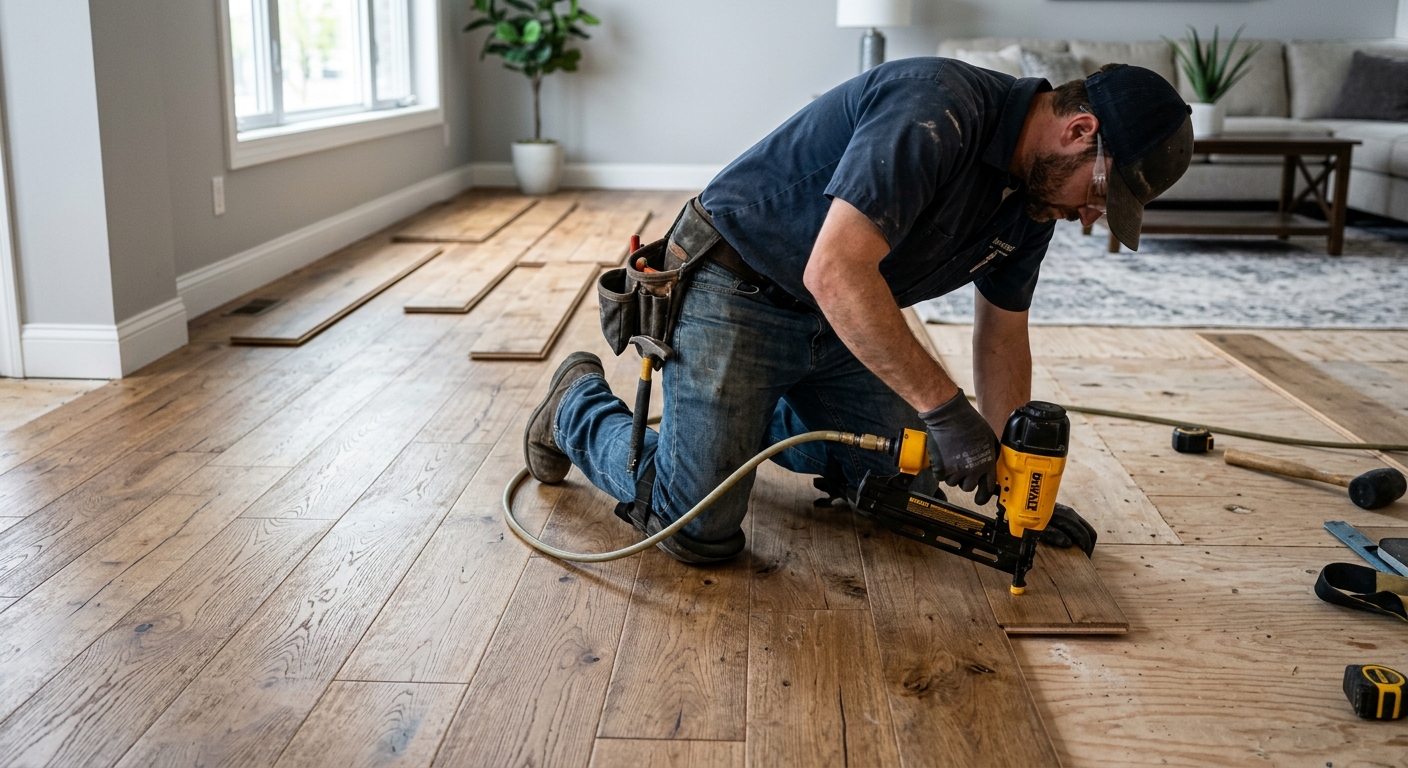
Flooring options and costs in North Delta
North Delta homeowners usually have plenty of flooring choices, but the right pick depends on how the Lower Mainland–Southwest climate behaves inside your home. With a population of 60,769 (Statistics Canada, 2021 Census), the area sees steady demand from replacement jobs as well as new builds. In day-to-day terms, that means plenty of installers are busy during seasonal slow-downs—quotes can tighten up in late spring and again in fall. The bigger driver for pricing is the wet, marine climate: indoor humidity swings in winter and shoulder seasons can show up as cupping or gapping, particularly with solid hardwood. It’s also common to encounter older housing stock with uneven subfloors, which often requires levelling or repair before new flooring can go down. In practice, that subfloor work typically adds about $1–$3 per sq ft, because you’re paying for prep materials, patching/underlayment decisions, and labour time to get the surface flat.
Basement and slab-on-grade areas in and around Tsawwassen and Ladner are where moisture becomes the deciding factor. Concrete can wick moisture upward, so we generally avoid solid hardwood below grade and recommend engineered wood or luxury vinyl plank (LVP) instead. For main living areas above grade, solid hardwood can still be a great look—if gaps/expansion are planned and indoor humidity is managed. With Greater Vancouver labour rates running high, installation is a major portion of the total price, so choosing a system that fits your substrate and moisture conditions protects your budget.
Below is a practical cost comparison you can use to sanity-check quotes, then we’ll refine it based on your room sizes, transitions, and what the subfloor needs.
| Type |
Best Room |
Moisture Resistance |
Lifespan |
Price per sq ft |
| Solid hardwood (nail-down, above grade only) |
Main living areas above grade |
Low–moderate (humidity sensitive; avoid basements) |
25–50 years with proper humidity |
$9,– $18 |
| Engineered hardwood (float or glue, above + on-grade) |
Living/dining, hallways, bedrooms |
Moderate (better tolerance for humidity than solid) |
20–35 years |
$9,– $16 |
| Laminate (click-lock, above-grade) |
Bedrooms, hallways, living areas |
Low–moderate (water can damage edges) |
10–25 years |
$4,– $10 |
| Luxury vinyl plank / LVP (waterproof, any level) |
Kitchens, bathrooms-adjacent zones, finished basements |
High (designed for moisture and humidity swings) |
15–25 years |
$5,– $12 |
| Porcelain / ceramic tile |
Bathrooms, kitchens, entryways |
Very high (properly set and grouted) |
25–50 years |
$10,– $20 |
| Carpet (broadloom or modular tile) |
Bedrooms, stairs, low-noise rooms |
Moderate (risk in humid basements without proper vapour control) |
8–15 years |
$4,– $9 |
Prices are estimates only and vary by project scope, site access and material selection.
What affects the price of flooring in North Delta
In North Delta and the broader Lower Mainland–Southwest, two quotes for the “same” floor can easily differ by 30–50% in total cost. The common reason is that what’s under your existing flooring and what needs to be fixed (levelling, vapour control, subfloor repairs) is rarely identical from one home to the next. On top of that, Greater Vancouver labour rates are among the highest in Canada, so labour-heavy prep work can quickly move a budget job into a higher tier. Climate also plays a role: the wet, marine conditions mean indoor humidity swings are more pronounced in winter and shoulder seasons, and that affects how installers must prep and what materials they recommend.
Technically, solid hardwood expands and contracts with humidity. That’s why it cannot be glued or floated over a typical concrete slab the way engineered wood and LVP can, and why it performs poorly in basements where moisture vapour can move through the slab. Engineered hardwood and LVP handle humidity and minor temperature changes far better, which can reduce the risk of callbacks and rework. Colder inland pockets and many newer Lower Mainland builds also use radiant heating—this tends to rule out most solid hardwood specs and limits some laminate choices, steering people toward engineered wood, tile, or LVP with proven radiant compatibility.
Concrete examples from North Delta: if your subfloor is out of flat by more than a tolerance (common in older homes), expect levelling to add about $1–$4 per sq ft. If you’re removing existing carpet or vinyl and disposing of it, that can add labour and hauling. And if you’re installing over a slab-on-grade or basement with moisture concerns, the vapour barrier and moisture-mitigation decisions can shift you from a “laminate-style” budget (around $4,– $10 per sq ft) to a more resilient solution like engineered hardwood or waterproof LVP (often closer to $9,– $16 or $5,– $12 per sq ft depending on product tier).
| Price Factor |
Why It Matters |
Cost Impact |
| Room area in sq ft |
Materials and labour scale directly with surface area and layout complexity |
Usually the largest variable; smaller rooms can cost more per sq ft after mobilization |
| Subfloor condition — levelling or repair needed before install |
Uneven plywood or damaged patches must be corrected for click systems and tile flatness |
Commonly adds about $1–$4 per sq ft in older Lower Mainland homes |
| Moisture / below-grade install — rules out solid hardwood |
Basements and slabs can wick moisture; wrong material choice leads to failure |
May shift you from solid hardwood pricing to engineered wood/LVP or add mitigation steps |
| Material choice — solid vs. engineered vs. LVP vs. tile |
Product cost and waste factor differ by system |
Can swing total cost by 2×; e.g., tile often sits in the $10,– $20 band |
| Removal and disposal of existing flooring |
Old underlay, nails, staples, and demolition add labour and landfill fees |
Often adds a noticeable line item, especially for tile thinset or multiple layers |
| Stair nosing / transitions — charged per step or per linear foot |
Transitions and stair materials are labour-intensive and may require custom trim |
Can add hundreds to thousands depending on steps and doorways |
| Radiant heat compatibility — limits material options |
Not every product tolerates supply temperatures or expansion movement |
May require engineered wood/tile or a rated underlayment; reduces “cheap” options |
| Installation method — float vs. glue-down vs. nail-down |
Labour time and prep requirements vary by method and substrate |
Nail-down and glue-down typically cost more due to prep and fastening/adhesive workflow |
Permits & regulations in British Columbia
In British Columbia, installing new flooring itself typically does not require a building permit. What can trigger permits is the related work that goes beyond surface covering—especially when you’re altering structure, remediating moisture conditions that involve significant substrate repairs, or touching electrical components. For example, if your project includes in-floor heating circuit work (or any electrical tie-ins for radiant systems), electrical permits may be required and the work must be done by qualified trades. If a contractor is addressing structural subfloor damage—such as replacing rotted framing or doing major substrate reconstruction—that associated scope can fall into permitted territory depending on extent and how it’s documented.
For condos in the Lower Mainland–Southwest, the requirement is often less about municipal permitting and more about building rules. Sound transmission requirements (STC/IIC) and approved underlay choices can restrict what you can install on upper floors. Before work starts, review the condo declaration and ask for board approval in writing, particularly if you’re installing hardwood, tile, or other hard-surface flooring that can transmit impact noise.
To verify a contractor in North Delta, check three things step-by-step: (1) licensing/registration using the appropriate provincial/industry registry page for your contractor type; (2) liability insurance—request a current certificate of insurance listing you as additional insured if applicable; and (3) proof of workers’ coverage for employees (commonly WSIB/WCB coverage). Ask for these documents before signing, and don’t rely on verbal confirmation.
Best flooring for each room in your North Delta home
Choosing flooring in North Delta is mostly about matching the material to moisture exposure, foot traffic, and comfort. In living and dining areas, homeowners typically want warmth without the drama of humidity swings. Engineered hardwood or high-quality laminate (proper underlay, correct acclimation, and good detailing) offers a balanced look. For bedrooms, carpet remains a favourite for comfort and sound absorption—especially on upper floors where neighbours appreciate reduced impact noise.
Kitchen flooring needs water resistance and easy cleaning. In the Lower Mainland–Southwest, we often recommend luxury vinyl plank (LVP) for its waterproof core and forgiving installation over minor substrate imperfections, or large-format porcelain tile if you want maximum durability and a crisp, low-maintenance surface. In basements, LVP is usually the clear winner: fully waterproof and designed for below-grade installs where moisture vapour can move through concrete. Solid hardwood and most laminate are a mismatch in these conditions unless moisture conditions are fully understood and the product is specifically approved for that use.
Bathrooms should be porcelain or ceramic tile only, with correct waterproofing underlayment and grout practices. If you have radiant heating—common in newer North Delta builds—focus on radiant-compatible products. Many installers avoid solid hardwood here due to strict temperature and movement requirements; engineered wood, tile, and many LVP systems are more reliable when specified properly.
Dollar-wise, it’s often worth paying the “right” tier once: for example, swapping from a $4,– $10 laminate approach to LVP in a finished basement can cost more per sq ft, but it can prevent moisture-related failures and expensive removal later. The initial choice protects the long-term value of your home.
| Room |
Best Material |
Why |
Moisture Risk |
Price Band per sq ft |
| Living / dining room |
Engineered hardwood |
Warm feel with better humidity tolerance than solid; suits above-grade movement |
Low (manage indoor humidity); moderate risk if large exterior envelope leaks |
$9,– $16 |
| Master bedroom |
Carpet or engineered hardwood |
Comfort and reduced noise (carpet), or a cleaner look with durable engineered planks |
Low (unless there’s a known basement moisture issue affecting slab/underside) |
$4,– $9 |
| Secondary bedrooms |
Laminate (high-quality) or carpet |
Budget-friendly durability; carpet adds comfort for daily use |
Low–moderate (avoid spills sitting for long periods) |
$4,– $10 |
| Kitchen |
Luxury vinyl plank (LVP) or porcelain tile |
Water resistance for spills; easy cleaning; tile for maximum longevity |
Moderate (typical spills and wet mopping) |
$5,– $20 |
| Basement (finished) |
Luxury vinyl plank (LVP) |
Designed for below-grade humidity; waterproof core handles moisture vapour better |
High (concrete wicking is common in Lower Mainland slab/basement setups) |
$5,– $12 |
| Bathroom |
Porcelain / ceramic tile |
Best wet-area performance when set correctly with appropriate underlayment |
Very high (routine water exposure) |
$10,– $20 |
How to choose a flooring contractor in North Delta
When you’re hiring a flooring contractor in North Delta, verify credentials before you compare price. In British Columbia, ask for proof of liability insurance and proof of workers’ coverage (WSIB/WCB) if they employ installers. Request the certificate of insurance and the coverage clearance documents in writing—then check that the policy is current and matches the company name you’re contracting. Also ask what licensing/registration applies to their trade and confirm it using the correct provincial registry. If a contractor can’t provide documentation promptly, that’s a risk flag.
Get 2–3 itemised written quotes. A proper quote breaks down materials and labour, not just a single lump sum. Make sure it states: exact flooring product tier, underlay/vapour barrier included or not, subfloor prep scope (level, patch, or repair), transition/stair nosing quantities, and removal/disposal. Ask whether a permit is required for any related electrical/radiant work (if applicable) and whether they handle it or you must. Warranty matters too: confirm workmanship warranty length, product/manufacturer warranty coverage, and whether warranties are transferable to the next owner.
Payment schedule should protect you. Never pay more than about 10–15% upfront. Hold back a portion until the job is complete and you’ve inspected the finished surfaces, transitions, and edges. Finally, get a written start date and completion estimate—Lower Mainland scheduling can shift quickly due to weather and installer availability.
- Ask for COI (certificate of insurance) and confirm coverage is active before work begins.
- Request WSIB/WCB proof (clearance documents) if the contractor uses employees.
- Confirm the appropriate BC registration/licence for the contracting entity using the correct online registry.
- Require 2–3 itemised quotes with a labour/material breakdown.
- Ensure subfloor prep scope is explicitly listed (level/patch/repair and who supplies materials).
- Confirm moisture plan for basements/slabs (vapour barrier, testing, and product approval).
- Verify underlay and vapour barrier are included for laminate/LVP as needed.
- Clarify removal and disposal: are old floors and underlay hauled away?
- State how transitions and stair nosing are measured and priced (per step/linear foot).
- Ask about acclimation time requirements for hardwood/engineered products.
- Review warranty terms: workmanship duration and manufacturer warranty details.
- Use a payment schedule with 10–15% max deposit and a holdback until completion.
In North Delta, red flags to watch for: (1) no written scope for subfloor prep or moisture mitigation; (2) quotes that omit disposal and transition/stair costs; (3) installers who won’t discuss indoor humidity needs for hardwood; (4) refusal to show insurance/coverage documents; and (5) asking for a large upfront payment with no signed agreement and start date.
Frequently asked questions — flooring in North Delta
How much does flooring cost in North Delta?
In North Delta, flooring pricing usually depends on the product tier plus how much prep your subfloor needs. As a quick reference, laminate/vinyl plank systems are commonly quoted in the $4,– $10 and $5,– $12 bands respectively, while tile often sits around $10,– $20 per sq ft. Installation labour can be a big share of your total because Greater Vancouver has higher labour rates, and Lower Mainland projects often require levelling or vapour control. If you’re working over older plywood or a slab with moisture wicking, subfloor levelling/repair can add roughly $1–$4 per sq ft before the finish floor goes down. For an accurate number, you’ll need itemised quotes based on your room sizes and the substrate condition.
Hardwood vs laminate vs vinyl plank — which is best?
Hardwood can be the best look and feel for above-grade living areas, but in British Columbia’s wet, marine climate it needs correct specification and indoor humidity control. Solid hardwood is humidity sensitive and is typically used above grade only; basements and concrete slabs are better suited to engineered wood or LVP. Laminate is often a good budget choice on dry, stable subfloors, but it’s less forgiving with standing water and can swell at seams if spills aren’t cleaned quickly. Vinyl plank (LVP) is usually the most versatile: most waterproof products handle moisture and humidity swings better across levels. If your goal is “one product everywhere,” LVP often wins—especially where moisture vapour is a concern. If your goal is “traditional character,” engineered hardwood is usually the safer compromise than solid wood in the Lower Mainland–Southwest.
What flooring is best for a North Delta basement?
For basements in North Delta, luxury vinyl plank (LVP) is typically the safest recommendation. The reason is moisture: in the Lower Mainland–Southwest, concrete can wick moisture upward even when the space looks dry, and winter humidity swings can expose that problem. Solid hardwood is usually a poor match in basements, and many laminate products aren’t designed for below-grade vapour conditions. LVP’s waterproof core and layered construction make it more tolerant of humidity and minor temperature movement, which reduces the chance of cupping, gapping, or seam swelling. If you choose engineered wood, you still need careful moisture planning and product approval, plus proper underlayment and installation method. For best results, ask your contractor whether they’ll include vapour control steps and how they address any moisture readings before installation.
Can I install hardwood over concrete?
In many North Delta homes, you can’t treat concrete the same way as a wood subfloor for solid hardwood. Solid hardwood is usually installed nail-down over an appropriate substrate and is designed for above-grade use; it’s not recommended for typical slab-on-grade because of humidity and moisture vapour movement. If you want a wood look over concrete, engineered hardwood is often the better option because it tolerates humidity changes more reliably and can be installed as a floating system or glue-down depending on the product and subfloor. You still need a proper moisture plan: slab dryness/conditions, correct underlay (where applicable), and a system approved for concrete. If you have radiant heat, that also affects specification. The safest approach is to match the concrete condition and temperature profile to an engineered product that explicitly supports your installation method.
How long does flooring installation take?
Timing depends on room count, subfloor prep, and the flooring type. On a straightforward main-floor job (good subfloor condition, minimal transitions), installation is often completed in a few days. Once levelling/patching is required, expect additional days for prep and curing time. Basement and slab projects can take longer because moisture-related prep, underlay/vapour barrier decisions, and acclimation steps add time. Tile usually takes longer than LVP or laminate due to careful layout, setting, and grouting. Stairwork and transitions (especially complex doorways) add more labour and can stretch timelines. In British Columbia’s variable weather, schedules can shift when crews are tied up with exterior work or moisture-affected prep. Get a written start date and completion estimate, and confirm how many hours per day the crew will work to avoid surprises.
What flooring works with radiant heat?
Radiant heat compatibility in North Delta is mostly about choosing the right product and installation method, then following the manufacturer’s temperature limits. In general, engineered hardwood, porcelain/ceramic tile, and many LVP products are more reliable options for radiant heating than solid hardwood. Solid hardwood is often restricted because it’s more sensitive to movement and requires strict limits on supply temperatures and indoor humidity. Laminate can work if it’s explicitly rated for radiant heat and installed with the correct underlayment, but not all products are suitable. If your contractor is planning radiant floors, ask for the specific product rating and temperature guidance, and ensure they account for acclimation and expansion gaps as required. If you’re comparing quotes, look for whether the materials are documented as radiant-compatible—not just “recommended.”