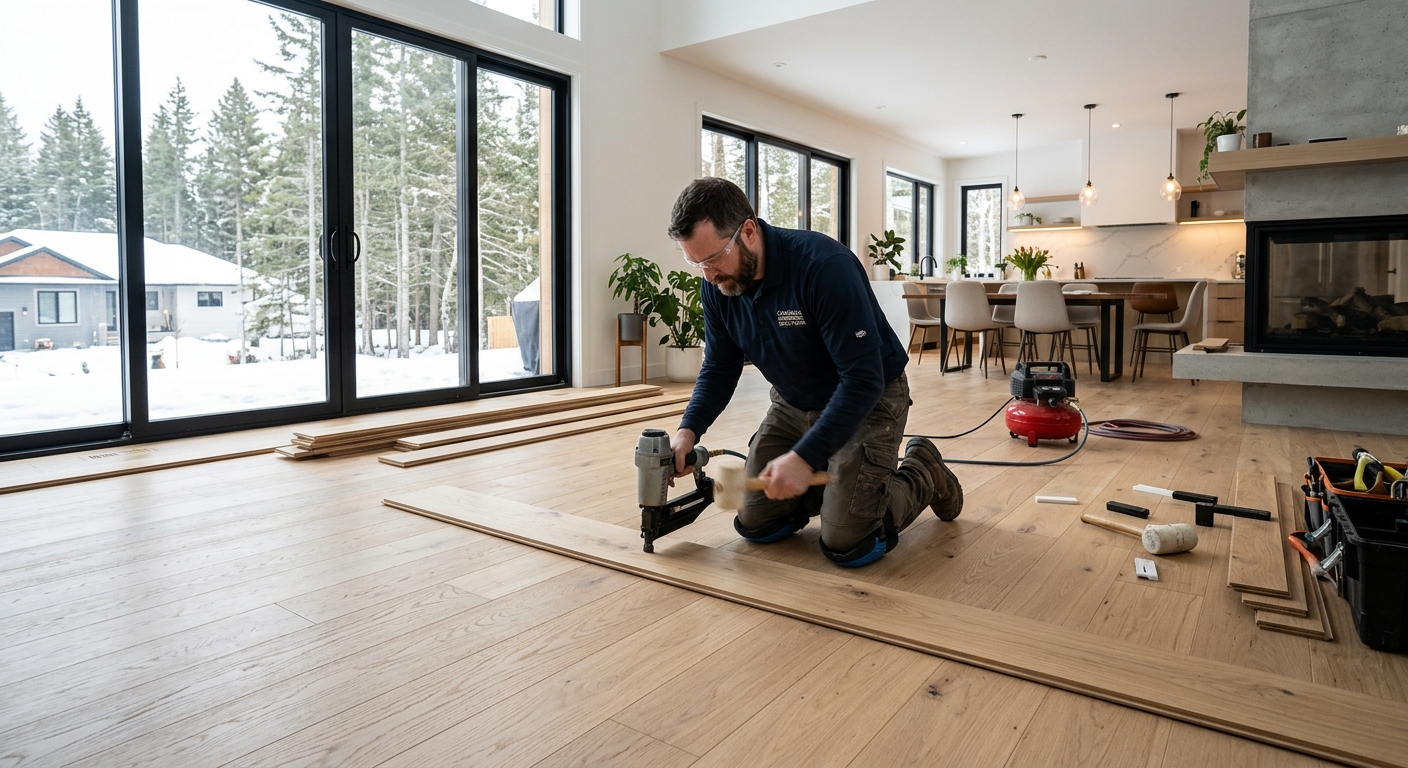
Flooring options and costs in North Vancouver
North Vancouver homeowners typically choose flooring based on comfort upstairs, moisture resistance in shoulder seasons, and practicality for older housing stock. In fact, 44.0% of homes were built before 1981 (Statistics Canada, 2021 Census), which often means you’ll run into aged subfloors, uneven plywood, or patchy concrete—costing more to level and prepare before any new surface goes down. And with 53.3% of households owning (Statistics Canada, 2021 Census), many projects are full-room replacements rather than small “spot” repairs, so installation time and prep work become a major share of the budget.
In the Lower Mainland–Southwest, the wet, marine climate creates indoor humidity swings that can lead to cupping, gapping, and squeaks if the floor system isn’t matched correctly to the substrate. That’s why below-grade spaces in particular drive decisions: moisture can wick through concrete, so we generally avoid solid hardwood in basements and recommend engineered wood or luxury vinyl plank (LVP). If you’re installing in areas like Lynn Valley or Lower Lonsdale—where lots of older homes sit close to grade and crawlspaces/basements are common—expect more time spent on moisture checks, underlayment choices, and subfloor corrections.
Labour availability can also affect pricing. Greater Vancouver trades are in steady demand, and installation cost can move quickly when a company is scheduling multiple large conversions.
Here’s a realistic at-a-glance comparison to help you start the conversation with your installer.
| Type |
Best Room |
Moisture Resistance |
Lifespan |
Price per sq ft |
| Solid hardwood (nail-down, above grade only) |
Main living areas |
Low to moderate (humidity sensitive) |
30+ years |
$9, – $18 |
| Engineered hardwood (float or glue, above + on-grade) |
Main living areas, hallways |
Moderate to high (better humidity tolerance) |
20–35 years |
$10, – $16 |
| Laminate (click-lock, above-grade) |
Bedrooms, living spaces (dry zones) |
Low to moderate (resists spills, not flooding) |
10–20 years |
$4, – $10 |
| Luxury vinyl plank / LVP (waterproof, any level) |
Basements, kitchens, entryways |
High (waterproof core) |
15–25 years |
$5, – $10 |
| Porcelain / ceramic tile |
Bathrooms, kitchens, entryways |
Very high (non-porous porcelain) |
30+ years |
$10, – $20 |
| Carpet (broadloom or modular tile) |
Bedrooms, stairs |
Low (needs careful moisture management) |
8–15 years |
$4, – $8 |
Prices are estimates only and vary by project scope, site access and material selection.
What affects the price of flooring in North Vancouver
In North Vancouver and across the Lower Mainland–Southwest, it’s common to see quotes for the “same” floor jump by 30–50% depending on prep scope and the substrate you’re working over. A big reason is that Greater Vancouver pricing reflects not just material, but the labour intensity of dealing with uneven plywood, older patchwork, and moisture conditions. Even within British Columbia, local availability of installers and the travel/load-out logistics for small jobs can shift the numbers noticeably.
Technically, the key driver is humidity and below-grade moisture. Solid hardwood expands and contracts with indoor humidity—so it cannot be installed over concrete in most cases, and it performs poorly in basements where vapour and wicking can be ongoing. Engineered hardwood and luxury vinyl plank (LVP) handle humidity swings far better because of their layered or PVC core construction, making them safer choices for on-grade slabs and finished basements. For colder inland pockets and radiant heat installations (increasing in newer builds), the system choice narrows: most solid hardwood and some laminate products can’t handle higher subfloor temperatures without risking movement or gapping.
Older regional housing stock also matters. If your home was built before 1981, you may need levelling and repair that adds roughly $1–$4 per sq ft to the project cost. For example, a 600 sq ft living-area replacement might pencil out around the laminate/vinyl band of $4–$10 per sq ft, but once levelling and transitions are included, engineered wood can land closer to the $9–$18 per sq ft hardwood range. Conversely, switching a basement from laminate to waterproof LVP can cost more on materials, yet reduce rework risk and hidden moisture-related callbacks.
| Price Factor |
Why It Matters |
Cost Impact |
| Room area in sq ft |
Material and installation time scale directly with square footage |
Varies widely; bigger jobs spread mobilization cost |
| Subfloor condition |
Uneven plywood, loose boards, or dips must be corrected before install |
Typically +$1–$4 per sq ft depending on repair scope |
| Moisture / below-grade install |
Wicking and vapour can limit solid hardwood and many laminate installs |
May require barriers/testing; can shift you to engineered/LVP |
| Material choice |
Solid vs. engineered vs. LVP vs. tile changes both supply and labour method |
Can move the job between roughly $4–$20 per sq ft bands |
| Removal and disposal of existing flooring |
Tear-out time and disposal fees can be substantial in older homes |
Often +10–25% on total labour for heavier removals |
| Stair nosing / transitions |
Special trim work is charged per step or per linear foot |
Can add several hundred dollars on typical stair sets |
| Radiant heat compatibility |
Limits product selection and requires correct installation specs |
May require different underlayment/top-layer; small to moderate uplift |
| Installation method |
Float vs. glue-down vs. nail-down changes labour and prep requirements |
Nail-down prep and acclimation can add time; glue-down may add material prep |
Permits & regulations in British Columbia
In British Columbia, the flooring installation itself generally does not require a building permit. Where permits can come into play is when the floor project expands into electrical or structural scope. For example, if you’re adding, modifying, or integrating in-floor heating circuits, you may trigger electrical permitting requirements. Likewise, any work that involves structural subfloor repair beyond typical cosmetic repair, moisture remediation that affects building envelope components, or major alterations around openings should be discussed with the trades involved—your contractor should confirm what’s needed before starting.
For condominiums, the biggest “rule” usually isn’t a permit—it’s the building’s bylaws and the corporation’s sound-transmission expectations. Upper-floor hard-surface installs (hardwood, tile, some LVP systems) often need specific underlay and may require documented STC/IIC performance, plus board approval in writing. Before you pick a product, ask to review your condo declaration and confirm any required underlayment system or installation method.
To verify a North Vancouver flooring contractor, check three things step-by-step: (1) British Columbia licence/registration where applicable—confirm the right business identity and whether they have the appropriate flooring trade registration through official provincial resources; (2) liability insurance—request a current certificate of insurance naming you as additionally insured if possible; and (3) WCB/WSIB equivalent coverage—ask for a clearance letter or proof of coverage. If they can’t provide current documents quickly, treat it as a red flag.
Best flooring for each room in your North Vancouver home
Picking the right flooring for each room in North Vancouver comes down to moisture exposure, foot traffic, and comfort under changing humidity. For living and dining areas, engineered hardwood or high-quality laminate are popular because they offer a warm look without the movement risk of solid wood. In bedrooms, comfort and sound control matter most—carpet is still a strong choice, especially if you want a quieter feel during the winter months. For kitchens, choose luxury vinyl plank (LVP) or large-format porcelain tile: both handle splashes and routine cleaning far better than wood in a typical food-prep zone.
Basements are where the Lower Mainland–Southwest climate really influences performance. In finished basements, waterproof LVP is usually the clear winner because it’s designed to tolerate moisture vapour and below-grade installs where solid hardwood and many laminate products can suffer. Bathrooms should be porcelain or ceramic tile only—tile is stable, non-porous (especially porcelain), and forgiving if you get steam or routine splashes.
Radiant heat compatibility is also increasingly relevant in British Columbia new builds and renovations. If a room has in-floor heating, engineered wood, tile, and many LVP options are usually the safest routes, while solid hardwood and some laminate installs need careful product temperature limits and installation specs.
To put pricing in perspective: upgrading a basement from laminate (often in the $4–$10 per sq ft band) to waterproof LVP (often $5–$10 per sq ft, depending on quality and thickness) can be only a modest material difference, but it can prevent moisture-related failures that are far more expensive than the initial uplift.
| Room |
Best Material |
Why |
Moisture Risk |
Price Band per sq ft |
| Living / dining room |
Engineered hardwood |
Looks like wood, handles humidity swings better than solid; good stability over on-grade |
Moderate (humidity variation) |
$10, – $16 |
| Master bedroom |
Carpet or engineered hardwood |
Carpet adds comfort and sound control; engineered provides a cleaner, warmer wood aesthetic |
Low to moderate |
$4, – $10 |
| Secondary bedrooms |
Laminate or carpet |
Laminate is cost-effective and durable for daily traffic; carpet is best for warmth and quiet |
Low to moderate |
$4, – $10 |
| Kitchen |
LVP or porcelain tile |
Easy clean-up and water resistance; stable under spills and temperature changes |
Moderate to high (spills) |
$10, – $20 |
| Basement (finished) |
Luxury vinyl plank (waterproof) |
Designed for below-grade moisture conditions; reduces movement failures from vapour |
High (vapour / wicking through concrete) |
$5, – $10 |
| Bathroom |
Porcelain / ceramic tile |
Non-porous surface options; long service life and best tolerance to steam/splashes |
High |
$10, – $20 |
How to choose a flooring contractor in North Vancouver
Choosing a contractor in North Vancouver is mostly about verifying coverage, then tightening the scope so you don’t get surprise costs mid-project. First, confirm British Columbia licensing/registration where applicable for the business you’ll hire. Next, ask for liability insurance documentation (current certificate of insurance is best). For worker coverage, request proof of WSIB/WCB coverage in the way the contractor can provide clearance or documentation—don’t accept verbal promises. If they can’t produce these items early, it’s a risk you don’t need with expensive materials.
Get 2–3 itemised written quotes. You want a breakdown that separates labour from materials, and ideally lists underlayment/barrier, levelling/repairs, transitions, stair work, and removal/disposal. Avoid a vague lump sum, especially if your home has older subfloors or built-in sound-control expectations. Ask specifically whether acclimation is included, whether moisture testing is done where needed, and what’s excluded (baseboards, painting, moving furniture, or concrete grinding).
Warranty matters in two layers: workmanship warranty (how many years for installation) and product/manufacturer warranty (and whether it’s transferable to a new homeowner). For payment, a safe guideline is to never pay more than 10–15% upfront; hold back the remainder until the job is complete and you’ve reviewed the finished floor. Finally, insist on a start date and completion estimate in writing so winter humidity doesn’t turn into schedule slippage.
- Confirm current licence/registration details for the exact company name on the contract.
- Request a current certificate of liability insurance and check coverage limits.
- Ask for proof of worker coverage (WSIB/WCB) and a clearance-style document if available.
- Use itemised quotes: labour, materials, underlay/barrier, levelling compounds, transitions, and waste/disposal.
- Verify what’s included for removal and hauling away old flooring.
- Ask whether moisture testing is included for basements/on-grade slabs.
- Confirm product specifications: acclimation process, fastening method, and required underlayment.
- Get the stair plan in writing: stair nosing method, number of pieces, and per-step/linear-foot charges.
- Check workmanship warranty length, what defects qualify, and response timelines.
- Ask if the manufacturer warranty is tied to licensed/approved installers.
- Agree on payment milestones: small deposit (10–15%), then progress payments with a completion holdback.
- Require a written schedule with start/finish targets and who handles site protection/cleanup.
Concrete red flags we see in North Vancouver include: contractors who won’t provide insurance/worker coverage documentation, quotes that omit levelling or moisture provisions for older homes, failure to describe underlayment/barrier choices, “all-in” pricing with vague scope exclusions, and pressure to pay the majority upfront before any work begins.
Frequently asked questions — flooring in North Vancouver
Hardwood vs laminate vs vinyl plank — which is best?
There isn’t one winner for all North Vancouver homes; it depends on where you’re installing. Solid hardwood is beautiful for above-grade living areas, but it’s humidity sensitive and usually shouldn’t be used in basements. Laminate (often budget-friendly around the $4–$10 per sq ft band) can work in dry zones like bedrooms, but it’s not designed for below-grade vapour or wicking. Vinyl plank, especially waterproof LVP, is the most forgiving choice across levels because its core handles moisture far better—often landing in the $5–$10 per sq ft range depending on quality. If your home is built before 1981 (Statistics Canada, 2021 Census shows 44.0% locally), expect more subfloor prep either way; the best “value” comes from matching the product to the risk, not just the lowest material price.
What flooring is best for a North Vancouver basement?
For North Vancouver basements, waterproof LVP is usually the safest practical option. The Lower Mainland’s marine climate contributes to indoor humidity swings, and concrete can allow moisture vapour to move upward—especially in older homes where 44.0% of housing stock was built before 1981 (Statistics Canada, 2021 Census). Solid hardwood can cup or gap and generally performs poorly in these below-grade conditions, while many laminate products are more vulnerable at seams if moisture levels rise. With LVP, the waterproof core helps resist swelling from spills and tolerates the moisture environment better during seasonal changes. The best outcome still depends on prep: a flat surface matters, and installers should address any high spots, patch loose areas, and confirm the right underlayment/underlays for your slab type.
Can I install hardwood over concrete?
Sometimes, but not in the “solid hardwood” sense most people mean. Solid hardwood is typically nail-down over a wood subfloor and is not recommended over concrete where moisture vapour can affect the planks. If you want a hardwood look over concrete in North Vancouver, engineered hardwood is usually the more appropriate option because it’s built in layers and is more stable under humidity changes. Even then, the surface needs to be properly prepared—flatness, moisture conditions, and the correct installation method (floating or glue-down as specified by the product) all matter. If you’re quoted solid hardwood over a slab, ask for the exact specification and whether they’ve confirmed moisture conditions. In many cases, shifting to engineered wood priced in the $10–$16 per sq ft range is the more predictable long-term choice.
How long does flooring installation take?
Timelines depend on the floor type and how much prep your subfloor needs. For straightforward above-grade installations where the subfloor is already flat and dry, a typical 300–600 sq ft area can take a few days once materials arrive and the work crew is on-site. If you need levelling/repairs—which is common in older North Vancouver homes (44.0% built before 1981, Statistics Canada, 2021 Census)—plan additional time for patching, grinding, drying/curing, and inspection of flatness. Tile and stair work take longer than LVP or laminate because of layout, thinset cure times, and grouting. Also factor in acclimation for wood products. Your contractor should provide a start date and completion estimate in writing before you sign, including whether removal/disposal is included.
What flooring works with radiant heat?
In British Columbia, radiant heating is increasingly common in newer builds and renovations, and it changes what flooring will perform well. Tile (porcelain/ceramic) is generally very compatible because it handles heat transfer well. Many engineered hardwood and LVP systems can work too, but they must be installed according to the manufacturer’s radiant heat temperature limits and with the correct underlayment requirements. Most solid hardwood installs require careful specification and often more restrictions because solid planks can be sensitive to movement when temperatures change. Laminate may work only if it’s specifically rated for radiant heat. The key is not the brand alone—it’s the system design: floor temperature setpoints, jobsite curing period, and installation method. Ask your installer to confirm the product rating for radiant heat and provide it in writing.
Engineered vs solid hardwood — what's the difference?
Solid hardwood is a single piece of wood with a consistent thickness across the plank; it’s typically installed above grade with nail-down methods. Because it’s one material, it responds more directly to humidity and temperature changes, so basements are usually not recommended. Engineered hardwood is made from layers: a wood veneer on top with a stabilizing core beneath. That layered construction improves stability during Lower Mainland humidity swings, which helps reduce cupping and gapping in many North Vancouver installations. If you’re comparing projects, also consider where the floor is going: engineered wood often fits better for on-grade applications or where you need a more stable system; solid tends to be reserved for main living areas. In many local quotes, engineered hardwood often sits around the $10–$16 per sq ft band, while solid hardwood is commonly priced higher, roughly in the $9–$18 per sq ft range depending on grade and installation scope.