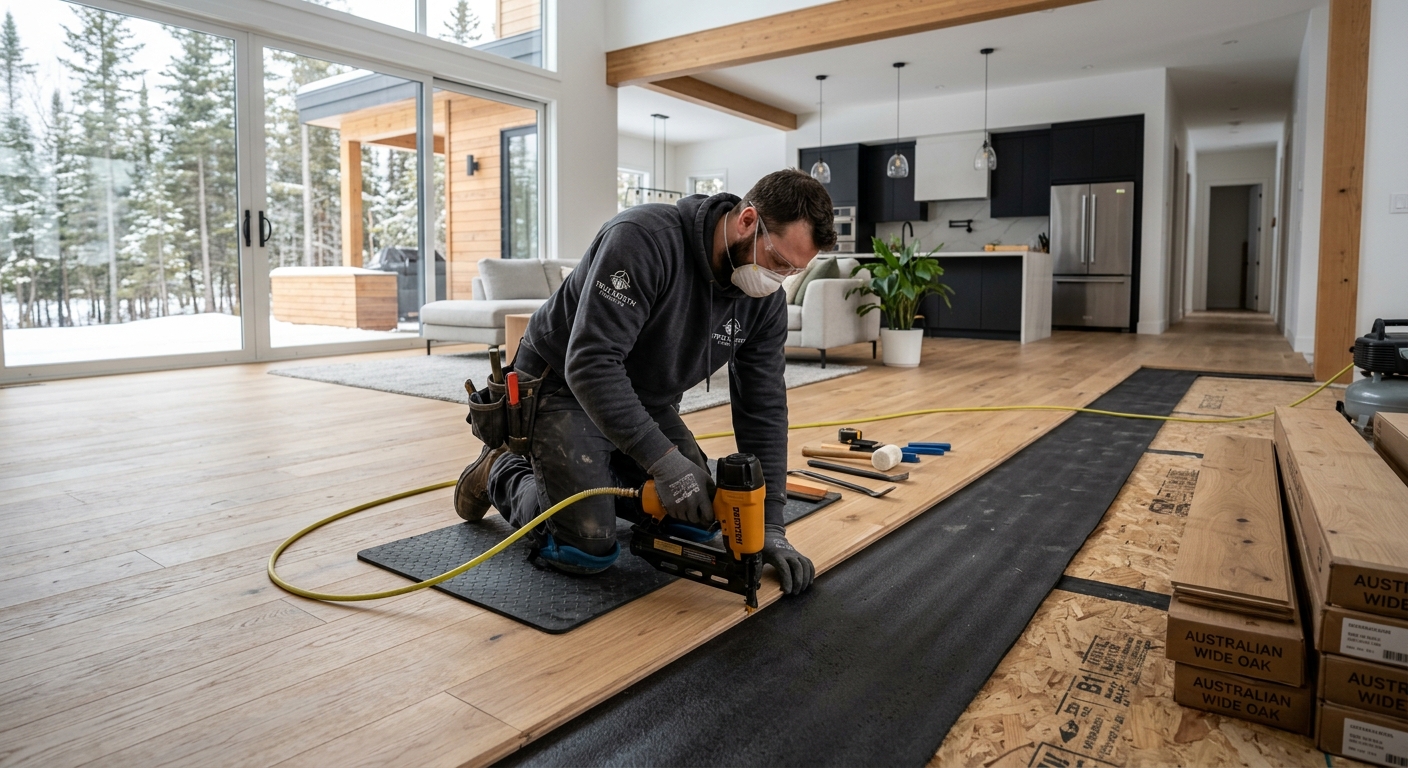
Flooring options and costs in Parksville
Parksville is a beautiful coastal community, and that coastal living shows up in the way we plan floors—humidity swings, sea-breeze moisture, and older subfloors all influence what holds up. With 13,642 residents (Statistics Canada, 2021 Census) and 29.5% of homes built before 1981 (Statistics Canada, 2021 Census), many projects start with reality checks: older plywood can be wavy, nails may be proud, and you often need levelling or repair before any new material goes down. On Vancouver Island and the Coast, contractor availability can also affect timelines and labour pricing, especially when the spring–fall renovation season overlaps with other trades.
When you’re pricing hardwood or vinyl, the big cost driver isn’t just the material choice—it’s moisture management. In Parksville, indoor relative humidity can drift beyond the ideal 35–55% range, so solid hardwood can expand and contract noticeably. That’s why solid hardwood is usually limited to above-grade, climate-stable rooms, while engineered hardwood and luxury vinyl plank (LVP) are more forgiving in spaces where moisture risk is higher. If your home includes a concrete slab or a damp basement (common in older housing stock), LVP and engineered wood with the right underlayment and vapour-control approach typically reduce callbacks and long-term issues.
In Parksville, trades tend to be busiest in the mid-island core around neighborhoods like Maplewood Drive and the Morningstar area, where many homes are family-friendly and renovations are concentrated. With that in mind, here’s a practical snapshot of flooring types and typical installed cost ranges to help you compare quotes before you book a site visit.
| Type |
Best Room |
Moisture Resistance |
Lifespan |
Price per sq ft |
| Solid hardwood (nail-down, above grade only) |
Living rooms, hallways (stable indoor conditions) |
Low to moderate (not for basements or concrete) |
25–40 years (with proper care) |
$9–$18 |
| Engineered hardwood (float or glue, above + on-grade) |
Main floors, bedrooms |
Moderate to high (depends on core + system) |
20–35 years |
$10–$18 |
| Laminate (click-lock, above-grade) |
Living rooms, bedrooms (not wet areas) |
Moderate (water spills must be cleaned fast) |
10–20 years |
$5–$10 |
| Luxury vinyl plank / LVP (waterproof, any level) |
Kitchen, basement (finished), main floor zones |
High to waterproof (with correct transitions) |
15–25 years |
$5–$10 |
| Porcelain / ceramic tile |
Bathrooms, kitchens, entryways |
High (grout needs good sealing/maintenance) |
20–50 years |
$12–$25 |
| Carpet (broadloom or modular tile) |
Bedrooms, media rooms |
Low to moderate (needs dry subfloor and good underpad) |
7–15 years |
$4–$9 |
Prices are estimates only and vary by project scope, site access and material selection.
What affects the price of flooring in Parksville
In Parksville and across Vancouver Island and the Coast, two quotes for the “same” room can vary by about 30–50% because the real scope often changes once we see the subfloor and moisture conditions. Material is only part of the equation. Labour intensity, underlayment choices, levelling/repair, and how the installer handles transitions (especially around doorways and stairs) can swing the total quickly. Seasonal scheduling also matters here: when trades are booked in both neighbouring communities and on the island’s heavier renovation weeks, labour rates and lead times can tighten.
The technical drivers are humidity swings and below-grade moisture. Solid hardwood responds to moisture movement by expanding and contracting; it’s typically not recommended over concrete slabs and performs poorly in basements where vapour pressure is common. That technical reality changes your options and your labour: engineered hardwood and LVP are more dimensionally stable in these coastal conditions. For radiant heat homes—which are increasingly common with electrically heated layouts—colder-region compatibility can nudge choices toward many LVPs, most engineered woods, tile, and many laminates, while solid hardwood is often avoided. Finally, older housing stock frequently needs subfloor levelling or repair. In Parksville, that add-on commonly lands around $1–$4 per sq ft depending on how far out the floor is and whether we’re doing spot repairs, full patching, or a full underlayment system.
Two concrete examples: (1) If your living room plywood is out of plane, you might see a levelling line item add $2 per sq ft before engineered wood or laminate is installed. (2) If the project includes a damp crawlspace-to-basement transition, choosing LVP (often in the $5–$10 per sq ft band) can be less expensive than trying to force solid hardwood where moisture management is the bigger problem. On the higher end, tile installations (often $12–$25 per sq ft) cost more because of substrate preparation, thinset layers, and finishing, but they also minimize moisture failures in bathrooms.
| Price Factor |
Why It Matters |
Cost Impact |
| Room area in sq ft |
More surface means more materials and more cutting/installation labour |
Direct driver; larger rooms typically reduce cost per sq ft slightly |
| Subfloor condition — levelling or repair needed before install |
Wavy plywood or uneven concrete must be corrected for click-lock and tile to perform |
Often adds about $1–$4 per sq ft depending on repairs |
| Moisture / below-grade install — rules out solid hardwood |
Basements and slabs need moisture-tolerant systems and vapour management |
Can shift you from solid hardwood to engineered/LVP; may raise or lower total depending on scope |
| Material choice — solid vs. engineered vs. LVP vs. tile |
Different materials carry different installation systems and labour intensity |
Typical ranges align with $5–$10 (LVP/laminate), $9–$18 (hardwood), $12–$25 (tile) |
| Removal and disposal of existing flooring |
Old flooring removal can uncover damage and adds waste handling |
Often a meaningful line item; can be higher with tile adhesive or thick underpad |
| Stair nosing / transitions — charged per step or per linear foot |
Stairs require extra material, templates, and more precise workmanship |
Can add cost quickly; commonly charged per step and per transition |
| Radiant heat compatibility — limits material options |
Not every product tolerates temperature cycling or appropriate underlayment |
May increase materials cost if you select radiant-approved products |
| Installation method — float vs. glue-down vs. nail-down |
Method determines prep time, adhesives under proper conditions, and tolerance to moisture |
Glue-down and tile are more labour-intensive than basic floating installs |
Permits & regulations in British Columbia
In British Columbia, flooring installation itself typically does not require a building permit. However, associated work sometimes triggers permitting—so your contractor should separate “flooring-only” tasks from electrical or structural scopes. For example, a permit may be required if you’re altering electrical circuits for in-floor heating, adding or modifying wiring for heated floors, or making changes tied to electrical systems. Structural or engineered adjustments—such as substantial subfloor reconstruction, moisture remediation that involves significant vapour barriers, or work that affects the building envelope—can also require permits depending on what’s being done and how it ties into building systems.
In condominiums, even when a permit isn’t required, the building’s strata rules often govern what underlay and floor coverings are acceptable. For upper floors, sound transmission requirements (STC/IIC) and specific underlayment products can be mandatory. Always request approval in writing before installing hard flooring like hardwood or tile on an above-grade multi-unit level.
To verify your Parksville contractor, do three checks in order: (1) Licensing: look up the contractor’s business and trades credentials in the appropriate BC registries and confirm the company name matches your quote and invoice. (2) Insurance: request a certificate of insurance (general liability) and confirm coverage limits and effective dates. (3) Coverage for workers: ask for confirmation of WSIB/WCB coverage for employees, or the applicable documentation if subcontractors are used. If anything can’t be provided, it’s a red flag—especially on projects involving demolition, patching, and dust-producing prep.
Best flooring for each room in your Parksville home
Choosing the right flooring for each room in Parksville comes down to matching material behaviour to moisture exposure, foot traffic, and comfort. In living and dining areas, engineered hardwood or a high-quality laminate usually provides the best balance of warmth, look, and durability without the moisture sensitivity of solid wood. For bedrooms, comfort matters: carpet remains popular because it absorbs sound and feels good underfoot, while engineered hardwood is a clean, allergy-friendly option if you keep humidity stable.
Kitchens benefit from waterproof flooring. LVP (luxury vinyl plank) is often the best fit because it handles splashes and quick cleanups, and it’s forgiving on coastal humidity swings. If you want a premium look and maximum water tolerance, large-format porcelain tile is another excellent choice, but plan for tile’s higher labour and substrate prep requirements. In basements, finished or not, LVP is usually the clear winner: it withstands below-grade moisture conditions better than solid hardwood and most laminates, especially when used with proper vapour-control planning.
Bathrooms should be porcelain or ceramic tile only. In this climate, the cost of “almost waterproof” materials isn’t worth the risk when you’re dealing with daily wetting and cold-wall condensation. For homes with radiant heat—an increasingly common upgrade—many LVPs, many laminates, tile, and many engineered hardwoods are compatible when installed with radiant-approved underlayment and correct temperature controls. A practical example: if engineered hardwood is in the $10–$18 per sq ft band and LVP lands in the $5–$10 per sq ft band, spending the extra on hardwood is usually justified on main-floor living areas where humidity is controlled; you typically save money and reduce risk by using LVP in basements.
| Room |
Best Material |
Why |
Moisture Risk |
Price Band per sq ft |
| Living / dining room |
Engineered hardwood |
Warm look with better dimensional stability than solid wood in coastal humidity swings |
Low to moderate (mostly humidity-driven) |
$10–$18 |
| Master bedroom |
Carpet or engineered hardwood |
Carpet adds comfort and sound control; engineered keeps a cleaner finish |
Low |
$4–$18 |
| Secondary bedrooms |
Laminate (quality click-lock) or carpet |
Laminate balances cost and durability; carpet improves comfort for kids and guests |
Low |
$5–$9 |
| Kitchen |
Luxury vinyl plank (LVP) or porcelain tile |
LVP handles spills easily; tile offers maximum cleanability and water tolerance |
Moderate to high (spills and cleaning water) |
$5–$25 |
| Basement (finished) |
Luxury vinyl plank (waterproof) |
Best dimensionally stable option for below-grade moisture management with the right vapour approach |
High (below-grade vapour) |
$5–$10 |
| Bathroom |
Porcelain / ceramic tile |
Designed for wet areas; durable surface for daily use |
Very high |
$12–$25 |
How to choose a flooring contractor in Parksville
To choose a flooring contractor you can trust in Parksville, start with verification and then move to paperwork quality. In British Columbia, flooring contractors should be properly set up to protect homeowners: confirm they carry liability insurance (request a certificate of insurance showing coverage amounts and active dates), and ask how they’re covered for workers through WSIB/WCB. If the company uses subcontractors, ensure coverage is in place for those workers too, and ask for documentation before work begins. Licensing and credentials vary by trade scope, but your contractor should be able to provide clear business information, a written quote tied to the job address, and the ability to stand behind workmanship.
Next, get 2–3 itemised written quotes—not just a lump sum. You want the breakdown that shows labour versus materials, underlayment and levelling/patching, removal and disposal, transitions (including stair nosing), and any environmental prep (dust control, floor protection). Clarify what’s excluded: is the scope limited to flooring supply and install only, or does it include subfloor repair? Ask whether permits are included if electrical work or radiant related work is part of the project. Confirm warranty details in writing: the workmanship warranty length, the product/manufacturer warranty terms, and whether the warranty is transferable to you as the homeowner.
For payment, never go heavy upfront. A common safe approach is 10–15% deposit, with a holdback until completion and cleanup. Also request timeline details: a written start date, installation schedule estimate, and what will happen if materials are delayed.
- Provide a written quote that lists labour, materials, underlayment/levelling, and disposal separately.
- Show proof of liability insurance (certificate with coverage dates and limits).
- Provide WSIB/WCB coverage documentation for workers (or subcontractors) before starting.
- Confirm who removes and hauls away old flooring and what items are included.
- Ask how they’ll handle subfloor flatness (and what they consider acceptable).
- Require details on moisture management: vapour barrier/underlayment type and placement.
- Get a clear transition plan for doorways and stair areas (what trim and nosing will be used).
- Confirm radiant heat compatibility if your home has in-floor heating.
- Ensure warranty terms are in writing for workmanship and product coverage.
- Keep deposits modest (typically 10–15% max) and hold back until the job is complete.
- Ask for dust-control measures and floor protection if you have occupied rooms.
- Verify completion steps: final inspection, caulking/trim finish, and cleanup standard.
Red flags to watch for in Parksville: “verbal-only” pricing with vague scopes, no proof of insurance/WSIB/WCB, refusing to itemize subfloor repair or removal costs, pushing 40%+ deposits, and offering a warranty that’s only mentioned verbally or excludes common moisture-related issues without explanation.
Frequently asked questions — flooring in Parksville
Is cork or bamboo flooring a good choice in Parksville?
Cork and bamboo can look great and feel comfortable, but in Parksville you have to be selective about construction and installation method. The coastal humidity swings matter: if the product is not fully sealed or if the installer doesn’t manage expansion gaps correctly, cork and bamboo can show movement at joints. For below-grade spaces, bamboo and cork should generally be avoided unless the specific product system is rated for moisture-prone applications with the right vapour-control underlayment. On main floors above grade, cork can be a solid comfort option, and bamboo can perform well when it’s installed as a dimensionally stable engineered product rather than something that relies on a single solid orientation. If you’re deciding between these and more moisture-tolerant options, LVP often offers better moisture resilience for the price band of $5–$10 per sq ft.
What is the difference between floating and glued-down flooring?
Floating flooring is installed over an underlayment pad, usually with click-lock joints, and it “floats” above the subfloor rather than being chemically bonded across the entire surface. It’s typically faster and allows some movement to help manage seasonal humidity changes. Glued-down flooring is bonded to the subfloor using adhesive, which can improve stability for certain products and subfloor conditions, but it demands careful surface prep and correct adhesive selection. In Parksville’s coastal environment, humidity swings can be significant, so floating installations often come with guidance on expansion spacing and underlay type to reduce gapping and noise. On the other hand, glued-down methods may reduce slight movement but can become problematic if the subfloor has moisture or is not properly prepared. Your installer should confirm which method matches your product’s warranty requirements and your home’s moisture risk.
What flooring holds up best to pets in a Parksville home?
For pets in Parksville, durability and moisture tolerance are usually top priorities. Waterproof LVP is often the best practical choice because it handles accidents and everyday cleanup without swelling the way some wood-based materials can. Look for a wear layer appropriate to your household and confirm scratch resistance—no flooring is scratch-proof, but quality LVP stands up well to claws compared with softer surfaces. If you prefer hardwood look, engineered hardwood can work, but you still need to address moisture spills quickly and ensure the subfloor is properly prepared. Carpet can be comfortable and hides minor damage, but it can hold odours and stains if the underlying area gets damp. For budget planning, many Parksville pet owners find LVP in the $5–$10 per sq ft band offers a strong balance of cost, cleanup ease, and real-life resilience.
How do I fix squeaky floors in my Parksville home?
Squeaks usually aren’t a flooring problem—they’re often caused by movement between subfloor layers, loose boards, or fasteners that have loosened over time. In older Parksville homes (and with 29.5% built before 1981, Statistics Canada, 2021 Census), squeaks are common because subfloors and joists can shift with seasons and moisture. The right fix depends on what’s causing the noise: sometimes you can stop it by securing subfloor panels to joists (from below if accessible), or by re-screwing specific spots. Unfortunately, you can’t reliably “fix” a squeak by swapping top flooring alone if the subfloor remains moving. Before installing new material, a good contractor checks for loose or spongy areas and addresses them as part of subfloor repair/levelling. This is one reason itemized quotes matter—squeak correction can add labour before the floor even starts.
What is luxury vinyl plank and is it worth it in Parksville?
Luxury vinyl plank (LVP) is a layered synthetic flooring system designed to mimic wood while staying more dimensionally stable than solid hardwood. In Parksville, it’s often “worth it” because coastal humidity swings and occasional moisture exposure make waterproof products easier to live with. Quality LVP is typically waterproof at the plank level, so spills and cleaning water are less likely to cause swelling or cupping. It also performs well in basements and on slabs when installed with the correct underlayment and transitions. While tile can be more expensive in the $12–$25 per sq ft range and hardwood can run $9–$18 per sq ft depending on the product, LVP frequently lands in the $5–$10 per sq ft band and delivers strong day-to-day practicality. For many homeowners, that combination is hard to beat.
How much does flooring cost in Parksville?
Flooring costs in Parksville depend on the product type, installation complexity, and how much subfloor work is needed. As a practical guide, many installed projects in the city line up with typical British Columbia bands: laminate or LVP commonly fall around $5–$10 per sq ft, carpet around $4–$9 per sq ft, hardwood typically around $9–$18 per sq ft, and tile often around $12–$25 per sq ft. Those are ranges, not guarantees—older homes can require levelling or repairs, and that can add roughly $1–$4 per sq ft depending on how uneven the subfloor is. Also expect variations for stair nosing, transitions, removal and disposal, and site access. If you share your room sizes and whether you’re dealing with a slab or basement, you can usually narrow the range quickly.