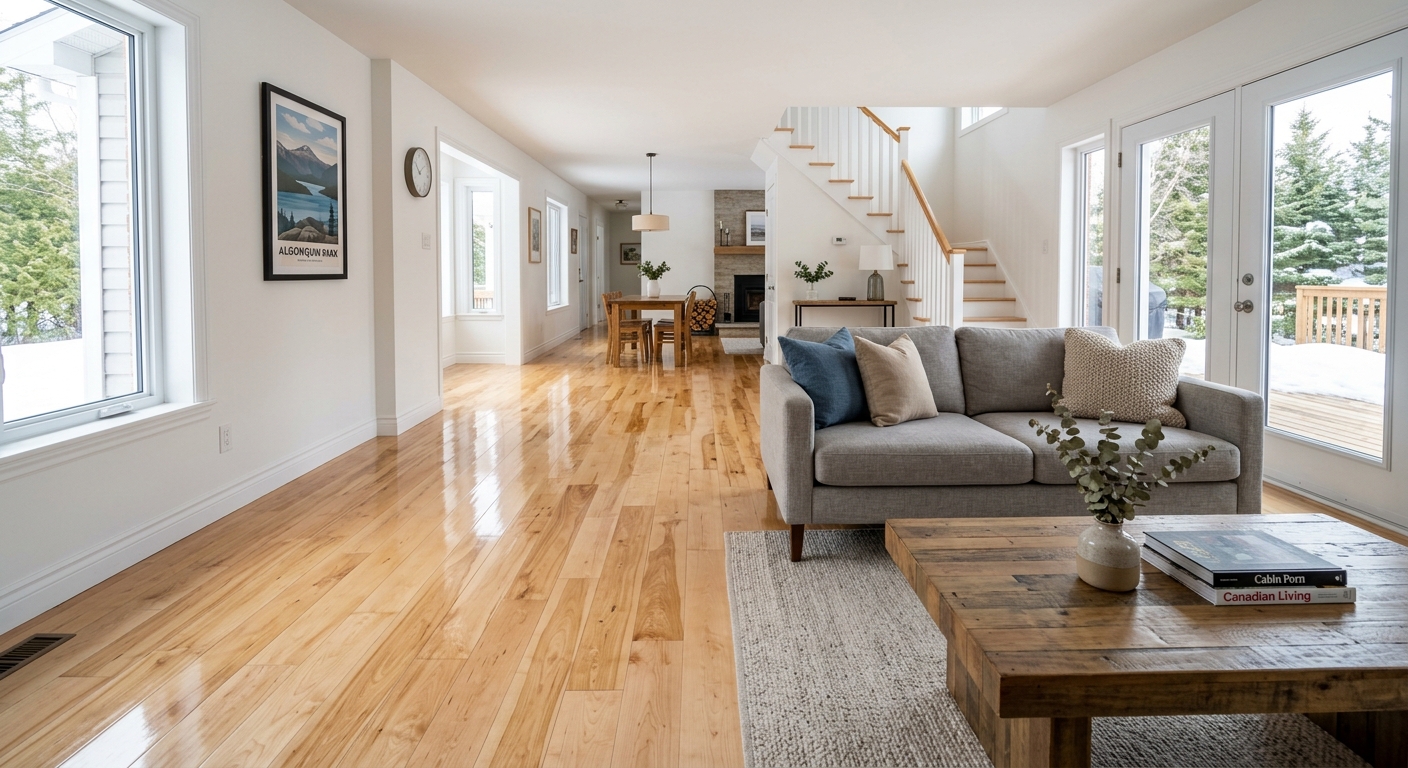
Flooring options and costs in Tumbler Ridge
Tumbler Ridge homeowners typically make flooring decisions based on durability and moisture behaviour first, because cold winters and humidity swings can be hard on materials. With a population of 2,399 and about 68.5% of households owning, many projects are full-home upgrades where contractors also have to contend with older housing stock. In fact, 18.3% of homes were built before 1981, which commonly means patching, OSB/ply upgrades, or subfloor levelling before new flooring can be installed. That prep work is one reason quotes can move quickly once measurements are confirmed.
In the Northeast B.C. market, engineered wood and luxury vinyl plank (LVP) are practical choices because they handle moisture changes and can be used on (or near) below-grade conditions better than solid hardwood. Solid hardwood remains a premium finish, but it’s usually reserved for main-floor, above-grade areas where you can keep indoor humidity stable. If your home has (or you’re adding) radiant heat, contractors in the Peace River region often steer you toward radiant-compatible options so the system performs efficiently during long, chilly stretches.
Demand is especially steady around downtown Tumbler Ridge and the older pockets near the highway corridor, where many basements and crawlspaces show seasonal moisture variation and where homeowners prioritize long-lasting, easy-care surfaces. Next, use the table below to compare typical material ranges for common flooring types in your area.
| Type |
Best Room |
Moisture Resistance |
Lifespan |
Price per sq ft |
| Solid hardwood (nail-down, above grade only) |
Main floor living areas |
Low to moderate; poor for basements |
30–60 years |
$11–$18 |
| Engineered hardwood (float or glue, above + on-grade) |
Main floor and some on-grade spaces |
Moderate to good |
20–40 years |
$10–$16 |
| Laminate (click-lock, above-grade) |
Living rooms, bedrooms (dry areas) |
Moderate; protect from standing water |
10–25 years |
$4–$10 |
| Luxury vinyl plank / LVP (waterproof, any level) |
Kitchen, hallways, basements |
High; handles vapour and spills |
15–25 years |
$6–$12 |
| Porcelain / ceramic tile |
Bathrooms, entryways, kitchens |
Very high (assuming good prep and grout) |
25–50 years |
$12–$22 |
| Carpet (broadloom or modular tile) |
Bedrooms, rec rooms (when moisture is managed) |
Low to moderate; avoid in damp basements |
8–15 years |
$3–$8 |
Prices are estimates only and vary by project scope, site access and material selection.
What affects the price of flooring in Tumbler Ridge
In Tumbler Ridge and across Northeast B.C., you can see the same general flooring plan priced 30–50% apart because the real cost is in preparation, material tolerances, and how the install adapts to moisture risk. Indoor humidity swings and any below-grade moisture are the key technical drivers. Solid hardwood expands and contracts with humidity, and it typically isn’t a good fit for basements or direct-on-concrete situations—so it often needs an above-grade environment to perform. That’s why engineered hardwood and luxury vinyl plank usually price out more predictably for Peace River-region basements and on-grade areas.
Cold regions also favour radiant-compatible flooring. That can narrow your selection and add to labour if an existing heat system needs adjustments or if the chosen product requires a specific underlay. Finally, older homes frequently need subfloor levelling or repair. In Tumbler Ridge, that prep work often runs an extra $1–$4 per sq ft depending on how out-of-flat the floor is and whether moisture remediation is required before install.
Here are a few real-world examples I see locally: (1) a 700 sq ft living area in an older house may require levelling and patching that pushes the project closer to engineered wood or LVP pricing instead of solid hardwood; (2) if the basement shows persistent dampness, tile or waterproof LVP becomes the practical route, while carpet may be deferred; and (3) if you want tile, expect the labour-intensive prep and setting work that typically sits within the higher $12–$22 per sq ft band. Those same factors influence why engineered wood (often around $10–$16 per sq ft) may feel “more expensive” than laminate at $4–$10 per sq ft, but can still be the better total-value choice when moisture protection and longevity are considered.
| Price Factor |
Why It Matters |
Cost Impact |
| Room area in sq ft |
Larger jobs require more material and longer labour time |
Direct; can swing totals by several thousand dollars |
| Subfloor condition |
Levelling/repairs may be needed before any click-lock or glue-down product goes in |
Often adds $1–$4 per sq ft |
| Moisture / below-grade install |
Solid hardwood is sensitive to humidity; basements typically require waterproof or vapour-tolerant systems |
Can change material choice and underlayment method |
| Material choice |
Solid vs engineered vs LVP vs tile varies in thickness, prep needs, and labour intensity |
Typical spread from $3–$8 to $11–$22 per sq ft (materials) |
| Removal and disposal of existing flooring |
Old glue, nails, or underlay can add hours and disposal fees |
Often $500–$2,000+ depending on what’s there |
| Stair nosing / transitions |
Transitions are labour and materials (tread nosings, reducers, mouldings) |
Charged per step or per linear foot; increases with complex layouts |
| Radiant heat compatibility |
Some products are not designed for heat cycling; correct underlay is critical |
May require better product selection and specific installation steps |
| Installation method |
Float, glue-down, and nail-down each require different labour, acclimation and prep |
Glue-down/solid nail-down can add prep and time compared to floating |
Permits & regulations in British Columbia
In British Columbia, a flooring installation itself generally does not require a building permit. However, some associated work often does. For example, if the project includes electrical work for radiant in-floor heating controls, you may need an electrical permit and inspection. Structural or building-related subfloor work can also trigger permit requirements when it goes beyond simple patching—especially if you’re repairing framing, changing load paths, or doing significant moisture remediation that affects building systems. In multi-unit buildings (including condominiums), the restrictions usually come from the condo corporation: sound transmission requirements and approved underlay rules can limit what you can install on upper floors and may require board approval before work begins.
Step-by-step, here’s how a Tumbler Ridge homeowner can verify a contractor’s credentials in B.C.: (1) check the contractor’s licensing status through the appropriate provincial registry for trades they perform (and confirm the exact scope in writing); (2) ask for a current certificate of liability insurance that lists your address/jobsite (or provides proof it covers the work); and (3) confirm workers’ coverage—commonly WSBC/WCB clearance—by requesting a clearance letter. Make these checks before signing, and keep copies.
Also, if you live in a condominium, request written approval covering product type (hard flooring), underlay, and any acoustic membranes. For hardwood or tile on upper levels, underlay selection can be the difference between compliant sound performance and redo work.
Best flooring for each room in your Tumbler Ridge home
Tumbler Ridge flooring should be chosen room-by-room around moisture risk, traffic and comfort—especially because Northeast B.C. winters can bring big indoor humidity swings. For living and dining areas, engineered hardwood or high-quality laminate gives you a warm, solid look without as much sensitivity to normal household changes as solid hardwood. In a master bedroom, carpet is a strong comfort option: it’s quieter underfoot and can help absorb sound in a house that’s otherwise all hard surfaces. If you want a cleaner, more durable feel, engineered hardwood is also a good fit where moisture is controlled.
Kitchens are where water incidents are most likely, so luxury vinyl plank (LVP) or large-format porcelain tile are the usual winners. LVP is typically easier and faster to install and it tolerates everyday spills well; tile gives a hard, stain-resistant surface but can be more labour-intensive because of prep, underlayment, and setting work. Basements in Tumbler Ridge are the clearest example: LVP is usually the clear winner because it’s waterproof and tolerates below-grade moisture vapour better than solid wood and most laminate. Bathrooms should stick to porcelain or ceramic tile only, since they handle ongoing splash and cleaning chemicals well.
If you have—or plan—radiant heat, ask your installer for radiant-compatible materials. In this region, radiant compatibility can be the difference between efficient heating performance and costly expansion issues later. As a dollar example, many homeowners compare laminate at roughly $4–$10 per sq ft to engineered hardwood often around $10–$16 per sq ft; when subfloor prep or humidity considerations are part of the plan, that extra $6–$8 per sq ft is sometimes justified by fewer callbacks and a longer usable lifespan.
| Room |
Best Material |
Why |
Moisture Risk |
Price Band per sq ft |
| Living / dining room |
Engineered hardwood |
Warm look with better tolerance than solid wood through humidity swings |
Low to moderate (monitor household humidity) |
$10–$16 |
| Master bedroom |
Carpet or engineered hardwood |
Carpet adds comfort and sound absorption; engineered wood stays durable |
Low (avoid damp storage areas adjacent to exterior walls) |
$3–$16 |
| Secondary bedrooms |
Laminate |
Value option with easier maintenance than carpet |
Low (good if rooms stay dry) |
$4–$10 |
| Kitchen |
Luxury vinyl plank (LVP) or porcelain tile |
Handles spills and frequent cleaning; tile adds maximum scratch resistance |
Moderate (spills and wet mopping) |
$6–$22 |
| Basement (finished) |
Luxury vinyl plank (LVP) |
Waterproof surface that tolerates below-grade moisture vapour better |
High (seasonal moisture variation) |
$6–$12 |
| Bathroom |
Porcelain / ceramic tile |
Best tolerance to water exposure and cleaning chemicals when installed correctly |
Very high (wet areas and condensation) |
$12–$22 |
How to choose a flooring contractor in Tumbler Ridge
Choosing the right flooring contractor in Tumbler Ridge comes down to credentials, clarity, and proven installation practices for Northeast B.C. conditions. Start by verifying British Columbia licencing for the scope being quoted (ask them what trade/coverage applies to their work). Next, request liability insurance and confirm the certificate is current and covers the jobsite. For workers’ coverage, ask for WSBC/WCB clearance (a clearance letter) or proof of coverage; reputable crews provide this without hesitation.
Then get 2–3 written, itemised quotes. You want a breakdown that separates labour, subfloor prep (levelling, patching, moisture remediation if needed), underlayment, floor removal/disposal, transitions, and any stair work—rather than a single lump sum. Read the scope carefully: confirm what’s included (e.g., disposal and haul-away), what’s excluded (trim, moving appliances, patch materials), and whether any permits are included if electrical or structural work is part of the project.
Warranty matters for both product and workmanship. Ask for the workmanship warranty length, what triggers exclusions, and whether it’s transferable if you sell your home. Payment schedule should be cautious: never pay more than 10–15% upfront, and use a holdback for substantial completion so quality is protected. Finally, insist on a start date and completion estimate in writing, and confirm responsibilities for site protection and dust control, especially when working around occupied homes.
- Confirm their licence and the exact scope of work in the contract.
- Request a current liability insurance certificate before work starts.
- Get WSBC/WCB clearance (or proof of coverage) in writing.
- Insist on an itemised quote: labour, materials, underlayment, prep, disposal.
- Clarify what “subfloor prep” includes (level, flatness goals, patch type).
- Confirm moisture testing/remediation steps if the basement shows dampness.
- Ask about acclimation requirements for wood and engineered products.
- Confirm transitions/stair nosing pricing: per step or per linear foot.
- Review warranty terms for both product and workmanship.
- Use a payment schedule with a holdback until completion.
- Get a written start date, estimated timeline, and protection measures.
- Ask who will handle dust control and site cleanup at the end of each day.
In Tumbler Ridge, red flags I watch for include: refusing to provide insurance/WSBC/WCB proof; quoting a “flat price” without measuring for subfloor prep; skipping a walk-through of basement moisture conditions; promising solid hardwood in a below-grade space without addressing humidity and flatness; and starting before confirming product acclimation, underlay requirements, and transition details.
Frequently asked questions — flooring in Tumbler Ridge
What flooring is best for a Tumbler Ridge basement?
For most Tumbler Ridge basements, luxury vinyl plank (LVP) is the practical first choice. It’s waterproof, handles moisture vapour better than solid hardwood, and it’s far more forgiving when humidity swings happen during Northeast B.C. winters. If your basement is fully finished and fairly dry, engineered hardwood can sometimes work on on-grade or well-prepared subfloors, but it still needs controlled moisture conditions. Carpet can be comfortable, but it’s a poor fit where dampness is a recurring issue because it can trap moisture and odours.
When you’re comparing costs, LVP often lands around the $6–$12 per sq ft range depending on wear layer and thickness. Solid hardwood is typically $11–$18 per sq ft, and in basements it often leads to callbacks if moisture isn’t addressed properly. (Statistics Canada, 2021 Census)
Can I install hardwood over concrete?
You may be able to install some hardwood-like products over concrete, but it depends on the type of “hardwood” and the concrete condition. Solid hardwood nail-down generally requires an above-grade, wood subfloor environment; it also needs stable humidity and usually isn’t recommended for basements or direct-on-concrete scenarios. Engineered hardwood is the common alternative in British Columbia because it’s built to tolerate humidity changes better and can be installed using approved systems (often float or glue-down, depending on product specifications).
Before installing anything, you should address concrete moisture and flatness: cracks, laitance, and high moisture vapour can ruin the installation. A reputable contractor will discuss moisture testing and levelling/patching—especially in older Peace River-area homes where subfloor prep is frequently required. If your quote includes engineered wood but not moisture/flatness steps, ask what they’re measuring and how they’ll prevent failure.
How long does flooring installation take?
Timelines in Tumbler Ridge depend on the square footage, product type, and how much subfloor prep is needed. A straightforward laminate or LVP install in an empty, well-levelled space can often be completed faster than tile because tile requires more prep, underlayment decisions, and careful setting and curing. Carpet is usually among the quickest once the subfloor is ready.
For older homes (and many in the Northeast B.C. area are built earlier—18.3% before 1981 per the local profile), extra time is commonly needed for levelling, patching, or moisture remediation. That’s the kind of work that can stretch timelines by days. To avoid surprises, ask your contractor to schedule a start date and a written completion estimate after they measure flatness and review the basement or on-grade areas.
As a practical reference: a 500–700 sq ft main-floor job may take roughly a few days; full home and basement prep can take longer, especially when transitions and stair work are included.
What flooring works with radiant heat?
Radiant heat compatibility is an important constraint in British Columbia because heat cycling affects how floors expand and contract. In practice, the safer choices are radiant-compatible laminate (specific products), engineered hardwood (that’s rated for in-floor heating), and many LVP products that are explicitly approved for radiant systems. Tile is often compatible too, since it transfers heat well—provided the installation follows the product and underlayment requirements.
Solid hardwood can be more complicated: it’s typically limited to radiant-compatible installs and stable humidity conditions. If a contractor recommends solid hardwood over radiant without referencing the wood’s radiant rating and acclimation requirements, that’s a concern.
Ask your installer what product is rated for radiant heat, which underlay is required (and which is prohibited), and whether acclimation and expansion gaps will be handled correctly. This avoids inefficient heating and reduces the risk of gapping or buckling later.
Engineered vs solid hardwood — what's the difference?
Solid hardwood is one continuous piece of wood and is usually installed nail-down in stable, above-grade conditions. Because it’s more sensitive to humidity changes, it’s not typically ideal for basements or where moisture vapour is an issue. In Tumbler Ridge’s Northeast B.C. climate, humidity swings and any below-grade moisture can make long-term performance harder unless the environment is very well controlled.
Engineered hardwood is made of multiple layers (a durable wear layer bonded to stable layers underneath). That construction generally gives it better dimensional stability, so it can handle typical indoor humidity changes and is more suitable for above-grade and some on-grade installations. In many regional projects, engineered wood is chosen over solid when the homeowner wants the wood look but expects moisture variability.
Cost-wise, solid hardwood commonly sits around $11–$18 per sq ft, while engineered often falls in the $10–$16 per sq ft range depending on the grade and install method. (Statistics Canada, 2021 Census)
Do I need to level my subfloor first?
In most Tumbler Ridge flooring projects, yes—subfloor levelling is either required or strongly recommended, and it’s especially important in homes built before 1981 where older subfloors may be uneven or have been patched over time. Even small dips and high spots can show through floating floors, prevent click-lock joints from locking properly, and create failure points at seams for LVP and laminate.
If the basement has moisture concerns, levelling may also be paired with moisture remediation. That’s different work than simple smoothing: it may involve addressing sources of dampness before installing a vapour-tolerant system. Contractors typically explain what they’re doing to meet flatness/level requirements and how that ties to your warranty.
Because levelling can change labour scope, always ask your contractor to include it in the itemised quote and explain the expected flatness standard. In older Northeast B.C. homes, that prep is one major reason upgrades can move across the $1–$4 per sq ft range for extra work.