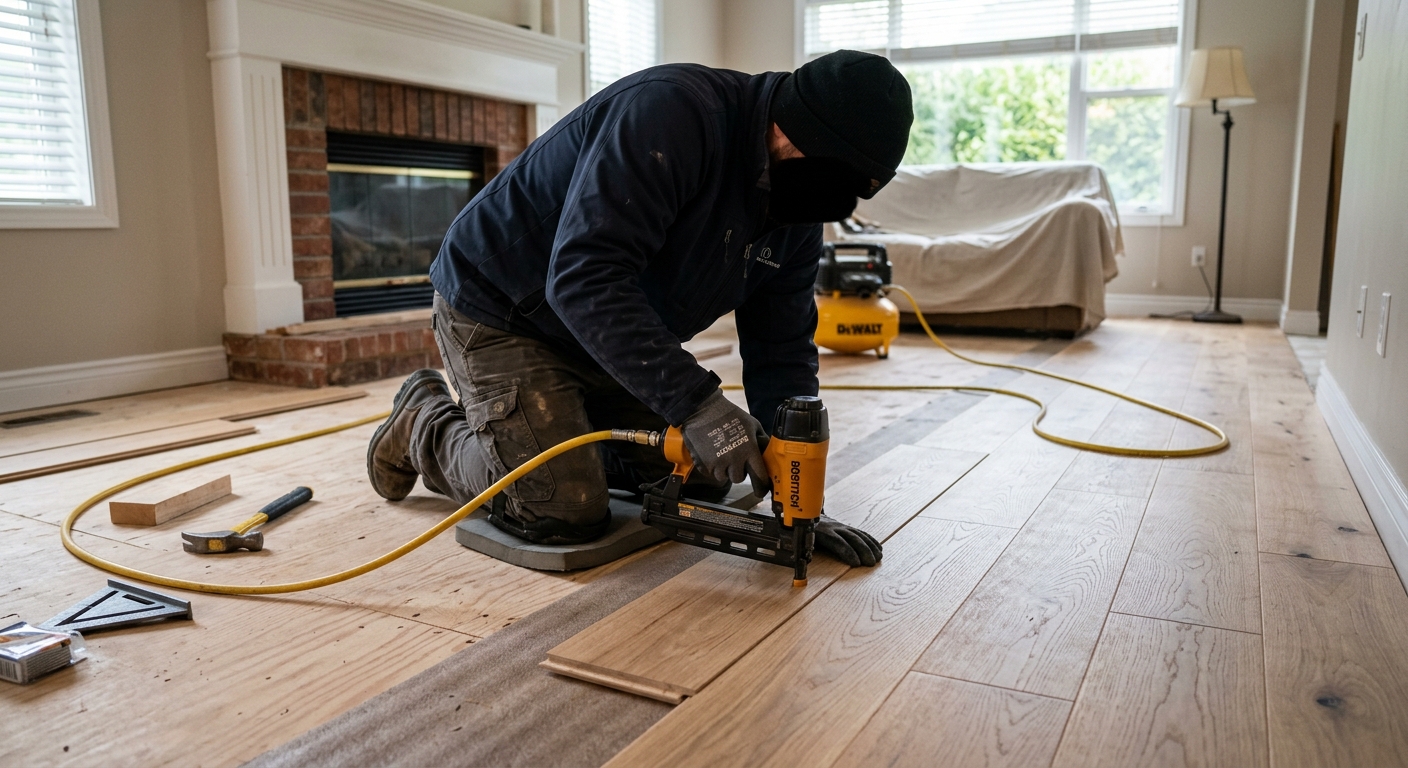
Flooring options and costs in Port Hardy
Port Hardy homeowners usually start with the same question: what flooring will last here without buckling or turning into a “gap-and-cup” problem. With a housing profile where many homes were built before 1981 and the majority of households are homeowners, upgrades are common—especially because older subfloors often need attention before anything “finished” goes down (71.3% of homes built before 1981, Statistics Canada, 2021 Census). On Vancouver Island and the Coast, humidity swings and coastal moisture mean indoor relative humidity can drift outside the ideal 35–55% range, so the installer’s prep work and the material’s dimensional stability matter as much as the surface you see.
That’s also why contractor availability and scope affect pricing. In Port Hardy, projects that require levelling wavy plywood, correcting uneven concrete, or adding a proper vapour-control underlayment typically cost more than “flat slab, no repairs.” Because many properties include older basements or below-grade areas, trades often steer clients toward engineered hardwood or LVP in moisture-prone zones. Solid hardwood can perform beautifully on main floors, but we’re more cautious on concrete slabs and anywhere chronic moisture risk exists.
In areas around Hardy Bay and the broader Port Hardy neighbourhoods where older housing stock is common, you’ll see more demand for engineered wood, waterproof LVP, and tile—materials that tolerate expansion/contraction and hold up during wet-season conditions. Next, use the table below as a budgeting baseline for common materials and realistic installed ranges.
| Type |
Best Room |
Moisture Resistance |
Lifespan |
Price per sq ft |
| Solid hardwood (nail-down, above grade only) |
Main floor living areas |
Low to moderate (must stay above-grade and dry) |
25–40 years |
$10 – $18 |
| Engineered hardwood (float or glue, above + on-grade) |
Living, dining, hallways |
Moderate to high (better dimensional stability) |
20–35 years |
$11 – $17 |
| Laminate (click-lock, above-grade) |
Secondary bedrooms, hallways |
Low to moderate (avoid chronic moisture) |
10–25 years |
$6 – $10 |
| Luxury vinyl plank / LVP (waterproof, any level) |
Kitchen, basement (finished) |
High (waterproof core when installed correctly) |
15–25 years |
$7 – $12 |
| Porcelain / ceramic tile |
Bathrooms, kitchens (and entryways) |
Very high (with correct underlayment) |
30+ years |
$14 – $25 |
| Carpet (broadloom or modular tile) |
Bedrooms, media rooms |
Low (needs clean dry conditions) |
7–15 years |
$6 – $11 |
Prices are estimates only and vary by project scope, site access and material selection.
What affects the price of flooring in Port Hardy
It’s common to see “the same” flooring project come back 30–50% different across Vancouver Island and the Coast because labour demand, material supply, and—most importantly—the amount of subfloor work required can change dramatically. In Port Hardy, many homes are older (71.3% built before 1981, Statistics Canada, 2021 Census), and older foundations and framing often mean uneven plywood or worn concrete. When you add coastal moisture management—vapour control, appropriate underlayment, and correct acclimation—your quote reflects the real prep needed, not just the finish material.
Technically, indoor humidity swings drive product behaviour. Solid hardwood expands and contracts with humidity and cannot be reliably installed over concrete or in basements; it also performs poorly where moisture is likely to persist. Engineered hardwood and luxury vinyl plank (LVP) handle humidity and below-grade conditions far better due to their layered construction and, for LVP, waterproof cores when installed with the correct system. Colder pockets and electrically heated homes also increase interest in radiant-compatible materials; many radiant-safe options include most engineered woods, LVP, many laminates, and tile, while solid hardwood options are more limited.
Two practical Port Hardy examples: if we find a wavy subfloor, levelling or repair can add about $1 – $4 per sq ft before new flooring goes down. If you’re replacing existing carpet plus tack strip and disposing of underlay, expect additional labour and haul-off; that can push a “carpet install” from the lower end of the $4–$9 carpet labour band toward the higher end once prep and disposal are included. Conversely, a simple above-grade installation with a flat subfloor can keep you closer to the lower end of the $9–$18 hardwood range.
| Price Factor |
Why It Matters |
Cost Impact |
| Room area in sq ft |
Materials and labour scale directly with square footage |
Low per-sq-ft spreads on small jobs, higher per-sq-ft on larger fixes |
| Subfloor condition |
Levelling, patching, or replacing damaged sections changes prep time |
Often adds about $1–$4 per sq ft in older homes |
| Moisture / below-grade install |
Rules out solid hardwood on slabs and basements; vapour control is required |
Can shift you to engineered/LVP or tile systems; typically higher prep costs |
| Material choice |
Solid, engineered, LVP, laminate, or tile have different product and underlayment costs |
Hardwood and tile usually raise total; LVP/laminate often reduce cost |
| Removal and disposal of existing flooring |
Tear-out, hauling, and dump fees vary by what’s installed and how it was bonded |
Commonly adds a noticeable amount to the overall project budget |
| Stair nosing / transitions |
Transitions and nosing require custom-cut pieces and more labour time |
Charged per step or per linear foot; can increase the “average” rate |
| Radiant heat compatibility |
Not every product is rated for radiant; some require specific underlayment |
May limit options and affect underlayment and labour details |
| Installation method |
Float, glue-down, and nail-down require different subfloor and technique |
Glue-down and nail-down can cost more depending on prep requirements |
Permits & regulations in British Columbia
In British Columbia, installing new flooring itself typically does not require a building permit. Replacing carpet, laminate, engineered wood, LVP, or tile floors over an existing floor surface is generally considered finish work. However, some related tasks can trigger permits—especially when they overlap with structural repairs, moisture remediation systems, or in-floor heating.
Work that may require permits includes: electrical work tied to in-floor heating (new circuits, thermostat rewiring, or any changes to existing heating controls) and significant structural subfloor replacement where it becomes more than patch-and-repair (for example, correcting structural failure or major framing adjustments). If moisture problems are severe, remediation steps may also involve trade coordination and inspections depending on what’s being corrected.
For condominiums, even when a permit isn’t required, sound-transmission rules are often strict. Condo corporations can restrict or require specific underlay under hard flooring on upper floors to meet sound requirements, so you should confirm the building’s requirements in writing before starting.
To verify your contractor in Port Hardy: (1) confirm their BC licence status through the appropriate provincial online registry; (2) request a current certificate of insurance (general liability) and verify dates and coverage; (3) ask for WSIB/WCB clearance (and a worker’s compensation clearance letter, where applicable) and keep a copy for your records. A reputable installer will provide these documents before you sign.
Best flooring for each room in your Port Hardy home
Choosing the right flooring by room matters a lot in Port Hardy because moisture risk and comfort needs differ floor to floor. For living and dining areas, engineered hardwood or high-quality laminate gives you a warm look while tolerating normal humidity swings better than solid wood. In bedrooms, people often choose carpet for comfort and sound absorption—especially in homes where footsteps carry through older structures—though it must be kept clean and dry to avoid trapping odours if humidity runs high.
For kitchens, the coastal lifestyle makes water management key: LVP or large-format porcelain tile is usually the best fit. Basements (finished) are where we’re most consistent: LVP is typically the clear winner because it’s waterproof and performs far better over damp-prone subfloors than solid hardwood or most laminate. Bathrooms should be porcelain/ceramic tile only, using a proper wet-area system and correct underlayment so water stays where it belongs.
Finally, radiant heating is increasingly popular in British Columbia. Many engineered woods, LVP, laminates (rated for radiant), and tile can work over radiant systems with the correct underlayment and temperature control—but many solid hardwood options are limited and require more strict humidity and installation conditions. If your budget is tight, you may justify an upgrade like moving from laminate at about $6–$10 per sq ft to LVP at roughly $7–$12 per sq ft when the room is prone to spills or you want a basement-ready surface.
| Room |
Best Material |
Why |
Moisture Risk |
Price Band per sq ft |
| Living / dining room |
Engineered hardwood |
Warmth and realistic wood feel with better stability through humidity swings |
Low to moderate |
$11 – $17 |
| Master bedroom |
Carpet or engineered hardwood |
Carpet adds comfort and quieter sound; engineered keeps a cleaner, harderwearing surface |
Low |
$6 – $16 |
| Secondary bedrooms |
Laminate |
Good value and easy maintenance with click-lock stability on flat, dry subfloors |
Low |
$6 – $10 |
| Kitchen |
Luxury vinyl plank (LVP) |
Waterproof core helps with spills and day-to-day cleaning without worrying about moisture |
Moderate |
$7 – $12 |
| Basement (finished) |
Luxury vinyl plank (LVP) |
Best dimensionally stable choice for below-grade conditions when installed with correct vapour control |
High |
$7 – $12 |
| Bathroom |
Porcelain / ceramic tile |
Designed for wet areas and long service life when installed as a proper system |
Very high |
$14 – $25 |
How to choose a flooring contractor in Port Hardy
When you’re hiring a flooring contractor in Port Hardy, start with proof and process—then move to pricing clarity. In British Columbia, confirm the contractor’s eligibility and standing by checking their BC licence details through the provincial online resources, and request their certificate of insurance so you can see coverage dates and limits. Ask for worker compensation clearance (WSIB/WCB as applicable) and keep a copy of the clearance letter for your records. If a contractor can’t provide documentation up front, that’s a warning sign.
Next, get 2–3 itemised written quotes that break out labour and materials separately, including underlayment/vapour control, transitions, and stair nosing (if applicable). Don’t accept a quote that only gives one lump sum without listing what’s included. Read the scope line-by-line: is subfloor levelling included or treated as an extra? Is permit-related work included (when it applies)? Is disposal/haul-off included, or is old flooring charged separately? Ask about acclimation time and whether the installer will check and document moisture conditions on site.
For warranty, verify both workmanship (how long the installer covers failures like gapping or separation) and the product manufacturer warranty. Ask if the warranty is transferable to you, and whether proof of purchase and correct installation details are required. Payment should be staged: never pay more than about 10–15% upfront, and use a holdback until the job is complete and you’ve confirmed clean edges, transitions, and final height adjustments.
- Verify BC licence status through the provincial registry before scheduling.
- Request a current certificate of insurance and confirm coverage dates.
- Get WSIB/WCB clearance letter and keep it on file.
- Insist on a written, itemised quote (labour + materials + underlay/vapour control).
- Confirm who handles disposal of old flooring and whether dump fees are included.
- Ask whether subfloor levelling/repair is included or billed separately.
- Request product-specific specs: radiant-compatible rating (if relevant) and recommended underlayment.
- Clarify transition and stair nosing pricing per step or per linear foot.
- Confirm acclimation expectations for humidity swings before installation.
- Get the start date and estimated completion date in writing.
- Confirm warranty length and what constitutes “workmanship” vs “product” coverage.
- Use a payment schedule with a holdback; avoid large upfront payments.
Red flags in Port Hardy include quotes that don’t mention subfloor prep, no written scope for removals/disposal, warranties that are “verbal only,” missing insurance/clearance documentation, and installers who refuse to discuss moisture testing or acclimation in our coastal humidity.
Frequently asked questions — flooring in Port Hardy
How do I prepare my subfloor before new flooring?
In Port Hardy, preparation is usually the difference between a long-lasting floor and one that fails early. Before installation, the goal is a flat, solid, clean, and dry substrate. For wood subfloors, check for squeaks, loose boards, and any movement; for concrete or patched areas, ensure there’s no moisture problem and that the surface is sound. Many older homes in the area have wavy plywood or aged patchwork, and levelling/repair is often where cost changes—commonly adding about $1–$4 per sq ft before product install. Your contractor should address high spots, fill low areas, and use the right underlayment/vapour control for the flooring type. If you’re considering solid hardwood, the subfloor must meet stricter conditions; engineered or LVP is more forgiving in below-grade situations.
Is cork or bamboo flooring a good choice in Port Hardy?
Cork and bamboo can look great, but in Port Hardy we’re careful because coastal humidity swings can affect dimensionally sensitive materials. Cork is naturally resilient, yet it’s not automatically “waterproof,” and underlayment/vapour control requirements are still critical in moisture-prone homes. Bamboo can be harder and sometimes more stable than softer natural woods, but it still doesn’t behave like LVP in chronic damp areas. In a typical Port Hardy setup, cork is often a better candidate for above-grade living spaces than for basements, and it should be installed only when the subfloor is properly flat and dry. If your quote is aiming for budget floors like laminate around $6–$10 per sq ft, cork/bamboo can be priced higher and may need extra prep. For below-grade rooms, LVP generally remains the safer value choice because it’s waterproof when installed correctly.
What is the difference between floating and glued-down flooring?
Floating flooring is installed without permanently bonding the planks to the subfloor; click-lock systems “float” over an underlayment, with expansion gaps at the perimeter. Glued-down flooring is bonded directly to the subfloor (or to a proper underlayment system), which can reduce some minor movement but requires stricter surface preparation—especially with glue and moisture-control layers. In Port Hardy, where humidity and coastal moisture can move outside ideal indoor ranges, floating engineered and LVP are popular because they’re designed to handle normal expansion/contraction without the same sensitivity that glue can have to subfloor conditions. Glued-down methods can still work well, but your contractor must verify the subfloor is ready and compatible with the adhesive system. If you have radiant heat, the installation method and manufacturer guidance matter—ask for radiant-rated specs in writing.
What flooring holds up best to pets in a Port Hardy home?
For pets in Port Hardy, look for surfaces that resist scratches, tolerate accidents, and don’t fear routine clean-up. Usually, waterproof LVP is a top pick for kitchens, hallways, and finished basements because spills and “oops” clean up quickly and the core is designed for wet conditions. High-quality laminate can also work well above grade, but it’s more vulnerable at seams if water sits for long periods. For a more natural look, engineered hardwood can be durable, yet we remain cautious in moisture-prone areas and in homes where water may be tracked in from rainy coastal days. If you’re comparing budgets, LVP often lands around $7–$12 per sq ft, while carpet can be more comfortable but may stain or hold odours if moisture gets trapped. Whatever you choose, use felt pads, consider a quality underlay, and keep humidity controlled to reduce gapping risks.
How do I fix squeaky floors in my Port Hardy home?
Squeaks usually come from movement between subfloor layers, nails or screws that have loosened, or gaps where boards flex. The right fix depends on the cause, which is why we start by locating the source—often in older Port Hardy homes with pre-1981 construction where subfloors can be uneven or aged (Statistics Canada, 2021 Census). If you can access the subfloor from below (unfinished basement, crawl space), adding screws/fasteners and properly fastening joists can stop squeaks before any new flooring goes down. If the squeaks are only on top and you’re replacing floors, it’s still best to address subfloor stability during prep—lifting and re-fastening areas may prevent future noise. Don’t cover squeaks with carpet or LVP and hope it goes away; the sound can return once the new floor settles. A good contractor will include subfloor correction in scope or clearly price it as a separate line item.
What is luxury vinyl plank and is it worth it in Port Hardy?
Luxury vinyl plank (LVP) is a layered flooring product with a waterproof core and a wear layer on top, designed to handle everyday spills and moisture better than many traditional materials. In Port Hardy, where coastal humidity swings and older basements are common, LVP is often “worth it” because it reduces the risk of cupping, gapping, and moisture-related failures—especially in rooms like kitchens and finished basements. It also tends to be more forgiving when subfloors have minor irregularities compared with solid hardwood. Pricing varies by product tier, but many installed projects in this area fall around $7–$12 per sq ft, which can be a strong value versus tile when you want waterproof performance without the heavier install. For radiant heating, confirm the product is rated and use the manufacturer-recommended underlayment system.