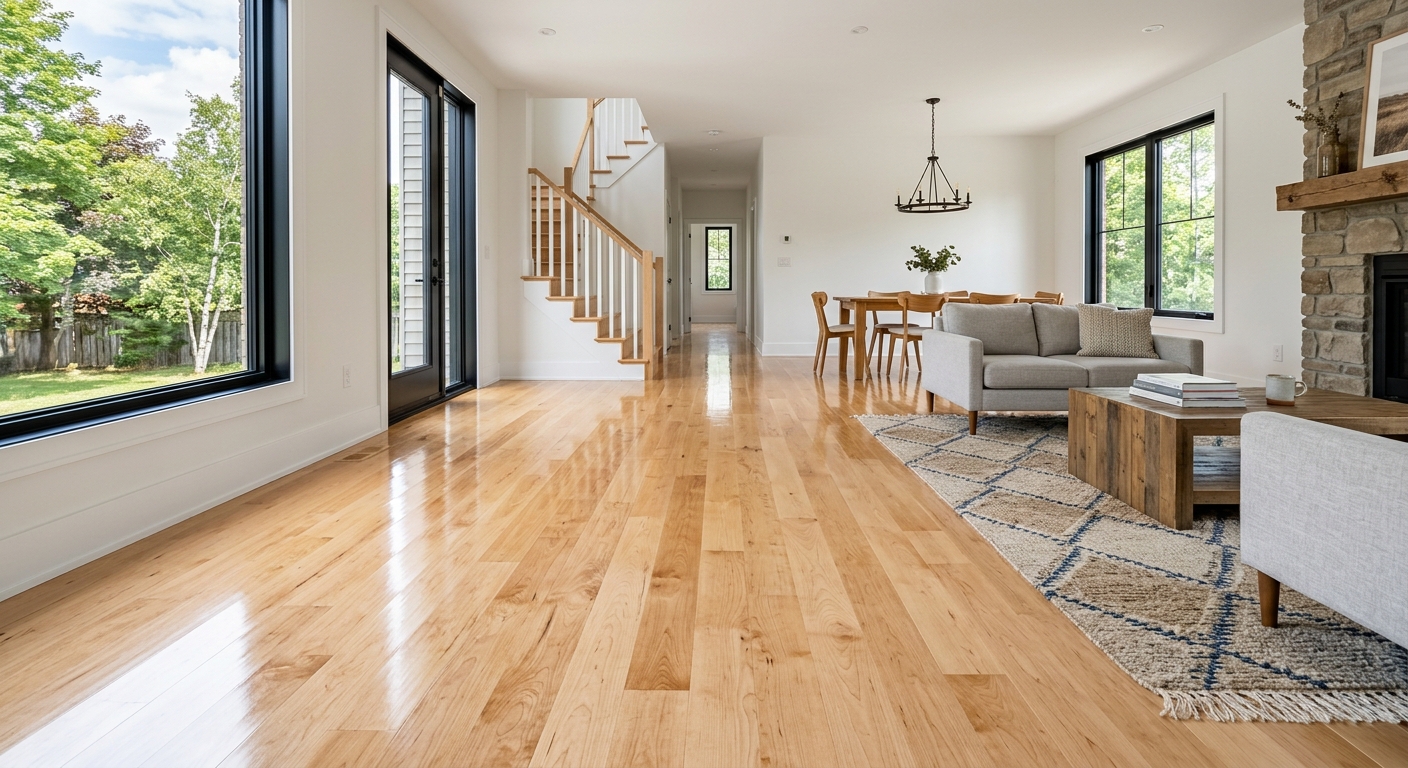
Flooring options and costs in Prince George
Flooring in Prince George has a very different feel than major-metro British Columbia because the Cariboo region swings through winter dryness and summer humidity, and many homes are older. In fact, 61.7% of dwellings were built before 1981, which means uneven subfloors, patched areas, and the need for levelling or new plywood before finish flooring goes down. That prep work can add a meaningful bump to your budget before you ever see the new surface.
On top of that, the climate affects dimensional stability. Solid hardwood can expand and contract with seasonal humidity, and it’s not a basement-friendly choice—especially where there’s any history of moisture or minor seepage. For most Cariboo homes, homeowners get better long-term performance with engineered hardwood or luxury vinyl plank (LVP), particularly when paired with the right vapour barrier and underlay. Radiant heat compatibility is also a big consideration here, because colder-region homes increasingly include in-floor heating, and not every material is rated for it.
Another cost driver is contractor availability and scheduling: projects often get more competitive during peak summer install windows, while winter work can be limited by indoor drying/conditioning needs. In neighbourhoods like College Heights and the broader central Prince George area, trades are especially busy for basement finishing and main-floor refreshes, where subfloor prep is common. With that in mind, the table below shows typical installed cost bands by product type so you can compare quotes side-by-side.
| Type |
Best Room |
Moisture Resistance |
Lifespan |
Price per sq ft |
| Solid hardwood (nail-down, above grade only) |
Main living areas (above grade) |
Low to moderate (not for basements) |
30–50 years (with stable humidity) |
$12–$22 |
| Engineered hardwood (float or glue, above + on-grade) |
Living areas, bedrooms |
Moderate to high (better with swings) |
20–35 years |
$12–$22 |
| Laminate (click-lock, above-grade) |
Bedrooms, living/dining (above grade) |
Moderate (protect seams; avoid standing water) |
10–25 years |
$6–$12 |
| Luxury vinyl plank / LVP (waterproof, any level) |
Kitchens, basements, main floors |
High (waterproof core; handles vapour conditions better) |
15–25 years |
$6–$12 |
| Porcelain / ceramic tile |
Bathrooms, entryways, kitchens |
High when properly installed (grout/seal matters) |
25–40+ years |
$15–$30 |
| Carpet (broadloom or modular tile) |
Bedrooms, stairs (comfort/sound) |
Low to moderate (avoid damp basements) |
7–15 years |
$5–$10 |
Prices are estimates only and vary by project scope, site access and material selection.
What affects the price of flooring in Prince George
Even for the “same” flooring, quotes in Prince George can vary by 30–50% across the Cariboo region and British Columbia because the real work isn’t just laying boards or tile—it’s preparation, moisture control, and how the installer handles uneven older floors. In a market where 21,665 homeowner households make up a large share of the housing base (Statistics Canada, 2021 Census), contractors are busy, but the scope differences are often large: one quote includes subfloor levelling and underlayment upgrades, while another assumes the existing floor is flat and dry enough.
The Cariboo climate is a technical cost driver. Indoor relative humidity swings can cause solid hardwood to cup and gap, and solid wood generally cannot be glued or floated over concrete for basement applications without strict moisture control. Engineered hardwood and LVP handle humidity and below-grade installations far better, so they’re typically specified for basements where older homes may have past moisture or minor seepage. Colder-region comfort needs also matter: radiant-heat-compatible products can restrict options and affect labour and materials pricing.
Older housing stock is where many dollars get added. Homes built before 1981 (61.7%) frequently require patching, grinding, or new plywood—often in the $1–$4 per sq ft range before you even start the finish. For example, an LVP install might land in the $6–$12 per sq ft band, but if you’re levelling a wavy subfloor and adding a proper vapour barrier, you can quickly push toward the upper end. Tile can feel “expensive” at $15–$30 per sq ft, but on wet areas it may still be the better value versus repeated repairs or replacing moisture-damaged flooring later.
Concrete examples from Prince George jobs include: (1) adding self-levelling compound or plywood to correct uneven joists; (2) specifying a full moisture-managed system in basements to protect materials; and (3) using radiant-heat rated adhesives and expansion allowances, which changes both product selection and installation method. Those choices are why your quote needs a careful line-by-line comparison before you decide.
| Price Factor |
Why It Matters |
Cost Impact |
| Room area in sq ft |
Materials (and cutting waste) scale with square footage; labour is time-based |
Direct proportional cost—large rooms swing totals the most |
| Subfloor condition |
Uneven boards, dips, or failing OSB/plywood must be corrected for a flat finish |
Often adds $1–$4 per sq ft depending on repairs/levelling |
| Moisture / below-grade install |
Basements require vapour control; rules out solid hardwood in most cases |
Can add vapour barrier/underlay and raise material selection costs |
| Material choice |
Solid vs engineered vs LVP vs tile changes the installation system and prep needs |
Solid/tile usually cost more; LVP often stays in the lower bands |
| Removal and disposal of existing flooring |
Demo time, hauling fees, and subfloor exposure affect labour and schedule |
Commonly a meaningful add-on if removal wasn’t included |
| Stair nosing / transitions |
Transitions and nosings are labour-heavy and require exact matching |
Charged per step or per linear foot; increases total noticeably |
| Radiant heat compatibility |
Some products won’t perform over heating lines or require specific underlay/adhesives |
May add product premiums and restrict options |
| Installation method |
Float vs glue-down vs nail-down changes prep, adhesive/fasteners, and time |
Glue-down typically increases labour and material line items |
Permits & regulations in British Columbia
In British Columbia, the flooring installation itself generally does not require a building permit. Where permits can enter the picture is when the flooring project includes “associated work” that touches building services or structure. For example, if you’re repairing or modifying subfloors in a way that becomes structural (or involves significant changes to framing), or if your job includes in-floor heating circuit work (electrical), you may need the appropriate permit(s). Similarly, if moisture remediation involves more than surface-level prep—such as addressing plumbing leaks or mechanical drainage—other scopes may trigger permit requirements.
For condos, the rules can be even more important than permits. Many condominium corporations restrict modifications that affect sound transmission (often referenced through STC/IIC performance) and require specific underlay for hard flooring on upper floors. Always review the condo declaration and request board approval in writing before installing hardwood or tile above grade in a multi-unit building.
For a homeowner in Prince George, verify a contractor’s British Columbia compliance step-by-step:
- Check the contractor’s licence status using the online registry relevant to their trade category.
- Ask for a certificate of liability insurance and confirm it covers the scope of flooring installation (not just general business).
- Request proof of WSIB/WCB coverage (clear evidence of coverage or an acceptable exemption where applicable).
- Get a written clearance letter or confirmation documentation directly from the insurer/employer where required.
- Keep copies with your contract and quote paperwork.
That checklist doesn’t replace due diligence, but it helps you avoid the most common “quote surprises” in older Cariboo homes.
Best flooring for each room in your Prince George home
Choosing the right flooring in Prince George is really about pairing the material with the room’s moisture exposure, traffic level, and comfort needs—then matching it to the Cariboo climate realities. For living and dining rooms, engineered hardwood or high-quality laminate tends to be the sweet spot: you get warmth and a more natural look without the same humidity sensitivity that makes solid hardwood risky. In the master bedroom, carpet is still a strong comfort choice (quiet, warm underfoot), while engineered hardwood is ideal if you prefer a harder surface.
For kitchens, go with luxury vinyl plank (LVP) or large-format porcelain tile. Both handle frequent spills and easy cleaning better than laminate, and LVP is especially forgiving if there are minor subfloor unevenness issues common in older homes. In basements (finished), LVP is the clear winner in Prince George because it’s waterproof and performs much better in moisture-prone conditions than solid wood. Bathrooms are the exception: porcelain or ceramic tile is the standard because it’s durable and water-tolerant when installed with the correct waterproofing and grouting system.
Radiant heat compatibility matters in colder-region homes. When a room has in-floor heating, you’ll want engineered hardwood and many LVP lines that are specifically rated for radiant heat, along with the right underlay/adhesives and appropriate expansion allowance. A practical example: if tile is at $15–$30 per sq ft and LVP is at $6–$12 per sq ft, you’d justify the higher tile spend in a bathroom for long-term moisture performance—while LVP can deliver similar everyday functionality in basements for less money.
| Room |
Best Material |
Why |
Moisture Risk |
Price Band per sq ft |
| Living / dining room |
Engineered hardwood |
Warm look, better stability than solid in humidity swings |
Low to moderate (depends on ventilation and seasonal RH) |
$12–$22 |
| Master bedroom |
Carpet or engineered hardwood |
Carpet adds comfort and sound absorption; engineered keeps a clean finish |
Low |
$5–$12 |
| Secondary bedrooms |
Laminate (above grade) or carpet |
Laminate is cost-effective; carpet is better for warmth and noise |
Low |
$6–$10 |
| Kitchen |
Luxury vinyl plank (LVP) or porcelain tile |
LVP handles spills; tile offers maximum moisture durability |
Moderate (spills/cleaning) |
$6–$30 |
| Basement (finished) |
Luxury vinyl plank (waterproof) |
Best performance for below-grade moisture conditions and vapour concerns |
Moderate to high |
$6–$12 |
| Bathroom |
Porcelain / ceramic tile |
Built for wet areas with correct installation system |
High |
$15–$30 |
How to choose a flooring contractor in Prince George
When you hire a flooring contractor in Prince George, start by verifying British Columbia compliance and coverage. Ask for their licence details for their trade area, then request a current certificate of liability insurance showing the business name and valid dates. Next, verify WSIB/WCB coverage: you want clear proof that they are covered for workers on your site (or the appropriate documentation for any exemption). A reputable installer will hand these over quickly and won’t pressure you to decide before you’ve reviewed the documents.
Get 2–3 itemised written quotes rather than lump sums. The best quotes break down labour and materials separately (underlay/vapour barrier, adhesives, levelling/patching, stair nosings, transitions, and disposal). Read the scope carefully: confirm what’s included (subfloor prep to a specified flatness), whether permit pulls are included if applicable, and whether old flooring removal and hauling are part of the price.
Warranty terms are another deal-maker. Confirm the workmanship warranty length and whether the product/manufacturer warranty is valid for your installation method. If you sell the home, ask whether any warranty is transferable. For payment, never pay more than 10–15% upfront; use a holdback until the job is complete and walkthrough items are addressed. Finally, insist on a written start date and an estimated completion timeline, especially since Cariboo projects can be delayed by seasonal indoor conditioning needs.
- Verify licensing/trade status and keep the reference number or confirmation.
- Require a current certificate of liability insurance (not expired).
- Confirm WSIB/WCB coverage with proof and dates.
- Use a written scope: prep level, underlay/vapour barrier details, and flatness requirements.
- Demand an itemised labour + materials breakdown (no “mystery totals”).
- Ask who disposes of demo waste and where hauling fees are included.
- Confirm stair nosing and transitions are priced clearly per step/linear foot.
- Check if radiant heat compatibility is included for rooms with in-floor heating.
- Require written start and completion dates (and weather/conditioning assumptions).
- Confirm acclimation requirements for wood/LVP are included and scheduled.
- Get a workmanship warranty in writing and confirm what it covers.
- Keep payment terms conservative: 10–15% max upfront, holdback until final walkthrough.
Red flags I see in Prince George include: (1) refusing to provide insurance/WSIB/WCB proof; (2) quotes that don’t mention subfloor levelling even when older homes show dips; (3) no written scope for vapour barriers in basements; (4) vague timelines (“sometime next week”) and missing completion dates; and (5) pressure for large deposits upfront.
Frequently asked questions — flooring in Prince George
What is luxury vinyl plank and is it worth it in Prince George?
Luxury vinyl plank (LVP) is a multi-layer floor with a printed wear layer on top and a stable core underneath. In Prince George and the wider Cariboo region, it’s often worth it because it handles the moisture and vapour conditions better than laminate and it avoids many humidity problems associated with solid hardwood. Many LVP products are waterproof, which makes them a smart choice for basements where older homes can have minor seepage or past moisture history. In price terms, LVP typically lands in the $6–$12 per sq ft band (installed), which can be a big advantage over tile ($15–$30 per sq ft) when you want durable, low-fuss performance. The key is using the right underlay/vapour barrier and ensuring proper subfloor prep.
How much does flooring cost in Prince George?
In Prince George, flooring costs depend heavily on product type and what subfloor work is required. As a baseline, hardwood-style floors generally land around $12–$22 per sq ft, while laminate and LVP commonly sit in the $6–$12 per sq ft band. Tile tends to be higher, often $15–$30 per sq ft due to labour-intensive layout, prep, and setting methods. Carpet installation is usually in the $5–$10 per sq ft range. The “hidden” variable is prep: because 61.7% of local dwellings were built before 1981 (Statistics Canada, 2021 Census), it’s common to correct unevenness, patch dips, or add plywood before finish flooring. That prep can raise your effective per-sq-ft cost, even when your finish material looks affordable. For best accuracy, insist on itemised quotes.
Hardwood vs laminate vs vinyl plank — which is best?
There isn’t one winner in Prince George; the best choice matches the room and moisture risk. Solid hardwood is beautiful, but in British Columbia’s climate swings it’s usually limited to above-grade areas. For basements, solid wood is a poor fit because humidity and below-grade moisture can cause cupping and gapping. Engineered hardwood is often the compromise: it’s more stable than solid and can work better across typical indoor humidity changes, with proper installation. Laminate is cost-effective in $6–$12 per sq ft style budgets, but it’s more vulnerable at seams if there’s any moisture intrusion. Vinyl plank (especially waterproof LVP) is usually the most forgiving option for Prince George basements and kitchens—often delivering better long-term performance. If you want “best overall” for mixed conditions, LVP often wins; if you prioritize a natural wood look above grade, engineered hardwood is typically the better move.
What flooring is best for a Prince George basement?
For a Prince George basement, the best-performing option for most homes is waterproof luxury vinyl plank (LVP) installed as a full moisture-managed system. Cariboo homes often have colder subgrade conditions and winter humidity shifts, and older housing stock can mean uneven floors or past moisture concerns. LVP handles vapour and minor moisture exposure far better than solid hardwood and most laminate, and it’s comfortable enough for frequent basement use. Where you’ll notice the difference between a good and great basement floor is in the prep: levelling/patching, correct vapour barrier or underlay, and careful detailing around edges and transitions. Carpet is generally not my first pick for basements unless the space is very dry and climate-controlled. If you’re comparing quotes, look for whether the contractor includes vapour control and subfloor flattening—those line items protect the long-term result.
Can I install hardwood over concrete?
In many Prince George homes, “hardwood” is where confusion starts. Solid nail-down hardwood is typically an above-grade product and isn’t designed to be glued or floated over concrete the way some engineered systems are. If you want a real wood look over concrete, the safer approach is usually engineered hardwood, installed with the appropriate method and moisture-control plan. The concrete’s moisture level, slab condition, and the presence of a vapour barrier matter—especially in basements where below-grade moisture risk is higher. This is one reason you’ll often see engineered wood specified instead of solid for Cariboo basements. If your plan is concrete slab flooring, ask the contractor what testing and moisture mitigation they’ll do, and whether their system is rated for concrete and your intended installation method.
How long does flooring installation take?
Typical installation timelines in Prince George depend on area size, subfloor prep, and the product chosen. A straightforward above-grade laminate or LVP job for a single floor can often be completed in a few days once materials are staged, while more complex projects with removal, levelling, and transitions can take longer. Tile usually requires extra time for careful layout, setting, grouting, and cure periods, especially if the contractor is also correcting uneven surfaces. Basements may take additional time because older homes often require patching and levelling before waterproof flooring is installed. Also factor in acclimation and indoor conditioning—critical in a climate with winter dryness and summer humidity swings. Always confirm a written start date and completion estimate in your contract, and ask how they handle weather or material delays.