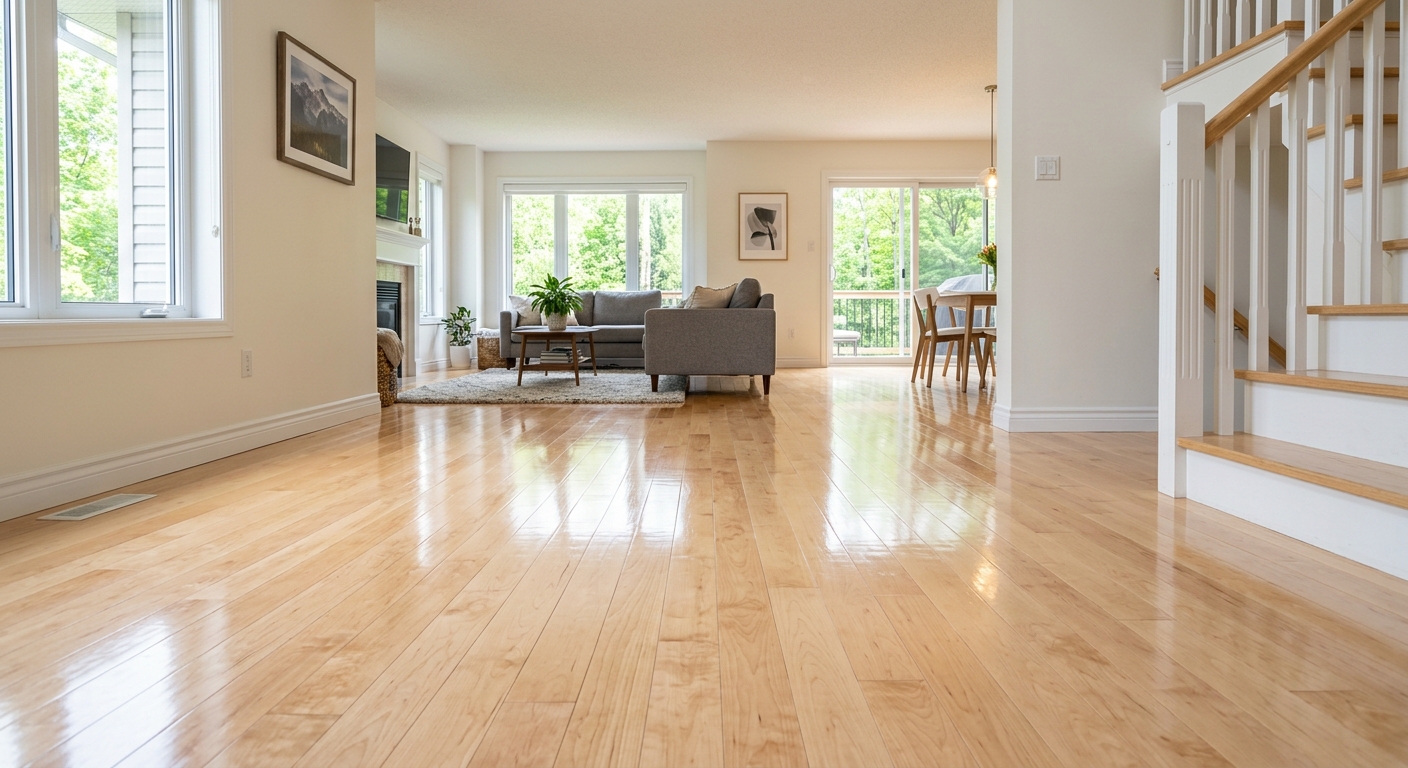
Flooring options and costs in Cache Creek
Flooring projects in Cache Creek, British Columbia tend to fall into two cost realities: most homes are older (65.3% were built before 1981), and that age often means uneven subfloors, patched areas, or past renovations that need levelling before a new floor can perform. With fewer options to “hide” a wavy subfloor, contractors typically plan more labour for grinding, OSB/plywood patching, or self-levelling compounds—commonly adding roughly $1–$4 per square foot depending on how far out-of-flat the surface is.
In the Thompson–Okanagan, dry winters and hot, sometimes smoky summers create indoor humidity swings, especially where people run wood stoves or HVAC inconsistently. That seasonal movement matters for wood products: solid hardwood expands and contracts with humidity and is best kept above grade only. For crawlspaces, basements, and any below-grade areas, engineered hardwood and luxury vinyl plank (LVP) are usually more cost-effective long-term because they tolerate minor slab moisture and occasional spills better.
In Cache Creek, trades also stay busy in the older core near the downtown/main service area and along Highway 1, where many renovations replace worn carpets and upgrade entry-level flooring. That local demand can affect turn-around times and the installed price, especially when disposal and levelling are required.
Use the table below as a baseline to compare material choices and the typical installed cost ranges before you request a detailed quote.
| Type |
Best Room |
Moisture Resistance |
Lifespan |
Price per sq ft |
| Solid hardwood (nail-down, above grade only) |
Living rooms, hallways, upper levels |
Low to moderate (humidity sensitive; not for basements) |
25–50 years |
$12–$25 |
| Engineered hardwood (float or glue, above + on-grade) |
Living rooms, dining areas, bedrooms |
Moderate (better tolerance to seasonal swings) |
20–40 years |
$10–$22 |
| Laminate (click-lock, above-grade) |
Bedrooms, offices, some hallways |
Low to moderate (edges can swell if water sits) |
10–25 years |
$4–$10 |
| Luxury vinyl plank / LVP (waterproof, any level) |
Kitchen, main level, basements, entryways |
High (waterproof wear layer) |
15–30 years |
$6–$15 |
| Porcelain / ceramic tile |
Kitchen, bathrooms, foyers |
Very high (with correct underlayment and grout) |
25–50 years |
$15–$30 |
| Carpet (broadloom or modular tile) |
Master and secondary bedrooms |
Low (wicks moisture; avoid below grade) |
7–15 years |
$5–$12 |
Prices are estimates only and vary by project scope, site access and material selection.
What affects the price of flooring in Cache Creek
It’s common to see wildly different quotes for the same “average” flooring job across the Thompson–Okanagan and the wider British Columbia market—often 30–50%—because the quote isn’t just about the surface finish. It’s about what’s underneath, how flat it is, how moisture will be managed, and what special work (prep, disposal, stair work, transitions) is required to get a warranty-ready installation.
In our climate, indoor humidity swings and any below-grade moisture are the key technical drivers. Solid hardwood expands and contracts with humidity and cannot be glued or floated over concrete in most cases; more importantly, it’s a poor fit for basements where moisture vapour can migrate. Engineered hardwood and LVP are designed to better handle these conditions, which is why they tend to price more predictably when crawlspaces or basements are involved.
Colder pockets and homes with radiant heating also affect cost and options: many solid hardwood products are restricted, and some laminate underlay setups don’t suit radiant systems. Older regional housing stock (65.3% pre-1981) often needs subfloor levelling or repair; even small changes add up quickly—think $1–$4 per square foot—especially if self-levelling, membranes, or primer systems are required.
Two concrete Cache Creek examples: (1) swapping from laminate at roughly $4–$10 per square foot to engineered hardwood can be worth it when the subfloor needs only one prep step—whereas a thicker underlayment strategy for laminate might not fix larger flatness issues; (2) choosing waterproof LVP for a finished basement can prevent costly “re-do” risk versus carpet or solid wood, even if the material line looks similar at first glance. If your home is mostly owned by owner-households (86.3% own, Statistics Canada, 2021 Census), you’ll often see homeowners investing earlier in prep to protect the floor for years.
| Price Factor |
Why It Matters |
Cost Impact |
| Room area in sq ft |
Direct driver of material quantity and labour time |
Typically scales linearly; larger jobs can reduce per-sq-ft labour |
| Subfloor condition |
Levelling or repair affects prep labour and product suitability |
Commonly adds $1–$4 per sq ft on older homes |
| Moisture / below-grade install |
Rules out solid hardwood; requires primers/membranes for some systems |
Can add several dollars per sq ft; changes the material choice |
| Material choice |
Solid vs engineered vs LVP vs tile have different installation complexity |
Hardwood and tile generally land higher (e.g., tile $15–$30); LVP often midrange |
| Removal and disposal of existing flooring |
Underlay, glue residue, and disposal fees affect time and costs |
Often adds a noticeable per-room charge and increases dust control needs |
| Stair nosing / transitions |
Edges and pattern matching require extra labour and special pieces |
Typically charged per step or per linear foot; can add hundreds |
| Radiant heat compatibility |
Some products aren’t rated for radiant heating or require specific underlay |
May increase material cost or limit options |
| Installation method |
Float vs glue-down vs nail-down changes labour and prep requirements |
Glue-down and nail-down usually cost more than click-lock where prep is minimal |
Permits & regulations in British Columbia
In British Columbia, a straightforward flooring replacement usually does not require a building permit. That means swapping carpet for LVP, installing click-lock laminate, or laying tile over an appropriate substrate typically falls under standard finishing work and does not trigger permits on its own.
However, permit requirements can come up with associated work. If the project includes electrical changes tied to radiant heating circuits (or any new wiring), an electrical permit may be required through the proper licensed channels. If flooring work involves structural subfloor repair (for example, significant load-bearing repairs) or major changes to the building’s components beyond typical surface prep, that can also trigger requirements depending on scope. In multi-unit buildings, the condo’s rules can be the main hurdle: sound transmission requirements (STC/IIC targets) often restrict what underlay you can use above other suites, particularly with hard surface floors on upper levels.
Step-by-step for Cache Creek homeowners: first, confirm the contractor’s business licensing status through the provincial systems they reference in their paperwork and marketing materials. Next, ask for a current certificate of liability insurance showing your address and jobsite details (and confirm coverage limits). Then ask for proof of WSIB/WCB clearance or the applicable clearance letter; reputable trades will provide it without hesitation. For condos, request board approval in writing before you start—this protects you if they later challenge underlay or noise ratings.
Best flooring for each room in your Cache Creek home
Choosing the right flooring for each room in Cache Creek is mostly about three things: moisture exposure, how much day-to-day traffic you get, and comfort underfoot. Living and dining spaces usually benefit from engineered hardwood or high-quality laminate because they bring warmth while staying practical for daily use. In bedrooms, carpet is a strong comfort and sound-dampening choice—especially in houses built before 1981, where older assemblies can be a bit drafty and uneven.
Kitchens are different: with spills, wet mopping, and frequent traffic, luxury vinyl plank (LVP) or large-format porcelain tile are the most reliable. LVP is generally easier to maintain and can handle minor subfloor imperfections better than tile, which is unforgiving on flatness. Basements (or any below-grade space) are where the Thompson–Okanagan moisture reality shows up: LVP is the clear winner because it’s waterproof and tolerates the seasonal moisture conditions that can challenge solid wood and many laminates. Bathrooms should use porcelain or ceramic tile only, with correct installation materials.
Radiant heat compatibility also matters. If you have in-floor heating (increasing in new construction), engineered wood, tile, and quality LVP are often the better fits versus solid hardwood, which can be restricted due to expansion during heating cycles.
Budget example: if you’re comparing laminate at roughly $4–$10 per square foot to engineered hardwood around $10–$22, the higher cost can be justified in your main living area when you need better dimensional stability for humidity swings. That stability can reduce the chance of gapping and rework after seasonal changes.
| Room |
Best Material |
Why |
Moisture Risk |
Price Band per sq ft |
| Living / dining room |
Engineered hardwood |
Warm look with better tolerance to humidity swings than solid |
Low to moderate (controlled interior conditions) |
$10–$22 |
| Master bedroom |
Carpet or engineered hardwood |
Carpet adds comfort and sound absorption; engineered stays stable |
Low (unless you have a known damp area) |
$5–$18 |
| Secondary bedrooms |
Laminate (quality click-lock) or carpet |
Laminate is practical for families; carpet helps with noise and comfort |
Low (avoid prolonged water events) |
$4–$12 |
| Kitchen |
Luxury vinyl plank (LVP) or porcelain tile |
Water resistance for spills and easier cleaning |
Moderate to high (spills, frequent washing) |
$6–$30 |
| Basement (finished) |
Luxury vinyl plank (LVP) |
Waterproof surface and better tolerance to below-grade moisture vapour |
High (seasonal moisture potential) |
$6–$15 |
| Bathroom |
Porcelain / ceramic tile |
Most durable and water-stable when installed with correct materials |
High (steam, splashes, leaks) |
$15–$30 |
How to choose a flooring contractor in Cache Creek
Start by verifying British Columbia credentials the right way. Ask for the contractor’s proof of liability insurance (certificate of insurance) and confirm it covers flooring installation at your address. Then request their WSIB/WCB clearance letter or proof of coverage—if they can’t supply it, treat that as a major risk. Licensing requirements can vary by trade components (for example, electrical tied to radiant heating), so make sure the company coordinates licensed work where needed.
Next, get 2–3 itemised written quotes. The best quotes break out labour and materials separately: floor product, underlay (if applicable), levelling/self-levelling or membranes, stair nosing, transitions, and the cost for removal/disposal. Avoid “lump sum” quotes unless the scope is exceptionally clear—what’s excluded matters just as much as what’s included.
Read the scope line-by-line: disposal included or not, subfloor prep included or capped, and whether they’re responsible for any additional repairs discovered after removal. Warranty details should be specific: workmanship warranty length, what it covers (e.g., installation defects), whether the product warranty is valid for your installation method, and if it’s transferable to future owners. For payment, never pay more than 10–15% upfront; hold back the remainder until the job is fully complete and clean. Finally, insist on a written timeline with a start date and a completion estimate—Cache Creek scheduling can slip when prep and disposal are more involved than expected.
- Confirm proof of liability insurance before signing.
- Ask for WSIB/WCB clearance documentation.
- Get an itemised labour + material quote (not one number).
- Verify disposal and haul-away are included in writing.
- Require flatness/leveling approach in the quote for older homes.
- Clarify what happens if additional subfloor repair is needed.
- Check warranty terms: workmanship vs manufacturer.
- Ask if the product warranty requires specific underlayment or prep.
- Confirm radiant heating compatibility if applicable to your rooms.
- Review transition details at doorways, thresholds and stairs.
- Agree on payment schedule with a holdback until completion.
- Ensure start date and completion timeline are in writing.
Red flags I often see with problematic flooring quotes in Cache Creek: (1) refusal to provide insurance/coverage documents; (2) “we’ll figure it out later” language about levelling, moisture mitigation, or disposal; (3) no written scope for stairs and transitions; (4) warranties described vaguely without coverage specifics; and (5) demanding large upfront payments without a clear contract schedule.
Frequently asked questions — flooring in Cache Creek
How do I compare flooring quotes?
In Cache Creek, compare quotes the same way you’d compare apples to apples: itemised labour and materials, not just the total. Make sure each quote includes the same prep scope—especially levelling/repair, because many homes built before 1981 (65.3% per Statistics Canada, 2021 Census) have uneven subfloors that affect installation success. Also compare moisture handling details: solid hardwood should be above-grade only, while engineered hardwood and LVP are usually the right call for on-grade and below-grade situations. Finally, check whether disposal and stair/transition costs are included. If one quote is lower but excludes self-levelling or underlayment, the price gap can easily disappear once hidden conditions are addressed.
Can I install flooring over existing tile in Cache Creek?
Sometimes, yes—but it depends on tile condition, flatness, and the new flooring system. Tile can be a good base for LVP or many engineered/laminate installs if it’s solid, firmly bonded, and flat enough. The key issue is height and flatness: if the tile surface has lippage or broken edges, you’ll need prep to meet installation tolerances. For tile removal itself, the decision is about the cost and mess of demo versus the risk of transferring imperfections. In Thompson–Okanagan’s humidity swings, edge swelling risk matters for laminate and grout lines can telegraph through if the substrate isn’t properly evaluated. If you’re aiming for a basement upgrade, LVP often makes more sense than solid wood over tile.
What is the best flooring for a high-traffic area in Cache Creek?
For high-traffic spaces in Cache Creek, LVP and engineered hardwood are usually the strongest practical picks, and tile is excellent if you can manage the higher cost and weight. LVP’s waterproof wear layer handles spills and frequent cleaning better, and it tolerates seasonal movement more reliably than solid hardwood—important with the region’s dry winters and hot summers. If you want a wood look, engineered hardwood provides that feel while typically coping better with humidity swings than solid. Solid hardwood can be great above grade but isn’t the best strategy for basements or where moisture vapour is a concern. Price-wise, you may see LVP installed somewhere in the middle (for example, laminate/vinyl plank commonly aligns with $4–$10 for basic bands, while higher LVP tiers run higher), while tile often starts higher (around $15–$30 per square foot).
How do I prepare my subfloor before new flooring?
Good prep is what separates a flooring job that looks great from one that fails prematurely. In Cache Creek, older housing stock often needs more attention: check for squeaks, soft spots, loose subfloor fasteners, and visible moisture issues from below-grade areas. The usual process is (1) remove existing flooring and underlay, (2) clean and assess the surface, (3) repair damaged sections (patching or replacing sheets as needed), and (4) level the floor using grinding and/or self-levelling compound. For moisture-prone areas, a primer or membrane may be required before installing engineered hardwood or LVP. This prep is why quotes can vary—subfloor correction can add roughly $1–$4 per square foot on many older projects. Don’t skip this step if you want warranty-ready results.
Is cork or bamboo flooring a good choice in Cache Creek?
Cork and bamboo can be attractive for comfort and appearance, but they need careful product selection in British Columbia’s humidity conditions. Cork is dimensionally stable for many residential uses, but it’s still a natural material with limits around prolonged moisture. Bamboo behaves like hardwood and is generally more sensitive to seasonal swings than vinyl or tile. In Thompson–Okanagan’s moisture management reality—particularly basements and crawlspaces—cork and bamboo are often not the first choice compared with engineered hardwood or LVP. If you’re installing on an upper, above-grade level with good humidity control, they may work well. If the area is below grade, I’d steer you toward waterproof LVP or tile. When budgeting, you’ll also find these products can land closer to hardwood pricing tiers, which may reduce the value versus LVP at mid-range bands.
What is the difference between floating and glued-down flooring?
Floating flooring installs without permanently bonding the planks to the subfloor. Most click-lock laminate and many engineered hardwood floors are “floating,” meaning they use a system underlay (as specified) and the boards connect to each other. Floating floors allow for small expansion and contraction movements, which can be helpful in Cache Creek’s humidity swings—provided the room has proper acclimation and the right underlay. Glued-down flooring is permanently bonded to the subfloor using adhesives designed for the product and substrate, which can help with stability but requires very correct substrate prep (flatness and moisture conditions). In basements or on concrete slabs, the decision often comes down to moisture tolerance: glue-down is typically more demanding on prep, while LVP is often installed in a way that better tolerates seasonal moisture changes.