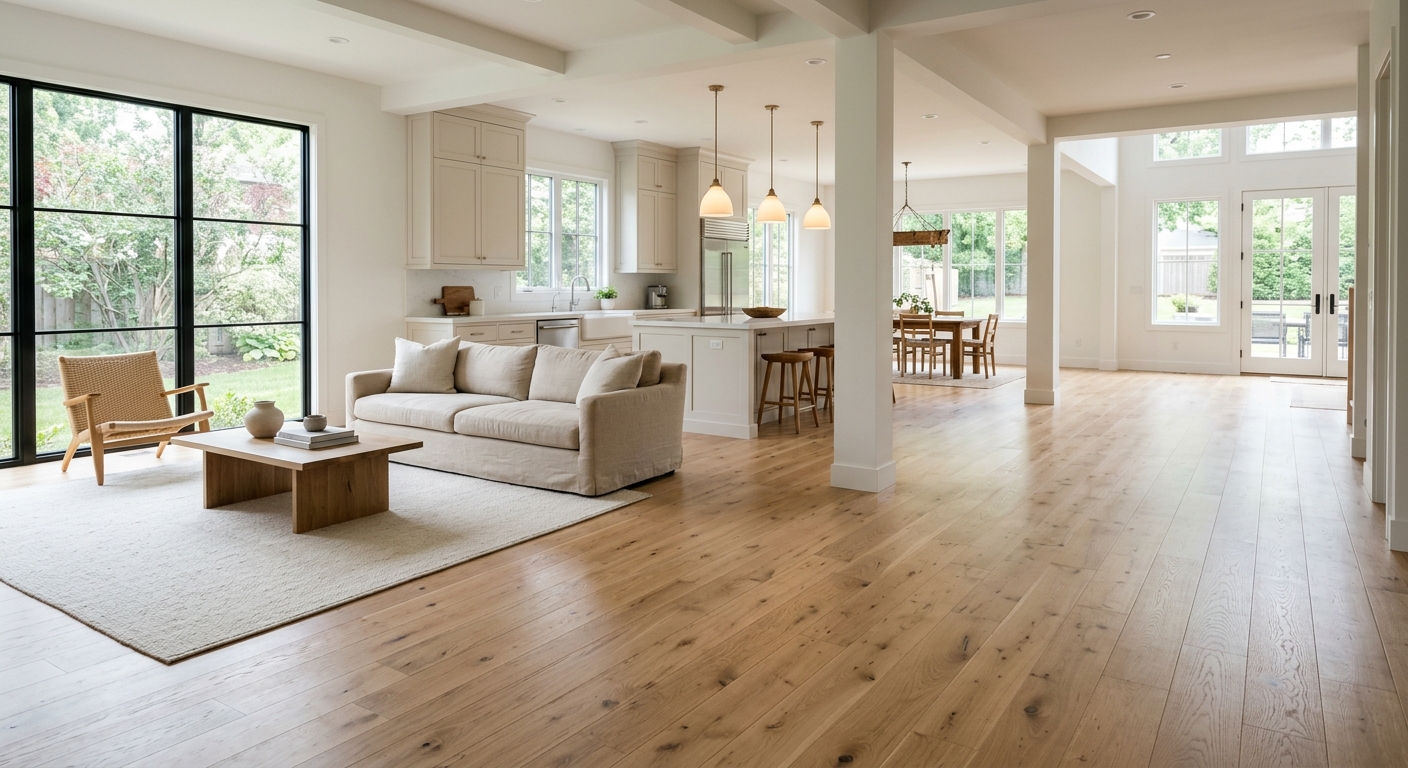
Flooring options and costs in Sooke
Sooke homeowners usually start with a simple question—“What will it cost?”—but the answer depends on what your subfloor is like and how your home handles the Vancouver Island and Coast’s moisture swings. With 31.4% of homes built before 1981, it’s common to uncover older plywood, patches, or uneven concrete, and that often means levelling or repairs before we can install new flooring. On top of that, Sooke has a large share of owner households (80.3% of households own), and many projects are upgrades where homeowners want a long service life and a quieter, warmer feel underfoot.
In this region, indoor relative humidity can drift outside the ideal 35–55% range. That matters because solid hardwood expands and contracts with humidity, so we typically avoid it on concrete slabs and damp basements. For on-grade and above-grade work, engineered hardwood is a strong choice, while luxury vinyl plank (LVP) is the go-to where moisture control, vapor barriers, and below-grade conditions are concerns. Cold snaps and electrically heated homes also make radiant-compatible products popular—most LVP, many laminates, tile, and most engineered woods can be installed over radiant systems with the right underlayment and temperature controls.
In Sooke, demand is especially steady in areas like Otter Point and the West Coast neighbourhoods, where older houses are being refreshed for everyday comfort. Once you know the room moisture risk and the subfloor condition, it’s easier to compare options—so the table below gives typical installed ranges to help you budget.
| Type |
Best Room |
Moisture Resistance |
Lifespan |
Price per sq ft |
| Solid hardwood (nail-down, above grade only) |
Living / dining on well-dried subfloor |
Low to moderate (needs stable indoor humidity) |
20–40 years |
$10–$18 |
| Engineered hardwood (float or glue, above + on-grade) |
Main floors, hallways, bedrooms |
Moderate (better stability than solid) |
15–30 years |
$10–$16 |
| Laminate (click-lock, above-grade) |
Bedrooms, living areas (dry) |
Low to moderate (spills can damage edges) |
10–20 years |
$5–$10 |
| Luxury vinyl plank / LVP (waterproof, any level) |
Kitchen, basements (finished) |
High (handles dampness better) |
10–25 years |
$6–$12 |
| Porcelain / ceramic tile |
Bathrooms, kitchens, entryways |
Very high (with good installation) |
25–50 years |
$12–$25 |
| Carpet (broadloom or modular tile) |
Master and secondary bedrooms |
Low to moderate (avoid chronic dampness) |
7–15 years |
$4–$9 |
Prices are estimates only and vary by project scope, site access and material selection.
What affects the price of flooring in Sooke
Even when two homeowners book “the same” flooring, quotes in Sooke and across Vancouver Island and the Coast can land 30–50% apart. The most common drivers are subfloor condition, moisture management requirements, and how much time the crew needs for layout, prep, and transitions. Labour availability can also affect pricing—when multiple remodels are running at once, crews often spend more time coordinating materials and the job schedule (which can increase effective labour hours).
Technically, indoor humidity swings and below-grade moisture are the key reasons prices vary here. Solid hardwood expands and contracts with humidity, and it performs poorly when installed over concrete slabs or into damp basements—so many projects either require redesign to engineered hardwood or move to LVP. Engineered hardwood and LVP are more dimensionally stable and work much better with vapor barriers and moisture-mitigation systems. In colder pockets of the region, electrically heated homes and radiant upgrades are increasingly common, and that rules out most solid hardwood and some laminate products unless they’re specifically rated. Older housing stock also matters: subfloor levelling or repair is frequently needed and can add roughly $1–$4 per sq ft in labour and materials before any flooring goes down.
Two real examples we see often in Sooke: (1) a wavy plywood subfloor under an existing carpet typically adds levelling/patching, which can push a “laminate at $5–$10/sq ft” job toward the top of that range; (2) a basement with a history of dampness may cost more upfront for LVP, but it avoids the long-term failure risk of solid wood. If radiant heat is involved, the choice between LVP (commonly used) and a non-rated material can also move you within the $6–$12/sq ft band or the $12–$25/sq ft tile band, depending on what the system supports.
| Price Factor |
Why It Matters |
Cost Impact |
| Room area in sq ft |
Materials, prep labour, and waste calculations scale with square footage |
Small rooms often cost proportionally more per sq ft |
| Subfloor condition |
Levelling/repair affects how long the crew spends prepping and patching |
Commonly adds about $1–$4 per sq ft |
| Moisture / below-grade install |
Rules out solid hardwood and changes underlayment and vapor barrier specs |
Typically increases costs if extra moisture control is required |
| Material choice |
Solid vs engineered vs LVP vs tile have different installation systems and product pricing |
Solid hardwood and tile are usually the highest all-in per sq ft |
| Removal and disposal of existing flooring |
Labour and dump fees vary based on underlay, glue residue, and thickness |
Can add noticeable labour time on older adhesive systems |
| Stair nosing / transitions |
Stairs require extra trim, measuring, and custom finishing |
Often priced per step or per linear foot |
| Radiant heat compatibility |
Not all products handle heat cycles or require the same underlayment |
May push you toward LVP/engineered/tile to stay within specs |
| Installation method |
Float, glue-down, and nail-down have different prep and labour intensity |
Glue-down and nail-down usually take longer than click-lock installs |
Permits & regulations in British Columbia
In British Columbia, most flooring replacements themselves do not require a building permit. Swapping like-for-like finished floor coverings—carpet, laminate, LVP, engineered hardwood, or tile over an existing dry subfloor—typically falls under normal trade work and is usually permit-free. However, related work can trigger permits. For example, structural subfloor repair that affects load-bearing components, moisture remediation that requires engineered systems, and in-floor heating electrical circuit work may require electrical permits depending on the scope.
For condos, the rules can be even more specific. Sound transmission requirements (often referenced through STC/IIC performance) can restrict which underlays are allowed under hard flooring on upper levels. Before you install hardwood, tile, or any product that impacts impact noise, review the condo declaration and request board approval in writing when needed.
Step-by-step verification you can do in Sooke: (1) Ask for the contractor’s British Columbia licence details (or business number where applicable) and confirm it through official provincial online resources when available; (2) request a certificate of insurance showing general liability—verify it covers your address and the job dates; (3) confirm workers are covered under WSIB/WCB by asking for proof/clearance letter; (4) ensure the quote includes underlayment/vapor barrier requirements and details of any moisture remediation so you know whether permit-related trades are actually involved.
Best flooring for each room in your Sooke home
In Sooke, the “best” floor is the one that matches that room’s moisture exposure, foot traffic, and comfort needs—while also respecting Vancouver Island and Coast humidity swings. For living and dining areas, engineered hardwood or a high-quality laminate typically offers a good balance of warmth, looks, and durability. For bedrooms, carpet (especially in the master) can be a comfortable, quieter choice because it softens sound and feels warmer underfoot on cooler mornings.
Kitchens are a different story: choose luxury vinyl plank (LVP) for waterproof spill tolerance and easy cleaning, or use large-format porcelain tile for a tougher, moisture-proof surface. In basements (finished), LVP is usually the clear winner due to below-grade moisture risk—solid wood and most laminate can suffer from swelling or edge damage if vapour management isn’t perfect. For bathrooms, porcelain or ceramic tile is the reliable option because it’s made for wet environments when installed with the right waterproofing approach.
Radiant heat compatibility matters more than many people expect in British Columbia. Many homes now use hydronic or electric radiant systems, and most LVP, many laminates, tile, and engineered woods are suitable when the installation instructions (including underlayment type and temperature controls) are followed.
Cost-wise, it’s common to see a small room where carpet looks cheaper, but the difference isn’t always worth it if moisture is a concern. For example, moving from carpet at roughly $4–$9/sq ft to LVP at $6–$12/sq ft might feel like a jump—however, in a basement, that extra investment often prevents a future replacement cycle that would erase the savings.
| Room |
Best Material |
Why |
Moisture Risk |
Price Band per sq ft |
| Living / dining room |
Engineered hardwood |
Warm look with better dimensional stability than solid |
Low to moderate (depends on humidity control) |
$10–$16 |
| Master bedroom |
Carpet or engineered hardwood |
Comfort and sound reduction; hardwood if you want easy maintenance |
Low (if humidity is kept stable) |
$4–$16 |
| Secondary bedrooms |
Laminate (dry rooms) or LVP |
Budget-friendly durability; LVP works if spills are common |
Low to moderate (laminate needs dry edges) |
$5–$12 |
| Kitchen |
Luxury vinyl plank (LVP) or porcelain tile |
Water resistance and easy clean-up in a high-spill area |
Moderate (routine wet mopping risk) |
$6–$25 |
| Basement (finished) |
Luxury vinyl plank (LVP) |
Designed for moisture-prone installs; better tolerance than solid wood/laminate |
High (below-grade vapour risk) |
$6–$12 |
| Bathroom |
Porcelain / ceramic tile |
Made for wet environments with long wear when properly installed |
Very high |
$12–$25 |
How to choose a flooring contractor in Sooke
Choosing the right flooring contractor in Sooke usually comes down to verification and transparency. Start by confirming British Columbia compliance: ask for proof of liability insurance (certificate of insurance) and request confirmation of WSIB/WCB coverage for workers. You can then review the certificate for coverage dates and the job location. For licensing, ask what category of flooring work they perform and request the relevant registration details they’re expected to carry; if they can’t provide anything clear, that’s a concern.
Next, get 2–3 itemised written quotes. The best quotes break down labour and materials separately (including underlayment/vapor barrier, prep, and transitions). Avoid vague “all-in” totals unless the scope is spelled out line-by-line. Read the contract for exclusions: will they remove and dispose of existing flooring? Is subfloor levelling included or priced as an allowance? Is the permit or electrical coordination required for radiant systems handled, if applicable?
Warranty matters too. Ask for the workmanship warranty length and whether it covers material defects caused by installation (not just product manufacturing). Also ask if the product warranty is transferable to you as the homeowner.
For payment schedule, never pay more than 10–15% upfront. Hold back the remainder until the job is complete and you’ve confirmed details like transitions, stair finishing, and cleanup. Finally, insist on a start date and a completion estimate in writing so you can plan around Sooke weather and material lead times.
- Ask for certificate of insurance and verify dates and address coverage.
- Request WSIB/WCB proof/clearance before work starts.
- Get an itemised estimate: labour, materials, underlayment/vapour barrier, and trim.
- Confirm whether subfloor levelling/repair is included or allowed as an extra.
- Check that removal and disposal of existing flooring is clearly stated.
- Make sure transitions (hallways, doorways, stairs) are priced per linear foot or step.
- Verify radiant heat compatibility for your specific product and underlayment.
- Ask what moisture testing/assessment is done for basements and on concrete.
- Review warranty: workmanship coverage length and exclusions.
- Confirm product warranty is not voided by installation method.
- Lock payment schedule: 10–15% deposit max, holdback until completion.
- Request a written timeline and discuss lead times for mouldings and transitions.
Concrete red flags I see with some Sooke flooring contractors: they refuse to provide itemised pricing, they can’t explain how they handle moisture/vapour barriers in below-grade areas, they ask for full payment upfront, they don’t offer a written workmanship warranty, or they won’t put the start date and finish estimate in writing.
Frequently asked questions — flooring in Sooke
What is the difference between floating and glued-down flooring?
Floating floors (common with click-lock laminate and many LVP systems) are installed with an underlayment and mechanically click together, without bonding to the subfloor. This helps them tolerate normal expansion and contraction from humidity swings common on Vancouver Island. Glued-down floors are bonded to the subfloor, which can feel more solid underfoot and can reduce movement, but it requires proper subfloor prep and suitable adhesives—especially important on concrete slabs or older patched areas. In Sooke, if your home has uneven plywood or any moisture concerns, the right method matters: LVP’s design can handle more variation and moisture than solid wood, while engineered hardwood may be installed floating or glue-down depending on product specs.
What flooring holds up best to pets in a Sooke home?
For most pet-owning households in Sooke, LVP is the practical winner because it’s waterproof, resists everyday accidents, and is easier to clean when muddy paws hit the floor. Choose a thicker wear layer and a reputable locking system to reduce joint separation with the region’s humidity swings. If you prefer the look of wood, engineered hardwood can work well on main floors, but you’ll want careful spot cleaning and stable indoor humidity. Carpet is comfortable, but pet traffic can shorten its lifespan faster due to matting and staining. Budget-wise, you’ll commonly see LVP installed around $6–$12 per sq ft, compared with carpet at $4–$9 per sq ft—often the extra cost is justified in active homes with spills or recurring cleanup.
How do I fix squeaky floors in my Sooke home?
Squeaks usually come from movement between subfloor layers, loose fasteners, or gaps caused by aging framing. The first step is identifying where the sound happens: the squeak is often localized to specific joists or plywood sheets rather than the whole floor. Sometimes a contractor can address it by fastening subfloor panels from the underside (when accessible), or by strategically re-fastening from the top after lifting a small section. If you’re planning new flooring, it’s smart to check subfloor stiffness and sound triggers before install—otherwise a new surface can make the problem more noticeable. In older Sooke homes (31.4% built before 1981), that prep step is frequently part of levelling/repair. If the squeak is tied to moisture-softened subfloor, moisture management becomes the priority before any floor goes down.
What is luxury vinyl plank and is it worth it in Sooke?
Luxury vinyl plank (LVP) is a layered, synthetic flooring product designed to be highly water resistant or waterproof, depending on the specific line. In Sooke’s climate and housing stock, LVP is often worth it because it tolerates moisture management better than solid hardwood and many laminates—especially in basements and in rooms where vapour risk is higher. It also tends to be compatible with radiant heating in many cases, provided the product and underlayment are rated for radiant use. If your quote has LVP at roughly $6–$12 per sq ft installed, that range frequently competes well against carpet ($4–$9) when you factor in durability and the reduced risk of damage from dampness. For bathrooms and chronic wet zones, tile is still the more reliable surface choice.
How much does flooring cost in Sooke?
In Sooke, installed flooring costs depend on material type, room size, and—big one—subfloor prep. Based on local Vancouver Island and Coast ranges used by contractors, hardwood-type options typically land higher, while LVP and laminate are usually more budget-friendly. For example, LVP commonly comes in around $6–$12 per sq ft installed, laminate often runs about $5–$10, and tile is frequently the top end at $12–$25 per sq ft. Carpet installation can be around $4–$9 per sq ft. Expect additional charges if levelling or moisture remediation is needed—older homes built before 1981 often require repairs before installation. You can also see quote differences (30–50%) between contractors due to prep scope and disposal/transitions included.
Hardwood vs laminate vs vinyl plank — which is best?
If you mean “best for Sooke conditions,” the answer is usually based on moisture risk and where you’re installing. Hardwood (especially solid) needs stable humidity and is typically limited to above-grade main floors; solid hardwood also isn’t the right choice over concrete slabs or in damp basements. Laminate is a good look-for-less option in dry rooms, but spills and moisture can damage edges and underlayers over time—so it’s less forgiving in basements. Vinyl plank (LVP) is often the most practical “whole-home” choice because it’s highly water resistant and more tolerant of the region’s humidity swings, and it’s commonly installed in areas where below-grade moisture management matters. Cost-wise, LVP often sits around $6–$12 per sq ft installed versus hardwood that can land around $9–$18. For radiant heat, many LVP and engineered options are selected because they’re compatible when installed to product specs.