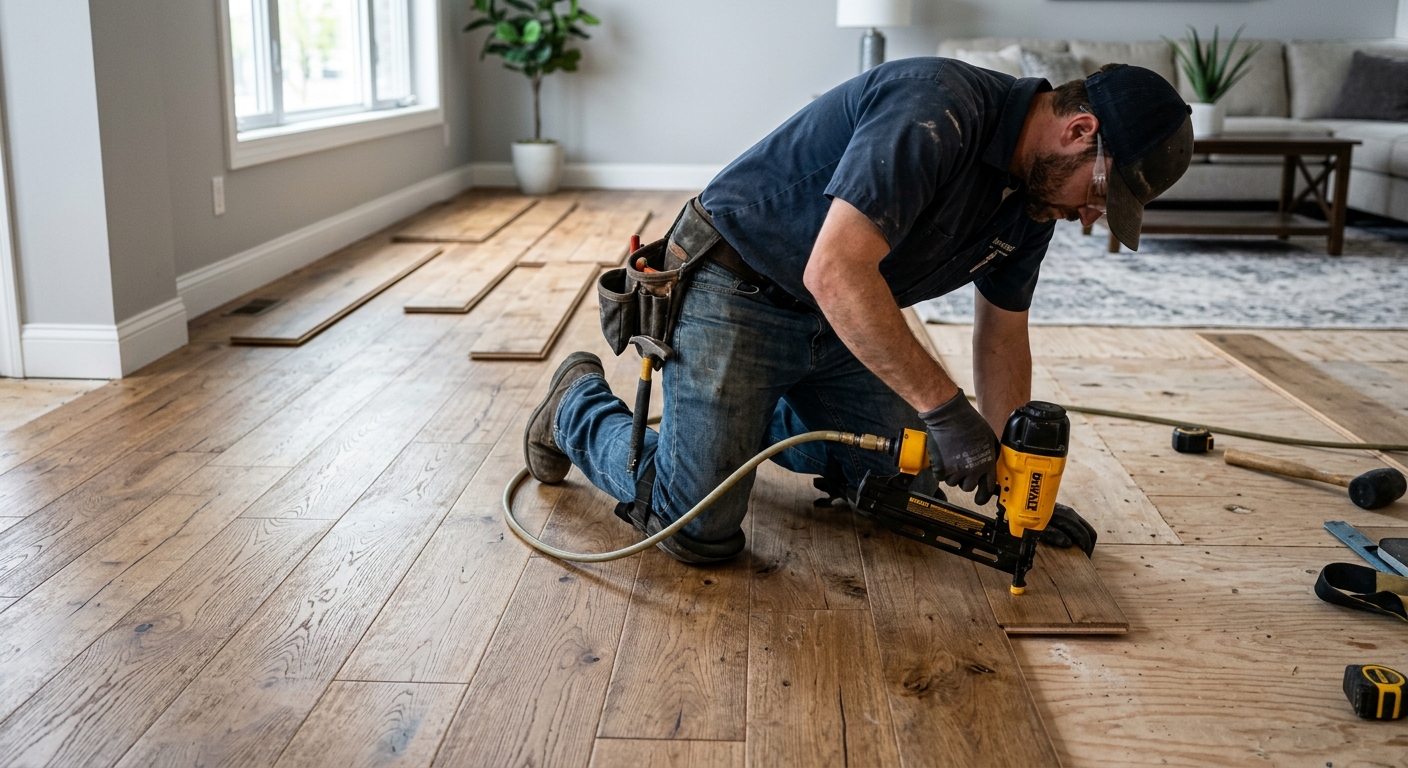
Flooring options and costs in West Vancouver
In West Vancouver, homeowners usually have strong preferences—warm-feeling floors for main living areas, but moisture-resilient choices where humidity can sneak in. With 12,535 homeowner households and a median household income of $104,000 (Statistics Canada, 2021 Census), many families are upgrading as they renovate kitchens, finish basements, and update older interiors. One reason budgets vary is our housing age: 53.8% of homes were built before 1981, and those older subfloors often need levelling or repair before any new material can be installed. In practice, that can add roughly $1–$3 per sq ft depending on how uneven the plywood or concrete is.
The Lower Mainland–Southwest region’s wet, marine climate drives indoor humidity swings, especially in winter and shoulder seasons. That affects installation planning and product selection. Contractors also see frequent demand along the North Shore corridor—particularly around Horseshoe Bay and Ambleside—because older homes there are commonly renovated in phases, with contractors coordinating flooring, stair work, and trim at the same time. Labour availability can tighten during peak renovation months, and Greater Vancouver labour rates remain among the highest in Canada—so installation scope is a major part of the total cost.
Below are typical material + install price bands homeowners use for early budgeting. Use them to compare options, then we’ll narrow to a per-room plan once we know your subfloor condition and where (and how) you’re installing.
| Type |
Best Room |
Moisture Resistance |
Lifespan |
Price per sq ft |
| Solid hardwood (nail-down, above grade only) |
Living rooms, dining rooms (above grade) |
Low to moderate; sensitive to humidity |
25–60 years |
$10–$18 |
| Engineered hardwood (float or glue, above + on-grade) |
Main floor, hallways (above + on-grade) |
Moderate to high; handles humidity swings better |
20–40 years |
$9–$16 |
| Laminate (click-lock, above-grade) |
Bedrooms, living areas (above grade) |
Moderate; avoid standing water |
10–25 years |
$4–$9 |
| Luxury vinyl plank / LVP (waterproof, any level) |
Kitchen, main floor, finished basement |
High; waterproof core |
15–25 years |
$6–$10 |
| Porcelain / ceramic tile |
Kitchen, bathrooms, entryways |
Very high |
30–50 years |
$12–$20 |
| Carpet (broadloom or modular tile) |
Master and secondary bedrooms |
Moderate; protect from moisture sources |
8–15 years |
$8–$12 |
Prices are estimates only and vary by project scope, site access and material selection.
What affects the price of flooring in West Vancouver
Even when two homeowners describe the “same” flooring change in West Vancouver, quotes can differ by 30–50% across the Lower Mainland–Southwest and the wider province. The biggest reasons are technical—humidity and subfloor condition—and then labour scope. In this marine climate, indoor moisture swings can cause gapping or cupping if a product and installation method don’t match the home. That’s why solid hardwood is typically limited to above-grade installations, while engineered hardwood and luxury vinyl plank (LVP) are the go-to options for on-grade and basement work.
Below-grade areas in many Lower Mainland homes can experience moisture wicking through concrete slabs and foundations. Solid hardwood expands and contracts with humidity and cannot be glued or floated over concrete; it performs poorly in basements where vapour is present. Engineered wood handles humidity better because of its layered construction, and waterproof LVP handles minor moisture and vapour migration far more reliably. If you’re dealing with in-floor radiant heat—which is increasingly common in newer builds—this also narrows product choices and can push you toward engineered wood, LVP, tile, and some higher-temperature-rated laminates.
Local housing age matters too: with 53.8% of homes built before 1981 (Statistics Canada, 2021 Census), uneven subfloors are common. In those cases, levelling/repair can add about $1–$4 per sq ft. As a concrete example, a 500 sq ft main-floor upgrade can land in the hardwood band of $10–$18 while the same footprint with LVP may come in closer to $6–$10, but the “gap” narrows if you need extensive subfloor prep for any install. Conversely, if your subfloor is relatively flat and moisture is well-controlled, carpet removal and LVP can be cost-effective without adding moisture remediation.
| Price Factor |
Why It Matters |
Cost Impact |
| Room area in sq ft |
More surface = more materials and labour time |
Direct (often 60–75% of total project cost) |
| Subfloor condition — levelling or repair needed before install |
Uneven plywood/concrete requires prep before products can perform |
Commonly adds about $1–$4 per sq ft |
| Moisture / below-grade install — rules out solid hardwood |
Vapour requires waterproof or engineered solutions |
May add moisture barriers or switch material type |
| Material choice — solid vs. engineered vs. LVP vs. tile |
Different cores and surface wear layers drive material price |
Can shift projects by $3–$10 per sq ft |
| Removal and disposal of existing flooring |
Demolition time + haul-away costs vary widely |
Often $1–$3 per sq ft equivalent |
| Stair nosing / transitions — charged per step or per linear foot |
Stairs need extra trims and precise finishing |
Can add significant per-step charges |
| Radiant heat compatibility — limits material options |
Some products can’t handle heat cycling safely |
May require engineered/LVP/tile and add spec time |
| Installation method — float vs. glue-down vs. nail-down |
Method affects time, labour intensity, and subfloor prep |
Glue-down often higher labour than floating |
Permits & regulations in British Columbia
In British Columbia, the flooring install itself generally does not require a building permit—whether you’re laying LVP, laminate, carpet, or even tile. Where permits can come up is when your scope includes associated work that touches building systems. For example, if the project involves electrical work for heated floors (in-floor radiant heating components, wiring modifications, or adding circuits), that electrical scope typically needs appropriate permits and inspections. If your plan includes structural subfloor repair (beyond minor patching), or moisture remediation work that addresses deeper building envelope concerns, you may be directed into permit/inspection requirements depending on what’s being repaired and where it ties into the structure.
In condominiums, the corporation’s rules are often the real “regulation” that governs flooring. Many buildings require specific underlay to control sound transfer and protect neighbours (sound ratings are often referenced through STC/IIC expectations). Before installing hardwood or tile on upper floors, review your condo declaration and request written board approval if your building requires it.
For licensing and coverage in West Vancouver, take a two-step verification approach: (1) confirm the contractor’s BC licence status using the provincial registry resources available online, and (2) request a current certificate of insurance (liability) plus confirmation of coverage such as WCB/WSIB or the applicable worker coverage documentation for the crew. Ask for the clearance letter/documentation and confirm the date range matches your installation window. A reputable flooring contractor should provide these immediately with your written quote package.
Best flooring for each room in your West Vancouver home
Choosing flooring room-by-room is the smartest way to handle West Vancouver’s wet, marine climate and the Lower Mainland–Southwest indoor humidity swings. For living and dining areas, engineered hardwood is often the best balance of warmth, look, and stability—especially if your home has on-grade or slightly variable moisture conditions. If you prefer a lower-cost alternative, high-quality laminate can work on above-grade floors, but we still plan for expansion gaps and recommend humidity control.
For bedrooms, many homeowners choose carpet for comfort and sound absorption—particularly in condos and older homes with less acoustic separation. For the master bedroom, engineered hardwood also works well if you maintain indoor humidity within a reasonable range. Kitchens need practicality: luxury vinyl plank (LVP) or large-format porcelain tile are best for water resistance and easy cleaning. In a basement (finished), LVP is usually the clear winner because it’s waterproof and tolerates the moisture vapour conditions that can exist when moisture wicks through concrete slabs—conditions where solid hardwood and most laminate struggle.
Bathrooms should be porcelain or ceramic tile only, with proper waterproofing practices behind the tile. If any rooms are installed over radiant heating—common in new construction—we pair the heat with engineered wood, LVP, and tile, and we avoid most solid hardwood unless it’s very carefully specified and acclimated for that heat profile.
Price-wise, the difference can be justified. For example, if your 200 sq ft kitchen area is only about appearance, laminate might look similar to hardwood at $4–$9 per sq ft—but once spills and wash-down cleaning are considered, LVP at $6–$10 per sq ft is often the better long-term value because it’s far more tolerant of moisture events.
| Room |
Best Material |
Why |
Moisture Risk |
Price Band per sq ft |
| Living / dining room |
Engineered hardwood |
Warm look with better dimensional stability in marine humidity |
Low (above grade), moderate if near exterior moisture sources |
$9–$16 |
| Master bedroom |
Carpet or engineered hardwood |
Comfort and sound control; engineered keeps better stability than solid |
Low |
$8–$12 |
| Secondary bedrooms |
Laminate or carpet |
Good value; easy maintenance in family homes |
Low to moderate (keep spills from soaking at seams) |
$4–$12 |
| Kitchen |
Luxury vinyl plank (LVP) or porcelain tile |
Handles spills and frequent cleaning; tile is the most waterproof |
Moderate (spills), high around sink/dishwasher |
$6–$20 |
| Basement (finished) |
Luxury vinyl plank (LVP) |
Waterproof and performs better with moisture-vapour conditions |
High (below grade moisture potential) |
$6–$10 |
| Bathroom |
Porcelain / ceramic tile |
Best resistance to water; durable finish for wet areas |
Very high |
$12–$20 |
How to choose a flooring contractor in West Vancouver
Start by verifying credentials the right way, not just by asking for a logo. In British Columbia, confirm the contractor’s licensing status through the provincial registry resources, and request proof of liability insurance plus clear documentation of worker coverage (WSIB/WCB or the applicable coverage documentation for your project). You should also ask whether subcontractors are used—if they are, you want coverage documents for the people doing the work, not just the office that sent the quote.
Next, get 2–3 itemised written quotes. The best quotes break out labour and materials by scope (prep/levelling, underlay, transitions, removal and disposal, stair work). Avoid lump sums where you can’t see what’s included. Read the scope carefully: is moisture testing included if needed, is levelling included or “as required,” and is disposal included? In a West Vancouver home—especially with older housing stock—subfloor repair can be the difference between an easy install and a costly rework, so make sure that part is clearly defined.
On warranty, separate workmanship from product. Ask the length of the installation warranty, whether it covers site-specific issues like edge lift, and whether product warranties are transferable (important if you sell). For payment schedule, never pay more than 10–15% upfront; hold back until the job is complete and cleaned up. Finally, insist on a start date and a completion estimate in writing, including lead times for special-order materials.
- Ask for current liability insurance and worker coverage documents before signing.
- Confirm the BC licence status using the provincial online registry.
- Require an itemised quote with labour and material line items.
- Clarify what “subfloor prep” includes (self-levelling, patching, sanding, or repair).
- Confirm removal and disposal costs are included or listed separately.
- Get details on underlay/moisture barrier specs and where they’ll be installed.
- Specify transition and stair nosing pricing per step or linear foot.
- Ask how they’ll handle humidity acclimation for wood products.
- Verify radiant heat compatibility for any heated-floor rooms before ordering.
- Request the workmanship warranty terms in writing.
- Discuss payment milestones and keep a holdback until completion.
- Make sure you receive a start date and completion timeline in the contract.
Common red flags in West Vancouver: (1) “one price fits all” quotes with no subfloor/prep details, (2) no insurance or worker coverage documents provided upfront, (3) refusal to itemise removal/disposal or transitions, (4) vague timelines with no start/completion estimate, and (5) promises to install solid hardwood in basements without a moisture plan and appropriate product specification.
Frequently asked questions — flooring in West Vancouver
What is luxury vinyl plank and is it worth it in West Vancouver?
Luxury vinyl plank (LVP) is a resilient flooring made with a wear layer over a vinyl core—many versions are waterproof, which is a big advantage in West Vancouver’s wet, marine climate. In the Lower Mainland–Southwest, indoor humidity swings and basement moisture vapour are common concerns, especially in older homes built before 1981 (Statistics Canada, 2021 Census). LVP is worth it when you want a realistic wood look without the same humidity sensitivity as solid hardwood or the spill risk of laminate. Budget-wise, LVP often lands around $6–$10 per sq ft, so it’s frequently a better long-term value than “cheaper laminate” if you expect spills, wash-down cleaning, or a finished basement.
How much does flooring cost in West Vancouver?
In West Vancouver, flooring pricing usually tracks room size, subfloor condition, and installation complexity. As a quick budgeting guide, laminate/vinyl plank projects typically fall into the $4–$10 per sq ft range, while solid hardwood typically starts higher, often around $9–$18 per sq ft depending on product grade and prep needs. Tile is commonly the premium option at about $10–$20 per sq ft. A major cost driver in this area is subfloor preparation in older housing stock—levelling and repair frequently add about $1–$4 per sq ft when concrete is uneven or plywood is damaged. For accurate pricing, request an itemised quote rather than a lump sum.
Hardwood vs laminate vs vinyl plank — which is best?
“Best” depends on where the flooring is going and how your home behaves with moisture. Solid hardwood looks great above grade, but it’s more sensitive to humidity swings and can’t be glued or floated over concrete. Laminate is a good value for above-grade rooms, but it’s not designed for waterproof basement installs—standing moisture can damage edges and seams. Vinyl plank (especially waterproof LVP) is usually the most forgiving option in West Vancouver because it handles moisture vapour risk better and performs well in kitchens and finished basements. If you want a practical comparison: solid hardwood often sits around $10–$18, while LVP commonly comes in around $6–$10, with LVP often justifying the cost difference where moisture is a factor.
What flooring is best for a West Vancouver basement?
For most West Vancouver basements, LVP is the clear winner. The Lower Mainland–Southwest climate and many homes’ below-grade conditions mean moisture vapour can migrate through concrete slabs, and that environment is hard on solid hardwood and many laminate products. LVP’s waterproof construction helps resist damage from minor moisture exposure, and it’s typically easier to install over less-than-perfect subfloors when proper prep is done. If your basement is over radiant heat, LVP and tile are also usually easier to specify than solid hardwood. Cost expectations commonly land in the $6–$10 per sq ft range for LVP installations, but the final number depends on moisture remediation, levelling, and whether you need new underlay and transitions.
Can I install hardwood over concrete?
In most West Vancouver situations, you should be cautious about installing solid hardwood over concrete. Solid hardwood is typically a nail-down product intended for above-grade wood subfloors; it’s sensitive to moisture and cannot be glued or floated directly over concrete in the way homeowners sometimes hope. Engineered hardwood is often the better choice because its layered construction handles humidity changes more effectively, and some engineered systems can be installed over concrete using the manufacturer-approved method (float or glue-down, with proper moisture controls). Before choosing, a reputable contractor should assess subfloor moisture, flatness, and your radiant heating setup if present. This is especially important in older Lower Mainland homes where concrete moisture wicking can occur.
How long does flooring installation take?
Installation time varies in West Vancouver based on room count, subfloor prep, and product type. On a straightforward day-rate plan, some teams can install LVP or laminate quickly in open areas, while hardwood and tile usually require more prep and detail work (acclimation, careful transitions, and longer cure times for adhesive). If levelling is required—common in older homes built before 1981 (Statistics Canada, 2021 Census)—that adds time for materials and drying. As a practical expectation, a modest main-floor project might take several days, while a multi-room renovation can run a week or more, including removal, prep, and trim work. Always ask for a start date and written completion estimate in your contract, and confirm lead times for stair parts and custom trims.