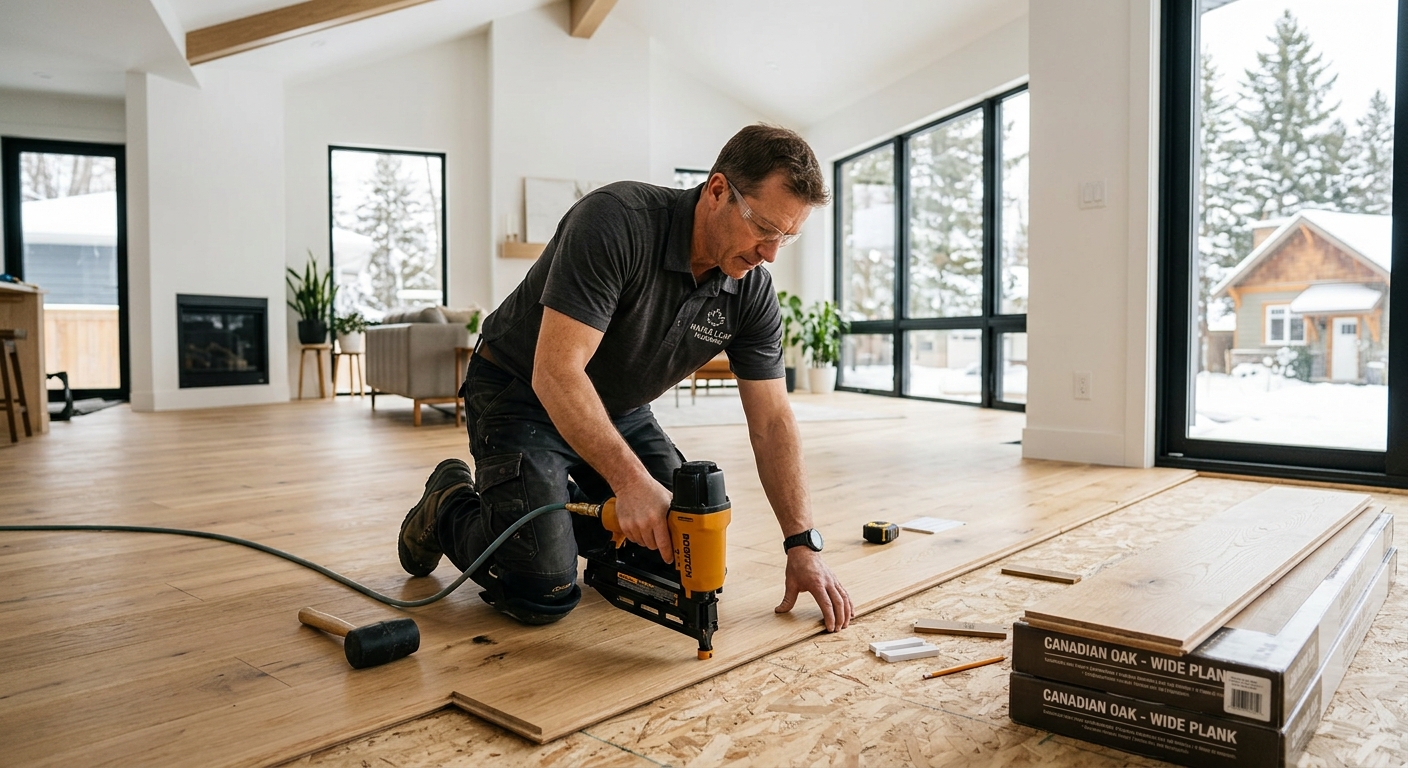
Flooring options and costs in Cambridge
In Cambridge, Ontario, choosing flooring is less about “what looks best” and more about what will hold up through our seasonal humidity swings and the common basement moisture issues in homes built across many decades—especially with 48.4% of dwellings built before 1981. That older housing stock often means the subfloor needs attention (flattening, patching, or even an OSB overlay) before new material goes down, and that prep can add real dollars to the job. Cambridge also has a large base of homeowner households (35,315, or 68.9% of households own), which typically drives steady demand for renovations and new-floor installs in neighbourhoods such as Preston and West Galt—areas where families are actively updating living space.
In the Kitchener–Waterloo–Barrie economic region, winters are relatively dry, summers are more humid, and basements can be the weak link. Those conditions affect how materials expand and contract. Solid hardwood (especially when detailed for nail-down) is best kept above grade, while engineered hardwood and luxury vinyl plank (LVP) handle moisture and minor subfloor imperfections far better. If you’re installing over concrete slabs, contractors often steer you toward products that tolerate dimensional change and can be detailed with the right vapour barrier and underlayment.
Below are practical cost ranges for the options homeowners most commonly consider in Cambridge, using the city’s market pricing bands as a backbone. Use this table to compare apples-to-apples, then we’ll break down what drives the final number.
| Type |
Best Room |
Moisture Resistance |
Lifespan |
Price per sq ft |
| Solid hardwood (nail-down, above grade only) |
Living / dining, main floor bedrooms |
Low (not for basements or concrete slabs) |
25–50 years (with refinishing) |
$9,–$18 |
| Engineered hardwood (float or glue, above + on-grade) |
Main floors, hallways, family rooms |
Medium–high (better with humidity) |
20–40 years |
$9,–$16 |
| Laminate (click-lock, above-grade) |
Bedrooms, living rooms (non-wet areas) |
Medium (edges are the weak point) |
10–25 years |
$4,–$8 |
| Luxury vinyl plank / LVP (waterproof, any level) |
Kitchen, basement (finished), main level flex spaces |
High (waterproof core) |
15–25 years |
$4,–$9 |
| Porcelain / ceramic tile |
Kitchen, bathroom, mudroom entries |
Very high (with correct prep and grout) |
30–60 years |
$8,–$20 |
| Carpet (broadloom or modular tile) |
Bedrooms, stairs (comfort-first) |
Low–medium (moisture sensitive) |
8–15 years (depending on quality) |
$4,–$7 |
Prices are estimates only and vary by project scope, site access and material selection.
What affects the price of flooring in Cambridge
In Cambridge, two homeowners can receive very different quotes for the “same floor” simply because the underlying conditions aren’t the same. Across the Kitchener–Waterloo–Barrie economic region—and across Ontario in general—it’s common to see a 30–50% difference between bids when one contractor includes proper subfloor levelling, moisture controls and detailed transition work, while another quotes on a simplified assumption. In a city where many homes date back to earlier eras and basements can show moisture, the technical prep and detailing are where costs swing.
Indoor humidity swings are a primary driver. Solid hardwood expands and contracts with seasonal moisture and is sensitive to concrete and below-grade environments; it cannot be glued or floated directly over concrete and typically performs poorly in basements. That’s why, in Cambridge, engineered hardwood and LVP are often priced higher per square foot than laminate, but lower overall when you factor fewer moisture constraints and less risk. If radiant heating is present (increasingly common in Ontario builds), material selection matters: engineered hardwood, quality laminate, LVP and many tiles are usually rated as radiant-compatible, but solid hardwood often requires tighter installation specs and may be discouraged with aggressive radiant cycling. Older regional housing stock frequently needs levelling or repair before install, adding roughly $1–$4 per sq ft depending on how uneven the floor is.
Concrete examples from typical Cambridge scopes: (1) a 600 sq ft main-floor install with a minor dip can add $600–$1,200 if levelling is needed before click-lock laminate; (2) a finished basement at 450 sq ft usually steers budgets toward LVP (often $4–$9 per sq ft range for materials and install depending on finish quality), because solid hardwood restrictions can force costly changes to the plan; (3) large-format tile can raise costs toward the higher end of the $8–$20 per sq ft band because of more prep, layout time and careful underlayment. Next, we’ll translate these drivers into a quote-friendly checklist.
| Price Factor |
Why It Matters |
Cost Impact |
| Room area in sq ft |
Material quantity and labour time scale directly |
Higher area can still reduce per-sq-ft pricing |
| Subfloor condition — levelling or repair needed |
Uneven surfaces cause gaps, joint failures and tile lippage |
Often adds roughly $1–$4 per sq ft in Cambridge |
| Moisture / below-grade install — rules out solid hardwood |
Basement vapour needs correct vapour barrier and product choice |
Can shift you from solid hardwood to LVP/tile budgets |
| Material choice — solid vs. engineered vs. LVP vs. tile |
Different product systems require different prep/underlay |
Hardwood at the top end vs laminate/LVP as budget options |
| Removal and disposal of existing flooring |
Tear-out can uncover damage and adds hauling time |
Often a hidden variable between quotes |
| Stair nosing / transitions |
Transitions are labour-intensive and priced per step/linear foot |
Can meaningfully increase total project cost |
| Radiant heat compatibility |
Some materials tolerate radiant cycling better than others |
May add underlay or require product-specific installation |
| Installation method — float vs. glue-down vs. nail-down |
Different methods require different labour and adhesives/fasteners |
Can change labour cost materially for the same look |
Permits & regulations in Ontario
In Ontario, the flooring installation itself usually does not require a building permit. However, associated work can trigger permits depending on what’s being altered. For example, if your project includes electrical work (such as modifying an in-floor radiant heating circuit, adding new thermostat wiring, or moving electrical baseboard heaters), an electrical permit may be required. If a contractor is dealing with structural subfloor repairs that go beyond simple patching—like significant joist/beam work—permits can come into play through the broader scope of building alterations.
In condominiums, the rules are often more restrictive than the Ontario permit question. Many condo corporations enforce sound transmission requirements, commonly described through STC/IIC performance targets, and that can restrict or require specific underlay systems for hard flooring on upper floors. Before you install hardwood or tile above grade in a multi-unit building, review the condo declaration and request written board approval when required—especially for nail-down hardwood, tile, or any hard surface that impacts neighbours below.
For Cambridge homeowners, verifying a contractor’s Ontario compliance is straightforward. Start by confirming the trade contractor is properly licensed where applicable (and that they have the right credentials for any related scope). Ask for a current certificate of liability insurance showing coverage amounts and effective dates, and confirm workers are covered under WSIB/WCB (workers’ compensation coverage) if the contractor is using their own employees. Request the paperwork before work begins, and keep copies—both for peace of mind and to avoid surprises if there’s a claim or inspection requirement later.
Best flooring for each room in your Cambridge home
Choosing the right flooring for each room in your Cambridge home starts with understanding how moisture and traffic behave through our climate. Living and dining areas benefit from warmth and a “quiet” feel: engineered hardwood or quality laminate often hits the best balance of comfort, durability and easier upkeep than solid wood in a variable humidity environment. For bedrooms, carpet remains a strong option because it cushions footsteps and absorbs sound—helpful in a housing stock where many families renovate for everyday comfort. If you prefer hard surfaces, engineered hardwood can still work, but keep it above grade and use a proper underlayment.
Kitchens and entry areas need resistance to spills and frequent cleaning. Luxury vinyl plank (LVP) or large-format porcelain tile are common winners in Cambridge because they tolerate moisture better than traditional wood, and they handle the seasonal “in and out” rhythm when people track in wet weather. Basements are where materials choices matter most: finished basements often see higher vapour and occasional dampness, so LVP is usually the clear winner—waterproof cores plus the right vapour barrier/subfloor prep are key. Bathrooms should be porcelain or ceramic tile only, because they’re designed for wet-room conditions when installed over a suitable substrate.
Radiant heat compatibility is increasingly relevant in Ontario. If you have in-floor heating, consult product ratings: engineered hardwood, laminate, LVP and many tiles can be radiant-compatible, while solid hardwood is more limited and may be discouraged by tighter installation requirements. As a practical example, if solid hardwood lands near the upper band (up to $18 per sq ft), switching to engineered hardwood or LVP can still meet your performance goals—while avoiding basement constraints—so the “savings” may show up as fewer change orders and less risk during a humid Cambridge summer.
| Room |
Best Material |
Why |
Moisture Risk |
Price Band per sq ft |
| Living / dining room |
Engineered hardwood |
Warm look, stable across humidity swings, easier than solid over variable conditions |
Low to medium (keep above grade) |
$9,–$16 |
| Master bedroom |
Carpet (or engineered hardwood if you prefer hard floors) |
Comfort for mornings, sound absorption, and forgiving underfoot |
Low (unless there’s basement seepage) |
$4,–$7 |
| Secondary bedrooms |
Laminate (click-lock) or carpet |
Durable for kids/pets, faster install, good value in busy households |
Low (avoid wet-mop saturation) |
$4,–$8 |
| Kitchen |
Luxury vinyl plank (LVP) or porcelain tile |
Handles spills, scrubbing, and frequent traffic; tile adds the most wet-room resilience |
Medium (spills and humidity bursts) |
$8,–$20 |
| Basement (finished) |
Luxury vinyl plank (LVP) |
Waterproof core; better tolerance with basement vapour when paired with correct prep |
High (below grade) |
$4,–$9 |
| Bathroom |
Porcelain / ceramic tile |
Built for wet conditions; durable grout/tile system when installed correctly |
Very high |
$8,–$20 |
How to choose a flooring contractor in Cambridge
When you’re hiring a flooring contractor in Cambridge, Ontario, the goal is to find someone who will protect your investment from the common local issues: uneven subfloors, basement moisture, and temperature/humidity swings. First, verify licensing and coverage. Ask for proof of liability insurance (certificate of insurance) so you know you’re covered if there’s property damage. Confirm workers are covered by WSIB/WCB for the crew doing the work; many reputable flooring businesses can provide a clearance letter or documentation on request. If a contractor can’t provide current proof quickly, that’s a sign to slow down.
Next, compare written quotes properly. Get 2–3 itemised estimates that separate materials and labour, and clearly list what’s included: underlay/vapour barrier, levelling compound or self-levelling, transition strips, stair nosing, and waste factor. Watch for exclusions like subfloor flattening, removing stubborn adhesive residue, or disposal fees. Make sure the quote states whether permits are included if any electrical work or in-floor heating modifications require them.
Warranty matters—demand specifics: the workmanship warranty length, what it covers, and whether product warranties are transferable to you. Payment terms should also be reasonable: avoid paying more than 10–15% upfront, and hold back until the job is complete and walk-through quality checks are done. Finally, require a start date and completion estimate in writing so you can plan around Cambridge weather and any scheduling constraints.
- Request certificate of liability insurance and confirm it’s current
- Ask for WSIB/WCB coverage proof (or clearance documentation) for the installing crew
- Get 2–3 itemised quotes (materials + labour, not lump sums)
- Confirm levelling/repair scope in writing (patches, self-levelling, feather-finish work)
- Ensure moisture controls are specified for basements (vapour barrier/underlayment details)
- Clarify disposal and hauling: is old flooring removal included?
- Confirm transitions and stair nosing pricing (per step or per linear foot)
- Verify radiant heat compatibility for your product (if you have in-floor heating)
- Ask who is responsible for substrate flatness testing and what standard they use
- Require a written timeline: start date and completion estimate
- Review warranty terms in writing (workmanship + manufacturer, transferability)
- Use a payment schedule with only 10–15% upfront and a holdback at completion
Red flags I see too often in Cambridge include: vague “labour included” language with no line items, refusing to provide insurance/WSIB documentation, quoting a basement install as if it were above grade (no vapour/moisture detailing), skipping substrate flatness discussion, and offering “too-good-to-be-true” pricing without explaining how they’ll handle levelling, transitions, or disposal.
Frequently asked questions — flooring in Cambridge
Do condos restrict hard flooring?
Yes, many condos in Cambridge restrict or regulate hard flooring because of sound transmission to units below. Even when Ontario doesn’t require a permit just to install flooring, the building’s rules can be the real gatekeeper. Corporations may require specific underlay (or a sound-rated system) to meet STC/IIC targets, and they often require board approval in writing before work begins—especially for tile and nail-down or rigid floors. If your unit is above neighbours, it’s smart to ask the condo office what underlay is approved and whether you need written permission before purchase and install. This is one reason engineered hardwood or LVP with the correct underlayment is so commonly specified.
How do I compare flooring quotes?
Start by comparing item-by-item, not the final total. Ask for an itemised breakdown of materials (including underlayment/vapour barrier, adhesives, and trim) and labour (prep/levelling, installation method, transitions and stair nosing). For Cambridge, also confirm how the contractor will handle older subfloors—homes built before 1981 are common, and those often need flattening/patching before install. If one quote includes levelling and moisture detailing and another treats it as optional, the difference can easily be 30–50%. As a reference point, hardwood pricing commonly sits in the upper band (up to about $9–$18 per sq ft), while laminate/vinyl plank typically comes in lower ($4–$8 or $4–$9 per sq ft depending on the product line).
Can I install flooring over existing tile in Cambridge?
Sometimes, but it depends on tile condition, height transitions, and your new flooring system. For LVP, many installers can work over properly bonded tile if the surface is very stable and not rocking; they’ll still need correct underlayment and may use self-levelling to correct grout ridges. For laminate or engineered wood, you need a flat substrate and the right underlay to manage moisture and minor unevenness. If the tile is cracked, loose, or uneven, removal may be the safer path to prevent joint gaps or tile telegraphing. Because Cambridge basements and older subfloors can hide moisture issues, a reputable contractor should discuss substrate testing and moisture considerations before recommending “install over tile.”
What is the best flooring for a high-traffic area in Cambridge?
For high-traffic areas in Cambridge—think entryways, family rooms and kitchens—LVP or porcelain/ceramic tile are often the most practical. LVP is waterproof and tolerates routine spills and frequent cleaning, which matters with seasonal tracking and basement-adjacent humidity. Tile is also highly resistant to moisture and wear, but it demands a very good substrate and careful installation, so labour/prep can push pricing toward the $8–$20 per sq ft band. If you prefer warmth and a more “wood-like” feel, engineered hardwood can be a good compromise above grade, but it’s not the best match for below-grade vapour conditions. Solid hardwood is typically limited to above-grade applications, especially when humidity swings are more pronounced.
How do I prepare my subfloor before new flooring?
Subfloor prep is where floors succeed or fail, especially in Cambridge’s climate. Most failures come from skipping levelling/repair or ignoring moisture. Preparation usually includes: removing existing flooring and fasteners, scraping residue, checking for soft spots, and addressing any dips or humps with patching or self-levelling. For basements or slab-adjacent rooms, correct vapour barrier and product pairing are essential—this is why solid hardwood is commonly avoided and why engineered hardwood/LVP are favoured for dimensionally stable performance. If radiant heat is involved, prep also includes confirming compatible underlay or systems so you don’t trap heat or interfere with manufacturer specs. A contractor should discuss flatness standards and show you how they’ll achieve a stable base before install begins.
Is cork or bamboo flooring a good choice in Cambridge?
Cork can be a comfortable option and it has natural sound-dampening benefits, but it still has limitations with Ontario moisture and basement conditions. In Cambridge, the biggest concern is below-grade humidity: cork is generally not the first choice for basements unless you’re using a system specifically rated and detailed for that environment. Bamboo can be similar to other engineered/wood products in that stability depends on construction and installation method; solid bamboo may be less forgiving than engineered options. If you’re considering these materials for main floors above grade, talk to your contractor about product ratings for humidity and, if relevant, radiant heat compatibility. For many Cambridge homeowners, engineered hardwood or LVP provides a more predictable performance profile in the $9–$18 (hardwood/engineered) and $4–$9 (LVP) range, respectively.