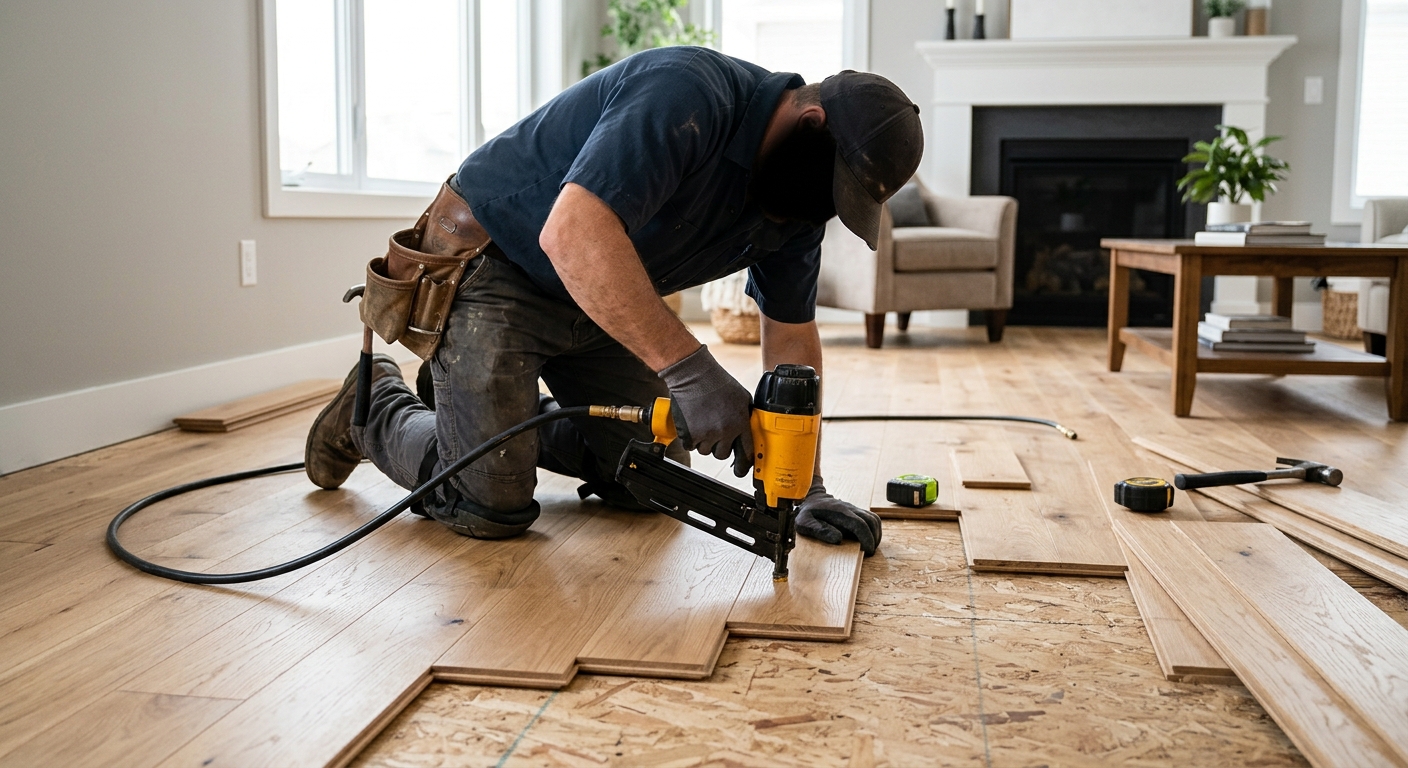
Flooring options and costs in Cornwall
Cornwall homeowners have plenty of flooring choices, but pricing and performance are strongly shaped by local housing age and Ottawa-region indoor humidity swings. With 70.4% of homes built before 1981, many properties still have older wood subfloors, uneven patches, and past renovations that require prep before any new surface can sit flat. That prep matters because even the best material can fail prematurely if the subfloor is out of plane or has moisture issues; levelling, plywood/OSB repair, and squeak fixes commonly add several dollars per square foot to the job before your new flooring is even installed. Ottawa-region conditions also swing between dry winters and humid summers, which can drive seasonal expansion and contraction. In basements and other below-grade spaces, moisture and hydrostatic pressure are common, so material choice becomes a safer investment decision—especially in Cornwall and South Stormont where many older basements see seasonal dampness.
Labour availability and disposal costs also affect what you pay. Projects in established neighbourhoods like Brookdale can involve more time for demolition, hauling, and careful transition detailing where old additions meet newer spaces. If you’re also adding or planning radiant floor heating, that narrows product compatibility and can increase underlayment and install labour. To help you budget realistically, the table below shows typical installed price ranges for common flooring types in Cornwall, along with the room locations where each option performs best.
| Type |
Best Room |
Moisture Resistance |
Lifespan |
Price per sq ft |
| Solid hardwood (nail-down, above grade only) |
Living room, dining room (above grade) |
Low—sensitive to humidity swings |
25–40 years |
$11–$22 |
| Engineered hardwood (float or glue, above + on-grade) |
Main floors, hallways (above/on grade) |
Medium–high—better dimensional stability |
20–35 years |
$10–$20 |
| Laminate (click-lock, above-grade) |
Secondary living spaces, bedrooms (above grade) |
Low–medium—edges can swell if standing water occurs |
10–25 years |
$6–$14 |
| Luxury vinyl plank / LVP (waterproof, any level) |
Kitchen, entry, basement (any level) |
High—waterproof with proper vapour barrier |
15–25 years |
$7–$15 |
| Porcelain / ceramic tile |
Kitchen, bathrooms, entry |
High—tile handles moisture well |
25–50 years |
$12–$25 |
| Carpet (broadloom or modular tile) |
Master bedroom, stairs, bedrooms |
Low—can trap moisture if below-grade |
7–15 years |
$5–$11 |
Prices are estimates only and vary by project scope, site access and material selection.
What affects the price of flooring in Cornwall
In Cornwall and the wider Ottawa region, you can see quote differences of 30–50% for what sounds like the “same” flooring—because labour, subfloor prep, and moisture protection often change project by project. Two homes might both choose LVP or engineered wood, but one might have a flat subfloor while the other has lath-and-plaster movement, soft spots, or a worn underlayment layer that has to be removed. In a market where 53.6% of households own their homes (Statistics Canada, 2021 Census), many upgrades happen as long-term renovations, which increases the need for careful levelling, transitions, and moisture-safe installation details.
Technically, Ottawa-region indoor humidity swings are the biggest driver. Solid hardwood expands and contracts with seasonal moisture and is not suited to basements or direct-on-concrete applications; it also can’t be glued or floated over concrete in typical installations—so if your quote includes basement areas, a solid hardwood option usually gets replaced with engineered wood or LVP. Engineered hardwood and luxury vinyl plank are more dimensionally stable and are better fits for many on-grade and above-grade situations, and LVP can be installed at “any level” when the vapour barrier and underlayment are correct. Colder local winters and rising energy efficiency also mean radiant floor heating is increasingly considered; not every product is compatible, and the wrong combination can lead to gapping or poor performance.
Local housing stock from the mid-20th century frequently means extra prep before the new floor goes down. As a ballpark, levelling compounds or patching commonly add about $1–$4 per sq ft, and more if transitions between older additions need careful feathering and new plywood/OSB overlay. That’s why a “budget” laminate job at roughly $6–$14 per sq ft can become closer to the $11–$22 hardwood band when moisture mitigation and subfloor correction push labour hours up.
| Price Factor |
Why It Matters |
Cost Impact |
| Room area in sq ft |
Materials and labour scale directly with footage, plus cutting waste on irregular rooms |
Low to high—affects both product and labour totals |
| Subfloor condition |
Levelling/repair is often necessary for a flat, squeak-free surface |
Typically adds $1–$4 per sq ft (sometimes more) |
| Moisture / below-grade install |
Basements can have moisture vapour and hydrostatic pressure; rules out solid hardwood |
May add membrane/vapour barrier and time; can increase $ per sq ft |
| Material choice |
Solid hardwood, engineered wood, LVP, and tile have different installation systems and labour demands |
Shifts the job between common $6–$22 bands |
| Removal and disposal of existing flooring |
Demo time, dust control, and hauling/disposal fees vary by flooring type |
Often increases total cost meaningfully on filled basements |
| Stair nosing / transitions |
Trim details can be charged per step or per linear foot and require precise fitting |
Can add several hundred dollars on typical stair counts |
| Radiant heat compatibility |
Not all products tolerate heat cycles and specific underlayments |
May require approved underlay and adds checking/coordination labour |
| Installation method |
Float vs. glue-down vs. nail-down changes labour time and prep requirements |
Glue-down and nail-down usually require more demanding prep |
Permits & regulations in Ontario
In Ontario, installing flooring by itself typically does not require a building permit. The work most homeowners think of as “just flooring” (removing an existing surface, setting underlayments, installing tile, or laying engineered wood/LVP) is generally not a permit trigger. However, associated work can be different. For example, if your project includes structural subfloor repair (like adding engineered support, major subfloor replacement beyond simple patching) or moisture remediation that involves addressing building envelope issues, you may need additional approvals depending on what’s being altered. If you’re installing or modifying radiant floor heating circuits, that electrical work often requires electrical permit approvals, and the installer must comply with applicable electrical safety requirements.
In condominiums, separate rules apply. Even when permits aren’t required, the building’s sound transmission requirements (often discussed through STC/IIC expectations) can restrict or require specific underlay systems on upper floors. Always review the condo declaration and request written approval before installing hardwood or tile on multi-unit floors, especially where vibration and noise control are concerned.
To protect yourself in Cornwall, verify your contractor’s Ontario compliance before any work starts: confirm they carry liability insurance (ask for a certificate of insurance showing your address as additional insured if possible), and confirm workers’ compensation coverage (WSIB/WCB) for employees. Then ensure their Ontario licence/registration is valid for the scope you’re hiring (many flooring trades operate under specific trade/registration rules). Ask for a clearance letter if they have a written WSIB clearance process, and cross-check the certificate details against the contractor’s company information.
Best flooring for each room in your Cornwall home
In Cornwall, the “best” choice is the one that tolerates Ottawa-region humidity swings and the way each room actually gets used. Living and dining areas typically suit engineered hardwood or high-quality laminate: they deliver a warmer feel than tile, and—unlike solid hardwood—they handle seasonal expansion better when installed above grade with the correct underlay. For master bedrooms, carpet is a strong comfort option because it reduces sound and feels warmer in cold winter mornings; however, it should stay above grade and stay dry to avoid odour or mould risk.
Kitchens demand easy-clean, water-tolerant surfaces. Luxury vinyl plank (LVP) is usually the practical winner, and large-format porcelain tile is the best “forever-clean” option if you don’t mind the cold feel underfoot. Basements are where the Ottawa-region moisture reality shows up: if your basement has any dampness history, LVP is the clear choice because it’s waterproof and can be installed with proper vapour barriers. Tile also performs well below grade, but the floor build-up, substrate prep, and labour intensity tend to be higher. Bathrooms should be porcelain or ceramic tile only—grout systems are designed for wet environments when installed and sealed correctly.
Radiant floor heating is increasingly popular in Ontario, but it narrows material selection. Engineered wood and most tile systems pair well with heat; solid hardwood is often limited due to heat cycling and humidity sensitivity. To see where pricing makes sense: if you’re comparing laminate at roughly $6–$14 per sq ft versus LVP in the $7–$15 range, the extra dollar per sq ft can be justified in kitchens or basements where water exposure and vapour conditions would otherwise shorten laminate’s lifespan.
| Room |
Best Material |
Why |
Moisture Risk |
Price Band per sq ft |
| Living / dining room |
Engineered hardwood |
Warm appearance with better stability for Ottawa humidity swings |
Low on above-grade slabs/joists when moisture is controlled |
$10–$20 |
| Master bedroom |
Carpet (or engineered hardwood if you prefer) |
Comfort and sound control; helps with winter feel |
Low if above grade and kept dry |
$5–$11 |
| Secondary bedrooms |
Laminate (quality grade) or engineered hardwood |
Durable under kids/pets when installed correctly |
Low to medium—avoid standing water at seams |
$6–$14 |
| Kitchen |
Luxury vinyl plank (LVP) |
Water-resistant and easy to maintain near spills |
Medium—higher chance of wet mopping and splashes |
$7–$15 |
| Basement (finished) |
Luxury vinyl plank (waterproof) |
Best match for moisture vapour and uneven below-grade conditions |
High—vapour and seasonal dampness risk |
$7–$15 |
| Bathroom |
Porcelain / ceramic tile |
Built for wet areas and long-term wear |
Very high—designed for continuous moisture exposure |
$12–$25 |
How to choose a flooring contractor in Cornwall
Choosing a flooring contractor in Cornwall is mostly about verifying competence before you sign: licensing/registration, insurance, and jobsite process. Start with liability insurance—ask for the certificate of insurance and confirm the coverage amount is appropriate for your project size. Next, confirm workers’ compensation coverage (WSIB/WCB) if they have employees; request proof (or a clearance letter) and make sure the document matches the legal company name. Then check Ontario licensing/registration for the scope you’re hiring, because flooring work that includes related trades (like electrical for radiant heating) must align with the appropriate approvals.
After you confirm eligibility, get 2–3 itemised written quotes. You want labour and materials broken down separately (including underlayments, vapour barriers, prep/levelling, stair transitions, and removals). Ask what’s excluded: disposal fees, subfloor repair, moving furniture, or patching beyond “basic” prep. A good quote will specify the installation method (float vs. glue-down vs. nail-down) and list the specific product/grade so you’re comparing apples to apples. If radiant heating is part of your plan, confirm compatibility in writing.
Warranty matters too: verify workmanship warranty length, what it covers, and whether the warranty transfers to a new owner. For payment, plan to keep control—never pay more than 10–15% upfront, and use a holdback until the job is complete and cleaned up. Finally, require a written start date and an estimated completion timeline with access conditions clearly stated.
- Ask for proof of WSIB/WCB coverage (clearance letter or equivalent) and match it to the contractor’s legal name.
- Request a current liability insurance certificate and ensure it covers flooring scope and jobsite activities.
- Confirm Ontario registration/licence status for the type of flooring and related scope you’re hiring.
- Require itemised quotes: materials, underlayments/vapour barriers, labour, and trim/transitions.
- Get a clear line for subfloor prep/levelling: what condition is assumed, what triggers extra cost.
- Confirm removal and disposal: where it’s hauled and whether dump fees are included.
- Ask who supplies and who installs transitions and stair nosing (and how it’s priced per step/linear foot).
- Review moisture handling: vapour barrier requirements for basements, and guidance on acclimation time.
- In radiant heat homes, confirm the approved floor-covering system and any required underlayment specs.
- Ensure the quote specifies the exact installation method (float/glue/nail) and underlay type.
- Demand a workmanship warranty in writing and ask whether it’s transferable.
- Use a payment schedule: 10–15% max upfront, then staged payments; hold back until complete.
Red flags to watch in Cornwall: a quote that’s only a single lump sum with no product or underlayment details; refusal to provide insurance/WSIB proof; missing written scope for disposal and subfloor prep; promises of “any basement works with solid hardwood” despite Ontario humidity and moisture realities; and vague start dates without a completion estimate or a signed contract that lists exclusions.
Frequently asked questions — flooring in Cornwall
How do I compare flooring quotes?
When comparing Cornwall flooring quotes, don’t just look at the total—compare how the quote is built. Ask for an itemised breakdown of materials and labour, including underlayment/vapour barriers, levelling compound or plywood/OSB repair (if needed), transitions, and stair nosing. Clarify what’s included in demo and disposal, because older homes built before 1981 often need more prep time than homeowners expect. Also confirm the installation method (float vs. glue-down vs. nail-down) and the exact product grade so you’re not comparing a budget laminate to a premium one. As a quick yardstick, if one quote is at the $6–$14 per sq ft band for laminate but another is at $7–$15 for LVP, ask what moisture protection is included—especially if you have any basement or on-grade area. A transparent quote usually saves money long-term.
Can I install flooring over existing tile in Cornwall?
Often, yes—but it depends on the tile condition and what flooring you’re installing over it. If the existing tile is well-bonded, level, and not cracked or loose, many contractors can install click-lock laminate or floating engineered wood over it using the correct underlayment (and sometimes a suitable underlay designed for hard surfaces). For LVP, waterproof planks can go over tile in many cases, but the surface must be sound and flattened to avoid “telegraphing” grout lines. The biggest cost variable is prep: you may need grinding/high spots or levelling to get the required flatness. If the tile subfloor is uneven from past renovations in Cornwall’s older housing stock, expect added levelling/patching before you even lay new material. If you want tile-to-tile, new tile is also possible but typically costs more in labour and substrate prep.
What is the best flooring for a high-traffic area in Cornwall?
For high-traffic areas in Cornwall—entries, hallways, and main living paths—choose materials that resist dents, scuffs, and moisture exposure. LVP is usually the most forgiving option because it’s waterproof and handles winter salt, wet boots, and everyday spills better than solid hardwood or standard laminate. If you prefer a more “natural wood look,” engineered hardwood can work very well above grade when installed properly, but it still isn’t a basement-first material in Ottawa-region humidity swings. Carpet is comfortable, but it wears faster in heavy traffic and can be tricky near entrances if moisture gets tracked in. In most homes, the best value sits around the mid bands: laminate in the $6–$14 per sq ft range can be fine for traffic if it’s quality, but for consistently messy or wet conditions, spending closer to the $7–$15 per sq ft LVP band is often justified.
How do I prepare my subfloor before new flooring?
Good subfloor prep is what prevents future squeaks, gaps, and premature failure—especially in Cornwall’s older homes where uneven subfloors are common. The usual steps are: remove the old flooring and any damaged underlayment; inspect for soft spots, moisture staining, and deflection; correct squeaks by fastening loose boards; and ensure the surface is flat enough for the chosen system. If there’s an old patchwork between additions, levelling compound or a plywood/OSB overlay may be required. For basements or below-grade areas, moisture protection is critical: vapour barrier requirements and proper underlayment selection matter more than many homeowners realize in Ottawa-region humidity swings. Subfloor prep is often the hidden line item that pushes pricing upward—commonly adding about $1–$4 per sq ft when patching/levelling is needed, and more if extensive repair is discovered.
Is cork or bamboo flooring a good choice in Cornwall?
Cork and bamboo can be attractive, but in Cornwall (Ontario) the decision should be tied to where you’ll install it and how the home handles moisture. Cork is naturally resilient and can feel warmer underfoot, but it still needs protection from standing water and high humidity; it’s typically not the first choice for basements unless you’ve confirmed a moisture-safe, properly sealed installation system. Bamboo flooring quality varies—some products are better handled as engineered planks, while others can behave like other wood products and react to humidity changes. In an Ottawa-region home with large indoor humidity swings between dry winters and humid summers, engineered products generally perform better than true solid wood solutions. If your project is in an above-grade living space and the contractor can confirm proper acclimation, underlayment choice, and flatness requirements, it can work—but if moisture risk is present, LVP or tile is a safer investment.
What is the difference between floating and glued-down flooring?
Floating flooring is installed without direct bonding to the subfloor. Click-lock laminate and many engineered wood planks are “floating,” meaning they sit on an underlayment and expand/contract slightly with humidity. Glued-down flooring is bonded directly to the subfloor (or to a prepared underlayment layer) using the manufacturer-approved adhesive. The big difference in Cornwall is how each method responds to moisture and subfloor conditions. Floating systems rely on stable subfloor flatness and an appropriate underlayment/vapour barrier; in basements or on-grade areas, moisture control is essential. Glued-down systems can offer a more rigid feel but require strict subfloor prep and correct moisture testing, and they’re not ideal if the slab or subfloor is questionable. If you’re budgeting, note that glue-down prep and adhesives can change labour and may move a job closer to higher bands—especially when total prep is added.