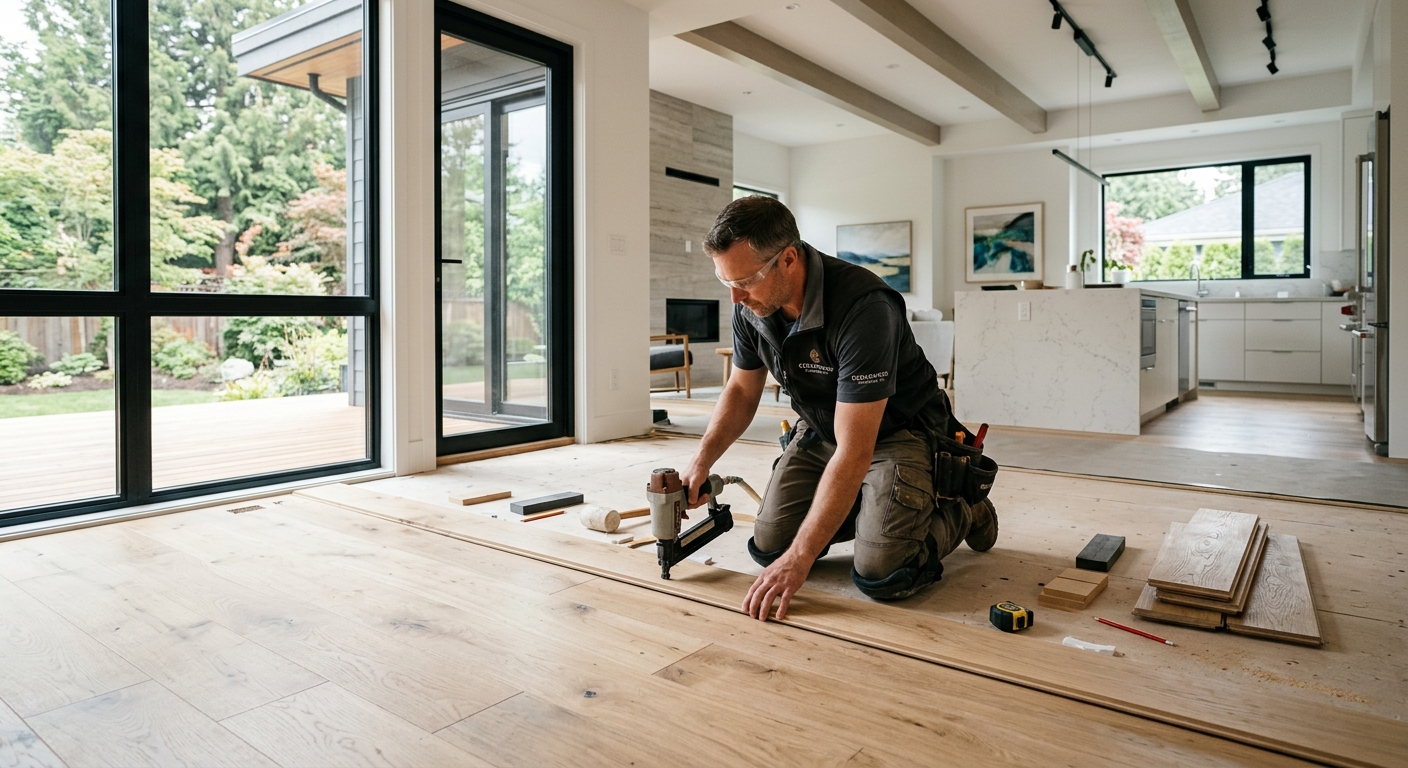
Flooring options and costs in Willowdale
Willowdale homeowners usually have plenty of flooring choices, but costs swing noticeably once you factor in Toronto-area moisture behaviour and the condition of the existing subfloor. With a Willowdale population of 79,440 (Statistics Canada, 2021 Census), there’s strong demand from both homeowners and investors, which keeps renovation labour steady year-round. Many nearby homes and rental properties were built decades ago and often need subfloor levelling, plywood repair, or moisture mitigation before install—especially when you’re going over older OSB/underlayment or uneven concrete. That prep can add roughly $1–$4 per sq ft, even before you buy a new material. In practice, that’s why the “same” finished look can land 30–50% apart across Toronto and Ontario.
Toronto’s seasonal indoor humidity swings are a key reason we steer clients toward engineered hardwood or luxury vinyl plank for most Willowdale projects, particularly condos and newer infill builds. Solid hardwood looks great, but it expands and contracts more with moisture and is a higher-risk choice over concrete or in basements. If your home has (or will have) radiant floor heating—more common in new custom builds—many owners pair it with engineered wood, tile, or select vinyl products because of heat and expansion considerations.
Contractors are especially busy in areas like Bayview Village, where multi-unit renovations and main-floor updates are frequent. Next, here’s a practical price snapshot to help you compare materials and plan for typical Willowdale project ranges.
| Type |
Best Room |
Moisture Resistance |
Lifespan |
Price per sq ft |
| Solid hardwood (nail-down, above grade only) |
Living / dining (above grade) |
Low (moves with humidity) |
25–60 years |
$10 – $18 |
| Engineered hardwood (float or glue, above + on-grade) |
Living / dining, bedrooms (above grade) |
Medium–high (more stable) |
20–40 years |
$9 – $16 |
| Laminate (click-lock, above-grade) |
Living areas, hallways |
Low–medium (seams matter) |
10–25 years |
$4 – $8 |
| Luxury vinyl plank / LVP (waterproof, any level) |
Kitchen, basement, main floor with pets |
High (waterproof) |
15–25 years |
$5 – $10 |
| Porcelain / ceramic tile |
Kitchen, bathrooms, entries |
Very high |
30–50 years |
$12 – $25 |
| Carpet (broadloom or modular tile) |
Bedrooms, stairs for comfort |
Low (needs dry environment) |
8–15 years |
$5 – $11 |
Prices are estimates only and vary by project scope, site access and material selection.
What affects the price of flooring in Willowdale
Even when you choose the “same” flooring name, Willowdale quotes can differ by 30–50% because contractors include different scopes—especially subfloor preparation, moisture mitigation, and how they handle transitions and stairs. Toronto-area indoor humidity swings mean solid hardwood can require stricter acclimation and more careful moisture management, while engineered hardwood and luxury vinyl plank tolerate Ontario’s seasonal changes far better. Below-grade moisture is also a practical driver here: basements and concrete slabs frequently bring vapour up through the surface, and solid hardwood is simply not designed for those conditions. That’s why, for many Toronto homes, you’ll see engineered hardwood or LVP represent the safer value. In colder parts of the region and in new builds with radiant heat, solid hardwood and some laminate options are limited—so product selection can push the price up or down.
Older regional housing stock is another cost lever. If your home’s subfloor is out of plane, has soft spots, or needs plywood replacement, you can easily see $1–$4 per sq ft added just to make the surface installer-ready. For example: swapping from laminate at the lower end of the band ($4–$9/sq ft) to engineered hardwood is one change, but adding levelling and underlayment because the existing floor is wavy can be another. A second example is basement installs: LVP is typically priced in the vinyl band ($5–$10/sq ft) because it’s built for below-grade moisture, while trying to use wood can multiply prep costs or lead to risk and delays. A third example: stair work—stair nosing and transitions—often becomes a bigger portion of the quote than homeowners expect, particularly in older homes where steps and landings aren’t square.
Finally, labour availability matters in Willowdale because renovation demand is steady across Vaughan/Markham/Richmond Hill and Toronto proper, keeping crews booked. That’s also why transparent scopes and itemised pricing can make or break whether your final cost matches the estimate.
| Price Factor |
Why It Matters |
Cost Impact |
| Room area in sq ft — direct driver of material and labour cost |
Bigger floors require more planks/tiles and longer install time. |
Often the largest line item (moves total cost proportionally). |
| Subfloor condition — levelling or repair needed before install |
Toronto-area homes frequently need plywood replacement or levelling to avoid future gaps/squeaks. |
Typical add: $1–$4 per sq ft depending on scope. |
| Moisture / below-grade install — rules out solid hardwood |
Vapour from concrete slabs requires waterproof or moisture-tolerant assemblies. |
May push you toward engineered/LVP or add mitigation steps. |
| Material choice — solid vs. engineered vs. LVP vs. tile |
Different products have different performance and complexity. |
Broad band shift: engineered ($9–$16) vs LVP ($5–$10) vs tile ($12–$25). |
| Removal and disposal of existing flooring |
Demos take time, and waste disposal costs add up quickly. |
Can add a noticeable fixed charge by room/level. |
| Stair nosing / transitions — charged per step or per linear foot |
Stairs require precise cuts, nosings, and extra labour. |
Often increases totals more than expected in stair-heavy homes. |
| Radiant heat compatibility — limits material options |
Heat cycling affects expansion and adhesive requirements. |
May require specific products, underlay, or installation method. |
| Installation method — float vs. glue-down vs. nail-down |
Glue-down and nail-down often involve more preparation and steps. |
Labour and material adders vary; can swing final cost materially. |
Permits & regulations in Ontario
In Ontario, installing flooring by itself typically does not require a building permit. That said, related work can trigger permits—so it’s important for Willowdale homeowners to separate “floor covering” from “construction and systems.” Examples of work that may require a permit include: structural subfloor repair that changes framing or supports; any moisture remediation that involves prescribed ventilation or significant substrate modifications; and in-floor heating work, such as changing circuits, installing new wiring, or modifying electrical connections.
In condominiums around Willowdale (including many in the North York area), the bigger hurdle is often not the permit—it’s the building’s rules. Many corporations require specific sound-control underlay to meet STC/IIC expectations for upper floors, and some restrict hardwood or thick systems. Always review the condo declaration and request board approval in writing before installing hardwood or tile on above-grade units.
To verify a contractor, do this step-by-step:
- Ontario licensing: confirm the contractor is properly registered for the specific trade(s) they perform (and that any subcontractors are licensed where required).
- Liability insurance: ask for a current certificate of insurance—verify limits and that your address/project is covered.
- WSIB/WCB: request proof of coverage and ensure it applies to employees performing the work.
- Clearance letter: if they claim coverage but can’t provide documentation, treat it as a red flag.
- Get everything in writing: scope, inclusions/exclusions, and timelines.
Best flooring for each room in your Willowdale home
Choosing the right flooring in Willowdale means matching the material to moisture exposure, foot traffic, and comfort needs—especially because Toronto-area humidity changes through the year can affect wood and laminate seams. Living and dining areas are often best with engineered hardwood or high-quality laminate: both give warmth and a clean finish, while engineered products handle humidity swings better than solid hardwood. In master bedrooms, carpet still wins on comfort and sound absorption, but engineered hardwood is also a great option if you want a harder-wearing surface.
Kitchens are where spills and wet mopping matter most. Luxury vinyl plank (LVP) is a common choice because it’s waterproof and forgiving under real-life cleaning schedules. Large-format porcelain tile is another strong option for families who want the most resistant surface, though it costs more and needs a compatible underlayment plan. Basements (especially in the Willowdale area, where concrete slabs are common) are where LVP is usually the clear winner. Solid wood and most laminate are riskier over below-grade moisture and vapour movement; engineered wood can work better than solid in controlled assemblies, but LVP remains the most straightforward “set-and-forget” approach.
Bathrooms should be porcelain or ceramic tile only for long-term performance. If your home has radiant floor heating in a living area or bedroom, engineered wood, tile, and select vinyl products are typically the best pairing—solid hardwood is often limited due to expansion behaviour under heat.
As a pricing reality check: if you’re comparing laminate at the lower end of the band (around $4–$8/sq ft) to LVP (often $5–$10/sq ft), the extra dollar-per-square-foot can be justified when you have a basement or a kitchen prone to spills, because it reduces the risk of moisture-related failures and the cost of rework.
| Room |
Best Material |
Why |
Moisture Risk |
Price Band per sq ft |
| Living / dining room |
Engineered hardwood |
Warm look, more stable than solid in Ontario humidity swings. |
Low to medium |
$9 – $16 |
| Master bedroom |
Carpet or engineered hardwood |
Comfort and quieter steps; engineered keeps the floor cleaner for allergies. |
Low |
$5 – $14 |
| Secondary bedrooms |
Laminate or carpet |
Laminate balances cost and durability; carpet is great for comfort. |
Low |
$4 – $11 |
| Kitchen |
Luxury vinyl plank (LVP) or porcelain tile |
Easy cleaning and spill tolerance; tile adds long-term durability. |
Medium |
$5 – $25 |
| Basement (finished) |
Luxury vinyl plank (LVP) |
Designed for below-grade moisture and vapour conditions. |
High |
$5 – $10 |
| Bathroom |
Porcelain / ceramic tile |
Water-resistant surface that handles cleaning and wet conditions. |
Very high |
$12 – $25 |
How to choose a flooring contractor in Willowdale
Start by verifying the contractor’s Ontario compliance and safety coverage. Ask for their licence details (for any trade scope they perform), then request a current certificate of liability insurance showing your project/address. For workplace coverage, confirm WSIB/WCB status by requesting proof of coverage and, if applicable, a clearance letter. A reputable flooring contractor in Willowdale will provide these without pressure.
Next, get 2–3 written quotes with an itemised breakdown—materials and labour separated, not just a lump sum. Ensure the scope lists: subfloor prep/levelling steps, underlay details (especially for laminate and floating systems), how they handle transitions and stair nosing, and whether removal/disposal is included. In condos, confirm the underlay/sound requirements and whether board approval support is offered.
Warranty should be specific: ask for the workmanship warranty length and what it covers, the product/manufacturer warranty terms, and whether it’s transferable if you sell. For payment, never pay more than 10–15% upfront; hold back funds until the job is complete and you’ve confirmed transitions, edges, and cleanup.
Finally, request a written start date and a completion estimate. Flooring is schedule-sensitive in Ontario because materials and subfloor prep can affect turnaround—especially in older Willowdale homes where plywood replacement or moisture mitigation is sometimes required.
- Check WSIB/WCB proof before work starts (not after).
- Confirm liability insurance and coverage limits via certificate.
- Request itemised quotes (labour + materials + disposal + prep).
- Ask who removes baseboards and how re-install is handled.
- Verify underlayment details match the flooring product.
- Get a written scope for subfloor levelling and flatness target.
- Confirm transitions and stair nosing pricing method (per step/linear foot).
- Ask what’s excluded: patching, painting, trim refinishing, or mouldings.
- Confirm whether stairs/landings are included in labour hours.
- Get warranty terms in writing (workmanship + product).
- Agree on payment schedule (10–15% maximum deposit).
- Get the start date, lead-time expectations, and completion estimate in writing.
Red flags I see in Willowdale: quotes that exclude subfloor levelling while still claiming “ready for install,” refusal to show WSIB/WCB or insurance paperwork, vague scopes (“materials and labour included” with no breakdown), large upfront payments without a schedule, and pressure to sign before you’ve reviewed moisture-prep steps for concrete or basement areas.
Frequently asked questions — flooring in Willowdale
What is the difference between floating and glued-down flooring?
Floating flooring clicks together and rests on an underlay (or underlayment system) over the subfloor; it’s not mechanically fixed to the base. Glued-down flooring is bonded directly to the subfloor (or a recommended underlayer) using the proper adhesive, which reduces movement but increases prep requirements. In Willowdale, where indoor humidity swings are common, floating systems can perform very well when the subfloor is flat and acclimation is followed, especially for laminate and many engineered products. Glued-down installs often suit engineered hardwood better when the subfloor is well-prepared and stable. If moisture is a concern over concrete or in a basement, the best choice is usually engineered with the right assembly—or waterproof LVP, rather than solid wood.
What flooring holds up best to pets in a Willowdale home?
For pets, the best balance in Willowdale is usually luxury vinyl plank (LVP) or engineered hardwood with a durable finish. LVP is popular because it’s waterproof and tolerates accidents better than laminate or carpet—important in basements and main floors where spills happen. Typical LVP pricing falls around $5 – $10 per sq ft, depending on thickness, wear layer, and installation complexity. Engineered hardwood can also work well, but it’s more sensitive to long-term moisture exposure and needs careful subfloor prep and proper acclimation. Carpet is comfortable, but it stains and holds odours if liquids aren’t cleaned promptly. Whatever you choose, ask your contractor about scratch resistance (wear layer rating for vinyl, surface finish for wood) and whether they’re using the right underlayment to prevent squeaks and shifting.
How do I fix squeaky floors in my Willowdale home?
Squeaks are usually caused by movement between subfloor layers, loose fasteners, or an uneven base that makes boards flex as people walk. Before replacing a floor, you should identify whether the squeak is from joists, subfloor panels, or underlayment. In many older Willowdale homes, squeaks come from worn/loose subfloor sheets, which means levelling and nailing/screwing issues may need addressing before new flooring goes in. If you’re on concrete, squeaks can be trapped movement between slab and underlay, which is why proper preparation matters. A good contractor will evaluate flatness and propose a fix as part of the scope—often “subfloor repair before install” rather than a band-aid. If moisture remediation is needed, delaying it can create bigger problems later.
What is luxury vinyl plank and is it worth it in Willowdale?
Luxury vinyl plank (LVP) is a multi-layer vinyl floor with a wear layer on top, designed to handle everyday moisture and cleaning. In Willowdale and the broader Toronto area, indoor humidity swings and occasional below-grade vapour issues make LVP a practical choice for many basements, kitchens, and entry areas. It’s also comfortable underfoot compared with tile and typically faster to install than tile. In price terms, LVP often sits around $5 – $10 per sq ft, which can be worth it when compared with higher-risk choices like solid hardwood in basements or laminate in high-moisture zones. It’s especially worth it if you want a waterproof surface that tolerates spills without the long-term risk of seam swelling or cupping.
How much does flooring cost in Willowdale?
Flooring cost in Willowdale depends on product type, the room size, and—most importantly—the condition of your subfloor and moisture exposure. As a practical guide, laminate or vinyl plank projects often start lower, while tile and higher-end hardwood push costs up. For example, LVP commonly lands around $5 – $10 per sq ft including typical project scope, while porcelain/ceramic tile is often in the $12 – $25 per sq ft range. Solid hardwood typically sits higher, around $10–$18 per sq ft, and may require above-grade placement to reduce humidity movement risk. In older Willowdale homes, levelling and repair can add a meaningful line item (often roughly $1–$4 per sq ft). Ask your contractor for an itemised quote so you can compare like-for-like scopes.
Hardwood vs laminate vs vinyl plank — which is best?
The “best” choice depends on moisture risk and how you live in your Willowdale home. Solid hardwood is beautiful but is the most sensitive to humidity swings and is risky over concrete and in basements; it’s best kept above grade. Laminate is budget-friendly and looks good, but it relies on keeping seams dry—so it’s not my first pick for basements. Luxury vinyl plank is usually the most forgiving option where moisture is a concern and where pets/kids mean more spills. In price bands, you’ll typically see laminate around $4–$9 per sq ft and LVP around $5 – $10 per sq ft, while engineered hardwood often lands around $9–$16 per sq ft. If you’re adding radiant floor heating, many owners choose engineered wood or compatible vinyl/tile rather than solid hardwood. For most Willowdale families, engineered hardwood for main living and LVP for kitchen/basement is the safest, most durable pairing.