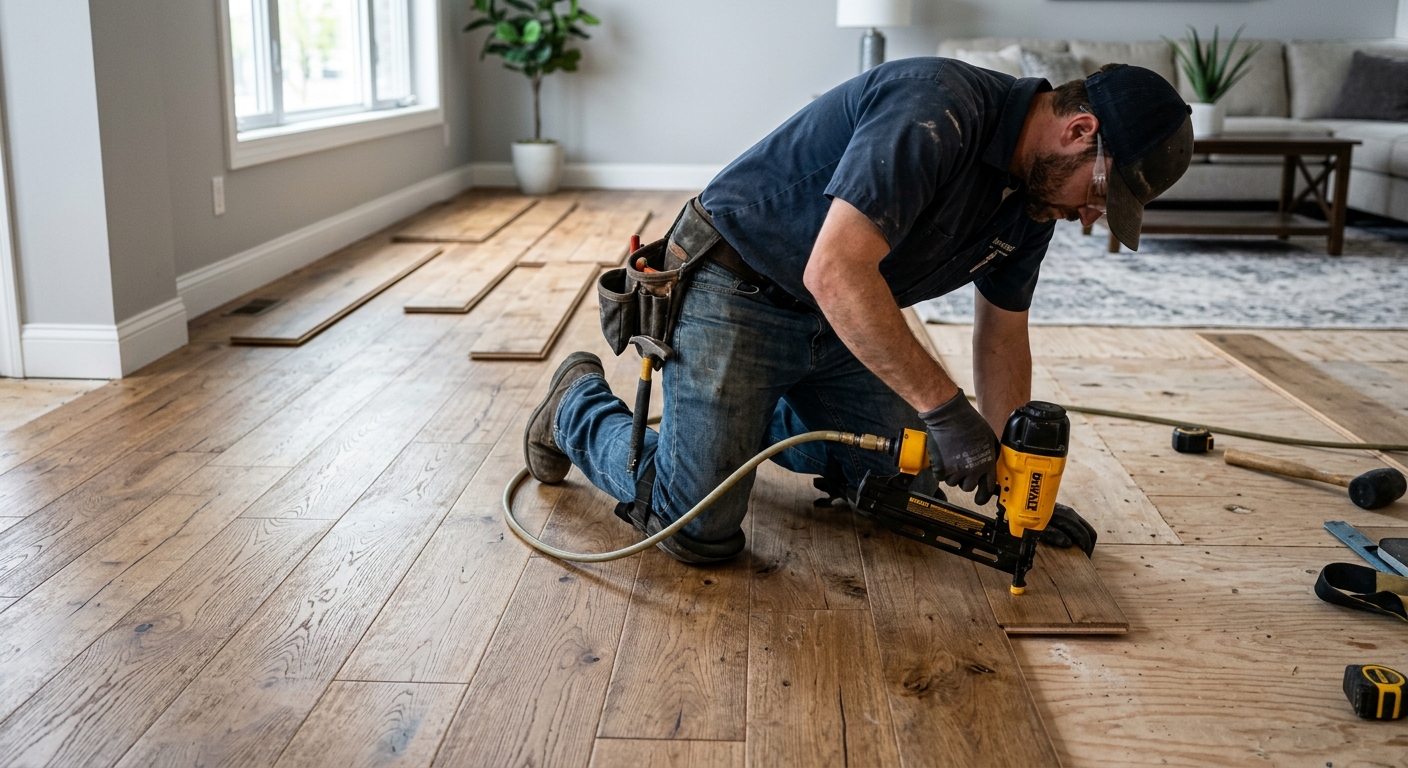
Flooring options and costs in Etobicoke
In Etobicoke, homeowners usually get the best value by matching the flooring to Toronto-area humidity swings and the way older homes behave once you open up the subfloor. About 365,000 residents call the area home (Statistics Canada, 2021 Census), and with renovation demand staying strong, contractors tend to be busiest in high-traffic neighbourhoods like Islington-City Centre and Eringate-Centennial-West Deane. City-wide, many properties date back decades; in older Ontario homes, it’s common to find minor crown in the subfloor and spot repairs before the new finish goes down. That prep work can add real cost, even when you choose a mid-range product.
Toronto-area indoor humidity can swing noticeably through winter and summer, which is exactly why solid hardwood—while beautiful—can be risky over concrete or in basements where moisture vapour is higher. In contrast, engineered hardwood and luxury vinyl plank (LVP) are more dimensionally stable and are routinely recommended for above-grade installs and some on-grade scenarios. If your home has or will have radiant heat, the material choice matters again: many owners favour engineered wood, tile, or compatible vinyl because heat and expansion have to be managed properly.
Cost also reflects labour pressure in the Toronto market, plus the amount of levelling, removal, and transitions needed. Before you compare quotes, it helps to anchor your expectations with realistic per-square-foot ranges—starting with the finished material costs you’ll likely see on paper—then layering in prep and installation complexity. Use the table below as your baseline.
| Type |
Best Room |
Moisture Resistance |
Lifespan |
Price per sq ft |
| Solid hardwood (nail-down, above grade only) |
Living / dining (dry, controlled humidity) |
Low to moderate (sensitive to humidity; not for below-grade) |
25–60 years (when conditions are stable) |
$9 – $18 |
| Engineered hardwood (float or glue, above + on-grade) |
Living / dining, bedrooms |
Moderate to high (better stability than solid) |
20–40 years |
$9 – $16 |
| Laminate (click-lock, above-grade) |
Secondary bedrooms, hallways |
Low to moderate (protect from standing water) |
10–25 years |
$4 – $9 |
| Luxury vinyl plank / LVP (waterproof, any level) |
Kitchen, basement (finished), main floor where spills happen |
High (waterproof core; handles vapour better) |
15–30 years (product dependent) |
$5 – $12 |
| Porcelain / ceramic tile |
Kitchen, bathrooms, entries |
Very high (tile itself; grout needs upkeep) |
30–50 years |
$12 – $25 |
| Carpet (broadloom or modular tile) |
Bedrooms, stairs (comfort and sound) |
Low to moderate (needs dry subfloor; avoid basements) |
7–15 years |
$5 – $11 |
Prices are estimates only and vary by project scope, site access and material selection.
What affects the price of flooring in Etobicoke
In Etobicoke and the broader Toronto area, quotes for the “same” flooring can be 30–50% apart because the biggest costs aren’t only the product—they’re the prep, moisture mitigation, and labour time needed to get a flat, stable subfloor. Even within Ontario, installers price differently based on how much levelling is expected, how many transitions or stair nosing pieces you need, and whether the job involves concrete, cut-outs, or detailed trim work.
Technically, the two key drivers for this region are indoor humidity swings and below-grade moisture risk. Solid hardwood expands and contracts with humidity, so it can’t be glued or floated over concrete and it performs poorly in basements. That’s why many Toronto-area projects steer toward engineered hardwood or LVP, especially where moisture vapour is a concern. In colder parts of the region—and many newer custom homes—radiant floor heating is common, and that further narrows the material list. Older housing stock also affects cost: you’ll often need subfloor levelling, plywood replacement, or moisture mitigation. Those steps can add roughly $1–$4 per sq ft before you even talk about the finish.
Here are a few concrete Etobicoke examples that move budgets quickly. A 1,000 sq ft main-floor job with minor dips can land near the laminate/vinyl bands ($4 – $9 per sq ft), but once levelling and plywood repairs are required, total installed cost rises even if the material stays mid-range. Conversely, upgrading to engineered wood may look more expensive than laminate, but if you’re already paying for heavy prep, the right engineered system can justify the difference versus risking solid hardwood stability. In a basement, choosing waterproof LVP instead of solid wood can prevent failures tied to moisture conditions.
| Price Factor |
Why It Matters |
Cost Impact |
| Room area in sq ft |
Directly drives material quantity and the number of labour hours for cutting and fitting |
Most variable line item (larger spaces scale all costs) |
| Subfloor condition |
Levelling and repairs must be done before the new floor goes down to prevent squeaks and gaps |
Often adds $1 – $4 per sq ft in older homes |
| Moisture / below-grade install |
Concrete and basements can carry moisture vapour; solid hardwood is a poor fit |
Can shift you toward engineered/LVP and add moisture-control materials labour |
| Material choice |
Solid hardwood, engineered, LVP, and tile have very different price points and install requirements |
Broad range; for example, laminate/LVP may start around $4 – $12 while tile often runs $12 – $25 |
| Removal and disposal of existing flooring |
Existing underlay, adhesive, and disposal fees can be time-consuming |
Often a meaningful add-on, especially with tile or glued-down products |
| Stair nosing / transitions |
Steps require more precision and materials; transitions add labour and special pieces |
Typically charged per step or per linear foot |
| Radiant heat compatibility |
Heat and expansion need compatible flooring and proper acclimation |
May restrict options and add oversight for installation method |
| Installation method |
Float, glue-down, and nail-down differ in prep, material, and labour intensity |
Glue-down and nail-down generally cost more than click-lock in most cases |
Permits & regulations in Ontario
In Ontario, installing floor coverings itself typically does not require a building permit. What can require permits is the associated work that touches electrical or structural systems. For example, if your project involves modifying or adding in-floor heating circuits, that electrical work may trigger permitting requirements through the electrical permit process. Similarly, if you discover rot and need structural subfloor repair beyond simple plywood replacement—especially if it involves engineered framing changes—that can raise permit or inspection needs depending on scope.
In condos in Etobicoke, the bigger “rule” is usually the building corporation’s sound-transmission requirements. Many condo by-laws and declarations restrict hard flooring on upper floors due to STC/IIC performance and underlay selection. Even when the floor type is approved, the corporation may require specific underlay systems or installation details, so you should request board approval in writing before ordering materials. Tile and hardwood over multi-unit floors often require careful underlay and an installation plan that meets their criteria.
Step-by-step, homeowners can verify a contractor’s credentials: (1) confirm the contractor is licensed/eligible to do the work as required under Ontario’s framework for their trade area; (2) request a current certificate of insurance for liability coverage and ensure the start date matches your project timeline; (3) ask for proof of WSIB/WCB coverage and review it for clearance status when applicable; and (4) keep copies—quotes, insurance certs, and any written condo approval—in your file before work begins.
Best flooring for each room in your Etobicoke home
Choosing the right flooring by room is the fastest way to control risk from Toronto’s humidity swings and prevent costly callbacks. In Etobicoke, living and dining spaces benefit from warmth and visual grain without overreacting to seasonal moisture. Engineered hardwood or high-quality laminate usually hits the sweet spot: they look elevated, install more predictably, and can be better tolerated than traditional solid hardwood when indoor conditions vary. For master bedrooms, many homeowners choose carpet for comfort and sound reduction, or engineered hardwood if they want easier cleaning.
In kitchens, spills and sink leaks are part of everyday life, so luxury vinyl plank (LVP) or large-format porcelain tile is the practical move. LVP is waterproof and forgiving for wipe-ups; porcelain tile brings excellent water resistance and handles heavy cleaning well. Basements are where most moisture failures originate, and in Etobicoke basements that are finished or frequently used, LVP is the clear winner—its waterproof core and vapour tolerance make it far safer than solid wood or most laminate. For bathrooms, porcelain or ceramic tile only is the reliable option.
If you have radiant floor heating, it’s increasingly common in new builds and renovations across the Toronto market. Engineered wood, tile, and certain compatible vinyl products pair well, while traditional solid hardwood and some laminate systems can be more sensitive to heat-driven expansion. As a dollar example: if you’re deciding between LVP and tile in a kitchen, LVP may land around $5 – $12 per sq ft, while porcelain often runs $12 – $25 per sq ft. You pay the extra for tile’s longevity and cleanability—if you expect long-term ownership or frequent deep-clean routines, that cost can be justified.
| Room |
Best Material |
Why |
Moisture Risk |
Price Band per sq ft |
| Living / dining room |
Engineered hardwood |
Warm look with better stability for seasonal humidity swings |
Low to moderate (manage indoor humidity) |
$9 – $16 |
| Master bedroom |
Carpet or engineered hardwood |
Comfort for mornings; engineered gives easy cleaning if desired |
Low (keep subfloor dry) |
$5 – $16 |
| Secondary bedrooms |
Laminate or engineered hardwood |
Durable for family use; laminate is budget-friendly if dry |
Low to moderate |
$4 – $14 |
| Kitchen |
Luxury vinyl plank (LVP) or porcelain tile |
Water resistance and wipe-clean practicality |
Moderate to high (spills and splash zone) |
$5 – $25 |
| Basement (finished) |
LVP |
Waterproof core and better tolerance of below-grade conditions |
High (vapour and seasonal moisture) |
$5 – $12 |
| Bathroom |
Porcelain / ceramic tile |
Reliable wet-area performance |
High (direct water exposure) |
$12 – $25 |
How to choose a flooring contractor in Etobicoke
When you’re hiring a flooring contractor in Etobicoke, credentials and transparency matter as much as price. Start by verifying Ontario licensing/eligibility for the contractor’s trade scope and ask for a certificate of liability insurance—make sure it’s active for your project dates. Next, request proof of WSIB/WCB coverage (or clearance where applicable). If they can’t provide documents promptly, treat it as a serious concern. For condo work, ask whether they’ve handled the same sound-transmission requirements (STC/IIC) your building enforces and whether they can submit underlay and installation details to the board.
Then get 2–3 itemised written quotes, not lump-sum numbers. You want a line-by-line breakdown separating material, labour, levelling/repairs, underlay, stairs/transitions, removal and disposal, and any moisture mitigation. Read the scope carefully: what is excluded (subfloor repair beyond a stated allowance, trim work, floor venting, minor drywall touching)? Confirm whether permits are included if radiant heat circuits or electrical scope are involved, and whether old flooring disposal is part of the price. Ask about warranties: workmanship warranty length, manufacturer warranty coverage, and whether warranties are transferable to a new owner.
For payment, never pay more than 10–15% upfront. Hold back funds until the job is complete and inspected, especially for stairs, transitions, and edging. Finally, require a start date and a realistic completion estimate in writing.
- Verify active liability insurance and request the certificate before work starts.
- Confirm WSIB/WCB coverage (or clearance) and keep the documentation on file.
- Ask for Ontario licensing/eligibility relevant to the work they’re doing.
- Get 2–3 itemised quotes: materials, labour, levelling/repairs, underlay, stairs/transitions.
- Ensure the quote states what’s included and excluded (removal, disposal, trim/caulking, subfloor allowances).
- Confirm acclimation requirements for hardwood/engineered products and how they’ll be handled.
- For condos, request the exact underlay and installation plan required by the corporation.
- Check warranty terms: workmanship duration, manufacturer warranty duration, and transferability.
- Confirm who is responsible for debris removal and where it’s disposed of.
- Require a written timeline with start date and estimated completion date.
- Payment schedule: limit upfront deposit to 10–15% and hold back until finishing details are done.
- Ask for references or photos from similar Etobicoke projects (including basements and on-grade installs).
Red flags I often see in Etobicoke include contractors who won’t provide insurance/coverage documents, quotes that omit removal or levelling details but assume a “perfect” subfloor, unclear warranty terms, pressure to pay large deposits upfront, and teams that can’t explain their moisture-control and underlay choices for your specific rooms.
Frequently asked questions — flooring in Etobicoke
How do I choose flooring for humidity in Etobicoke?
Etobicoke homes deal with seasonal indoor humidity swings, so your best “humidity plan” is to pick materials that tolerate small changes without moving or cupping. Solid hardwood can be risky above concrete and in basements because it expands and contracts with moisture; it’s also not a good fit for below-grade conditions. In most Toronto-area renovations, engineered hardwood and luxury vinyl plank (LVP) are the safer choices because they handle humidity better and are designed for above-grade and more demanding installs. If you’re comparing budgets, remember LVP often sits around $5 – $12 per sq ft, while engineered hardwood typically lands more like $9 – $16. Whichever you choose, make sure the subfloor is flat, dry, and prepped correctly—humidity problems usually start there, not in the finish.
Do condos restrict hard flooring?
Yes, many condos in Etobicoke restrict or control hard flooring on upper floors due to sound transmission requirements (STC/IIC). The condo corporation may require specific underlay thickness/type, installation details (like floating method vs. glue-down), and sometimes board approval before you order materials. Even if the product is approved generally, you still need to follow the building’s documentation process in writing. Before you sign a contract, ask your contractor for an underlay/product specification sheet and a flooring installation plan that matches the condo’s requirements. This is especially important for hardwood and tile, where sound impact is more noticeable. If you’re installing over existing flooring, clarify what the condo allows for height changes and whether removal is mandatory.
How do I compare flooring quotes?
Compare quotes like an inspector: line by line. Ask each contractor for itemised pricing that separates material, labour, underlay, subfloor levelling/repairs, stair nosing/transitions, removal and disposal, and any moisture mitigation. If one quote looks cheaper but excludes levelling or disposal, it won’t be apples-to-apples once the installer meets reality on site—especially in older Toronto-area homes where plywood replacement or levelling is sometimes needed. Also confirm what finish details are included: undercutting door jambs, caulking/base shoe details, and transition trim type. Look for warranty clarity (workmanship and manufacturer) and a written timeline. Finally, verify coverage documents (liability and WSIB/WCB) so you’re comparing not only price but risk protection as well.
Can I install flooring over existing tile in Etobicoke?
Sometimes, but it depends on the tile condition, flatness, and what product you’re installing. Many installers can lay laminate or vinyl over certain existing surfaces if the tile is fully bonded, stable, and the overall height works with doors and transitions. However, if the tile is cracked, loose, or uneven, you’ll need remediation first—otherwise click-lock or LVP edges can fail or telegraph imperfections. Over wet areas or basements, moisture testing matters even more. For hardwood products, laying over tile is generally not recommended unless the system and subfloor conditions are engineered for that use case, and it typically adds complexity. Ask your contractor whether they’ll level, patch, or use an appropriate underlayment system—and confirm who is responsible for achieving the required flatness.
What is the best flooring for a high-traffic area in Etobicoke?
For high-traffic areas, you want durability, easy cleaning, and stability through humidity swings. In many Etobicoke households, LVP is a top practical choice because it’s waterproof and holds up well to daily spills and frequent foot traffic; it also installs cleanly in areas with seasonal moisture exposure. A common installed price range you’ll see is about $5 – $12 per sq ft depending on thickness and wear layer. If you prefer the look of real wood, engineered hardwood in a quality wear layer can work, but you still need proper subfloor prep and humidity control. Tile is also excellent for durability (often $12 – $25 per sq ft) and is great in kitchens/entries—just note it’s harder underfoot than wood or carpet. The “best” option is usually the one that matches your room moisture and your tolerance for maintenance.
How do I prepare my subfloor before new flooring?
Subfloor prep is where good jobs are won. Before installation in Etobicoke, the contractor should check flatness, remove anything loose (old adhesive residue, curled underlay, or failing patches), and verify the subfloor is dry and structurally sound. For older homes, that often includes levelling compound, spot plywood replacement, or mechanical fastening corrections to prevent squeaks. If there’s any risk of below-grade moisture, a moisture plan is required—especially for basements—since solid hardwood and many laminate installations can fail under vapour pressure. For LVP, the surface still needs to be smooth and stable; waterproof doesn’t mean “ignore bumps.” Ask the installer to describe exactly how they’ll measure flatness, what materials they’ll use for repairs, and how long the surface will cure before flooring goes down.