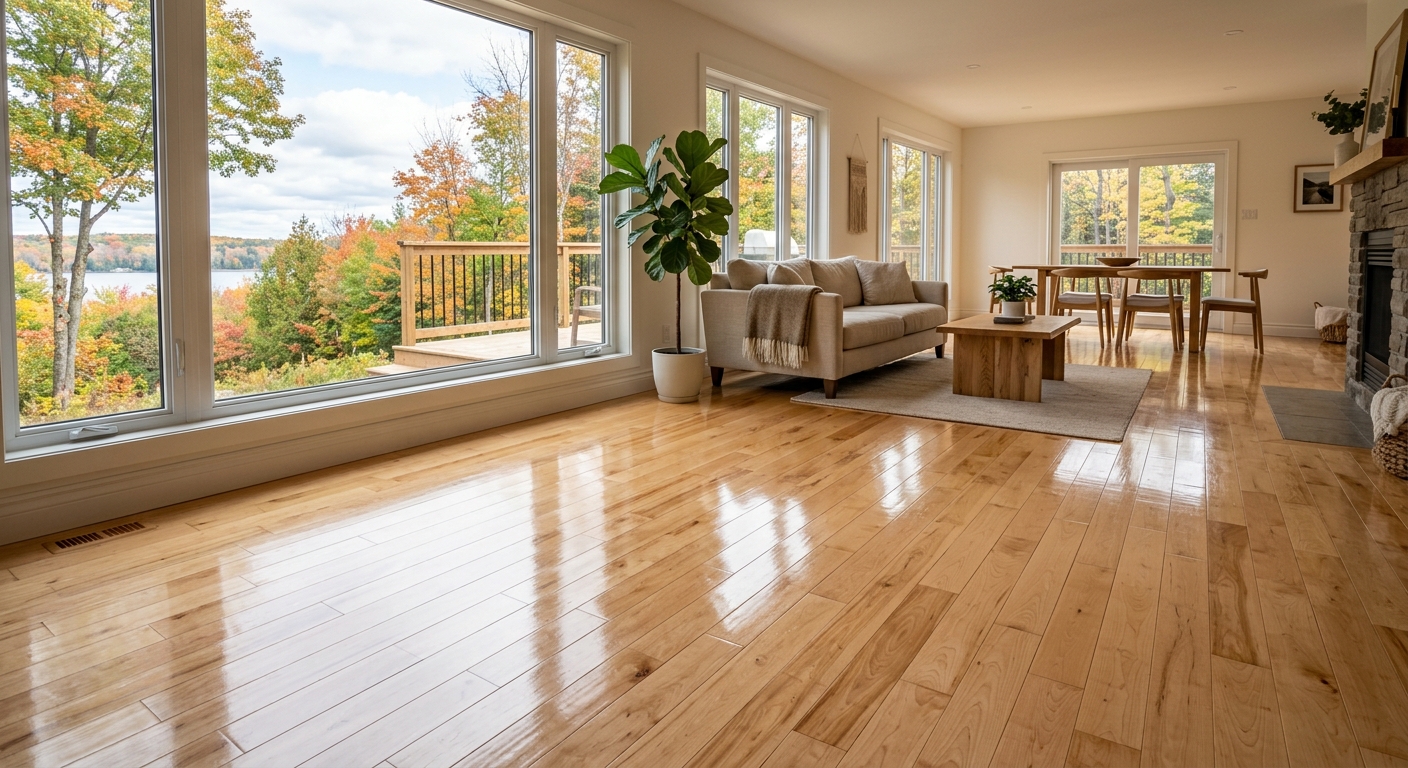
Flooring options and costs in Willowdale East
Flooring choices in Willowdale East, Ontario typically come down to balancing looks with stability in a climate that swings hard from season to season. With a population of 50,434 in the area profile (Statistics Canada, 2021 Census), there’s steady demand for renovations—especially around busy pockets like Yonge Street and the surrounding condo and infill neighbourhoods where upgrades happen frequently. That combination of demand and older housing stock means many installs start with subfloor checks; in this Toronto-area market, homes built earlier often need levelling or repair work before the “new” floor can go down. In practical terms, that kind of prep can add roughly $1 to $4 per sq ft depending on what’s found and how much plywood/levelling is required.
Toronto-area indoor humidity swings also push pricing and product selection. Solid hardwood is beautiful, but it expands and contracts with moisture and is a higher-risk choice over concrete and in basements. Engineered hardwood and luxury vinyl plank (LVP) are more dimensionally stable and are specifically made for above-grade and on-grade installs—plus LVP is usually the safest bet where moisture vapour is a concern. Labour can also run higher than you’d expect because renovation volume keeps contractors booked up and raises general site wage rates. If you’re planning radiant floor heating (common in newer custom builds), that can further affect material selection, often favouring engineered wood, tile, and certain LVP systems.
Use the table below to compare typical material price bands, then we’ll break down what changes your quote the most for Willowdale East.
| Type |
Best Room |
Moisture Resistance |
Lifespan |
Price per sq ft |
| Solid hardwood (nail-down, above grade only) |
Living / dining (above grade) |
Low to moderate (sensitive to humidity) |
25–40 years |
$9–$18 |
| Engineered hardwood (float or glue, above + on-grade) |
Living, bedrooms (above/on-grade) |
Moderate to high (more stable) |
15–30 years |
$9–$16 |
| Laminate (click-lock, above-grade) |
Bedrooms, hallways |
Low to moderate (not for wet areas) |
10–20 years |
$4–$9 |
| Luxury vinyl plank / LVP (waterproof, any level) |
Kitchen, finished basement |
High (waterproof core) |
15–25 years |
$5–$12 |
| Porcelain / ceramic tile |
Kitchen, bathrooms |
Very high (water resistant) |
25–50 years |
$12–$25 |
| Carpet (broadloom or modular tile) |
Bedrooms, stairs (comfort) |
Low to moderate (susceptible to spills) |
8–15 years |
$5–$11 |
Prices are estimates only and vary by project scope, site access and material selection.
What affects the price of flooring in Willowdale East
In the Greater Toronto Area, quotes for the “same” flooring can land 30–50% apart because the hidden work is rarely identical—especially in Willowdale East where older 1960s–1990s homes and active condo renovation cycles overlap. Labour pricing is also strongly influenced by renovation demand: when contractors are busy, installation schedules tighten, crews cost more, and site handling (protection, staging, additional labour for stairs) increases. That’s why a homeowner might see one installer come in at a laminate band while another shows engineered or LVP with more prep included, or where levelling and moisture mitigation are correctly priced.
Technically, the biggest drivers are indoor humidity swings and below-grade moisture. Solid hardwood expands and contracts with humidity and is typically restricted to above-grade, nail-down installs; it’s not the right match over concrete and it performs poorly in basements. Engineered hardwood and luxury vinyl plank handle humidity and below-grade applications far better, and that can reduce rework risk. In colder parts of the region and in homes with radiant floor heating, that heat and expansion behaviour often rules out traditional solid hardwood and some laminate products—pushing you into engineered, tile, or compatible vinyl systems.
Two local cost examples are common in Willowdale East: (1) if plywood replacement or subfloor levelling is needed before installation, that prep alone can add about $1 to $4 per sq ft; (2) if there’s an existing floor to remove, disposal and grind/patch time can meaningfully raise labour, especially in condo corridors and tight walk-ups. When you compare product bands, the difference between laminate at about $4–$9 per sq ft and engineered hardwood at about $9–$18 is often justified by stability and reduced failure risk—not just appearance.
| Price Factor |
Why It Matters |
Cost Impact |
| Room area in sq ft |
Materials and labour scale directly with surface area |
Large jobs can lower the per-sq-ft labour rate |
| Subfloor condition |
Levelling/repair is often required in Toronto-area housing |
Typically adds about $1–$4/sq ft where issues are found |
| Moisture / below-grade install |
Solid hardwood is risky; moisture mitigation may be needed |
Can shift you from solid to engineered/LVP, changing the price band |
| Material choice |
Different products require different underlay, labour and install methods |
Often the biggest swing (laminate/LVP vs engineered vs tile) |
| Removal and disposal of existing flooring |
Old flooring removal affects labour and disposal fees |
Commonly adds a measurable labour premium on tight sites |
| Stair nosing / transitions |
Transitions and stair work are time-intensive |
Often priced per step or per linear foot |
| Radiant heat compatibility |
Heat affects expansion; limits some products in Ontario |
May require engineered/tile/LVP rated for heat |
| Installation method |
Float vs glue-down vs nail-down changes labour and prep |
Glue-down and nail-down often need more detailed substrate prep |
Permits & regulations in Ontario
In Ontario, installing new flooring typically does not require a building permit. If you’re only removing existing flooring and installing a replacement surface (engineered wood, laminate, LVP, carpet, or tile), that’s generally treated as an interior finishes project. The “permit line” usually shows up when the flooring project touches systems or structural elements.
Work that may require permits includes electrical tasks related to in-floor heating circuits (for example, electrical connection/modifications to heating controls and wiring). Work that typically does not require permits includes levelling and patching a subfloor, replacing damaged subfloor panels (non-structural), installing underlay/vapour barriers, and laying new flooring finishes.
For condos in Willowdale East and across Toronto, the bigger practical rule is often the building’s by-laws and the corporation’s sound transmission requirements. Many buildings restrict hard flooring on upper floors because of impact noise, and they may require specific underlay or flooring build-up to meet STC/IIC expectations. Before you sign anything, request approval in writing—especially for hardwood or tile on above-grade floors.
To verify your contractor, start with their Ontario credentials: check licensing details through provincial/industry listings (as applicable), confirm they carry liability insurance, and ask for current clearance documentation for workers (WSIB/WCB coverage). Request a current certificate of insurance and keep it with your contract paperwork. For extra safety, ask for a written scope that states who handles site protection, debris removal, and any required permits for electrical work.
Best flooring for each room in your Willowdale East home
Choosing the right flooring room-by-room matters in Willowdale East because your indoor environment and traffic patterns are different from space to space, and Ontario’s humidity swings can stress certain materials. For living and dining areas, homeowners usually want warmth and a clean look without worrying about seasonal movement—engineered hardwood is often the best middle ground, while high-quality laminate can work if your install stays above-grade and the subfloor is well-prepped. In master bedrooms, comfort and sound absorption are key: carpet is a popular option for softness and noise reduction, while engineered hardwood offers a more durable alternative for allergy-friendly households.
In kitchens, go for moisture tolerance and easy cleanup. Luxury vinyl plank (LVP) is a common Toronto-area favourite because it’s waterproof and forgiving if water spills or drops occur. If you want a “forever” finish, large-format porcelain tile is excellent for water resistance, though it’s heavier and needs a more precise subfloor. Basements are where solid wood and most laminate typically struggle in Ontario: LVP is the clear winner because it’s designed for below-grade conditions and handles moisture vapour better than traditional hardwood.
For bathrooms, stick with porcelain or ceramic tile only. If your home includes radiant floor heating, it’s increasingly common in newer builds; that system changes the compatibility conversation. Engineered wood, tile, and certain LVP products are usually the better partners because they’re made to handle heat cycling more predictably than traditional solid hardwood.
Budget-wise, it’s often worth paying the jump from a laminate band at about $4–$9 per sq ft to LVP at about $5–$12 per sq ft when the room is near moisture sources or in a finished basement—because the risk of edge swelling and call-backs drops significantly.
| Room |
Best Material |
Why |
Moisture Risk |
Price Band per sq ft |
| Living / dining room |
Engineered hardwood |
Warm look, better stability than solid hardwood in humidity swings |
Low to moderate |
$9–$16 |
| Master bedroom |
Carpet or engineered hardwood |
Comfort and quieter feel; engineered still holds up well long-term |
Low |
$5–$16 |
| Secondary bedrooms |
Luxury vinyl plank (or laminate if dry) |
Durable for kids/pets; easier maintenance than carpet |
Low to moderate |
$4–$12 |
| Kitchen |
Luxury vinyl plank or porcelain tile |
Waterproof performance and wipe-clean surfaces |
Moderate |
$5–$25 |
| Basement (finished) |
Luxury vinyl plank |
Engineered for below-grade moisture and dimensional stability |
High |
$5–$12 |
| Bathroom |
Porcelain / ceramic tile |
Best-in-class water resistance and longevity |
Very high |
$12–$25 |
How to choose a flooring contractor in Willowdale East
Start by confirming the contractor can legally and responsibly do the work in Ontario. Ask for their insurance documents first: liability insurance proof (certificate of insurance with your project named where possible) and their worker coverage status for WSIB/WCB. You’ll also want to verify their business details and standing through available provincial/industry resources, and ensure the quote is in writing with a defined scope.
Next, get 2–3 itemised written quotes. The best quotes separate labour and materials and list key line items: removal, subfloor levelling/repair, underlay/vapour barrier, transitions, stair work, and waste factor. Avoid “lump sum only” estimates if you can—especially in Willowdale East where older subfloors can change the job midstream. Ask whether permits are included (for any electrical work tied to radiant systems) and whether disposal is included, too.
Warranty matters on two levels. Confirm the workmanship warranty length and what it covers (for example, hollow spots after installation, separation at seams, or improper adhesion). Then confirm the product/manufacturer warranty and whether it’s transferable to future owners. Finally, align payment to progress: never pay more than about 10–15% upfront, and hold back a portion until the job is complete and cleaned. Request a start date and completion estimate in writing so you have a realistic schedule.
- Verify liability insurance with a current certificate before any deposit.
- Confirm WSIB/WCB coverage for installers and ask for the clearance documentation if applicable.
- Use itemised quotes (labour, materials, underlay, vapour barrier, levelling, transitions).
- Ask who supplies and installs underlay/vapour barrier and whether it matches the manufacturer spec.
- Clarify what’s included in removal and disposal of old flooring and underlay.
- Require a written scope for subfloor prep (levelling/patching, plywood replacement if needed).
- Confirm stair work pricing (nosing, stringer prep, and return cuts).
- Ask how they handle door trimming and undercutting thresholds.
- Check the timeline in writing (start date, estimated completion date, and any milestones).
- Confirm dust control/protection plan for stairs, hallways, and adjacent rooms.
- Get warranty details in writing: workmanship term + what triggers coverage.
- Set payment terms: 10–15% max upfront, with a holdback until close-out.
Red flags in Willowdale East: contractors who won’t provide insurance/WSIB/WCB proof; “one price fits all” quotes with no subfloor inspection; no written scope for levelling, transitions, or stair nosing; pressure to pay more than 10–15% upfront; and vague warranty language (especially workmanship duration and exclusions).
Frequently asked questions — flooring in Willowdale East
What's the most durable flooring for pets and kids?
For pets and kids in Willowdale East, luxury vinyl plank (LVP) is usually the most durable practical choice. It’s waterproof, handles common spills, and is more forgiving if accidents happen near entryways or kitchens. If you’re choosing between bands, LVP typically lands around $5–$12 per sq ft depending on thickness and wear layer, while laminate is commonly in the $4–$9 range but can be more vulnerable to swelling if water sits at seams. Engineered hardwood also works well in living spaces, but it’s still sensitive to standing moisture compared with waterproof vinyl. The real durability win, regardless of product, is correct subfloor prep—Toronto-area homes often need levelling or repair before installs to prevent bounce and premature wear.
How do I choose flooring for humidity in Willowdale East?
Toronto’s indoor humidity swings are exactly why many Willowdale East homeowners are steered toward engineered hardwood or LVP rather than solid hardwood—especially when installs are over concrete or in basements. Solid hardwood expands and contracts with moisture and is typically limited to above-grade nail-down installs. Engineered hardwood is more dimensionally stable, and LVP is designed for higher humidity and below-grade conditions. Before ordering, ask your contractor to check and document subfloor moisture conditions and to plan correct underlay/vapour barrier use. If you’re considering radiant floor heating in a newer infill build, verify product compatibility first because heat cycling affects expansion and can void warranties if the wrong system is used. In older homes, budget for levelling and repair—commonly $1–$4 per sq ft—because a well-prepped substrate helps floors perform through seasonal changes.
Do condos restrict hard flooring?
Yes—many condos in Willowdale East and the broader Toronto market restrict or regulate hard flooring on upper floors due to impact noise and sound transmission requirements (STC/IIC expectations). While flooring itself usually doesn’t require a permit, condo approvals often do because the building is trying to control vibration and noise. Common restrictions include using a specific underlay system under engineered hardwood or tile and following limits on installation methods that affect sound. Before you start, request board approval in writing, and provide product details and underlay specifications to match what the corporation requires. Also confirm hallway/stair protection rules and debris removal procedures; that can affect how labour is scheduled and priced. If you’re comparing quotes, ask whether the contractor’s scope includes the required underlay for sound performance—because it can change the project cost even with the same floor product.
How do I compare flooring quotes?
To compare quotes in Willowdale East fairly, don’t just look at the total—compare the line items. Ask for an itemised breakdown separating labour and materials, including removal/disposal, subfloor levelling/repair, underlay/vapour barrier, transitions, and stair work. Confirm what’s excluded: is plywood replacement included if the contractor finds damage, or is it an add-on? Also check whether the quoted price assumes a certain room area or includes waste factor. For moisture-sensitive installs, ask how they address below-grade risk; solid hardwood often comes with higher constraints, which can affect your real “apples to apples” comparison. Use the local price bands as a sanity check: laminate and vinyl are often around $4–$9 and $5–$12 per sq ft respectively, while tile commonly falls in the $12–$25 range. A quote that’s far outside these bands may be missing prep or scope details.
Can I install flooring over existing tile in Willowdale East?
Sometimes, but it depends on the condition and height build-up. In Willowdale East, homeowners ask this because removing ceramic can be expensive and messy. Many installers can proceed over existing tile only if the tile is well-bonded, flat, and stable—no loose sections or significant lippage. There may be required prep like grinding high spots and using the correct patch/underlayment system, especially if you’re installing LVP, laminate, or engineered wood. If you’re installing tile over tile, you still need proper substrate prep and compatible thinset methods. The best next step is to have the contractor assess for soundness, flatness, and any moisture concerns in the slab. If moisture vapour is a risk (common in some basements), LVP systems may be more appropriate than materials that are less tolerant. Always request the contractor’s written prep steps so you understand whether the existing tile becomes part of the “substrate” or must be removed.
What is the best flooring for a high-traffic area in Willowdale East?
For high-traffic areas like entries, hallways, and main living zones, LVP and engineered hardwood are often the top picks because they balance durability with everyday comfort. LVP is waterproof and tends to tolerate messy weather better—important in Ontario when wet boots, salt, and tracked moisture are common near doorways. Engineered hardwood offers a more upscale look and can work well when the indoor humidity is managed and the substrate is properly prepped. If you’re comparing the market price bands, LVP is commonly around $5–$12 per sq ft, which can be a strong value versus tile at $12–$25 per sq ft for the same hallway size, unless you want the permanence and water resistance tile provides. Whichever option you choose, ask about wear layer thickness for LVP and the quality of the install (flatness, underlayment, and seam/transition detailing). Those details are what keep floors looking good through the busy Toronto seasons.