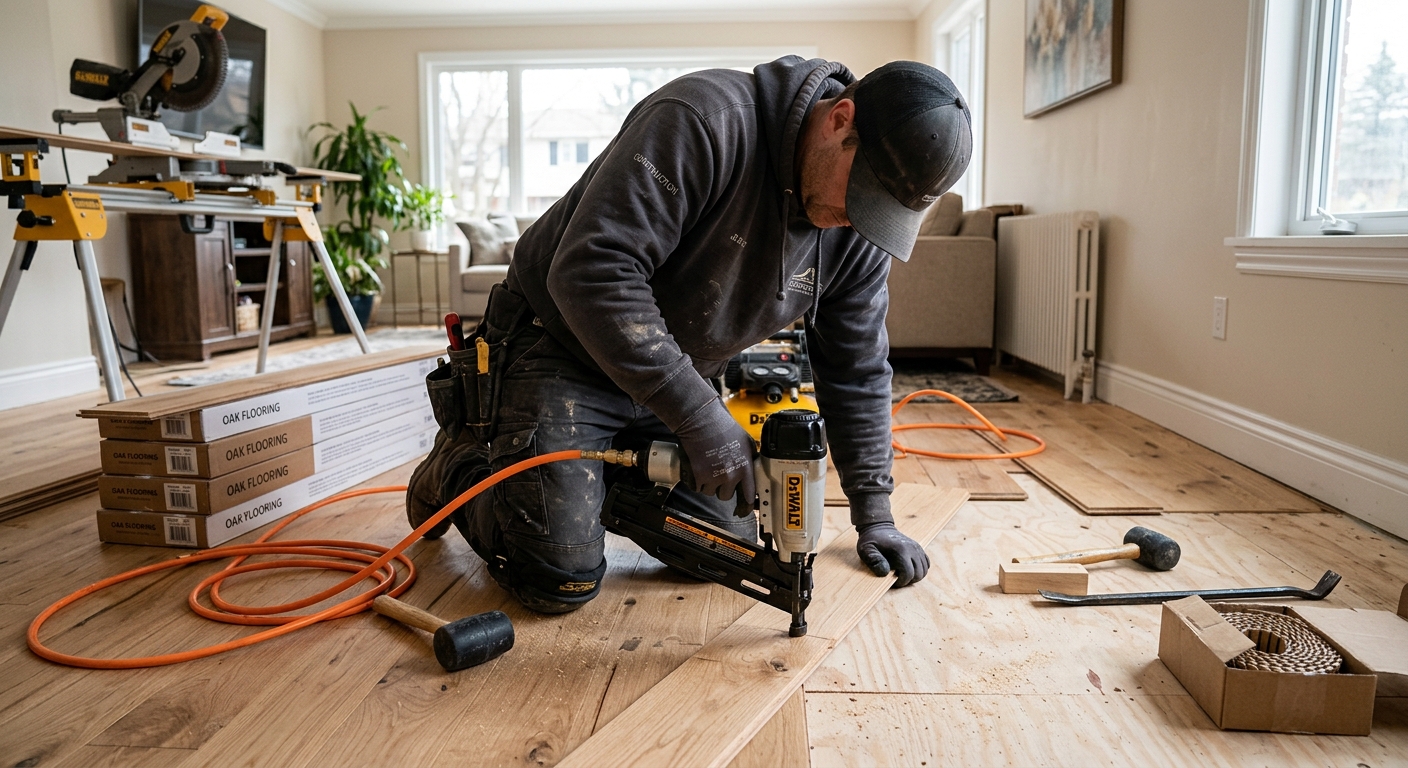
Flooring options and costs in LaSalle
LaSalle homeowners usually start by comparing “looks” and “price,” but the real cost story is driven by what’s under the existing floor. In LaSalle, with 31.6% of homes built before 1981 (Statistics Canada, 2021 Census), it’s common to find older subfloors that need patching or levelling before any new finish goes down—especially if boards are cupped or the surface is uneven. That preparation step can add labour and materials that many entry-level quotes don’t show upfront.
In the Windsor–Sarnia corridor, dry winter air and humid summers create indoor humidity swings that affect flooring performance and warranty coverage. Basements in the region often sit over damp concrete, so moisture testing, a proper vapour barrier, and upgraded underlayments are frequently required before installing engineered hardwood or luxury vinyl plank (LVP). If you’re also planning radiant heat in colder areas of southwestern Ontario, you’ll want products rated for in-floor systems; otherwise you risk gaps, joint separation, or surface issues later.
Contractor demand is especially steady around family-oriented areas like Tecumseh Road East and the neighbourhoods closer to the Highway 401 corridor, where homeowners commonly renovate for resale and comfort. The good news: once moisture control and subfloor prep are addressed, you can choose between long-term wood looks and waterproof, low-fuss options.
Below is a practical price range guide for LaSalle so you can compare apples-to-apples, then we’ll break down what moves those numbers up or down.
| Type |
Best Room |
Moisture Resistance |
Lifespan |
Price per sq ft |
| Solid hardwood (nail-down, above grade only) |
Living / dining on well-controlled floors |
Low to moderate (humidity-sensitive) |
25–40 years |
$10,–$18 |
| Engineered hardwood (float or glue, above + on-grade) |
Living rooms, bedrooms, hallways |
Moderate to high (product-dependent) |
20–35 years |
$11,–$17 |
| Laminate (click-lock, above-grade) |
Bedrooms, low-moisture living areas |
Moderate (stands up to light spills) |
10–25 years |
$5,–$10 |
| Luxury vinyl plank / LVP (waterproof, any level) |
Kitchen, finished basement |
High to very high (waterproof core) |
15–30 years |
$6,–$13 |
| Porcelain / ceramic tile |
Kitchen, bathrooms, entries |
Very high |
30–50 years |
$12,–$22 |
| Carpet (broadloom or modular tile) |
Bedrooms, stairs for comfort |
Low (needs dry subfloor) |
8–15 years |
$4,–$9 |
Prices are estimates only and vary by project scope, site access and material selection.
What affects the price of flooring in LaSalle
In LaSalle and the wider Windsor–Sarnia corridor, the same “1,000 sq ft living space” can come in 30–50% apart because the quote depends on what’s happening under your existing floor. Unlike markets with uniformly newer homes, southwestern Ontario includes a lot of older stock—31.6% built before 1981 (Statistics Canada, 2021 Census)—so contractors often factor subfloor levelling, patching, or even an OSB/plywood overlay before they’ll guarantee a flat installation. If a proposal assumes a perfectly smooth substrate, the final cost usually catches up once the crew starts measuring.
The climate is the second big driver. Winter air can be dry indoors, while summers are humid, so solid hardwood expands and contracts with moisture; it’s also not intended for basement concrete. Solid hardwood generally can’t be glued or floated directly over concrete and performs poorly in basements where vapour pressure is higher. By contrast, engineered hardwood and LVP handle humidity and below-grade conditions far better—especially when paired with the right vapour barrier and underlayment. In colder homes with radiant heat, material selection tightens further; many solid wood products won’t be recommended, and not all laminate is approved.
Two common LaSalle examples: (1) if your subfloor is wavy, we often see levelling materials and labour add about $1–$4 per sq ft before any finish goes down; (2) if there’s a finished basement, moisture testing and an upgraded underlayment package can push overall basement installs closer to premium bands—while the same footprint upstairs may land nearer entry laminate levels such as $5–$10 per sq ft. On tile, the floor stays stable, but labour rises if the slab is uneven because that needs smoothing or backer prep first.
| Price Factor |
Why It Matters |
Cost Impact |
| Room area in sq ft |
Material quantities and crew time scale with square footage |
Higher for small jobs due to minimum charges; often $0.50–$3 per sq ft swings |
| Subfloor condition |
Levelling/repair is required to prevent squeaks, gaps, and joint failures |
Commonly adds about $1–$4 per sq ft on older homes |
| Moisture / below-grade install |
Vapour barriers and moisture testing can be mandatory for warranty |
Can shift a basement project from mid-band to premium by several dollars per sq ft |
| Material choice |
Solid, engineered, LVP, and tile have different performance requirements and costs |
Entry laminate/vinyl may sit around $5–$10/sq ft; tile can be $12–$22/sq ft |
| Removal and disposal of existing flooring |
What’s underneath (glue, underlay, nails) affects labour and disposal |
Often adds $1–$5 per sq ft depending on complexity |
| Stair nosing / transitions |
Transitions and stair components are measured per step or per linear foot |
Can add a noticeable premium on multi-level homes |
| Radiant heat compatibility |
Limits product types and affects required underlay and acclimation |
May move you from solid hardwood pricing into engineered/tile/LVP bands |
| Installation method |
Float, glue-down, or nail-down determines prep, materials and labour intensity |
Glue-down and careful nail-down prep typically cost more than basic float |
Permits & regulations in Ontario
In Ontario, flooring installation by itself typically does not require a building permit. What can trigger permits is the associated work around the flooring system. For example, if your project includes structural subfloor repair (engineering may be needed in rare cases), moisture remediation involving significant construction work, or upgrades that tie into electrical circuits for in-floor radiant heat, you may need electrical permits depending on the scope. If you’re adding or modifying thermostat wiring, power supplies, or in-floor heating components, that electrical work is where permits usually come into play.
For condominiums in LaSalle (or any multi-unit building in Ontario), the bigger issue is often not permits—it’s the building rules. Many corporations have restrictions related to sound transmission (commonly discussed as STC/IIC performance) and require specific underlay under hardwood or other hard-surface floors on upper floors. Before you start, review the condo declaration and request written board approval when needed—especially for hardwood, tile, or any installation that can transmit impact sound.
Step-by-step, here’s how a homeowner should verify a contractor before work begins:
- Confirm the contractor’s Ontario business details and licence/registration status via the appropriate online registry page they provide for their trade.
- Request proof of liability insurance (certificate of insurance) and ensure it lists your address/project as applicable.
- Ask for WSIB/WCB coverage documentation (clear evidence they’re registered and in good standing).
- Verify they’re insured for the specific flooring scope you’re hiring them for (removal, subfloor patching, underlayment, and installation method).
- Keep copies of the quote, insurance cert, and clearance documents with your contract.
Best flooring for each room in your LaSalle home
Your best choice in LaSalle depends on moisture exposure, foot traffic, and comfort—plus whether the room is above grade, at grade, or below grade. For living and dining areas, engineered hardwood or high-quality laminate are popular because they deliver warmth and a natural look while handling seasonal humidity swings better than solid wood. In the master bedroom, homeowners often choose carpet for comfort and quiet, or engineered hardwood if they want easier cleaning.
For kitchens, the Windsor–Sarnia humidity mix and the likelihood of water exposure (spills, wet boots) make luxury vinyl plank (LVP) an excellent fit because it’s designed as waterproof, including around normal household incidents. If you want a “forever” option and plan to keep the home, large-format porcelain tile is also a strong choice—especially in families that like a cleanable surface.
Basements are where the region’s moisture reality shows up. Fully waterproof LVP is usually the clear winner for finished basements because it tolerates below-grade installs much better than solid hardwood and most laminate systems. For bathrooms, stick with porcelain or ceramic tile only; it’s the most reliable against ongoing wet conditions and it keeps maintenance straightforward.
If you’re using radiant heat (increasing in Ontario new builds and renovations), choose products explicitly rated for in-floor systems. Radiant-friendly engineered wood and tile typically perform best, while many solid hardwood installs and some laminates aren’t recommended because of expansion gaps under heat cycling. As a budget example: upgrading a basement from laminate (often $5–$10 per sq ft) to LVP can cost more per sq ft, but you’re paying to reduce moisture-related failures—an expense you’ll rarely want to repeat.
| Room |
Best Material |
Why |
Moisture Risk |
Price Band per sq ft |
| Living / dining room |
Engineered hardwood |
Warm look with better tolerance for seasonal humidity swings than solid |
Low to moderate (manage indoor RH) |
$11–$17 |
| Master bedroom |
Carpet or engineered hardwood |
Carpet adds comfort and sound dampening; engineered keeps a cleaner surface |
Low |
$4–$9 |
| Secondary bedrooms |
Laminate (quality click-lock) or carpet |
Laminate is durable for kids; carpet adds softness for comfort |
Low |
$5–$10 |
| Kitchen |
Luxury vinyl plank (waterproof) or porcelain tile |
LVP handles spills and cleaning; tile offers a long-life, water-ready surface |
Moderate (spills and wet traffic) |
$6–$13 (LVP) or $12–$22 (tile) |
| Basement (finished) |
Luxury vinyl plank (waterproof) |
Best tolerance for damp concrete and humidity—paired with vapour control |
High (below-grade vapour pressure) |
$6–$13 |
| Bathroom |
Porcelain / ceramic tile |
Proven performance under wet conditions; maintains value and longevity |
Very high |
$12–$22 |
How to choose a flooring contractor in LaSalle
Choosing the right contractor in Ontario comes down to verification and clarity. First, confirm Ontario licensing/registration where applicable for the contractor’s trade and ask for proof of liability insurance (certificate of insurance). Next, verify WSIB/WCB coverage so you’re not exposed if a worker is injured on your property. In practice, you should ask for: (1) insurance certificate, (2) WSIB/WCB clearance letter or equivalent proof, and (3) identification of who will be on-site (crew vs. subcontractors).
Second, request 2–3 itemised written quotes. You want a breakdown that separates labour, materials, underlayment/vapour barrier components, levelling compound/patching, transitions, and removal/disposal. Lumping everything into one line makes it easy for scope gaps to show up as change orders. Read the scope carefully: is disposal included, is moisture testing included for basements, and is there an allowance for stair nosing and transitions? Also ask whether the quote includes permit-related work for radiant heat electrical components (if applicable) or if that’s handled separately by an electrician.
Third, confirm warranty coverage in plain language. There should be a workmanship warranty (often longer for premium installers) and a separate manufacturer warranty for the product, including whether it’s transferable to future owners.
For payment, keep it controlled: never pay more than 10–15% upfront. Use a holdback until the job is complete and you’ve received final walkthrough notes.
Finally, get the start date and estimated completion timeline in writing, so you can plan around humidity control, acclimation, and subfloor prep.
- Ask for the contractor’s liability insurance certificate before signing.
- Confirm WSIB/WCB clearance letter or equivalent proof is current.
- Verify the quote is itemised: labour, materials, underlay/vapour barrier, levelling, and transitions.
- Require an on-site assessment of subfloor flatness and moisture risk for basements.
- Confirm whether removal and disposal of existing flooring is included.
- Ask who supplies and installs transition pieces (reducers, t-moldings, stair nosing).
- Ensure the scope states the acclimation requirements for wood or engineered products.
- Request a moisture testing method for below-grade installs where applicable.
- Clarify warranty terms: workmanship duration, product warranty, and transferability.
- Check payment schedule: keep upfront to 10–15% and hold back until punch-list completion.
- Get a detailed schedule in writing (start date, milestones, completion date).
- Confirm cleanup standards (dust control, final sweep, and debris haul-away).
Red flags in LaSalle include: vague “all-in” pricing with no itemised scope, refusal to provide insurance and WSIB/WCB proof, skipping moisture testing for basement installs, pressuring large upfront payments, and not documenting product/manufacturer model numbers or warranty details in the contract.
Frequently asked questions — flooring in LaSalle
How much does flooring cost in LaSalle?
In LaSalle, most homeowners budget based on installed price bands that reflect subfloor prep and moisture control. For example, laminate and vinyl plank often land around $5,–$10 for mid-range installs, while tile commonly runs $12,–$22 installed depending on labour, layout cuts, and prep. Basements tend to cost more because Windsor–Sarnia humidity swings and damp concrete require vapour control, moisture testing, and upgraded underlayments; that preparation can add $1–$4 per sq ft in older homes. With 31.6% of LaSalle homes built before 1981 (Statistics Canada, 2021 Census), uneven subfloors are a frequent cost driver. The best way to price accurately is a walkthrough that includes substrate and moisture checks.
Hardwood vs laminate vs vinyl plank — which is best?
“Best” depends on the room’s moisture exposure and your tolerance for seasonal changes. Solid hardwood looks great but is humidity-sensitive and generally isn’t recommended for basements or direct concrete installs; it can expand and contract with winter/summer swings. Engineered hardwood is often a better compromise for main floors, while luxury vinyl plank (LVP) usually wins for kitchens and finished basements because it’s waterproof and handles humidity and below-grade conditions more reliably. Laminate is a solid budget option for bedrooms and low-moisture areas, typically in the $5,–$10 band, but it shouldn’t be treated like waterproof if a spill sits. If you’re doing radiant heat, confirm product ratings because not all laminate and solid wood are compatible with in-floor systems.
What flooring is best for a LaSalle basement?
For LaSalle basements, LVP is usually the safest choice because it’s waterproof and better suited to damp concrete conditions common across the Windsor–Sarnia corridor. Contractors often start with moisture testing and then include proper vapour barriers and the right underlayment system before installation; this is key for warranty and long-term performance. Solid hardwood is typically a poor fit for below-grade humidity and can struggle with expansion/contraction, while many laminate products are also vulnerable if moisture gets through seams or edges. If your basement has an uneven slab or older framing, you may also pay for levelling/patching to ensure the floor stays flat. Expect basement pricing to sit closer to premium bands for waterproof materials rather than entry-only flooring.
Can I install hardwood over concrete?
Usually, solid hardwood is not a good candidate for direct concrete installs. In Ontario, the typical best practice is: solid hardwood nail-down on an above-grade subfloor, with conditions that keep humidity stable. Concrete is different because moisture vapour can rise through it, and solid wood is designed to work over a properly built wood subfloor. Engineered hardwood is often the more appropriate option for on-grade or certain slab situations, but it still requires the correct moisture mitigation plan (vapour barrier system, proper prep, and the product’s installation instructions). If you’re in LaSalle, a moisture test is especially important for basements. If radiant heat is present, confirm the engineered wood and adhesives are explicitly rated for that application.
How long does flooring installation take?
Timing depends mainly on subfloor prep, the number of rooms, and how much removal/levelling is needed. For many above-grade installs, a crew can often complete a single main-floor level within a few days once materials arrive—but older LaSalle homes may need extra prep. If your subfloor requires patching or self-levelling, that can extend the schedule because levelling compounds need time to cure and the surface must reach the right flatness. Basement projects add drying/verification steps due to moisture vapour control requirements. Wood products also require acclimation to your indoor conditions. The most reliable way to get an accurate timeline is an on-site measure and scope review, where the contractor confirms prep needs before you pay any deposit.
What flooring works with radiant heat?
Radiant heat is increasingly common in Ontario renovations and new builds, and it changes what you should install. Tile and many engineered wood products are commonly used because they can be installed with systems designed for in-floor heating and typically tolerate cyclical temperature changes well. LVP can also work if the product is explicitly rated for radiant heat and if the recommended underlayment approach is followed. Most solid hardwood options are more limited; the combination of heat cycling and humidity sensitivity increases the risk of gapping or movement, so it’s important to follow manufacturer guidelines or choose a product that’s specifically approved. If you’re planning radiant heat in LaSalle, ask your contractor to match the flooring specification to the heating system instructions before ordering—this avoids costly rework and warranty disputes.