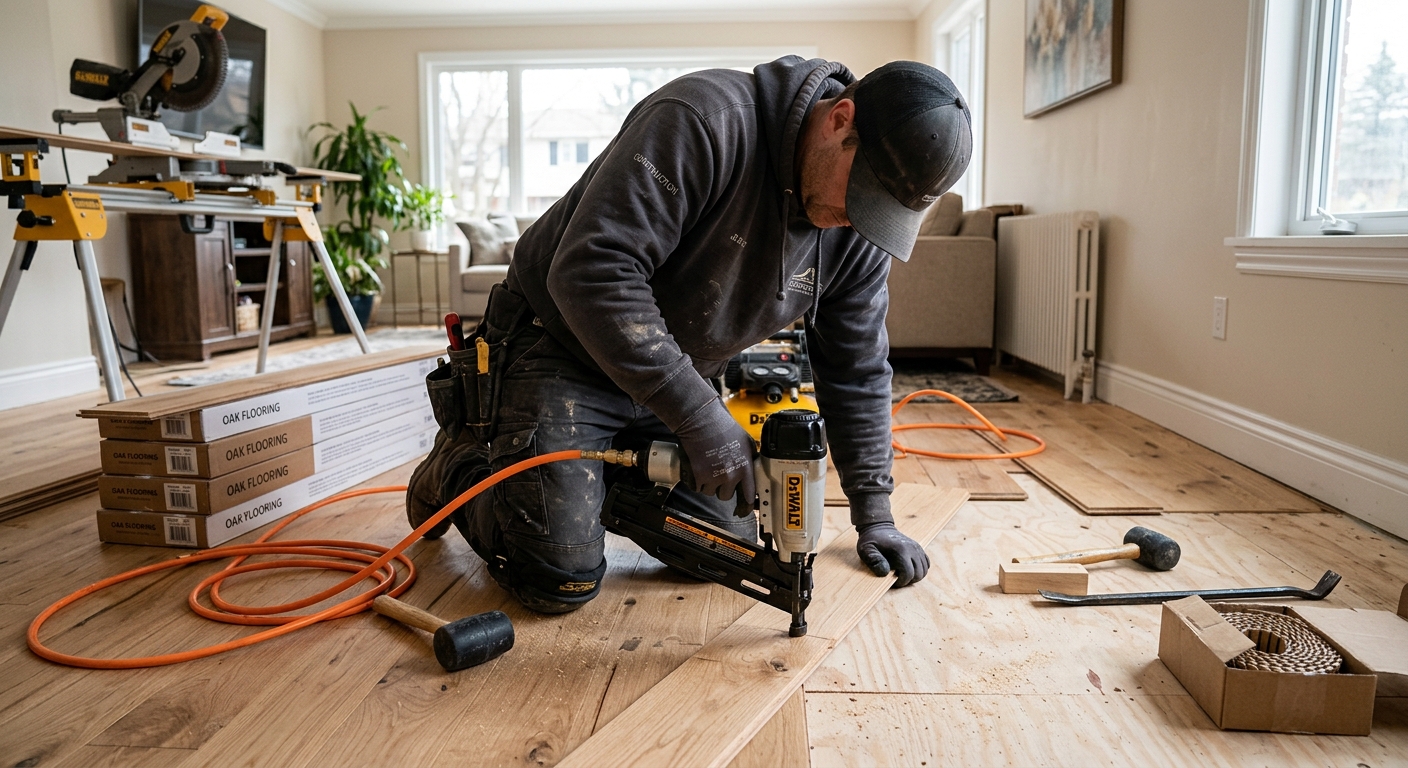
Flooring options and costs in Malvern
In Malvern, your flooring choice usually comes down to how Ontario weather swings indoor humidity—and how your home’s foundation and subfloor handle it. Malvern’s population is 43,794 (Statistics Canada, 2021 Census), and that means steady renovation demand in the Toronto region, with contractors booked quickly during peak seasons. Many homes here date from the 1960s–1990s, so it’s common to plan for subfloor levelling, plywood replacement, or moisture mitigation before the “new floor” can even go down. In practice, that prep work can add roughly $1–$4 per sq ft, and in stubborn cases more, depending on how far the contractor has to correct the surface.
Because Toronto-area homes see wide indoor humidity swings across seasons, we typically steer homeowners toward engineered hardwood or luxury vinyl plank (LVP) in most cases—especially in condos and newer infill builds. Solid hardwood looks premium, but it’s more sensitive to moisture; it’s risky over concrete and in basements. Also, labour in the Toronto area is pushed up by renovation volume and higher construction wages, so two similar quotes can diverge significantly if one contractor includes more prep, transitions, or subfloor repairs in their scope.
If you’re considering a facelift in high-traffic pockets like Clarkson area / Malvern Town Centre zone (where many residents are in condos and townhouse communities), you’ll often see faster scheduling and more competitive pricing because more crews are available for regular, repeatable install types. Next, use the comparison table to estimate material and install budgeting for your exact room plan.
| Type |
Best Room |
Moisture Resistance |
Lifespan |
Price per sq ft |
| Solid hardwood (nail-down, above grade only) |
Living / dining (dry, above grade) |
Low to moderate (moves with humidity) |
25–60 years |
$9 – $18 |
| Engineered hardwood (float or glue, above + on-grade) |
Main floor, bedrooms |
Moderate to high (more stable) |
15–35 years |
$9 – $17 |
| Laminate (click-lock, above-grade) |
Bedrooms, hallways (dry use) |
Moderate (not for wet areas) |
10–25 years |
$4 – $9 |
| Luxury vinyl plank / LVP (waterproof, any level) |
Kitchen, finished basement |
High to excellent (waterproof core) |
15–25 years |
$4 – $10 |
| Porcelain / ceramic tile |
Kitchen, bathrooms, foyers |
Excellent (properly sealed) |
25–50 years |
$12 – $25 |
| Carpet (broadloom or modular tile) |
Bedrooms, stairs for comfort |
Low to moderate (needs dry maintenance) |
7–15 years |
$5 – $11 |
Prices are estimates only and vary by project scope, site access and material selection.
What affects the price of flooring in Malvern
In Malvern and the broader Toronto region, you can see 30–50% differences between quotes for the same “square footage” job. The most common reason is that one contractor prices the full reality of the install (subfloor prep, moisture mitigation, transitions, and removal), while another prices only the finish floor. Toronto-area homes also deal with indoor humidity swings across seasons, which affects product selection and the prep needed to keep materials from separating, cupping, or gapping later.
Technically, the key drivers are below-grade moisture and humidity movement. Solid hardwood expands and contracts with humidity and cannot be glued or floated over concrete; it also performs poorly in basements and over slab where moisture vapour can rise. Engineered hardwood and luxury vinyl plank are more dimensionally stable and are designed for above-grade and, when specified correctly, for higher-humidity or below-grade installations. If you’re in a colder-part-of-region build planning radiant heat, that can rule out most traditional solid hardwood and some laminate products, while engineered wood and tile are more compatible.
Older regional housing stock frequently needs subfloor levelling or repair before install. In Malvern, that can add $1–$4 per sq ft (and sometimes more if plywood replacement is required). For example, a 500 sq ft main-floor refresh might land closer to mid-range laminate/vinyl at $4–$9/sq ft if subfloors are sound—but can climb toward the $9–$18/sq ft hardwood band once prep and transitions are included. As another example, tile work is often higher at $12–$25/sq ft because labour includes layout, underlayment or membrane choices, and careful edge finishing.
| Price Factor |
Why It Matters |
Cost Impact |
| Room area in sq ft |
Direct driver of material quantity and labour time |
Small rooms cost more per sq ft due to setup and waste; larger rooms often reduce unit cost |
| Subfloor condition |
Levelling/repair prevents floor failure and keeps warranties valid |
Typically adds $1–$4 per sq ft for levelling/repair in older Toronto-area homes |
| Moisture / below-grade install |
Rules out solid hardwood and requires correct underlayment for other products |
May add moisture mitigation steps; can shift you to engineered wood or LVP |
| Material choice |
Solid wood, engineered, LVP and tile have different prep needs and labour intensity |
Can move the project between laminate/vinyl ($4–$9) and hardwood/tile ($9–$18 / $12–$25) bands |
| Removal and disposal of existing flooring |
Access, fasteners, underlay, and haul-off time vary widely |
Often adds several hundred to over a thousand dollars depending on layers |
| Stair nosing / transitions |
Stairs and doorway transitions are detailed work |
Typically priced per step or per linear foot; frequently overlooked until late in quoting |
| Radiant heat compatibility |
Heat and expansion require specific flooring assemblies |
May increase material cost (often engineered wood, tile, or compatible vinyl) and reduce product options |
| Installation method |
Float vs glue-down vs nail-down changes time and subfloor prep requirements |
Nail-down and glue-down usually require more precise prep; float is often faster |
Permits & regulations in Ontario
In Ontario, installing flooring itself usually does not require a building permit. The permit question mainly appears when your flooring project includes other regulated work. For example, if you’re doing structural subfloor repair that changes the structure, adding or modifying in-floor heating circuits, or doing electrical work tied to radiant systems, you may need permits through the appropriate channels. In those cases, plan for additional steps and scheduling with qualified trades.
Condominiums add another layer: even when flooring doesn’t require a permit, the condo corporation’s rules around sound transmission commonly come into play. Many buildings restrict or require specific underlay under hard flooring on upper floors to meet sound criteria (often referenced through STC/IIC performance). Always review the condo declaration and ask for board approval in writing before you install hardwood or tile on upper levels.
For homeowners in Malvern, verifying a contractor is straightforward if you know what to ask. First, request their Ontario business documentation (and confirm they’re in good standing where applicable). Second, ask for a current certificate of insurance showing general liability and that they can legally work at your address. Third, for workplace safety coverage, request proof of WSIB/WCB coverage—this protects you if someone is injured on site. If a contractor provides clear documentation and a line-item scope (removal, levelling, underlayment, transitions, disposal), you’re far more likely to avoid surprise change orders.
Best flooring for each room in your Malvern home
Choosing flooring in Malvern is about matching the finish to moisture exposure, daily traffic, and comfort needs—then selecting an install method that can handle Toronto’s humidity swings. Living and dining areas typically do best with engineered hardwood or high-quality laminate: you get the look and warmth without the same movement risk as solid hardwood. For master bedrooms, homeowners often pick carpet for comfort and sound control, or engineered hardwood if they prefer easier cleaning. Secondary bedrooms can lean laminate or carpet depending on noise and whether you expect wet-foot traffic (for example, during rainy shoulder seasons).
In kitchens, luxury vinyl plank (LVP) is a practical favourite because it handles spills and mopping without worry about swelling. Large-format porcelain tile is another strong option if you want durability and a long lifespan, but it’s a more labour-intensive install—layout, grout lines, and substrate prep matter. In finished basements, LVP is usually the clear winner in this region: it’s waterproof and more forgiving over common below-grade moisture conditions. Solid hardwood and most laminate aren’t the right fit for below-grade installs due to vapour and dimensional movement. Bathrooms should be porcelain or ceramic tile only.
If your home is over radiant floor heating, many owners in Ontario new builds add comfort while keeping the floor stable. Engineered wood (with the right assembly and manufacturer specs) or tile pairs best with radiant systems; traditional solid hardwood is often limited by heat and expansion considerations. For a concrete budgeting example: upgrading a 300 sq ft kitchen from laminate (typical $4–$9/sq ft) to LVP (often also in that general band, but with better waterproof performance) can be justified because the kitchen is a spill zone—while moving from LVP to tile can be justified when you want 25+ years and heat-friendly surfaces, even though tile usually lands closer to $12–$25/sq ft.
| Room |
Best Material |
Why |
Moisture Risk |
Price Band per sq ft |
| Living / dining room |
Engineered hardwood |
Stable appearance through seasonal humidity changes; easier than solid over marginal slabs |
Low to moderate |
$9 – $17 |
| Master bedroom |
Carpet or engineered hardwood |
Carpet adds comfort and sound; engineered gives cleaner maintenance with better stability than solid |
Low |
$5 – $11 |
| Secondary bedrooms |
Laminate or carpet |
Laminate suits dry rooms; carpet suits noise reduction and kid-friendly comfort |
Low |
$4 – $9 |
| Kitchen |
Luxury vinyl plank (LVP) or porcelain tile |
Waterproof performance and easier clean-up; tile offers long-term durability |
Moderate to high |
$4 – $25 |
| Basement (finished) |
LVP (waterproof) |
Designed for below-grade moisture conditions; tolerates vapour better than solid or most laminate |
High |
$4 – $10 |
| Bathroom |
Porcelain / ceramic tile |
Impervious surface with proper sealing; long service life in wet areas |
Very high |
$12 – $25 |
How to choose a flooring contractor in Malvern
Choosing a flooring contractor in Malvern is mostly about proof: proof they understand Ontario jobsite expectations, proof their pricing matches your actual scope, and proof the work is covered if something goes wrong. Start by verifying insurance—ask for a current certificate of general liability (and ensure it matches the company doing the work). Then request proof of WSIB/WCB coverage. In Ontario, these documents are key for protecting you financially if an injury or damage claim arises during the install.
Next, ask for 2–3 itemised written quotes that break out labour and materials separately, not just a single lump sum. You want to see what’s included: subfloor levelling/repair allowances, underlayment or moisture mitigation (if required), floor transitions, stair nosing, removal and disposal, and how they handle waste factor. Clarify whether permits or approvals are included where needed—especially for any related electrical work with radiant systems. For condo floors, confirm you’re covered on sound underlay requirements in writing.
Review warranty details before signing. A workmanship warranty is typically separate from the product warranty, and you’ll want the length and whether it’s transferable if you sell the home. Finally, payment terms matter: never pay more than 10–15% upfront, and hold back a portion until the job is complete and you’ve done a final walkthrough.
- Ask for an Ontario-based business listing and confirm the company is the one invoiced.
- Request certificate of insurance before any work starts.
- Request proof of WSIB/WCB coverage (current clearance/document).
- Get a written scope that lists removal, disposal, and underlayment/levelling inclusions.
- Verify how they calculate waste (especially for tile) and confirm an allowance.
- Confirm transition details at doorways, hallways, and stair edges.
- Ask whether floor acclimation time is included for engineered wood/LVP.
- For basements, confirm moisture mitigation steps and the specific product system.
- Make sure stair work (nosing) is priced per step or per linear foot—no guesswork.
- Check warranty paperwork: workmanship length, product warranty terms, and exclusions.
- Require a start date and completion estimate in writing.
- Use a payment schedule with a final holdback until you approve the finished surface.
Red flags I see in Malvern: quotes that don’t mention underlay or moisture steps for LVP/engineered; “too low” pricing that omits levelling/plywood replacement; unwillingness to provide COI/WSIB/WCB documents; vague scopes that don’t specify transitions or stair nosing; and payment requests for large upfront deposits.
Frequently asked questions — flooring in Malvern
Can I install hardwood over concrete?
In Ontario homes around Malvern, you can sometimes install engineered hardwood over concrete, but solid hardwood is usually the problem. Solid hardwood nail-down generally needs an appropriate above-grade structure and a suitable subfloor—Ontario contractors typically avoid gluing or floating solid hardwood over slab because moisture vapour and humidity swings can cause cupping or gaps. For concrete, engineered hardwood is the safer route because it’s more dimensionally stable, and it can be installed with the right adhesive and system specified by the manufacturer. Before committing, a reputable contractor will check the concrete moisture and level, then confirm an install method that matches the product warranty. If you’re shopping, remember hardwood pricing here often sits in the $9–$18 per sq ft band, but the real cost difference is whether prep is required.
How long does flooring installation take?
Timelines in Malvern depend on room size, the condition of your subfloor, and whether you’re removing old flooring. For many typical above-grade installs (like click-lock laminate or LVP), a main-floor project can often be completed in a few days once prep is done. Hardwood—especially engineered glue-down—may take longer because of acclimation, precise layout, and more careful subfloor preparation. Tile generally takes the most time because of prep, layout planning, setting, grouting, and cure times. Also factor in remediation: if levelling or plywood replacement is needed (common in older Toronto-area housing stock), that adds days. Ask your contractor to give a written start date and completion estimate, and confirm how long they anticipate for prep versus “finish floor” work. On average, expect a noticeable difference between a clean, level subfloor and one needing repairs.
What flooring works with radiant heat?
For radiant floor heating in Ontario, you want materials that can tolerate heat without excessive movement. In Malvern, we often recommend engineered hardwood (when the product is specifically rated for radiant heat) and tile. Certain compatible vinyl products may also work, depending on the manufacturer’s installation guidelines and thickness. Traditional solid hardwood is frequently limited because temperature changes can drive expansion and contraction that may lead to gapping or finish stress unless the system and product are strictly compatible. The safest path is to provide your contractor the radiant system’s details (temperature targets, slab type, and whether it’s controlled by a thermostat) and confirm the flooring manufacturer’s written requirements. This is one reason quotes vary: a “radiant-ready” assembly might cost more up front, even though the overall install may be cleaner and more stable long term.
Engineered vs solid hardwood — what's the difference?
Solid hardwood is one piece of real wood throughout, and it’s more sensitive to indoor humidity changes. In Malvern and the Toronto area, where humidity swings can be wide across seasons, solid hardwood needs a stable environment and is generally limited to above-grade installs. Engineered hardwood is built with a top real-wood layer over multiple plies, which makes it more dimensionally stable. That stability is why engineered products are commonly chosen for Ontario homes with variable humidity conditions and—when the correct system is used—for certain concrete slab situations. Both can look excellent, but the risk profile differs. Solid hardwood may feel like the premium choice, yet if you have a basement, slab, or recurring moisture concerns, engineered hardwood typically performs better and better protects your investment. Pricing varies by grade, but hardwood options here commonly fall within the $9–$18 per sq ft band depending on product and prep.
Do I need to level my subfloor first?
Often, yes—especially in older Malvern homes—because new flooring is only as good as the surface underneath. If the subfloor is uneven, laminate can develop hollow spots, engineered planks can separate at seams, and tile can crack or show lippage. Ontario installers usually check flatness and planarity before laying anything. If levelling is needed, it can mean patching low spots, applying a self-levelling compound, or replacing damaged plywood. This prep is a real cost driver in Toronto-area renovations, and it’s why one quote may be higher than another. As a practical benchmark, subfloor levelling or repair commonly adds about $1–$4 per sq ft in older housing stock when issues are moderate; more extensive replacement can push higher. The best contractors document what they find and write the prep work into the scope.
What's the most durable flooring for pets and kids?
For durability with pets and kids in Malvern, luxury vinyl plank (LVP) is often the top practical pick because it’s waterproof, easier to clean, and less vulnerable to moisture than wood products. Many LVP options handle everyday spills and wet cleanup without swelling, which matters in Ontario’s rainy seasons when mud and moisture can get tracked inside. Engineered hardwood can be durable too, but it still needs careful moisture management and may be a less forgiving choice in basements or high-humidity areas. Laminate can work in dry areas, but it’s not the best when moisture gets into seams. If you’re comparing budgets, LVP is frequently in the $4–$9 per sq ft range, while tile can be higher (often $12–$25 per sq ft) but is very tough for impacts and easy cleanup. For pets, also consider thicker wear layers, realistic underlayment for comfort, and floor protectors on furniture.